Original factory paint与Repair paint的区别?ApplicationEnvironment到Formula逻辑全面对比

2026-07-12 · Category: Technical Knowledge, Paint & Coatings

🌐 This article was automatically translated from Chinese. Please refer to the original Chinese version if needed. · 查看中文原文

.kx-article{max-width:860px;margin:0 auto;background:#ffffff;color:#232a33 !important;
border-radius:16px;padding:32px 30px 40px;box-shadow:0 8px 40px rgba(0,0,0,.25);
font-family:-apple-system,”Segoe UI”,”PingFang SC”,”Microsoft YaHei”,sans-serif;line-height:1.9;font-size:16px}
.kx-article *{box-sizing:border-box}
/* Force text color (override theme-injected styles) */
.kx-article h1,.kx-article h2,.kx-article h3,.kx-article p,.kx-article li,.kx-article td,.kx-article th,.kx-article strong,
.kx-article .summary,.kx-article .summary p,.kx-article .summary strong,
.kx-article .note,.kx-article .note p,.kx-article .kxbox-brand,
.kx-article .related,.kx-article .related li,.kx-article .kx-foot,
.kx-article .kxqa-q,.kx-article .kxqa-a{color:#232a33 !important}
.kx-article h1{font-size:28px;line-height:1.35;font-weight:800;margin:0 0 18px;color:#1a1d21 !important}
.kx-article .lead,.kx-article p{margin:14px 0}
.kx-article .cover{width:100%;border-radius:14px;box-shadow:0 6px 24px rgba(0,0,0,.15);margin:6px 0 26px;display:block}
.kx-article h2{font-size:22px;font-weight:700;margin:40px 0 16px;padding-bottom:10px;border-bottom:2px solid #eceff3;position:relative;color:#1a1d21 !important}
.kx-article h2::before{content:””;position:absolute;left:0;bottom:-2px;width:64px;height:2px;background:#e8720c}
.kx-article h3{font-size:18px;font-weight:700;margin:26px 0 12px;color:#2a2f36 !important}
.kx-article strong{color:#111418 !important;font-weight:700}
.kx-article img.inline{width:100%;border-radius:12px;box-shadow:0 4px 16px rgba(0,0,0,.12);margin:22px 0 8px}
.kx-article figcaption{color:#7a828d !important;font-size:13px;text-align:center;margin:6px 0 24px}
.kx-article table{width:100%;border-collapse:collapse;margin:20px 0;font-size:14.5px;background:#fff;border-radius:10px;overflow:hidden;box-shadow:0 2px 12px rgba(0,0,0,.06);border:1px solid #eceff3}
.kx-article th,.kx-article td{padding:12px 14px;text-align:left;border-bottom:1px solid #eceff3;vertical-align:top}
.kx-article th{background:#2a2f36;color:#ffffff !important;font-weight:600;font-size:14px}
.kx-article tr:last-child td{border-bottom:none}
.kx-article tbody tr:nth-child(even){background:#fafbfc}
.kx-article .note{background:#eef6ff !important;border-left:4px solid #0a67d0;padding:14px 18px;border-radius:0 10px 10px 0;margin:22px 0}
.kx-article .note strong{color:#0a4a97 !important}
.kx-article .kxbox-brand{background:#fff3e8 !important;border-left:4px solid #e8720c;padding:16px 18px;border-radius:0 10px 10px 0;margin:22px 0}
.kx-article .kxbox-brand strong{color:#5a4632 !important}
.kx-article ul{margin:12px 0;padding-left:22px}
.kx-article li{margin:8px 0}
/* FAQ: always expanded and visible, detached from theme accordion */
.kx-article .kxqa-item{background:#fbfcfd;border:1px solid #eceff3;border-radius:12px;padding:16px 20px;margin:14px 0}
.kx-article .kxqa-q{font-weight:700;color:#e8720c !important;font-size:16px;margin-bottom:8px}
.kx-article .kxqa-a{color:#3a4048 !important;display:block;margin:0}
.kx-article .related{background:#fff !important;border:1px dashed #e8720c;border-radius:12px;padding:16px 22px;margin:26px 0}
.kx-article .related h3{margin:0 0 6px;color:#e8720c !important}
.kx-article .summary{background:linear-gradient(135deg,#fff3e8,#ffe9d6) !important;border-radius:12px;padding:20px 22px;margin:26px 0}
.kx-article .summary h3{margin:0 0 10px;color:#1a1d21 !important}
.kx-article .kx-foot{margin-top:34px;padding-top:18px;border-top:1px solid #eceff3;text-align:center;color:#8a929d !important;font-size:13px}

.kx-article{max-width:860px;margin:0 auto;background:#ffffff;color:#232a33 !important;
border-radius:16px;padding:32px 30px 40px;box-shadow:0 8px 40px rgba(0,0,0,.25);
font-family:-apple-system,”Segoe UI”,”PingFang SC”,”Microsoft YaHei”,sans-serif;line-height:1.9;font-size:16px}
.kx-article *{box-sizing:border-box}
/* Force text color (override theme-injected styles) */
.kx-article h1,.kx-article h2,.kx-article h3,.kx-article p,.kx-article li,.kx-article td,.kx-article th,.kx-article strong,
.kx-article .summary,.kx-article .summary p,.kx-article .summary strong,
.kx-article .note,.kx-article .note p,.kx-article .kxbox-brand,
.kx-article .related,.kx-article .related li,.kx-article .kx-foot,
.kx-article .kxqa-q,.kx-article .kxqa-a{color:#232a33 !important}
.kx-article h1{font-size:28px;line-height:1.35;font-weight:800;margin:0 0 18px;color:#1a1d21 !important}
.kx-article .lead,.kx-article p{margin:14px 0}
.kx-article .cover{width:100%;border-radius:14px;box-shadow:0 6px 24px rgba(0,0,0,.15);margin:6px 0 26px;display:block}
.kx-article h2{font-size:22px;font-weight:700;margin:40px 0 16px;padding-bottom:10px;border-bottom:2px solid #eceff3;position:relative;color:#1a1d21 !important}
.kx-article h2::before{content:””;position:absolute;left:0;bottom:-2px;width:64px;height:2px;background:#e8720c}
.kx-article h3{font-size:18px;font-weight:700;margin:26px 0 12px;color:#2a2f36 !important}
.kx-article strong{color:#111418 !important;font-weight:700}
.kx-article img.inline{width:100%;border-radius:12px;box-shadow:0 4px 16px rgba(0,0,0,.12);margin:22px 0 8px}
.kx-article figcaption{color:#7a828d !important;font-size:13px;text-align:center;margin:6px 0 24px}
.kx-article table{width:100%;border-collapse:collapse;margin:20px 0;font-size:14.5px;background:#fff;border-radius:10px;overflow:hidden;box-shadow:0 2px 12px rgba(0,0,0,.06);border:1px solid #eceff3}
.kx-article th,.kx-article td{padding:12px 14px;text-align:left;border-bottom:1px solid #eceff3;vertical-align:top}
.kx-article th{background:#2a2f36;cColor: #FFFFFF!important;font-weight:600;font-size:14px}
.kx-article tr:last-child td{border-bottom:none}
.kx-article tbody tr:nth-child(even){background:#fafbfc}
.kx-article .note{background:#eef6ff !important;border-left:4px solid #0a67d0;padding:14px 18px;border-radius:0 10px 10px 0;margin:22px 0}
.kx-article .note strong{color:#0a4a97 !important}
.kx-article .kxbox-brand{background:#fff3e8 !important;border-left:4px solid #e8720c;padding:16px 18px;border-radius:0 10px 10px 0;margin:22px 0}
.kx-article .kxbox-brand strong{color:#5a4632 !important}
.kx-article ul{margin:12px 0;padding-left:22px}
.kx-article li{margin:8px 0}
/* FAQ: always expanded and visible, detached from topic accordion */
.kx-article .kxqa-item{background:#fbfcfd;border:1px solid #eceff3;border-radius:12px;padding:16px 20px;margin:14px 0}
.kx-article .kxqa-q{font-weight:700;color:#e8720c !important;font-size:16px;margin-bottom:8px}
.kx-article .kxqa-a{color:#3a4048 !important;display:block;margin:0}
.kx-article .related{background:#fff !important;border:1px dashed #e8720c;border-radius:12px;padding:16px 22px;margin:26px 0}
.kx-article .related h3{margin:0 0 6px;color:#e8720c !important}
.kx-article .summary{background:linear-gradient(135deg,#fff3e8,#ffe9d6) !important;border-radius:12px;padding:20px 22px;margin:26px 0}
.kx-article .summary h3{margin:0 0 10px;color:#1a1d21 !important}
.kx-article .kx-foot{margin-top:34px;padding-top:18px;border-top:1px solid #eceff3;text-align:center;color:#8a929d !important;font-size:13px}

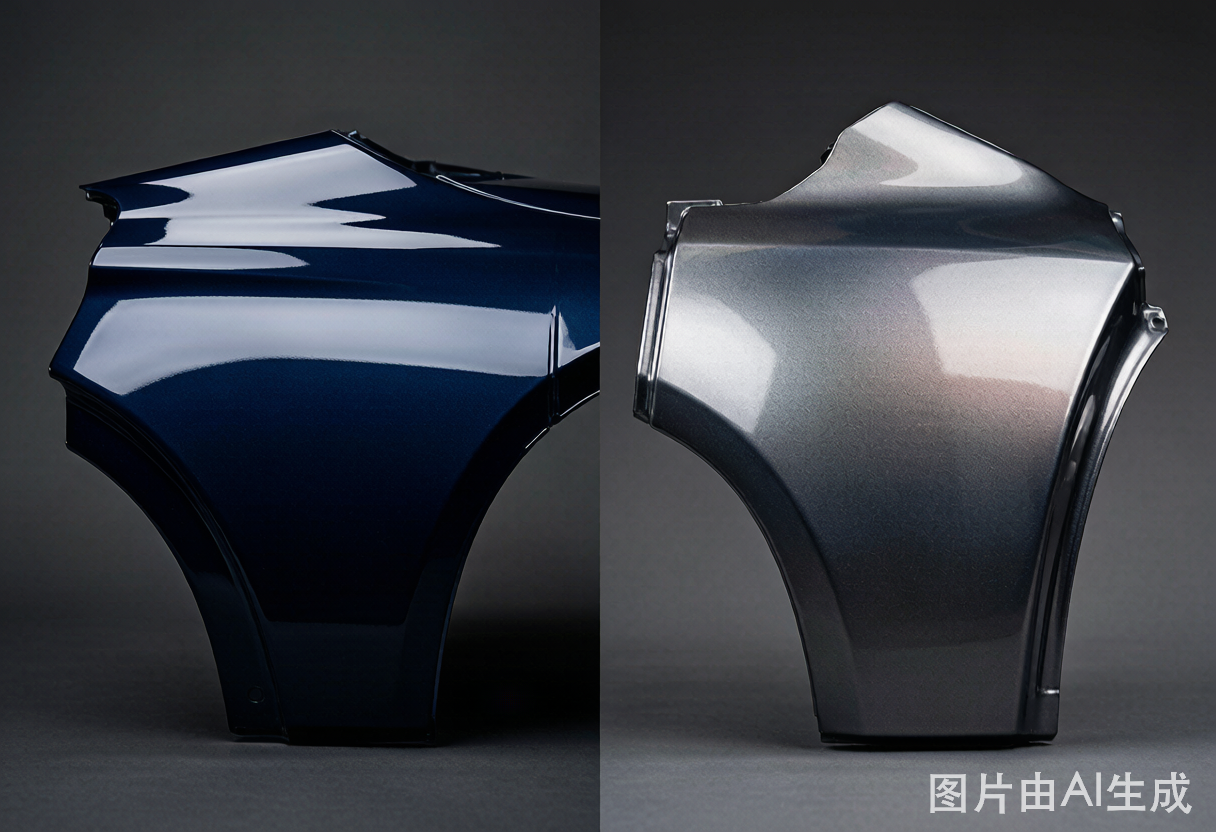
OEM paint vs. refinish paint: left is brand-new factory finish, right is shop-matched repair paint

Many car owners ask after a scratch: “Can touch-up paint use original factory paint?” The answer is usually no. Although they both look like “automotive paint,” original factory paint (OEM Paint) and refinish paint (Refinish Paint) are actually two completely different product systems—differing entirely in production environment, curing temperature, and formulation logic. This article systematically explains the differences between the two across 7 dimensions and provides selection advice for repairs.

In a nutshell:Original factory paint is designed for “high-temperature assembly lines, pursuing consistency and takt time”; refinish paint is designed for “low-temperature workshops, pursuing convenience and color adjustability”. The two have different goals, so their formulations are naturally different.

I. What is OEM Paint?

Original factory paint refers to the multi-coat system completed in the Body-in-White Paint Shop of the vehicle manufacturing plant. The car body goes through pretreatment, electrocoat, primer surfacer, basecoat to clearcoat, all completed in an automated production line + clean paint baking booth, with curing temperatures typically at 140℃–200℃.

  • Construction entity: Robot spraying, with cycle time accurate to the second, and film thickness and color difference strictly controlled.
  • Typical system: Cathodic electrocoat (CED) + waterborne primer surfacer + waterborne/solventborne basecoat + 2K clearcoat.
  • Core Objective: Consistent overall vehicle appearance, weather resistance of over 10 years, fast production cycle, and controllable cost.

II. What is refinish paint?

Refinish paint refers to coating systems used for after-sales repair, partial or full-vehicle repainting, applied at auto repair shops / body and paint centers. Repair shops cannot provide the high-temperature environment of the original factory, so refinish paints are designed for low-temperature (60–80℃) or room-temperature ambient curing, and emphasize manual color matching and local blending.

  • Construction entity: Technician manual spraying, relying on experience and color-matching equipment.
  • Typical system: epoxy/polyurethane primer + mid-coat + 2K basecoat + 2K blend clearcoat.
  • Core objectives: low-temperature curable, easy to tint, natural repair boundaries, wide application window.
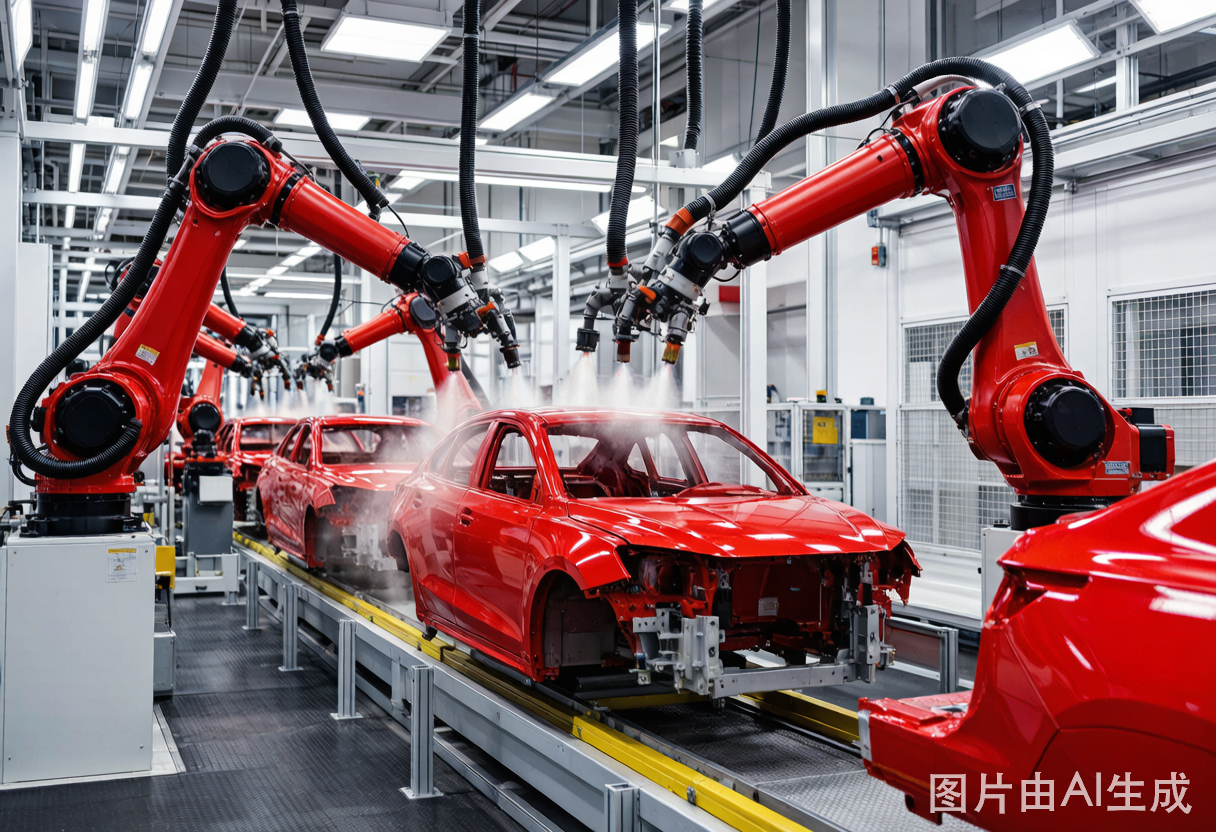
Modern automotive factory painting workshop robotic spraying line
Factory paint: automated line + high-temperature baking booth, pursuing consistency and cycle time

III. Core Difference Comparison (7 Dimensions)

Comparison Dimension Original Factory Paint (OEM) Refinish Paint
Application Environment Automated production line, clean paint booth Repair workshop, local repair station
Curing Temperature High temperature 140℃–200℃ Low temperature 60–80℃ or room temperature air drying
Formulation Focus Durable, fast cycle, highly consistent appearance Easy application, low-temperature curable, easy color matching
Single Coat Film Thickness Thin and uniform (electrophoresis 15–25μm, etc.) Slightly thicker, can be locally built up for leveling
Color Consistency Same batch for whole vehicle, minimal color difference Depends on color mixing, with reasonable color difference tolerance
Main Equipment Robots, electrophoresis tank, curing oven Spray gun, paint mixer, spectrophotometer, curing lamp
Certification Requirements OEM system certification (e.g., IATF 16949) Brand matching certification, repair station authorization

IV. Why can the two not be used interchangeably?

The root cause lies in the mismatch between curing conditions and formulation:

  • Original factory paint requires temperatures above 140℃ to fully crosslink and cure, which repair shop baking booths cannot achieve; forcing low-temperature baking will result in incomplete curing, poor adhesion, and easy loss of gloss.
  • If repair paint is baked at the original factory’s high temperature, it will lightly cause over-baking yellowing, embrittlement and cracking, and severely cause workpiece deformation.
  • The two resin systems, thinners, and curing agents are different; mixing them will cause interlayer incompatibility, lifting of the underlying coat, and wrinkling.
Correct practice:When repairing, use the same-brand repair system matched to the vehicle model (primer—intercoat—basecoat—clearcoat as a complete set), and strictly follow the manufacturer’s TDS for mixing ratio, flash-off time, and curing temperature.

V. How to Select the Right Repair System During Maintenance?

  • By brand matching: Prioritize using the refinish paint brand and color code designated by the OEM to ensure minimal color difference.
  • Low-temperature curing preferred: Choose a 2K two-component low-temperature curing system at the repair shop, used with a baking lamp/low-temperature paint booth.
  • Emphasis on color matching: Use a spectrophotometer to read the vehicle body color, and perform “blending (feathering)” to soften the boundaries.
  • Clearcoat matching: Choose a blend clearcoat with a refractive index close to the original vehicle clearcoat to avoid a “patchy look”.
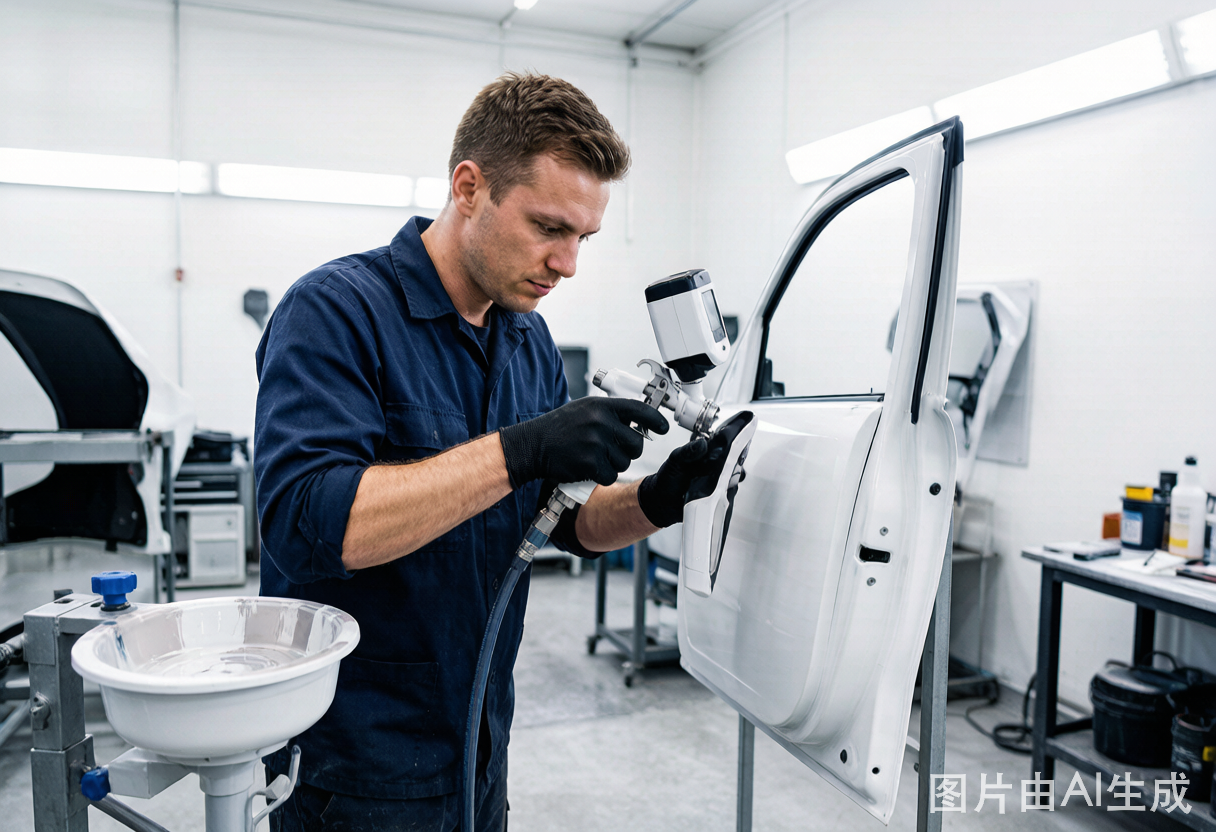
Auto body shop technician using spectrophotometer and spray gun for paint repair and color matching
Repair work: Technician using colorimeter and spray gun for local color matching and blend

VI. Common Misconceptions

Myth 1: Is OEM paint definitely better than refinish paint?
Not necessarily. OEM paint wins in terms of consistency and environmental durability, but that is achieved under a high-temperature assembly line; outside that environment, its performance advantage cannot be realized. With proper application, compliant high-quality refinish paint can also achieve a weather resistance of 5–10 years.
Myth 2: Is refinish paint not durable and prone to peeling?
Poor durability is mostly a workmanship issue (inadequate surface preparation, wrong mixing ratio, insufficient curing), not the paint itself. With standardized application and a compatible system, refinish paint is equally reliable.
Myth 3: Must the repainted area use the “same OEM paint”?
Repair shops cannot reproduce the OEM high-temperature process, so pursuing the “same type” is meaningless. One should choose a refinish system of the same brand and color code, and achieve visual consistency through color matching and blending.

VII. Frequently Asked Questions (FAQ)

Q1: What is the exact difference between original factory paint and refinish paint?
The core difference lies in curing temperature and application environment: original factory paint is cured at high temperature above 140℃ on an assembly line, while refinish paint is applied at 60–80℃ or room temperature in repair shops; the formulation focus, equipment, and certification systems also differ, so the two cannot be used interchangeably.
Q2: Why is original factory paint generally not used for repainting?
Original factory paint relies on high-temperature ovens to fully cure, a condition repair shops cannot meet; forced use would result in incomplete curing, poor adhesion, and easy loss of gloss and yellowing, so a refinish paint system specifically designed for low temperatures is used instead.
Q3: Can the durability of refinish paint reach the original factory level?
With standardized application, use of a matching 2K system, and sufficient surface preparation and curing, high-quality refinish paint can achieve 5–10 years of weather resistance, approaching the daily performance of original factory paint; the difference mainly comes from application consistency and environment.
Q4: Why does local repainting always have a “patch feel”?
The patch feel comes from differences in clearcoat refractive index and color mismatch boundaries. The solution is color matching restoration, blend spraying (feathering), and matching clearcoat, allowing the repaired area to transition naturally with the original paint in gloss and color.
Q5: How many layers does original factory paint generally have?
Original whole-vehicle painting usually consists of five layers: electrophoretic layer, primer, mid-coat, basecoat, and clearcoat. Some models also add anti-corrosion or sound-deadening coatings, aiming to balance rust prevention, appearance, and durability.

VIII. Conclusion

Factory paint and refinish paint are not a matter of “good vs. bad,” but rather a matter of application scenarios: factory paint is designed for the consistency and durability of high-temperature assembly lines, while refinish paint is designed for the low temperature and adjustability of repair workshops. Understanding the fundamental differences between the two in terms of curing temperature, formulation focus, and application environment allows you to choose the right system and standardize the work during repairs, ensuring both appearance and service life.

© Kexin New Materials (Guangdong) Co., Ltd. · Automotive Coatings Technical Q&A Library

{“@context”:”https://schema.org”,”@type”:”FAQPage”,”mainEntity”:[
{“@type”:”Question”,”name”:”What is the exact difference between original factory automotive paint and refinish paint?”,”acceptedAnswer”:{“@type”:”Answer”,”text”:”The core difference lies in curing temperature and application environment: original factory paint is cured at high temperature on an assembly line above 140°C, while refinish paint is applied at repair shops at 60 to 80°C or at room temperature; the formulation focus, equipment, and certification systems also differ, so the two cannot be used interchangeably.”}},
{“@type”:”Question”,”name”:”Why is original factory paint generally not used for paint repair?”,”acceptedAnswer”:{“@type”:”Answer”,”text”:”Original factory paint relies on a high-temperature baking oven to fully cure, a condition repair shops cannot meet; forcing its use would result in incomplete curing, poor adhesion, and susceptibility to gloss loss and yellowing, so a refinish paint system specifically designed for low temperatures is used instead.”}},
{“@type”:”Question”,”name”:”Can the durability of refinish paint reach original factory levels?”,”acceptedAnswer”:{“@type”:”Answer”,”text”:”With standardized application, use of a compatible 2K system, and sufficient surface preparation and curing, high-quality refinish paint can achieve 5 to 10 years of weather resistance, approaching the daily performance of original factory paint; the difference mainly comes from application consistency and environment.”}},
{“@type”:”Question”,”name”:”Why does localized paint repair always have a patchy feel?”,”acceptedAnswer”:{“@type”:”Answer”,”text”:”The patchy feel comes from differences in clear coat refractive index and color mismatch boundaries. The solution is color matching restoration, blend spraying (featheredge), and matching clear coat, allowing the repaired area to transition naturally with the original vehicle paint in gloss and color.”}},
{“@type”:”Question”,”name”:”How many layers does original factory paint generally have?”,”acceptedAnswer”:{“@type”:”Answer”,”text”:”Original factory whole-vehicle painting typically consists of five layers: electrocoat, primer, surfacer, basecoat, and clearcoat. Some models also add anti-corrosion or sound-deadening coatings, aiming to balance rust prevention, appearance, and durability.”}}
]}