Introduction: Coatings That Can "Heal" Themselves After Being "Injured" — A Materials Revolution Inspired by Nature
After human skin is cut — blood clotting → cell regeneration → scar repair — this self-repair mechanism inspired coating scientists — if coatings could also "self-heal" like skin, the coating's lifespan would no longer be limited by micro-cracks and micro-scratches — the coating's "lifetime maintenance-free" would become possible. The chemical essence of self-healing coatings — (1) Microcapsules — pre-embedded "repair agent capsules" in the coating; cracks rupture capsules → repair agent flows out → chemical reaction fills cracks (one-time repair); (2) Intrinsic self-healing — coating molecular chains contain reversible covalent bonds; under external stimuli (heating/UV/infrared) the broken bonds reconnect (multiple repairs); (3) Vascular network — micrometer-scale pipe network (3D printed) embedded in the coating — repair agent circulates in the pipe network — cracks cut the pipe network → repair agent releases and cures at the crack — multiple repairs + continuous replenishment of repair agent.
I. Comprehensive Comparison of Three Self-Healing Strategies
| Strategy | Healing Mechanism | Healing Cycles | Healing Efficiency (%) | Trigger Condition | Technology Readiness | Cost Index |
|---|---|---|---|---|---|---|
| Microcapsule | Capsule ruptures → healing agent flows out → cures | 1 time (same location) | 60-90 | Mechanical damage auto-triggered (passive) | Pilot - early product | 2-5 |
| Intrinsic self-healing (Diels-Alder) | DA bond thermally reversible breaking → reconnecting | Multiple (>10 times) | 80-95 (highest) | Heating 60-120°C / infrared | Laboratory - pilot | 3-10 |
| Vascular network | Network delivers healing agent → released at damage site | Multiple (>20 times) | 70-90 | Mechanical damage auto-triggered | Laboratory (3D printing) | 10-50 |
FAQ
Q1: The "one-time" limitation of microcapsule self-healing — why can't the same location be repaired a second time?Microcapsules rupture in the first crack — healing agent flows out + curesthe capsule has been consumedthe healing agent at that location is "depleted to zero". If a crack appears again at the same location (possibly a weak bonding zone at the healing agent/original coating interface) — no new capsule is available to rupture — repair fails. Microcapsule self-healing is"a life for a life"each capsule can only be used once — this limits its application in "repeated scratching" scenarios (such as automotive paint) — it is more suitable for "one-time anti-corrosion" (such as buried pipelines / one-time protection in place).
Q2: What is the chemical nature of the Diels-Alder (DA) reversible bond?The DA reaction is a [4+2] cycloaddition between a conjugated diene (e.g., furan) and a dienophile (e.g., maleimide) to form a six-membered ring adduct. The "reversibility" of the DA reaction—at 60–120°C—the DA adduct cleaves (Retro-DA) into the original furan + maleimide—cooled to <25°C—the DA reaction proceeds again—the adduct regenerates. The "heating–cooling" cycle is the "repair switch" of the DA bond. The broken DA adduct at the crack cleaves under heating → free ends of molecular chains → re-DA connection under cooling → crack "heals".
Q3: How to quantitatively evaluate the "healing efficiency" of self-healing coatings? Tensile strength recovery rate = (tensile strength after self-healing / original tensile strength) × 100% — specimen is first stretched to fracture → align and contact the two broken ends → apply healing stimulus (heating/UV) → stretch to fracture again — compare the strengths of the two tests — >80% indicates high-efficiency self-healing. For scratches — use a blade or nanoindenter to create standard scratches (width/<10μm/depth<20μm) → apply healing stimulus → measure the healed area of the scratch by optical microscope/SEM (original scratch area - residual scratch area) / original × 100%.
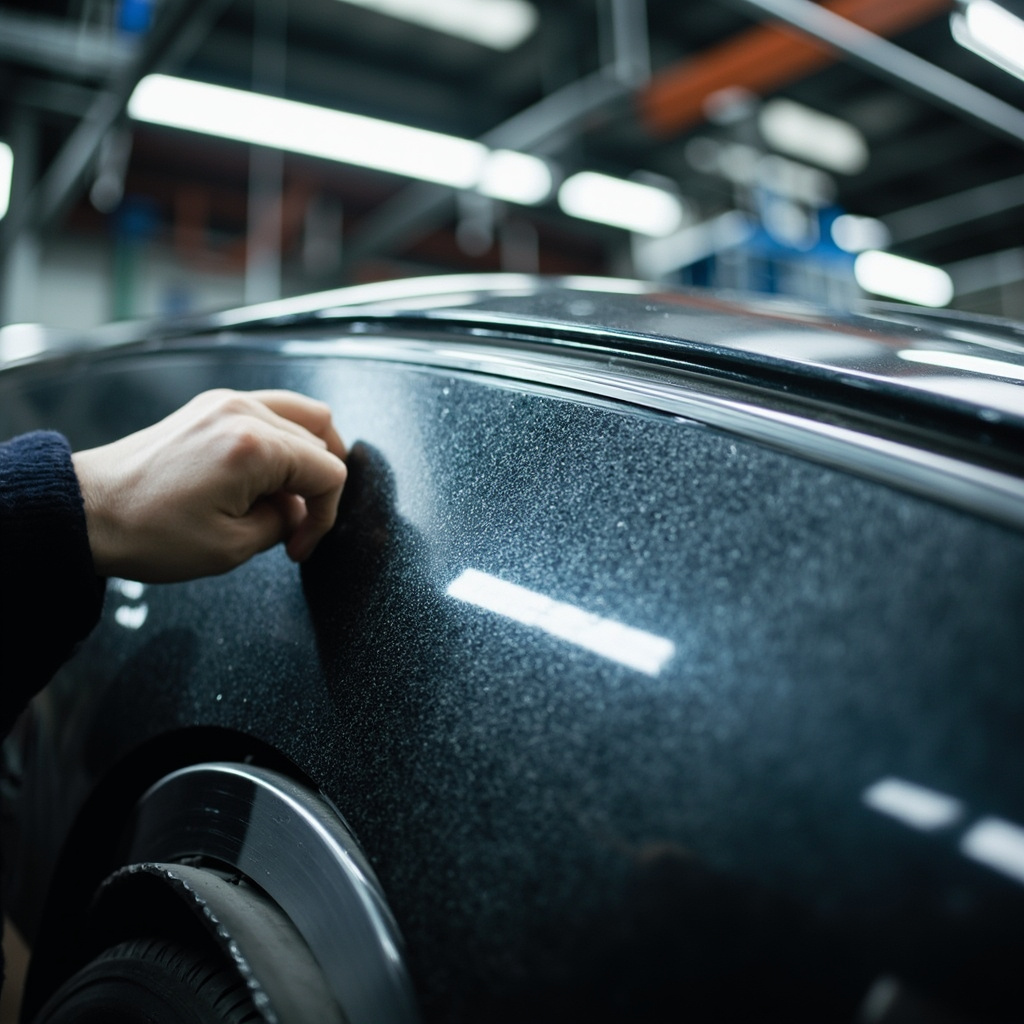
Q4: Current application status of self-healing coatings on automotive clearcoats?Self-healing needs of automotive paintMicro-scratches (car wash/branches/fingernail scratches)Scratch depth <5μm——only the clearcoat layer is damaged. Nissan's "Scratch Shield" self-healing clearcoat (2005)——uses high-elasticity polyurethane resinScratches undergo elastic recovery under heating (>40°C/direct sunlight exposure) (not chemical repair)——physical rebound of scratches——this is the most "simple" self-healing implementation——not the complex mechanisms such as microcapsules/DA bonds mentioned above.
Q5: The value of self-healing coatings in the anti-corrosion field—from "passive protection" to "active self-healing"? The most vulnerable moment for an anti-corrosion coating is after the coating is scratched—the substrate at the scratch is exposed and corrosion begins immediately. Traditional anti-corrosion coatings—passive barrier—rely on cathodic protection from zinc dust at scratches (e.g., epoxy zinc-rich primer)—but cathodic protection fails once the zinc is consumed. Self-healing anti-corrosion coatings—microcapsules embedded in the primer → release corrosion inhibitor/repair resin when scratched → form a "temporary protective layer" at the scratch to delay corrosion by 10–50×.
Q6: Differences between disulfide bond (S-S) self-healing and DA bond self-healing?Disulfide bond exchange reaction (Disulfide Exchange/thiol-disulfide exchange)——S-S bonds under UV or infrared light irradiation (non-heating)——undergo breaking and reconnecting, "light-triggered" healing——more precise than DA's "heat-triggered" (only light needed)——no thermal effect on substrate. Disulfide bond self-healing can be completed at room temperature + light——healing conditions are milder than DA (>60°C heating)——but the chemical stability of disulfide bonds is weaker than DA bonds (poor chemical/oxidation resistance)——in outdoor UV+O₂ environments——S-S bonds may be irreversibly oxidized.
Q7: How are the "vessels" of the vascular network self-healing coating made?(1)Sacrificial fiber method Embed soluble/degradable sacrificial fibers (e.g., PLA polylactic acid) in the coating — after the coating cures, use solvent/heating to "dissolve" the sacrificial fibers, leaving micron-scale hollow channels — inject healing agent into the channels; (2)3D printing (direct writing/inkjet/stereolithography) Directly print hollow network — high precision (>100μm) — but equipment and material costs are extremely high — currently only at laboratory research level. The continuous circulation of healing agent in the network requires a micropump (>microfluidic) — system complexity is extremely high — more than 10 years away from engineering application.
Q8: Cost-effectiveness comparison between self-healing coatings and "traditional repainting" — when is "self-healing" more economical? The initial cost of microcapsule self-healing coatings is 2-5 times that of traditional coatings. The break-even point where "self-healing 100k RMB per day) — the "maintenance-free one-time investment" of self-healing far outperforms "frequent maintenance"; (2) scenarios with extremely high downtime losses (aircraft grounding / >1M RMB per day) — the high initial cost of self-healing can be recovered in "avoiding a single grounding". For "low-cost + easy maintenance" scenarios (e.g., ordinary steel structures) — the economics of self-healing coatings do not hold — traditional coatings + periodic maintenance is the optimal solution.
Q9: How does the "accelerated life testing" of self-healing coatings verify that their self-healing function does not degrade during long-term service?Functional testing of self-healing coatings——(1) Multiple healing tests (>10 times)——each time create a scratch → heal → re-scratch → re-heal——record the decay curve of healing efficiency. Microcapsule efficiency drops sharply (>50%) after the 1st time——DA bond efficiency remains >70% after >10 times; (2) Healing efficiency after aging——coating first aged in QUV/salt spray >1000h——then test healing efficiency——evaluate the effect of coating aging on healing function. DA bond healing efficiency decays 40% (capsule wall embrittles during aging——crack does not reach capsule (capsule wall already ruptures on its own)——healing function reduced).
Q10: The "ultimate form" of self-healing coatings—fully autonomous + infinite cycles + room-temperature healing?Currently, the three strategies each have limitations—microcapsules (single use), DA bonds (require heating), vascular networks (complex fabrication). The future ultimate form—(1) fully room-temperature + light healing—no heating/pressure needed, "self-heals under sunlight"; (2) infinite healing (>100 times)—DA bonds + disulfide bonds + hydrogen bonds triple reversible network synergistic self-healing system complementing each other's shortcomings; (3) autonomous + smart coating with built-in micro-sensors detecting crack location → triggering local light/heat → targeted repair instead of heating the whole coating—higher repair efficiency + lower energy consumption. The commercialization of ultimate self-healing coatings still has a long way to go (estimated 2040-2050).
Related Reading
Summary
Self-healing coatings three major strategies—microcapsules (single repair / highest technology maturity / lowest cost), intrinsic self-healing (DA bonds / disulfide bonds / multiple repairs / >80% efficiency) and vascular networks (multiple repairs / continuous replenishment / most complex technology). The reversible [4+2] cycloaddition of DA bonds (Nth-order reaction) is currently the most extensively studied self-healing chemistry. The "cost-effectiveness" of self-healing coatings has the greatest advantage in scenarios of high maintenance cost + high downtime loss. Kexin New Materials focuses on the frontier technology of self-healing coatings—providing customers with forward-looking technology assessment and product planning.