Introduction: Natural gas pipelines — coatings must both "prevent corrosion" and "help save gas"
In the operating costs of long-distance natural gas pipelines, >>60% is compressor energy consumption (driving gas to flow against the resistance of the pipe inner wall). For every 5μm reduction in pipe wall surface roughness (Ra), gas transmission resistance decreases by about 5%-8%, and compressor energy consumption decreases by 3%-5%. For thousands of kilometers of long-distance pipelines, this can save millions to tens of millions of yuan in energy costs annually. Solvent-free liquid epoxy internal coating (100% VS / single-coat DFT >65μm) reduces the steel pipe inner wall roughness from Ra 30-60μm of bare steel to <5μm, while providing long-term anti-corrosion protection in 60-80°C corrosive environments—combining drag reduction and anti-corrosion in a dual function.
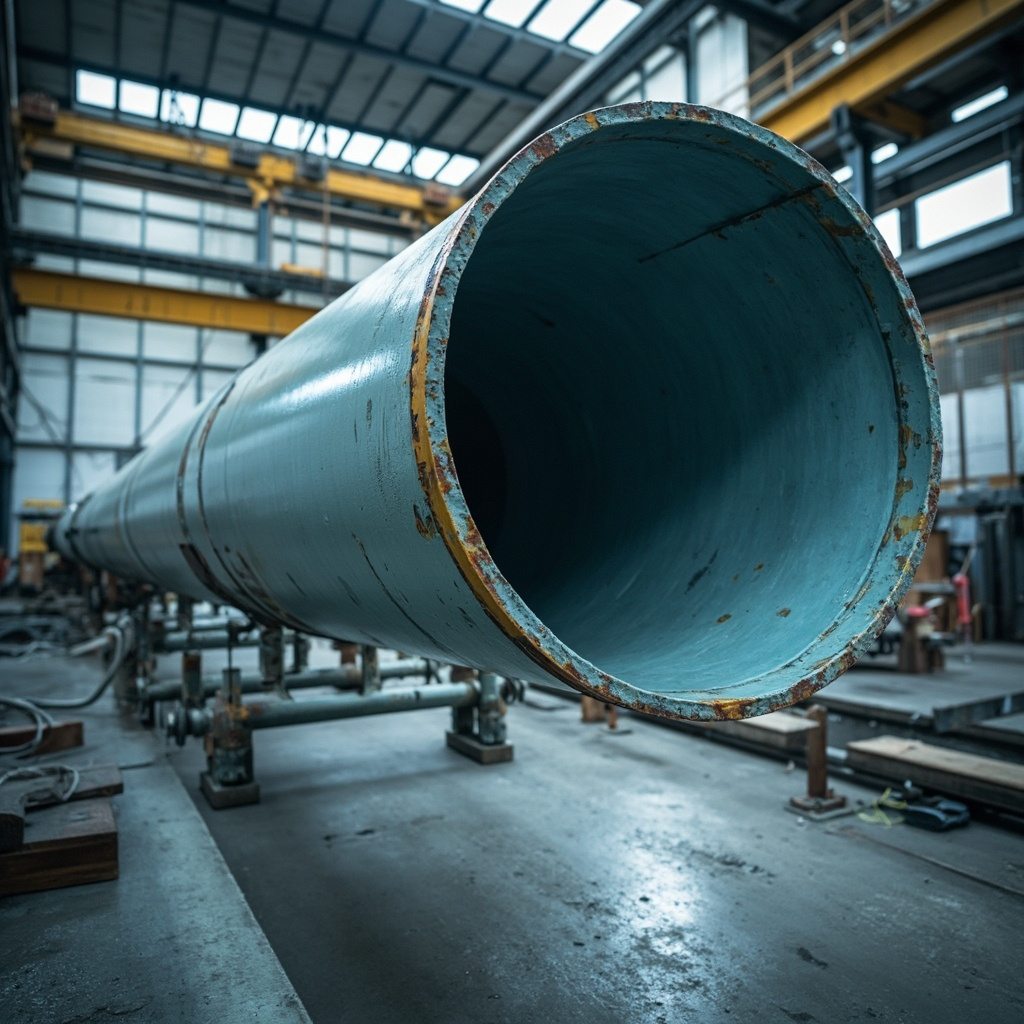
I. Key Performance Indicators for Pipeline Internal Coating (API RP 5L2 Standard)
| Performance Indicator | Standard Requirement (API RP 5L2) | Typical Solvent-free Epoxy Measured Value | Test Method |
|---|---|---|---|
| Dry Film Thickness (DFT) | >65μm (single coat) | 80-120μm | Dry film thickness gauge (for pipe inner wall) |
| Surface Roughness (Ra) | <5μm (drag reduction requirement) | 2-4μm | Stylus roughness tester |
| Adhesion (Pull-off method) | >5MPa | 8-15MPa | ISO 4624 (dolly/20mm) |
| Pinholes | 0 (zero pinholes) | 0 | High-voltage holiday detector (1500V/65μm DFT) |
| Salt Spray Resistance (ASTM B117) | >500h (cross-cut) | >1500h | ASTM B117 + ISO 4628 rating |
II. Overview of Technical Parameter Comparison
| Technical Indicator | Standard Requirement | Premium Level | Test Method |
|---|---|---|---|
| Adhesion | ≥3MPa | ≥5MPa | ISO 4624 Pull-off Method |
| Salt Spray Resistance | ≥500h | ≥1000h | ASTM B117 |
| Weather Resistance (QUV) | ≥1000h Gloss Retention >50% | ≥3000h Gloss Retention >80% | ISO 16474-3 |
| VOC Content | Compliant with GB Standard | 50% below limit | GB/T 23985 |
| Application Window | 5-35°C | -10~40°C (wide temperature range) | TDS Recommended Conditions |

II. APCA Spray Coating Process
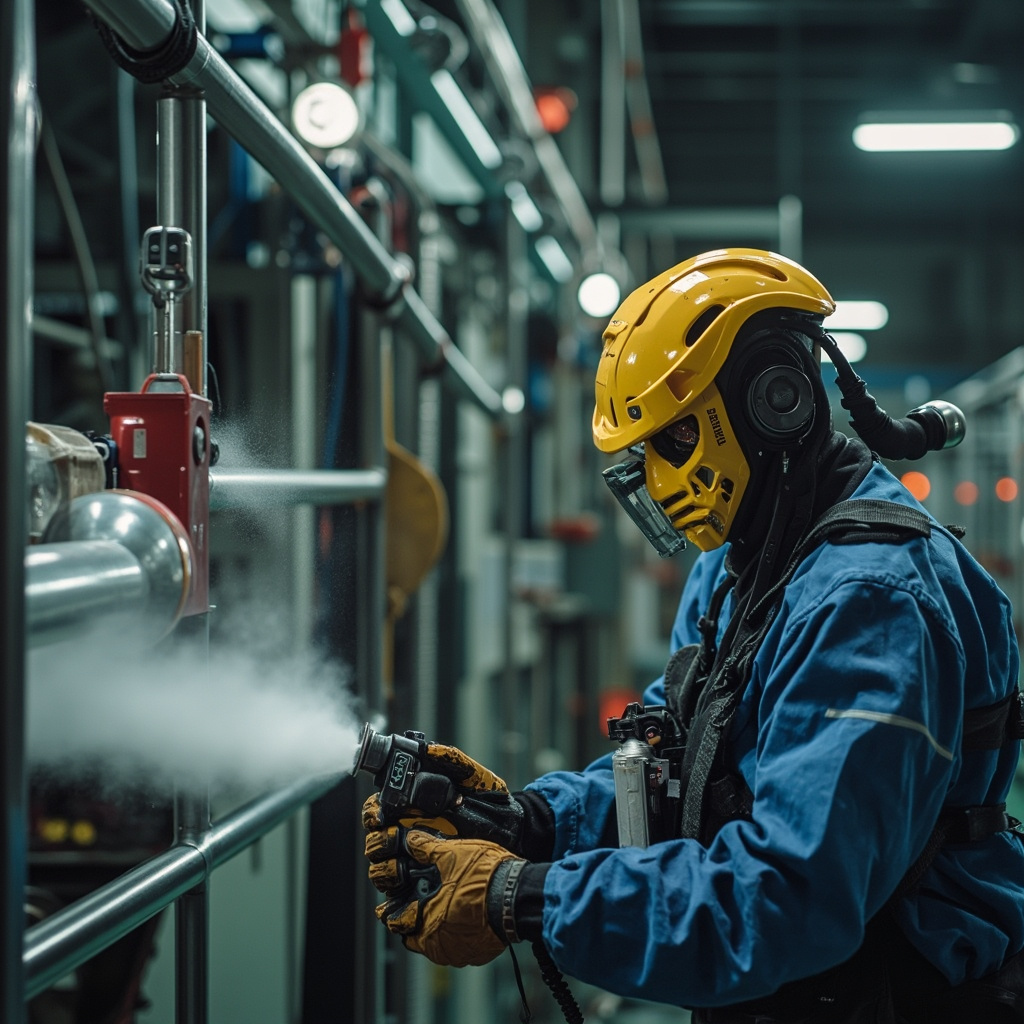
The spray application of internal pipeline coating adopts the APCA (Airless Plural Component Application) process—(1) The main paint and curing agent remain separated before entering the spray gun—transported to the front end of the spray gun through two independent heated lines (each line at 50-60°C to reduce viscosity); (2) Instantly mixed in the spray gun mixing chamber at a ratio of 1:1 (or per formula ratio); (3) The rotary spray nozzle rotates at 3000-8000 rpm—uniformly coating the inner wall of the pipeline; (4) The sprayer moves forward at a constant speed of 0.3-1 m/s along the pipeline axis. For large-diameter pipelines of Ø500-1420mm, a crawler-type pipeline spray robot (Crawler) is used—the robot is equipped with lighting + camera + sprayer—operated remotely by personnel outside the pipe end.
The application of internal pipeline coating must be completed on the pipe manufacturing line at the pipe mill (factory prefabrication) — it is almost impossible to internally coat pipelines already welded in the field (wild). Therefore, the weld joint area of the pipeline (Field Joint) is the "skylight" of the internal coating and cannot be protected by the internal coating — it needs to rely on external coating and cathodic protection for compensation.
Technical deepening: systematic optimization methods for process parameters (DOE experimental design)
The optimization of coating production processes should not rely on the "trial-and-error method" but should adopt the scientific method of DOE Experimental Design. Taking the dispersion process as an example—factors affecting quality (linear velocity/time/filling rate/temperature), 4 factors each at 3 levels—a full factorial requires 81 experiments—DOE uses orthogonal experiments L9 (9 times) or response surface methodology (27 times) to greatly reduce the number of experiments—while simultaneously obtaining the main effects and interactions of each factor. For example, it is found that "the interaction of linear velocity × time is significant": high linear velocity + short time and low linear velocity + long time can achieve the same dispersion effect—but the former saves over 20% energy.
In DOE analysis, interpretation of the P-value — P95% confidence). DOE ultimately outputs a set of prediction models (polynomial regression equations) — input line speed/time/temperature → predict fineness/viscosity/gloss — providing formulation engineers with a ”digital formulation optimization” tool.
Industry practice: from "master craftsman's feel" to "parameter standardization"
The common challenge in the coatings industry—when experienced veteran workers retire, their "feel" (mixing resistance / fineness gauge scraping / visual inspection of wet film gloss) is taken away—new employees cannot replicate it. Transform the "feel" into quantifiable standard parameters (1) mixing resistance → viscometer reading; (2) fineness gauge scraping → fineness gauge reading (μm); (3) wet film gloss → gloss meter (GU value). The "standard parameter card" for each process is posted next to the equipment—new employees operate according to the "card" rather than "by feel". "Parameter standardization" is a key step for coating factories to move from "workshop" to "factory".
FAQ
Q1: How is the drag reduction and energy-saving effect of pipeline internal coating quantified?Through the "Pipeline Efficiency Factor" EF = actual gas throughput / (theoretical smooth pipe throughput) × 100%. Bare steel pipe without internal coating has EF ≈ 92%-95%, while internally coated pipe has EF ≈ 98%-100%. Each 1% increase in EF — for a 1000 km / Ø1000 mm gas pipeline — saves approximately 2 to 5 million RMB in annual compressor energy consumption.
Q2: Why does solvent-free epoxy need to be heated when spray-applied inside pipelines?Solvent-free epoxy has a viscosity >5000mPa·s at room temperature—unable to be atomized for spraying. After heating to 50-60°C, viscosity drops to <1000mPa·s—can be atomized. However, heating shortens the Pot Life—at 50°C the Pot Life may be only 20-40min vs 2-4h at room temperature—requiring the use of an APCA inline mixing system (spray immediately after mixing / no pre-mixing).
Q3: Impact of APCA mixing ratio deviation (e.g., 1:0.9 or 1:1.1) on coating performance?Severe! Deviation of main paint/curing agent ratio >5% — NCO/OH ratio imbalance — >10% deviation → incomplete coating curing (hardness↓/chemical resistance↓) or over-curing (brittleness/cracking). The metering pump of the APCA system needs daily calibration — verify ratio accuracy by weighing the actual output weight of the two components within 1 minute.
Q4: How is the quality inspection of internal pipe coating conducted?(1) Crawler-type pipeline inspection robot (Crawler/with DFT probe + pinhole detection electrode + camera) automatically inspects and measures DFT and pinholes on the inner pipe wall at 0.2-0.5 m/s — sections covering >99% of the total pipe length are qualified; (2) DFT is measured once every 10 m; (3) Pinhole detection is performed over 100% of the total length. The automation level of internal coating quality inspection is higher than that of external coating (external coating requires manual inspection — large pipes can be entered manually / small pipes rely on robots).
Q5: What if the internal coating of the pipeline field joint cannot be applied?The field joint area is about 200-300mm wide—without internal coating protection—this part of the pipeline inner wall is exposed. Two compensation strategies: (1) Use field joint pipe sections made of corrosion-resistant alloy (CRA/stainless steel 316L) (mechanically clad pipe)—high cost; (2) Field joint external coating + cathodic protection (CP) combined—CP current also produces a cathodic protection effect at the field joint on the pipeline inner wall—this is the standard solution for long-distance pipelines.
Q6: Does "pigging" of internally coated pipelines damage the internal coating? There is slight damage but it is acceptable. The long-term friction of the pig's wire brushes and polyurethane scraper cups on the internal coating will slowly reduce the coating thickness (approximately 1-3 μm reduction per 100 pigging runs). The cumulative impact of pipeline pigging frequency (1-4 times per year / depending on the rate of internal impurity deposition) on coating life requires reserving a wear allowance when designing the coating thickness.
Q7: What are the coating pressure resistance requirements for high-pressure natural gas pipelines?The coating itself does not need to bear pressure (the steel pipe bears the pressure), but the coating must not develop bubbles (RGD blistering) due to gas escaping and expanding through micro-pores in the coating during Rapid Gas Decompression — this is a key test item distinguishing internal coatings for natural gas pipelines from those for liquid pipelines (ISO 23936-2/NORSOK M-710). Solvent-free epoxy, with its high cross-link density, offers good RGD resistance.
Q8: Does the "gloss" of the internal coating have functional significance? Yes. A high-gloss (>85 GU/60°) internal coating surface is smoother → lower friction coefficient between gas and pipe wall → better drag reduction effect. The initial gloss of the internal coating and its gloss retention after service are indirect indicators for measuring the durability of drag reduction.
Q9: What is the essential difference in formulation between internal pipe coating and external pipe coating (3PE/FBE)?Internal coating (liquid epoxy) — low viscosity (heated at 50-60°C) / application method is spray coating — focuses on drag reduction (surface smoothness) and resistance to trace H₂S/CO₂ acidic corrosion in gas. External coating (3PE/FBE/powder) — solid state / application method is extrusion or powder fusion bonding — focuses on mechanical impact resistance (backfill rocks) and resistance to soil/groundwater corrosion. The performance requirements of internal and external coatings differ greatly — formulations cannot be interchanged.
Q10: Special coating requirements for Hydrogen Pipeline?As the smallest molecule, hydrogen has much higher permeability and RGD risk than natural gas. The internal coating of hydrogen pipelines must pass the RGD test per ISO 23936-2 (hydrogen atmosphere/100bar → rapid decompression/10 cycles/no blistering). Standard solvent-free epoxy shows significantly higher blistering tendency under hydrogen RGD than under natural gas — formula upgrade is required (higher crosslink density + lower porosity).
Related Reading
Summary
Solvent-free liquid epoxy pipeline internal coating (API RP 5L2 / DFT > 65 μm / Ra 20 years). The APCA two-component heated airless spray process is the core technology for pipeline internal coating. Pipeline internal coating must be completed at the pipe manufacturing plant—field welds cannot be repaired with coating. Kexin New Materials provides pipeline customers with a full range of internal and external pipeline coating products and APCA spray technical support.