Introduction: From the "Lotus Effect" to Industrial Self-Cleaning Coatings
The superhydrophobicity of the lotus leaf surface (water contact angle >150°, rolling angle <5°) originates from the synergistic effect of its micro-nano hierarchical rough structure and low-surface-energy waxy layer. To engineer and apply this principle to the coating field, it is necessary to simultaneously construct a micro-nano rough structure and a low-surface-energy chemical composition within the resin system. Fluorocarbon-modified resin, due to the extremely low surface energy of its C-F bonds (6-18 mN/m) and its spontaneous tendency to migrate directionally to the coating surface, is the core film-forming material for achieving superhydrophobic self-cleaning functionality.
Superhydrophobic nano self-cleaning coating is a functional coating that, after application, exhibits a water contact angle >150° and a sliding angle <10°. Water droplets remain in a nearly spherical rolling state on its surface, and during rolling off, they carry away surface dust and contaminants to achieve a self-cleaning effect.
I. Film-Forming Kinetic Model of Fluorocarbon-Modified Resin
| Film Formation Stage | Time Scale | Dominant Physical/Chemical Process | Effect on Surface Fluorine Content |
|---|---|---|---|
| Wet Film Stage (Solvent Evaporation) | 0-10 min | Solvent evaporation, resin concentration increases | Fluorinated segments begin to migrate toward the surface |
| Surface Dry Stage | 10-30 min | Surface resin viscosity rises sharply, fluorinated segments enrich at surface | Surface fluorine content increases from 1%-5% in bulk to 10%-30% |
| Early Curing Stage | 0.5-4 h | Crosslinking reaction proceeds, fluorinated segments are "locked" at the surface | Surface fluorine content stabilizes (20%-35%) |
| Full Cure | 24 h-7 days | Crosslinking reaction complete, fluorinated segments permanently fixed at surface | Final surface fluorine content (25%-40%) |
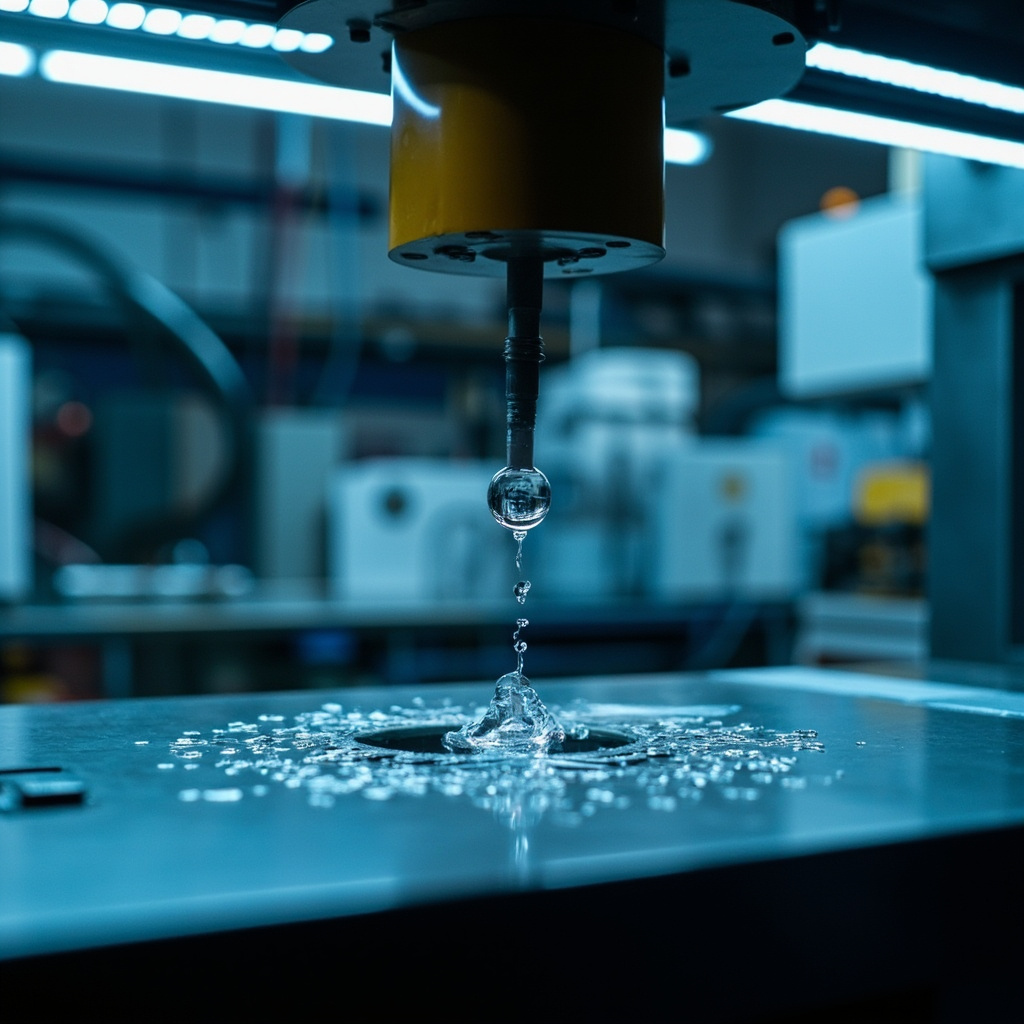
The surface migration driving force of fluorocarbon segments comes from the thermodynamic minimum surface energy principle. The surface energy of C-F bonds (6-18 mN/m) is much lower than that of C-H bonds (31 mN/m) and C-O bonds. The system minimizes the total free energy by enriching the low-surface-energy fluorocarbon segments at the coating-air interface. The migration rate is jointly influenced by the fluorocarbon chain length (C6-C8 migrates fastest), the resin Tg (low Tg favors migration), and the solvent evaporation rate.
II. Comparison of Four Hydrophobic Modification Strategies
| Strategy | Water Contact Angle (°) | Sliding Angle (°) | Durability | Cost | Application Scenario |
|---|---|---|---|---|---|
| Pure fluorocarbon resin (no nano-fillers) | 100-115 | >30 (non-rolling) | High (>10 years) | Medium-high | Building curtain walls, bridges |
| Fluorocarbon + SiO₂ nanoparticles | 130-150 | 10-30 | Medium (3-5 years) | Medium | Photovoltaic panels, glass curtain walls |
| Fluorocarbon + SiO₂ + TiO₂ dual nano-fillers | 150-165 | 2-8 | Medium-low (1-3 years) | Medium-high | Self-cleaning coatings, anti-icing/snow |
| Perfluorosilane + micro-nano hierarchical rough structure | 160-175 | 1-3 | Low (<1 year, sensitive to mechanical wear) | High | Laboratory / demonstration samples |
Technical deepening: systematic optimization methods for process parameters (DOE experimental design)
The optimization of coating production processes should not rely on the "trial-and-error method" but should adopt the scientific method of DOE experimental design. Taking the dispersion process as an example—factors affecting quality (linear velocity/time/filling rate/temperature), 4 factors each at 3 levels—a full factorial requires 81 experiments—DOE uses orthogonal experiments L9 (9 times) or response surface methodology (27 times) to greatly reduce the number of experiments—while simultaneously obtaining the main effects and interactions of each factor. For example, it is found that "the interaction of linear velocity × time is significant": high linear velocity + short time and low linear velocity + long time can achieve the same dispersion effect—but the former saves over 20% energy.
Interpretation of P-value in DOE analysis — P95% confidence). The final output of DOE is a set of prediction models (polynomial regression equations) — input line speed/time/temperature → predict fineness/viscosity/gloss — providing formulation engineers with a "digital formulation optimization" tool.
Industry practice: from "master craftsman's feel" to "parameter standardization"
The common challenge in the coatings industry — when experienced veteran workers retire, their "feel" (mixing resistance / fineness gauge scraping / visual inspection of wet-film gloss) is taken away — new employees cannot replicate it. Transform the "feel" into quantifiable standard parameters (1) mixing resistance → viscometer reading; (2) fineness gauge scraping → fineness gauge reading (μm); (3) wet-film gloss → gloss meter (GU value). The "standard parameter card" for each process is posted next to the equipment — new employees operate according to the "card" rather than "by feel". "Parameter standardization" is a key step for coating factories to move from "workshop" to "factory".
FAQ
Q1: What is the self-cleaning principle of superhydrophobic coatings?Water droplets exhibit a Cassie-Baxter state on superhydrophobic surfaces—the droplets "float" on the air cushion of the micro-nano structures rather than wetting the surface, and when the rolling angle is <10°, the droplets roll off very easily. The rolling droplets entrain and carry away surface dust particles (the van der Waals force between the particles and the coating is < the capillary force of the droplets on the particles). This is the core mechanism of the "lotus effect".
Q2: Why do superhydrophobic coatings have poor durability?(1) The micro/nano rough structures are easily worn flat or "smoothed out" under external friction, losing the surface roughness required for superhydrophobicity; (2) The enriched fluorocarbon segments on the surface are slowly lost under UV irradiation and mechanical wear; (3) Accumulation of contaminants (oil stains) on the surface transforms the Cassie-Baxter state into the Wenzel state (water-wetted surface), causing the hydrophobic angle to drop sharply to <120°.
Q3: Does higher fluorine content mean better hydrophobicity?Not exactly. When the bulk fluorine content increases from 1% to 5%, the surface water contact angle rises significantly (90°→115°). Beyond 5% bulk fluorine content, surface enrichment has reached saturation, and further increases yield limited improvement in hydrophobicity while costs rise linearly. At the same time, excessively high fluorine content (>15%) may lead to reduced interlayer adhesion (between topcoat and intermediate coat).
Q4: What is the difference between fluorocarbon-modified resin and ordinary fluorocarbon coatings?Ordinary fluorocarbon coatings (e.g., PVDF) have fluorine atoms evenly distributed throughout the entire coating; fluorocarbon-modified resins (e.g., fluorinated acrylate copolymers) use molecular design to preferentially distribute fluorocarbon segments on the coating surface, achieving equivalent or even superior surface hydrophobic effects with lower bulk fluorine content, significantly reducing material costs.
Q5: Can superhydrophobic coatings be used for anti-icing?Yes, it is an important application direction. Superhydrophobic surfaces can: (1) delay ice crystal nucleation (increase in supercooling degree by 5-10°C); (2) reduce the adhesion strength between ice and the surface (ice shear strength reduced to 500 kPa). However, note that under extreme conditions such as freezing rain, superhydrophobic surfaces will fail (water enters the micro-nano structures under pressure and freezes).
Q6: How to test the superhydrophobic performance of a coating?(1) Static water contact angle (WCA) — Use a contact angle meter with a 5 μL deionized water droplet, and take the average of 5 points; (2) Sliding angle (SA) — Slowly tilt the sample stage and record the tilt angle when the water droplet begins to roll; (3) Contact angle hysteresis (CAH = advancing angle − receding angle) — Only when CAH < 10° does it truly possess self-cleaning function.
Q7: How is the anti-fouling (anti-graffiti) property of the superhydrophobic coating?Excellent. Oil-based pens (such as Sharpie markers) cannot write on superhydrophobic surfaces—the ink quickly retracts into small beads instead of spreading. However, it should be noted that the resistance of superhydrophobic surfaces to oil stains/fingerprints is limited (the surface tension of oil is <30 mN/m, far lower than that of water at 72.8 mN/m); achieving omniphobicity (both hydrophobic and oleophobic) requires more complex fluorinated polyether (PFPE) type materials.
Q8: What is the optimal addition amount of nanofillers in the coating?SiO₂ nanoparticles (particle size 10-50 nm) are recommended at 3%-8%. Too low (10%) filler excess leads to a brittle coating, reduced transparency (if it is a varnish), and increased cost. Using two different particle sizes of SiO₂ (e.g., 20 nm + 200 nm) can more efficiently construct a dual-scale rough structure.
Q9: What are the film-forming differences between solvent-based and water-based fluorocarbon-modified resins?In water-based systems, the driving force for fluorocarbon segment migration is weaker—because the aqueous environment is unfavorable for the stretching and migration of hydrophobic fluorocarbon segments. In formulation design, it is necessary to: (1) reduce the film-forming rate to give fluorocarbon segments more migration time; (2) add a small amount of glycol ether cosolvent (e.g., DPnB 3%-5%) to promote fluorocarbon segment migration; (3) set the film-forming temperature slightly above MFFT by 5-10°C to enhance segment mobility.
Q10: Future development directions of superhydrophobic coatings?(1) Durable superhydrophobic — adopt self-similar structure design (the newly exposed surface after wear is also superhydrophobic); (2) Self-healing superhydrophobic — microcapsules storing fluorocarbon segments or SiO₂ particles release to repair when the surface is worn; (3) Fluorine-free superhydrophobic — use silicone (PDMS) or long-chain alkyl to replace fluorocarbon materials (in response to PFAS ban); (4) Transparent superhydrophobic — used in scenarios requiring transparency such as optical glass and mobile phone screens.
Related Reading
Summary
The core of superhydrophobic nano self-cleaning coatings lies in the synergistic effect of the directional surface migration and film-forming mechanism of fluorocarbon-modified resin combined with the micro-nano hierarchical rough structure constructed by nanofillers. Through the molecular design of fluorinated segments (fluorine content 1%–5%) and the optimized combination with nano-SiO₂ particles (3%–8%), a self-cleaning function with water contact angle >150° can be achieved. Kexin New Materials possesses extensive formulation development experience in the field of fluorocarbon functional coatings and can provide customized hydrophobic/self-cleaning coating solutions for corporate clients.