
Settling of waterborne basecoat tinters refers to the migration of pigment particles out of the working volume of a paint and down toward the base of a sealed container during static storage, driven by density difference, inter-particle attraction and the breakdown of structural viscosity, and producing three distinguishable failure states—soft settling, hard settling and a clear separated upper layer. Redispersibility is the ability of that system to return to a uniform, usable state once a defined amount of mixing energy has been applied. Its engineering significance is this: the tinter is the concentration reference of a tinting formula, so as soon as the pigment volume fraction at the top and the bottom of a can no longer agree, one and the same formula code mixes two different colours at the front and the back of a shelf life—the fault lies not in the formula but in the fact that the paint in the draw-off spoon has already drifted by the time it is sampled.
The real sequence at a regional tinting centre: a 0.41 L can of black waterborne tinter sits on the tinting rack for 11 months without ever being turned. On opening, the upper paint reads grey and noticeably thin in flow; a settling knife dropped by the drop method of GB/T 6753.3-1986 passes through the clear upper layer, meets resistance at about 25 mm and has to be pressed to reach the base, where a dark compacted mass is difficult to move with the flat of the knife—yet about 4 min of hand stirring still returns it to a uniform tinter, a score of 2 on that standard's settling scale. The technician draws paint against the original formula code and compares it with a retain kept three months earlier: ΔE*ab at the 45° face drifts from a typical 0.3 to 1.8, the lightness difference at 110° is larger still, and the two panels recoated on the same vehicle show a visible difference under grazing light. The review found that the formula, the colour code and the spray parameters were all unchanged; the only variable was that this can had stood for 11 months and received only a 20 s hand shake before sampling. Settling itself is not the incident; drawing material without first grading the settling is.
TL;DR — Verifiable conclusions up front
- Settling rate scales with the square of particle size: on the Stokes form v = g·(ρp − ρf)·d² / (18μ), for rutile titanium dioxide (density about 4.2 g/cm³) in water, where the density difference is about 3.2 g/cm³ and the medium viscosity is 100 mPa·s, a 0.1 μm particle settles at about 0.015 mm/d, a 1 μm particle at about 1.51 mm/d and a 10 μm floc at about 150.7 mm/d, taking roughly 6,540 d, 65 d and 0.65 d respectively to fall the 98.5 mm can height prescribed in ASTM D869.
- The three failure modes look different and are treated differently: gravity settling shows a compact layer at the base with a relatively clear top; flocculation and coarsening show a rise in grind fineness (a higher draw-down reading) together with a loss of tinting strength; loss of the thixotropic structure shows phase separation first, a low-viscosity clear layer at the top, and at that point the settling rate of the same system can be two orders of magnitude faster than before.
- Four test regimes are currently usable: GB/T 6753.3-1986 (hot storage at 50±2 ℃ for 30 d, drop-knife scoring from 10 to 0, adopting ASTM D1849:1980 as non-equivalent); ASTM D869 (500 mL sample can, 45±1 g knife, shelf ageing for 6 months, 10-to-0 grading, and stating plainly that its precision is poor); ISO 21545:2018 on the determination of settling (issued 2018-07-25, ISO/TC 35/SC 9); and ISO 8781-1:1990, which assesses pigment dispersion through the change in tinting strength.
- Converting accelerated hot storage to natural storage is only a screen: the note in GB/T 6753.3-1986 states that 30 d at 50±2 ℃ roughly corresponds to six months to a year of natural storage, and that where there is a dispute the test should instead be run at 23±2 ℃ or 25±1 ℃ for the 6 to 12 months specified by the product, as an arbitration test.
- Deciding whether a can is still usable depends on four gates, not on whether it settled: tinting-strength recovery after a defined mixing energy (ISO 8781-1 basis), change in fineness of grind (GB/T 1724-2019 / GB/T 6753.1-2007 / ISO 1524:2020, draw-down ranges commonly 0~50 μm at a 2.5 μm graduation), rate of viscosity change, and multi-angle colour drift—if any one of the four falls outside its band, the material must not enter formula sampling.
- Anti-settling and levelling share the same lever: in published industry practice anti-settling additives are dosed mainly in the 0.2%~1.0% range (on the total formulation), with bentonite, polyamide wax, fumed silica and modified polyurea each having its own working window; over-dosing buys poorer levelling, lower gloss and worse atomisation, and on metallic finishes it adds poor flake orientation.
- Storage clauses have to be written in numbers: tinter storage conditions are commonly given as 5~35 ℃, sealed and light-protected, with a stated shelf life of 12 months; waterborne systems should also state a freeze-thaw regime—the common practice under GB/T 9268-2008 is one cycle of freezing at (-5±2) ℃ for 18 h and thawing at (25±2) ℃ for 6 h, run over 1 to 5 cycles, while ASTM D2243 / D2245 use freezing at -18 ℃ for 17 h and thawing at room temperature for 7 h.
One — Settling is not a single phenomenon: appearance criteria and root causes of the three destabilisation mechanisms
Field practice tends to lump everything seen on opening under "it settled", yet the three states differ completely in cause, in reversibility and in the cost of remedy. Telling them apart is the precondition for turning "scrap it or remix it" into a checkable action.
1. Gravity settling: the line between soft and hard settling
A single particle sinking in a still medium reaches a constant velocity set by the balance of gravity, buoyancy and viscous drag—the Stokes regime. The coarser the particle, the larger the density difference and the lower the medium viscosity, the faster it falls. Soft settling means the settled layer is still wetted by the paint and the particles have not formed a rigid contact network, so hand stirring returns it; hard settling means the particles at the base are compacted by the liquid column above and their volume fraction rises to point contact and bridging, so redispersing then demands more than "a little longer stirring"—it must re-break an already compacted agglomerate. Telling the two apart rests on the drop knife and the drag resistance, not on eyeballing colour depth: both GB/T 6753.3-1986 and ASTM D869 use a settling knife of defined mass (the former about 30 g, about 100 mm long with a blade about 20 mm wide; the latter 45±1 g, blade 125 mm long, about 20 mm wide) in a free-fall test.
2. Flocculation and coarsening: a rise in fineness is the real lead
Insufficient dispersant adsorption, co-solvents pulling the adsorbed chains off the pigment surface, or a pH that falls outside the 7~10 working window of an anionic polymeric dispersant all let pigments that were once deagglomerated draw together again into loose flocs. A floc behaves hydraulically like one large particle and, under the square law, settles faster; at the same time the draw-down reading rises, tinting strength falls, and film transparency and gloss shift. The industry calls this coarsening. It often appears together with "settling fast", but the root cause differs: coarsening calls for restoring dispersing adsorption and regrinding, whereas simply adding more anti-settling agent only props up more coarse particles together.
3. Loss of the thixotropic structure and phase separation
An anti-settling system relies on structural viscosity at low shear: at rest it forms a three-dimensional network that holds the particles up, and under shear the network opens temporarily for pumping and spraying. When the network is weakened by time, temperature, electrolytes or incompatibility, the macroscopic sign is phase separation first—the upper layer gives up a low-viscosity clear liquid while the lower layer thickens. The cost of this step is high: once pigment reaches the clear layer the medium viscosity can fall from the order of 100 mPa·s to the order of 1 mPa·s, and the same 1 μm particle goes from settling at about 1.51 mm/d to about 150.7 mm/d—exactly two orders of magnitude faster, and the common route to "it looked fine, but became a hard bottom three months later". For how this interacts with the network formed by matting agents and fumed silica, see gloss stability of matte coatings and settling control of matting powder.
| Destabilisation type | What is visible on opening | Drop-knife and drag behaviour | Governing variables | Reversibility and direction of remedy |
|---|---|---|---|---|
| Gravity settling (soft) | Upper layer slightly clear, a thin concentrated layer at the base, a gradual interface | Knife reaches the base under its own weight, low drag resistance on the flat | Particle size, density difference, low-shear viscosity | Largely reversible; remix with a defined energy and re-check tinting strength |
| Gravity settling (hard) | Upper layer clear and grey, a dark dense mass at the base | Does not reach the base under its own weight, must be pressed; clear resistance along the edge | Compaction time, volume fraction, interfacial contact | Partially reversible; high-shear re-dispersion needed, high scrap risk |
| Flocculation and coarsening | Overall consistency rises, tinting strength darkens, no distinct clear layer | Resistance evenly distributed, not concentrated at the base | Dispersant anchoring strength, pH, co-solvent | Mechanically irreversible; must regrind or change the dispersion system |
| Thixotropic loss (phase separation) | Low-viscosity clear layer above, paste-like layer below | No resistance in the upper layer, abrupt hardening below | Network strength, temperature, electrolyte compatibility | First judge whether the network can recover, then whether settling has already occurred |
Two — Where the order of magnitude of settling velocity comes from: the Stokes form and its limits
Turning "how long can this can of tinter sit" into an estimable question calls for an order-of-magnitude judgement, not a precise forecast. The constant settling velocity of a single spherical particle under laminar conditions is v = g·(ρp − ρf)·d² / (18μ), with g taken as 9.81 m/s², ρp the pigment density, ρf the medium density, d the particle diameter and μ the medium viscosity. The table below uses typical values for rutile titanium dioxide (ρp ≈ 4.2 g/cm³) in a waterborne medium (ρf ≈ 1.0 g/cm³, a density difference of 3.2 g/cm³), taking the fall distance as the ASTM D869 sample-can height of 98.5 mm.
| Scenario | Particle size d | Density difference Δρ | Medium viscosity μ | Settling velocity v | Time to fall 98.5 mm |
|---|---|---|---|---|---|
| Fully deagglomerated inorganic pigment | 0.1 μm | 3.2 g/cm³ | 100 mPa·s | about 0.015 mm/d | about 6,540 d |
| Fine-particle organic pigment | 0.2 μm | 3.2 g/cm³ | 100 mPa·s | about 0.060 mm/d | about 1,630 d |
| Normally dispersed titanium dioxide | 1 μm | 3.2 g/cm³ | 100 mPa·s | about 1.51 mm/d | about 65 d |
| Low-density carbon black type | 1 μm | 0.8 g/cm³ | 100 mPa·s | about 0.38 mm/d | about 261 d |
| The clear layer after phase separation | 1 μm | 3.2 g/cm³ | 1 mPa·s | about 150.7 mm/d | about 0.65 d |
| High structural-viscosity anti-settling system | 1 μm | 3.2 g/cm³ | 5,000 mPa·s | about 0.030 mm/d | about 3,270 d |
| Agglomerate after coarsening | 10 μm | 3.2 g/cm³ | 100 mPa·s | about 150.7 mm/d | about 0.65 d |
| Aluminium flake and mica effect pigments | 5 μm (equivalent) | 1.7 g/cm³ | 500 mPa·s | about 4.0 mm/d | about 24.6 d |
1. Particle size is the squared term, so the cost of coarsening is amplified
From 0.1 μm to 1 μm is a factor of 100, and from 1 μm to 10 μm another factor of 100—at the same density difference and viscosity the velocities differ by four orders of magnitude. This is why "fineness up by 2 μm" reads like a small change in the industry yet becomes a disaster once the anti-settling system fails: a dispersion state the milling step has already paid for is allowed to retreat under storage conditions. For agglomeration and surface modification within pigment dispersions, continue with dispersion stability of nanocoatings: agglomeration and surface modification.
2. Corrections for density difference, platelet particles and concentration effects
Common pigment densities differ widely: rutile titanium dioxide about 4.2 g/cm³, precipitated barium sulfate about 4.5 g/cm³, talc and mica about 2.7~2.8 g/cm³, aluminium powder about 2.7 g/cm³, carbon black about 1.8~2.0 g/cm³, phthalocyanine organic pigments about 1.5 g/cm³ (figures are on a published-data basis). A small density difference does not mean low risk: although carbon black has a small Δρ, its high specific surface area and flocculation tendency often form large agglomerates that fall back into the strong region of the square law. The drag coefficient of platelet and flake particles (aluminium, mica) departs clearly from the spherical assumption, so the Stokes value is only for cross-comparison, not for measured prediction. Raising the solids content also triggers hindered settling: with a Richardson–Zaki type correction taking an exponent of about 4.65 at low Reynolds number, the velocity drops to about 61% at a volume fraction of 0.1, about 35% at 0.2 and about 9% at 0.4. Across all the cases in the table above the Reynolds number lies between the orders of 10⁻¹³ and 10⁻⁶, so the laminar assumption holds; but below about 0.2 μm Brownian motion begins to compete with settling, and above about 100~200 μm the particle wake transitions and the formula itself breaks down, so neither end should be extrapolated.
Three — Anti-settling and levelling share the same lever: the additive selection window
Anti-settling agents build low-shear viscosity through hydrogen bonding, a house-of-cards network or inter-particle interaction, pushing up the μ in the table above. It is not "the more the more stable" but a window with upper and lower bounds: under-dose and the network does not outlast the storage period; over-dose and viscosity rises in the high-shear region too, giving poor levelling, orange peel, lower gloss and coarser atomisation, and on effect colours it adds poor aluminium orientation. In published technical practice a common approach is to combine an inorganic gel (bentonite) with organic rheology additives—for example fumed silica 0.5% plus modified bentonite 0.3% (on the total formulation) to improve high-temperature storage layering, or polyamide wax 0.8% for high-pigment-loading systems; fumed silica must be processed at no less than 2,000 rpm for 10~15 min of high-speed dispersion to open up its aggregates, otherwise the network is uneven and the anti-settling effect is discounted. For the trade-off between dispersion and anti-settling, see dispersion, anti-settling and matting/abrasion resistance of nano-silica in coatings.
| Additive type | Published dosage (on total formulation) | Mode of action | When under-dosed | When over-dosed beyond the window |
|---|---|---|---|---|
| Fumed silica | 0.2%~1.0%, commonly 0.5% | Inter-particle hydrogen-bond network, raises viscosity at low shear | Bottom settling appears within 30 d of hot storage | High-shear viscosity rises in step, levelling and atomisation drop |
| Modified bentonite (inorganic gel) | 0.3%~5%, higher for carbon black and phthalocyanine green systems | Hydration swelling forms a gel, also locks water and stabilises viscosity | Viscosity drifts with time, the system turns pasty | Slow surface dry, sensitive to film thickness, particles interfere with fineness readings |
| Polyamide wax | 0.2%~1.0%, commonly 0.8% | Polymer-chain hydrogen-bond network, less effect on gloss | Cannot hold down settling in high-pigment systems | Requires solvent pre-activation; if unactivated, fisheye-type defects form |
| Modified polyurea type | 1%~10% (on a pigment-paste formulation basis) | Urea-group hydrogen bonding, relatively gentle thixotropy | Layering appears first in low-viscosity grades | Extrusion and pumping resistance rise |
| Associative polyurethane / cellulose derivative | Adjusted to the levelling target, commonly blended with the above | Associates with emulsion particles to build structure | Cannot recover after phase separation | Water resistance and haze risk rise, gloss drops |
There is another easily overlooked boundary: the dispersant dosage itself is worked out from the pigment's specific surface area, and the published figures are high-tinting carbon black 10%~20%, general organic pigments 5%~10%, iron oxide and titanium dioxide inorganic pigments 2%~5% (all on pigment mass). Free dispersant beyond the saturation adsorption point does not help anti-settling and may instead reduce film water resistance and cause craters—opposite to the intuition that "if it is not stable enough, add more additive".
Four — How to test: opening score, accelerated hot storage, tinting strength, fineness and freeze-thaw
The four regimes answer four different questions: whether the material is usable at the end of shelf life, how to screen during formulation development, whether the dispersion state has degraded, and whether cold transport will damage the network. Mixing them up is the main source of tinter acceptance disputes.
| Evaluation dimension | Citable method and conditions | Expression of result | Where it applies | Known limitation |
|---|---|---|---|---|
| Degree of settling and remixing | GB/T 6753.3-1986: hot storage at 50±2 ℃ for 30 d (0.41 L crimped can, filled to about 15 mm below the rim), or 6~12 months under natural conditions; drop knife of about 30 g | Six levels 10 / 8 / 6 / 4 / 2 / 0, where 0 means not remixable by hand within 3~5 min | General acceptance for finished paint and tinter | The score is read by eye and by hand, so inter-operator agreement must be calibrated |
| Opening after shelf ageing | ASTM D869: 500 mL sample can (inside diameter 85.5±1.5 mm, height 98.5±1.5 mm), filled to 13 mm below the rim, shelf ageing for 6 months, 45±1 g knife | Grading from 10 to 0, intermediate states taking odd values | Buyer-supplier acceptance and specification reference | The standard itself states "poor precision", so a specification reference must agree an allowable deviation |
| Determination of settling (current international) | ISO 21545:2018 Paints and varnishes — Determination of settling (issued 2018-07-25, ISO/TC 35/SC 9) | Settling amount or grade as prescribed by the standard text | Export and cross-border supplier alignment | Method detail is per the official text; this article does not replace it |
| Whether the dispersion state has degraded | ISO 8781-1:1990 (assessing the dispersion characteristics of pigments and extenders via the change in tinting strength) | Relative deviation in tinting strength before and after storage | Discriminating coarsening and redispersion effectiveness | Needs standard colour charts and a stable base paint as reference |
| Fineness and coarsening | GB/T 1724-2019, GB/T 6753.1-2007 (equivalent to ISO 1524; the 2020 edition is the current international one), ASTM D1210; draw-down ranges commonly 0~50 / 0~100 / 0~150 μm at a 2.5 μm graduation | Upper limit of the coarse-particle reading in μm, convertible to Hegman (0 corresponds to 100 μm, 4 to 50 μm, 8 to 0 μm) | Milling endpoint and post-storage recheck | Reading angle 15°~30°, and 23±2 ℃ and humidity control affect repeatability |
| Consistency and thixotropy | GB/T 9269 / ASTM D562 (Stormer-type viscometer, 200 rpm); published instrument ranges 40~141 KU, 32~1099 g, 27~5274 cP, accuracy about ±1% | KU or g value; thixotropic index expressed as the ratio of low-shear to high-shear viscosity | Balancing pumping, spraying and anti-settling ability | Figures across instruments of different principles are not directly comparable |
| Low temperature and freeze-thaw | GB/T 9268-2008 (common practice: one cycle of (-5±2) ℃ freezing for 18 h plus (25±2) ℃ thawing for 6 h, run over 1~5 cycles); the ASTM D2243 / D2245 regime of -18 ℃ freezing for 17 h plus 7 h at room temperature | Grades or percentages of viscosity breakdown, coagulation, coarsening, gelling and viscosity change | Winter transport and northern warehouse storage | Waterborne systems vary widely in freeze-thaw sensitivity and must be calibrated by grade |
The fineness band also varies by product grade and is worth writing into the specification: high-decorative topcoats (automotive topcoats, premium furniture coatings) are usually held below 20 μm, some within 10 μm; general industrial and architectural topcoats are mostly 30~40 μm; primer and anti-corrosion grades with a functional focus may be relaxed to 50~60 μm. For tinters as semi-finished goods, published industry practice commonly gives a pigment-paste fineness not greater than 5 μm and finished coatings not greater than 20 μm, with a post-hot-storage fineness change within 2 μm used as a screening line (supplier's enterprise-standard basis).
Five — How to judge redispersibility: the four gates from bottom settling to colour-match consistency
Turning "give it a stir and it is fine" into a re-checkable process means passing four gates in order. Their purpose is to prevent treating "remixed" as "unchanged".
1. First gate: quantifying the remixing energy
Hand shaking, inversion shaking, adding a stir ball inside the can, and machine turning each feed the system a different amount of energy and give different results. Acceptance language should state energy, not action: for example "sample after oscillating to remix for 120 s" and "sample after 5 min of high-speed dispersion at 3,000 rpm" are not interchangeable. The sampling action that grades the settling should be ordered before remixing, because the drop reading itself is the evidence of "how deep it settled" and cannot be checked once the can has been remixed. Quantified descriptions that have appeared in published industry practice include: after adding an anti-settling agent, 50 ℃ hot storage improved from a 15 mm hard settle at 7 d to a settling depth no greater than 2 mm at 14 d, with an application-viscosity change rate no greater than 8%.

2. Second gate: tinting-strength recovery
Prepare a dilution tinting scale against a fixed base paint and compare the tinting strength of the stored sample with a fresh retain (ISO 8781-1 basis). Tinting-strength recovery means the pigment has returned to its working volume fraction; if, at the same dilution step, the lightness reads low or the hue shifts, the particles are still agglomerated and the effective optical path has changed. It is recommended to state the criteria as a pair: ΔE*ab not greater than 0.5 passes, 0.5~1.5 requires a recheck (reading multi-angle and colour development together), and greater than 1.5 must not enter formula sampling—the grading thresholds themselves are industry practice, and specific projects follow the buyer-supplier technical agreement.
3. Third gate: paired change in fineness and viscosity
If the post-remix fineness reading matches the pre-hot-storage value (deviation held within one draw-down graduation, commonly required not greater than 2 μm), there is no irreversible coarsening; the viscosity change rate is commonly set at a line of not greater than 10%~15% in published practice. The two must be read together: fineness unchanged but viscosity sharply up points to the solvation layer or a pH drift; viscosity unchanged but fineness up points to dispersant desorption and flocculation.
4. Fourth gate: multi-angle colour values and orientation recheck

Metallic effect tinters carry both a density difference (aluminium about 2.7 g/cm³) and the orientation problem of platelet particles: the concentration gradient formed by standing changes the flash first and the shade later. Colour measurement follows 45° illumination with viewing angles at 15°, 25°, 45°, 75° and 110° off the specular (multi-angle geometry consistent with SAE J1545), and instrument repeatability and inter-instrument agreement are typically around 0.02 ΔE*ab and 0.2 ΔE00. The reading principle: when 45° passes but 110° is out of band, suspect the concentration and orientation of the platelet particles first, not the tinter ratio in the formula; for metamerism and formula-prevention thinking see coating colour science: root causes, detection and formula-prevention strategies for metamerism, and for the boundary between aluminium-flake orientation defects and spray parameters see aluminium-flake orientation and flop control in metallic basecoats.
Six — Field practice at the tinting centre: stock rotation, batch retains and on-site handling
Most settling problems at a tinting centre are not formula problems but shelf-management problems. Tinter bottles range from 0.5 L to 5 L, and the static height directly determines "how long is long"; on the order of magnitude in Table 2, a 1 μm particle in a 100 mPa·s system falls the 98.5 mm in about 65 d, so a can left untouched for 11 months has long crossed that line. A workable practice in the industry is to write four actions—turn, inspect, retain, judge—into the SOP.
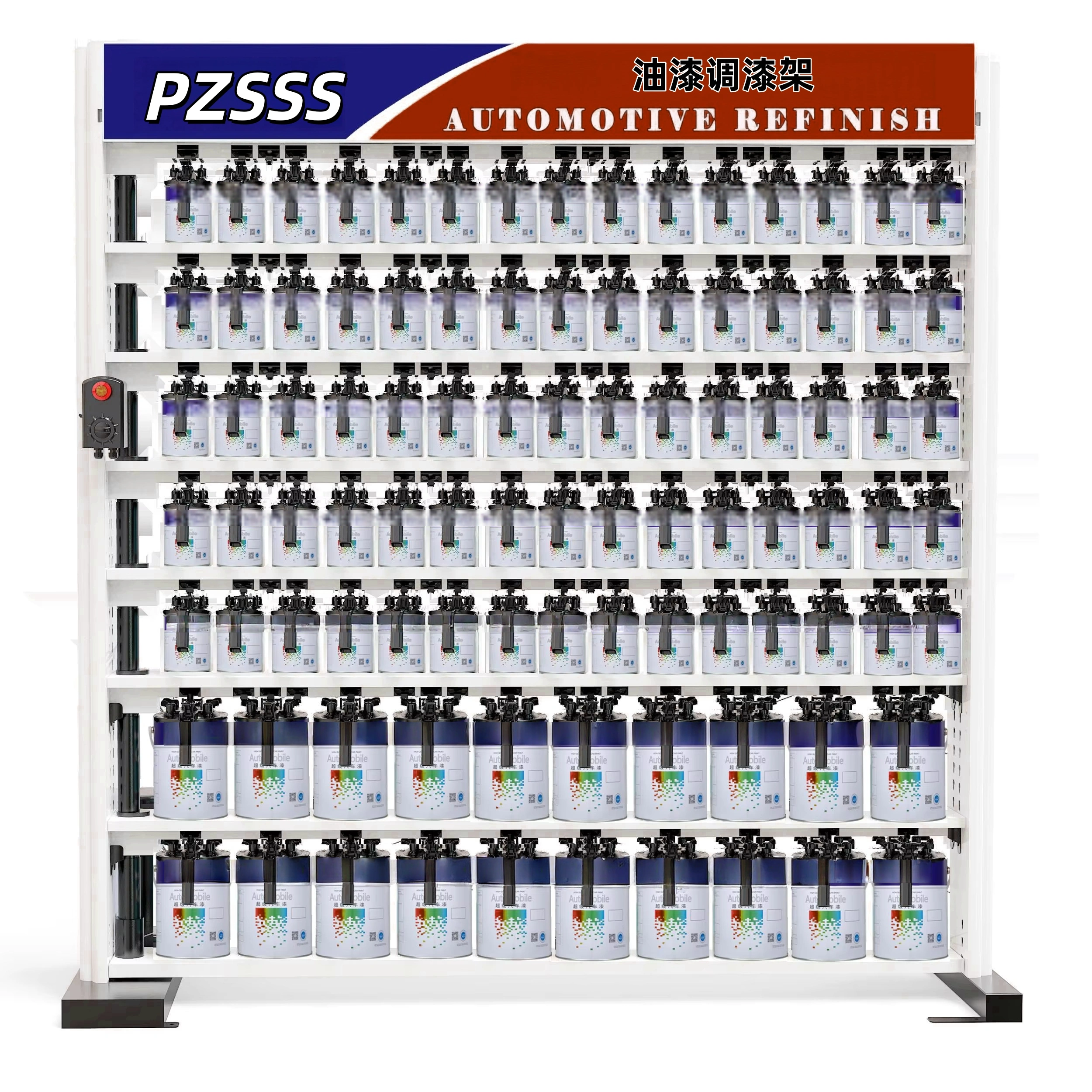
- First-in first-out and rotation cycle: put the date opened and the expiry date on the can, follow the supplier's stated shelf life (commonly 12 months at 5~35 ℃, sealed and light-protected on a published basis), and use the earliest first; keep high-frequency and low-frequency tinters on separate rack positions and shorten the turning cycle for low-frequency grades.
- Periodic turning and inversion: invert or turn each can once per cycle so the compacted settled layer is rewetted by the paint; for effect tinters with a large density difference, combine with short shaking. Log turning by day so that a disputed batch can be traced back.
- Retain samples: when each tinter batch is opened, seal a small retain as the reference baseline for tinting strength and colour values; after changing cans, compare with the retain before loading a vehicle formula.
- Remix before sampling: remix by fixed time or fixed energy before sampling, so the "clear upper draw-off" is not treated as the standard concentration; keep the pre-sampling treatment consistent across cans of the same batch.
- Temperature and warehouse conditions: summer high warehouse temperature both lowers the medium viscosity and speeds chemical change, while winter cold transport must be assessed against the freeze-thaw regime; logging warehouse temperature and humidity is the step most easily dropped after the acceptance sheet.
- Scrap criteria: a drop score of 0 (still not remixable to uniform by hand within 3~5 min), or any of the four gates falling out of band on recheck, is scrapped; it must not be pushed into a formula by "making the colour up" with a larger draw-off.
Where digitalisation helps here is the process, not the colour measurement itself: linking formula code, tinter batch, sampling time and colour records into one chain is what lets you locate, when a ΔE drift appears, which can, which remix and which batch. For the path from experience-driven to data-driven operation at a tinting centre, see digital operation of an automotive refinish tinting centre—from experience to cloud-based intelligence.

Seven — Writing the storage clauses into the specification: incoming acceptance and handling
The usual way purchase agreements describe a tinter is "uniform appearance, no settling"—a criterion that must distort at the end of shelf life, because slight soft settling is a physical law. A checkable wording should prescribe conditions, method and grading, and write in the recheck trigger.
| Recheck item | Method and conditions | Criteria basis | Non-conformance handling |
|---|---|---|---|
| Container and fill condition | Inspect the seal and the can markings, record the production and expiry dates; retain a sample on the GB/T 6753.3-1986 basis of the 0.41 L can filled to about 15 mm below the rim | No bulging lid, no leakage; storage conditions meet the 5~35 ℃ light-protected requirement | Quarantine batches with poor sealing and reassess before restocking |
| Mass consistency before and after storage | GB/T 6753.3-1986: after hot storage at 50±2 ℃ for 30 d, condition at room temperature for 24 h and weigh | A weight difference over 1% means poor container sealing, and that set of results is not accepted | Retest using a container of proven sealing |
| Degree of settling | Drop-knife method (GB/T 6753.3-1986 / ASTM D869), observing a sample taken before remixing | Not less than 6 (soft settling, reaches the base under its own weight, light drag resistance) as the routine acceptance line | Below 4, assess the cost of high-shear re-dispersion; at 0, scrap |
| Skinning, pressure and odour | Open, observe and record, scored on the six levels (10 none, 8 very slight, 6 slight, 4 moderate, 2 fairly severe, 0 severe) | Each item not less than 8; a putrid or sour odour is handled separately | Return batches suspected of microbial or chemical degradation to the supplier for analysis |
| Fineness | GB/T 1724-2019 / ISO 1524 draw-down method, range chosen by grade | Pigment paste not greater than 5 μm, finished product not greater than 20 μm; post-hot-storage change not greater than 2 μm | When the change exceeds the limit with viscosity rising in step, judge the dispersion system failed |
| Tinting strength and colour values | Fixed-base dilution tinting scale with 45°/75°/110° measurement, compared against the retain | ΔE*ab not greater than 0.5 released directly; 0.5~1.5 recheck; greater than 1.5 stopped | Rechecked batches are used only for spray trials, not for vehicle formulas |
| Low temperature and transport | Run 1~5 cycles per GB/T 9268-2008 or the ASTM D2243 regime | After cycling, no viscosity breakdown, no non-redispersible coagulation, viscosity change within the prescribed band | Add antifreeze clauses for winter shipment, or switch to temperature-controlled transport |
The specification should also state three further things: the exact remixing energy (a time, or a speed × duration), the number of retests for scrap and the sampling positions (a three-point draw-off at the top, middle and bottom), and the source of the data basis. Whenever a figure comes from the supplier's technical data sheet, acceptance should note whether it was measured at the as-applied mix ratio; when computing solids and VOC for a waterborne system the water dilution ratio should not be counted, and such basis differences are a common reason hot-storage data fail to reconcile.
Eight — Key data at a glance
- The settling velocity depends on particle size as a square: 0.1 μm about 0.015 mm/d, 1 μm about 1.51 mm/d, 10 μm about 150.7 mm/d (Δρ = 3.2 g/cm³, μ = 100 mPa·s).
- Taking the medium viscosity after phase separation as 1 mPa·s, a 1 μm particle settles at about 150.7 mm/d, about 100 times the original system.
- Hindered-settling correction: at volume fractions of 0.1 / 0.2 / 0.4 the velocity falls to about 61% / 35% / 9% (low Reynolds number, exponent about 4.65 basis).
- Mapping accelerated hot storage to natural storage: 50±2 ℃ × 30 d ≈ 6~12 months in natural conditions (GB/T 6753.3-1986 note); a weight difference over 1% means a non-sealed container.
- Opening settling grades: six levels 10 / 8 / 6 / 4 / 2 / 0, where level 0 is defined as not remixable to a uniform tinter by hand within 3~5 min.
- Sample-can dimensions directly set the order of magnitude: ASTM D869 uses a 500 mL can, inside diameter 85.5±1.5 mm, height 98.5±1.5 mm, filled to 13 mm below the rim; at an inside diameter of 85.5 mm a 5 mm deposit has a volume of about 28.7 mL, about 6% of the 473 mL can capacity.
- Fineness grading basis: topcoats below 20 μm (some within 10 μm), general topcoats 30~40 μm, primers 50~60 μm; pigment paste not greater than 5 μm, post-hot-storage change not greater than 2 μm.
- Consistency measurement conditions: Stormer type at 200 rpm, ranges 40~141 KU / 32~1099 g / 27~5274 cP, accuracy about ±1%; the thixotropic index is commonly expressed as the low-shear-to-high-shear viscosity ratio, with a published case range of 3.5~5.0.
- Colour-consistency criteria: ΔE*ab not greater than 0.5 released, 0.5~1.5 recheck, greater than 1.5 stopped; multi-angle viewing angles 15°, 25°, 45°, 75°, 110° (45° illumination).
Nine — Frequently asked questions
1. There is a layer of settled material at the base of the tinter can—after stirring, can I still use the original formula?
You cannot release it simply because "it stirred back in"; judge it in two steps first. The opening move is to record the degree of settling with the drop knife before remixing, keeping the evidence of how deep it settled and whether it compacted. The second step is to pass the four gates after remixing: whether the tinting strength has recovered against the retain (ISO 8781-1 basis), whether the draw-down fineness matches the pre-hot-storage value (deviation within one graduation, commonly required not greater than 2 μm), whether the viscosity change rate is within the 10%~15% band, and whether the 45°/75°/110° colour values are out of band. Only when all four pass may the material be used under the original formula code; if any one is out of band, the working pigment concentration in this can has changed, and continuing to use it accumulates a gap between the formula and the sprayed panel.
2. How do you read the settling grade—does "not settled to the base" count as passing?
No. Both GB/T 6753.3-1986 and ASTM D869 use a settling knife of defined mass—the former about 30 g, about 100 mm long with a blade about 20 mm wide, the latter 45±1 g, blade 125 mm, about 20 mm wide—dropped freely from a height level with the can rim. A score of 10 is full suspension with no change from the original state; 8 is a clear settling feel, the knife bringing up a small amount of settled pigment with no obvious resistance when moved sideways; 6 is pigment lumps present, yet the knife's own weight passes to the base; 4 is that its own weight does not reach the base and sideways movement is difficult, yet it still remixes easily; 2 is that the knife must be pressed through the settled layer and there is clear resistance along the can edge, yet it can still be mixed uniform; 0 is a hard mass, not remixable by hand within 3~5 min. The acceptance line depends on use: it is commonly taken as not less than 6, below 4 the re-dispersion cost is assessed, and 0 is scrapped.
3. If it does not settle after 7 days at 50 ℃ hot storage, does that mean it will last a year?
You cannot extrapolate that way. GB/T 6753.3-1986 gives only a rough mapping: storage at 50±2 ℃ for 30 d roughly corresponds to six months to a year of natural storage, and the word "roughly" reflects how greatly formulations and systems differ. The real use of an accelerated test is cross-screening—comparing different anti-settling systems or different particle-size dispersion states under the same batch of base paint and the same sampling method. To determine a shelf life, run an arbitration test at 23±2 ℃ or 25±1 ℃ for the 6~12 months specified by the product, recording fineness, viscosity, tinting strength and colour values together rather than a single "did it settle or not". One more easily missed detail: after hot storage the sample must stand at room temperature for 24 h before weighing, and a weight difference over 1% means the container was not sealed, so that set of results should not be accepted in the first place.
4. After adding an anti-settling agent, levelling and gloss suffer—how do I recover the balance?
Roll back along the "network strength versus high-shear viscosity" line. An anti-settling agent works by raising the low-shear viscosity, but a dosage beyond the window raises the viscosity in the application-shear range too, showing up as poor levelling, orange peel, coarser atomisation and lower gloss; on aluminium-bearing basecoats it also locks the platelet particles when the network is too strong, giving poor orientation and a flash and flop that depart from the standard chart. A workable order is: first recheck the dispersion process (fumed silica must be processed at no less than 2,000 rpm for 10~15 min to open its aggregates), then the blended structure (inorganic gel and organic rheology additives covering different shear regions), and only then the total dosage; do not try to rescue flocculation-driven bottom settling by adding more anti-settling agent—the root cause of flocculation lies in the adsorption layer and pH, and coarsening is fixed by regrinding or changing the dispersion system.
5. After winter outdoor transport a tinter shows layering or graininess—how do I judge it?
First judge whether this is a reversible viscosity drift or freeze-thaw damage. Low temperature itself raises viscosity and makes the drop read loose; re-measure once the sample is conditioned back to the standard temperature (23±2 ℃), so that a temperature effect is not read as a structural failure. If the system experienced freezing in the warehouse or in transit, the emulsion particles are compressed, dehydrated or even broken, showing up as non-redispersible particles, a large viscosity drop, or an abnormal rise. Evaluate against GB/T 9268-2008 (common practice: one cycle of freezing at (-5±2) ℃ for 18 h plus thawing at (25±2) ℃ for 6 h, run over 1~5 cycles) or ASTM D2243 / D2245's regime of -18 ℃ freezing for 17 h plus 7 h at room temperature. Judge on four points: whether there is non-redispersible coagulation, viscosity breakdown or gelling; whether fineness rose; and whether tinting strength and colour values are out of band. A batch that is grainy with a rising draw-down reading should not be kept in use by filtering—filtering only moves the problem from the can onto the filter.
6. Why does the same formula code mix two colours from a new can and an old one?
Because the formula code describes the paint in the spoon at the moment of draw-off, not "this class of tinter". During standing, the pigment volume fraction forms a gradient from top to bottom, and the draw-off depth, the pre-sampling remix method and the amount left in the can (which sets the static height) all change the effective concentration. For metallic effect tinters, the concentration gradient of the platelet particles changes the 15°/25° flash first and the 45° shade later, and the 110° lightness difference often exposes the problem earlier than the face. Three controls: standardise the remixing energy before sampling, keep per-batch retains as reference, and shorten the turning cycle for low-frequency grades. For multi-angle colour measurement, the geometric conditions (45° illumination, viewing angles 15°/25°/45°/75°/110°) and the basis of consistency with SAE J1545, see the two feature articles on tinting-centre operation and coating colour science.
7. After a tinter settles, can I make the colour up by drawing more material?
Not advisable—it converts a consistency risk into a formula risk. Drawing more assumes this can's pigment concentration is uniform but low, whereas the concentration profile of a settled can is a function of time and position: low at the top, high at the bottom, so a small change in the draw-off port reverses the direction of the error; meanwhile overestimating the concentration compresses the relative ratios of the other tinters in the formula, raising metamerism risk and making matching under different light sources harder to judge. The correct handling is to first restore a uniform concentration with the remixing energy, then pass the two recheck gates of tinting strength and fineness; if the recheck fails, scrap it or downgrade it to spray-trial use, and log the result in the batch record so the supplier can tell whether it is a formula-window problem or a warehouse-exposure problem.
8. How do I write the storage clauses for a tinter into a purchase specification so that acceptance does not turn into a dispute?
Write four things: conditions, method, grading and recheck. Conditions state the temperature band (for example 5~35 ℃, sealed, light-protected), the shelf life (supplier-stated, commonly 12 months) and whether antifreeze transport is required. Method cites the basis (for example settling degree to GB/T 6753.3-1986 or ASTM D869, fineness to GB/T 1724-2019 and the ISO 1524 basis, consistency to GB/T 9269 / ASTM D562 at 200 rpm). Grading gives the acceptance line (for example settling not less than 6, pigment-paste fineness not greater than 5 μm, post-hot-storage change not greater than 2 μm, viscosity change rate not greater than 15%, ΔE*ab not greater than 0.5). Recheck specifies the sampling positions (top, middle and bottom), the remixing energy and the number of scrap retests. End with a note on basis: figures follow the buyer-supplier technical agreement and the supplier's technical data sheet, the test state is measured at the as-applied mix ratio, and the water dilution ratio is not counted when computing a waterborne system.
Ten — Reference material and notes on basis
- GB/T 6753.3-1986 Test methods for storage stability of coatings (approved 1986-08-26, implemented 1987-08-01, confirmed on review 2011-04-18, adopting ASTM D1849:1980 as non-equivalent): hot storage at 50±2 ℃ for 30 d, 0.41 L crimped can, filled to about 15 mm below the rim, drop knife of about 30 g, six-level scoring for skinning, pressure, corrosion and putrid odour, settling graded from 10 to 0, and an arbitration test at 23±2 ℃ or 25±1 ℃.
- ASTM D869 (D869-85, reapproved through 2011 / 2015, current edition up to 2021) Standard Test Method for Evaluating Degree of Settling of Paint: 500 mL sample can (inside diameter 85.5±1.5 mm, height 98.5±1.5 mm), filled to 13 mm below the rim, 45±1 g knife, shelf ageing for 6 months, graded from 10 to 0, and the precision section noting that the method is highly subjective; it cites ASTM D1309 as an accelerated-settling related method.
- ISO 21545:2018 Paints and varnishes — Determination of settling (issued 2018-07-25, ISO/TC 35/SC 9); the corresponding adopted versions BS ISO 21545:2018 (12 pages) and DIN EN ISO 21545. Method detail is per the official text.
- ISO 8781-1:1990 Pigments and extenders — Methods of assessment of dispersion characteristics — Part 1 (assessing dispersion via the change in tinting strength of coloured pigments).
- Fineness: ISO 1524 (current 2020 edition), GB/T 6753.1-2007, GB/T 1724-2019, ASTM D1210; draw-down ranges 0~50 / 0~100 / 0~150 μm at a 2.5 μm graduation, the Hegman-to-micrometre conversion (0 corresponds to 100 μm, 4 to 50 μm, 8 to 0 μm), reading angle 15°~30°, test environment 23±2 ℃.
- Consistency and rheology: ASTM D562, GB/T 9269-2009 (Stormer-type viscometer, 200 rpm, 40~141 KU / 32~1099 g / 27~5274 cP, accuracy about ±1%); freeze-thaw: GB/T 9268-2008, ASTM D2243 / D2245.
- Colour draw-off and multi-angle: the general geometry of 45° illumination with viewing angles at 15°/25°/45°/75°/110° off the specular, SAE J1545, and the repeatability and inter-instrument agreement of multi-angle instruments (about 0.02 ΔE*ab and 0.2 ΔE00, on a published manufacturer-instrument basis).
- Physical basis: the Stokes constant settling velocity v = g·(ρp − ρf)·d² / (18μ) and its limits (spherical assumption, laminar flow, Brownian motion below about 0.2 μm, wake transition above about 100~200 μm); the Richardson–Zaki type exponent correction for hindered settling; reference pigment densities (rutile titanium dioxide about 4.2, barium sulfate about 4.5, mica and aluminium about 2.7~2.8, carbon black about 1.8~2.0, phthalocyanine types about 1.5 g/cm³).
- Industry and published manufacturer basis: pigment-paste storage conditions 5~35 ℃, shelf life mostly 12 months; anti-settling dosage 0.2%~1.0% (on the total formulation); dispersant on the pigment's specific surface area (high-tinting carbon black 10%~20%, general organic pigments 5%~10%, inorganic pigments 2%~5%); universal pigment-paste pH commonly 7.5~9.0, effective range of anionic polymeric dispersants about 7~10; waterborne pigment-paste viscosity control band 2,000~5,000 mPa·s (patent-literature basis); improvement data such as a post-50 ℃ hot-storage fineness change not greater than 2 μm, a viscosity change rate not greater than 15% and a pigment settling rate not greater than 3% all come from published manufacturer technical material.
- Note on basis: the settling velocities in Table 2 are order-of-magnitude estimates computed from the formula, not measured values; the improvements cited in the text (settling depth, application-viscosity change rate, ΔE grading thresholds and the values taken as routine acceptance lines) are industry practice and a published-data basis, and do not constitute a performance commitment for any specific formulation. For real projects the limits follow the design documents, the supplier's technical data sheet and the contract technical agreement.
Last updated: 2026-11-18
Compiled by the technical team of Kexin New Materials (Guangdong) Co., Ltd. for process, quality-control and purchasing staff in the automotive refinish and waterborne tinter fields. This is a B2B technical compilation written on an industrial-technical basis; it does not constitute a product design basis or a performance commitment, and the storage and acceptance figures for any specific system should follow laboratory retest and on-site verification data. The company's external business is industrial-grade supply and technical support, offered on EXW / FOB trade terms.