Introduction: Wind turbine towers — one side facing the sea, the other enclosed and humid
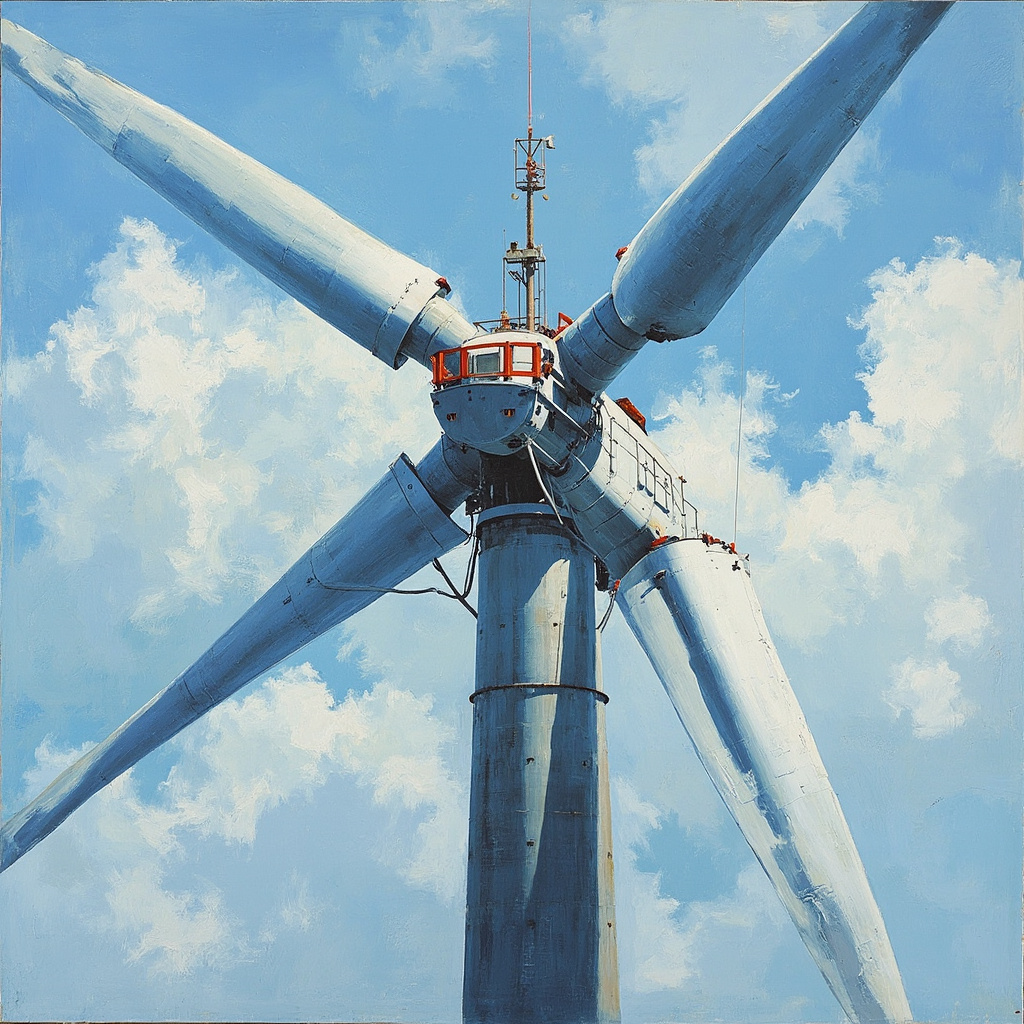
Offshore wind turbine towers are subjected to dual asymmetric corrosion: the outer wall faces direct high salt spray (CX level) + intense UV radiation + rain erosion, while the inner wall is in a continuous high-humidity condensation environment in an enclosed space (RH>90%/no ventilation). The corrosion mechanisms of the outer and inner walls are completely different, requiring differentiated coating system designs. The core design goal of tower coating is 25 years maintenance-free, because the cost of a single maintenance at an offshore wind farm (vessel + personnel + weather waiting) often exceeds the total initial coating cost.

I. Differentiated Coating Scheme for Inner and Outer Walls
| Component | Corrosion Environment | Recommended Coating System | Total DFT (μm) | Target Service Life |
|---|---|---|---|---|
| Tower exterior (atmospheric zone) | C5-M/CX+UV | Epoxy zinc-rich + epoxy micaceous iron oxide + polysiloxane topcoat | 320-400 | 25 years |
| Tower exterior (splash zone) | CX (most severe) | Epoxy zinc-rich + epoxy micaceous iron oxide + glass flake epoxy + polysiloxane | 500-600 | 25 years |
| Tower interior | C3-C4 (enclosed high humidity) | Epoxy primer (zinc-free) + epoxy high-build intermediate coat | 200-300 | 25 years |
| Flange surface / bolts | C5-M (crevice corrosion) | Inorganic zinc-rich primer + touch-up after bolt tightening | 100-150 | 25 years |
II. Comparison of Salt Spray Resistance Tests among Different Coating Systems
| Coating System | Salt Spray Resistance (h/ASTM B117) | Scribe Creep (mm) | Blistering Rating (ISO 4628) | Applicable Environment |
|---|---|---|---|---|
| Epoxy Primer (Single Layer) | 400-600 | >3.0 | Class 3 | C1-C2 |
| Zinc-rich Epoxy + Epoxy Micaceous Iron Oxide | 1000-1500 | 1.0-2.0 | Class 1-2 | C3-C4 |
| Zinc-rich Epoxy + Epoxy Micaceous Iron Oxide + Polyurethane | 1500-2000 | 0.5-1.0 | Class 0-1 | C5-M |
| Zinc-rich Epoxy + Epoxy Micaceous Iron Oxide + Glass Flake + Polysiloxane | >2500 | <0.5 | Class 0 | CX |

Technical deepening: systematic optimization methods for process parameters (DOE experimental design)
Coating production process optimization should not rely on the "trial-and-error method" but should adopt the scientific method of DOE experimental design. Taking the dispersion process as an example—factors affecting quality (linear velocity/time/filling rate/temperature), 4 factors each at 3 levels—full factorial requires 81 experiments—DOE uses orthogonal experiment L9 (9 times) or response surface methodology (27 times) to greatly reduce the number of experiments—while obtaining the main effects and interactions of each factor. For example, it is found that "the interaction of linear velocity × time is significant"—high linear velocity + short time and low linear velocity + long time can achieve the same dispersion effect—but the former saves energy by >20%.
In DOE analysis, interpretation of the P-value — P95% confidence). DOE ultimately outputs a set of prediction models (polynomial regression equations) — input line speed/time/temperature → predict fineness/viscosity/gloss — providing formulation engineers with a "digital formula optimization" tool.
Industry practice: from "master craftsman's feel" to "parameter standardization"
The common challenge in the coatings industry — when experienced veteran workers retire, their "feel" (mixing resistance / fineness gauge scraping / visual inspection of wet-film gloss) is taken away — new employees cannot replicate it. Transform the "feel" into quantifiable standard parameters (1) mixing resistance → viscometer reading; (2) fineness gauge scraping → fineness gauge reading (μm); (3) wet-film gloss → gloss meter (GU value). The "standard parameter card" for each process is posted next to the equipment — new employees operate according to the "card" rather than "by feel". "Parameter standardization" is a key step for coating factories to move from "workshop" to "factory".
FAQ
Q1: Why is zinc-rich primer not used on the inner wall of the tower? The inner wall is an enclosed space (no UV, no rain wash), but sustained high humidity (>90%RH) causes condensation water to adhere for long periods. The corrosion products of zinc-rich primer in high-humidity enclosed environments (ZnO/Zn(OH)₂) accumulate too quickly → white rust expansion → affects adhesion of subsequent coatings. For the inner wall, a zinc-free epoxy primer + high-build epoxy intermediate paint is recommended — providing pure barrier protection rather than sacrificial anode.
Q2: Is tower painting usually done in the factory or on site?Factory painting (painting line at the tower manufacturing plant) — controlled environment (temperature/humidity/cleanliness) → optimal coating quality. On site, only the following are performed: (1) touch-up painting of welds at flange connections; (2) repair of mechanical damage incurred during transportation and lifting. The quality control level of factory painting is incomparable to that of on-site painting.
Q3: Special considerations for coating design on flange faces?Flange faces are subjected to extremely high contact pressure (>200MPa) after bolt tightening—the coating may be squeezed and cracked. Solution: (1) Do not paint the flange sealing face (rely on metal-to-metal contact for sealing); (2) Paint the outer circumference of the flange and extend it 5-10mm into the flange face; (3) After bolt tightening, spray "touch-up coating" on the exposed bolt heads and flange gaps.
Q4: Coating vulnerability at tower weld seams?The roughness of weld seams (Rz 50-100μm) is much higher than that of the steel plate base material (Rz 30-50μm) → poor film thickness uniformity of the coating at weld seams (too thin at peaks / too thick at valleys) → preferential rusting at peaks. Solutions: (1) Apply Stripe Coat (pre-coating) at weld seams — before overall spraying, use a brush to separately pre-apply one coat of primer to the weld seams; (2) During sandblasting, focus on treating the weld seam areas to ensure uniform roughness.
Q5: Is 25-year maintenance-free truly possible?The offshore wind industry's current longest service record is about 20 years (Vindeby/Denmark, the first offshore wind farm in 1991) — the coating was in good condition after 20 years (no significant rusting/only slight chalking). Laboratory accelerated testing (ISO 20340/4200h cyclic aging) shows that a reasonably designed high-standard coating system can last 25-30 years. However, coatings in the splash zone may require local maintenance at 15-20 years — only the tower atmospheric zone and inner wall can be completely maintenance-free.
Q6: Application prospects of environmentally friendly coatings (water-based/solvent-free) in wind power coating?The use of water-based paint for wind turbine tower coating (factory assembly line) is technically feasible—water-based inorganic zinc-rich primer has already been applied in some European wind power projects. Solvent-free epoxy (100% VS) used for inner walls can eliminate the risk of VOC accumulation in confined spaces. Currently, solvent-based coatings remain mainstream—but environmental regulations (especially in the EU) will drive the accelerated substitution of water-based/solvent-free coatings in wind power coating.
Q7: Differences in wind power coating requirements across different sea areas (North Sea / South China Sea / East China Sea)?North Sea (Europe): Low temperature (5-15°C) + high salt spray (>500mg/m²·day) + storm splash impact — emphasis on the mechanical impact resistance and low-temperature curing capability of the coating. South China Sea (China): High temperature (25-35°C) + strong UV + high salt spray + microorganisms (barnacles) — emphasis on the UV resistance and anti-marine biofouling of the coating. Coating systems for different sea areas need to be custom-adjusted according to the local marine environment.
Q8: Typical process layout of wind turbine tower coating line?Sandblasting (Sa2.5) → Cleaning (dust removal / salt detection) → Primer spraying (airless / automatic traveling sprayer) → Primer drying (60-80°C / 30-45min) → Intermediate coat → Drying → Topcoat → Drying → Cooling → Inspection (DFT + pinhole + adhesion + appearance) → Shipment. The tower rotating roller stand rotates at 2-3 rpm for 360° uniform coating. Total coating man-hours for a single tower (approx. 80m high / divided into 4-6 sections) is about 8-12h per section.
Q9: Are there functional considerations in the color selection of tower coating?Light colors (white/light gray) reflect solar radiation heat to reduce the internal temperature of the tower (summer inner wall temperature can be lowered by 10-15°C) → slowing down inner wall condensation generation and coating aging. However, aviation warning requirements mandate red/orange bands at the top of the tower. Light-colored coatings have high visibility of fouling (facilitating inspection) but salt deposits and bird droppings are more conspicuous → requiring regular cleaning.
Q10: How are the coatings on decommissioned wind turbine towers handled?After the tower is decommissioned, the steel is recycled—the coating is completely thermally decomposed in the scrap steel remelting (electric arc furnace >1600°C), leaving no solid waste residue. The zinc powder in the epoxy zinc-rich primer enters the electric arc furnace dust in the form of zinc oxide (ZnO)—which can be recovered via baghouse dust collector (zinc recovery rate >95%). Coating systems free of organic chlorine/heavy metals do not generate secondary pollutants such as dioxins. The recyclability design (Design for Recycling) of wind turbine towers is an important consideration for green wind farms.
FAQ: In-Depth Technical Q&A Supplement
Q11: How do the differences in domestic and international standards for this technology affect product export?Domestic standards (GB) differ from ISO/ASTM standards in test methods and acceptance criteria. For example, salt spray testing—GB/T 1771 (equivalent to ISO 7253) has test conditions basically consistent with ASTM B117—but the rating systems (ISO 4628 vs ASTM D610/D714) differ—when providing test reports for exported products, the corresponding international standards must be indicated simultaneously, otherwise overseas customers cannot make a comparative assessment. It is recommended to list both GB and ISO/ASTM dual-standard indicators in the TDS (Technical Data Sheet) of exported products—to enhance the trust of international customers.
Q12: How to verify the long-term service performance of this technology in actual engineering?Laboratory accelerated testing (salt spray/QUV/cyclic corrosion) provides comparative data—but cannot fully replace actual outdoor exposure testing. Recommendations—(1) Set up outdoor exposure racks at both the factory location and typical customer locations (e.g., coastal C5-M/industrial C4)—conduct annual inspections of coating appearance/adhesion/film thickness changes—establish a company-owned outdoor service database; (2) Collaborate with universities/research institutes—combine enterprise data with academic research—enhance data credibility.
Q13: What should SMEs pay attention to when purchasing related raw materials/equipment?(1) The batch stability of suppliers is more important than unit price—it is recommended to require suppliers to provide COA data for >10 batches—and evaluate batch variation (CpK); (2) For equipment procurement, visit peers who have used the equipment for >2 years to understand the long-term reliability and after-sales service quality of the equipment—rather than relying only on the demonstration data from equipment suppliers; (3) For key raw materials (resin/curing agent)—maintain at least 2 qualified suppliers to guard against single-supply risk.
Q14: What is the current state and trend of digital transformation in this field?The digital transformation of the coatings industry is evolving from “point-based applications” (automation of individual equipment/processes) to ”system integration” (full-chain ERP+MES+PMS). Currently, the digitalization of small and medium-sized coatings factories has the ”highest ROI investment”: automatic batching systems + digitalization of quality control data — payback period of 1-3 years — which is the prioritized recommended direction. Future trend — AI + sensors enabling real-time optimization of process parameters — further reducing quality fluctuations between batches.
Q15: How can a newly entered coating engineer quickly master this technology?(1)Combine theory and practiceDo not only read literature without touching actual production—nor rely solely on experience without studying theory;(2)Build a “failure case archive”Every customer complaint/production anomaly/coating failure—record the root cause and resolution process—this is the most effective learning material;(3)Learn from suppliersTechnical personnel from resin/additive/pigment suppliers are carriers of "tacit knowledge" in this field—communicate more with them about solutions to specific problems.
Related Reading
Summary
Offshore wind turbine tower coatings should be designed differently for the external (CX+UV) and internal (high-humidity enclosed) surfaces — the external surface uses a zinc-rich + micaceous iron oxide + polysiloxane system (DFT 320–600 μm), while the internal surface uses a zinc-free epoxy system (DFT 200–300 μm). Factory pipeline coating quality is superior to on-site application. A 25-year maintenance-free design is an economic requirement for offshore wind power. Kexin New Materials provides customized coating systems and full-process technical support for wind turbine tower coating clients.