
Wood grain heat transfer printing — also called thermal sublimation wood grain transfer or vacuum wood grain transfer — is a finishing process in which transfer paper or a PET transfer film carrying a wood grain ink pattern is laid tight against the surface of an already cured coating. Heat softens the ink and makes it sublime and migrate toward the outer layer of the coating; once the carrier is stripped off, the grain is left inside the coating. It is not the same thing as foil lamination or hot-pressing of impregnated paper — in those two the grain sits in its own film or paper layer and the interface lies in the adhesive layer, while in transfer printing the grain stays within the top 40–60 µm of the coating (figure taken from publicly available sources; see the note on the data basis at the end). Following the two established in-site references furniture coating on engineered-board substrates and grain raising in wood coatings, this article deals with the transfer line only: the transfer temperature window, how to read transfer yield, how the topcoat has to match it, and weathering acceptance. Adhesive-interface questions of foils and impregnated paper fall outside the judgements made here.
The same failure scenes keep recurring in furniture and profile plants. A cabinet door shows soft, hazy pattern edges three months after the customer has installed it, as though a layer of fog sat on the surface; the sampling inspection finds that the clear topcoat was applied before the transfer layer had cooled completely, so the ink was lifted again by the solvent. A south-facing elevation of window profile loses saturation overall after two years and can be wiped by hand without picking up colour; the verdict is chalking of an under-cured powder coating rather than "the ink came off". On a transfer-printed panel of board furniture, a coffee stain removed during a stain-resistance check leaves local gloss loss with the base colour showing through, and the cause is a topcoat film thickness below the lower limit of the process sheet, not the transfer parameters. All three rework cases were written up as "appearance acceptable" at ex-works inspection, yet not a single test in that inspection covered the heat, moisture and mechanical loading seen in service. The in-site page colour difference control of furniture coatings already settles how ΔE is judged; this article does not repeat the colour-difference arithmetic and concentrates on three things: a transfer process that is under control, a topcoat that genuinely matches it, and acceptance criteria that can be tested.
TL;DR|Six conclusions up front
- The transfer window is set by the metal temperature of the part: 180–200 ℃ with 12–18 min dwell on the vacuum-bag route; 190–200 ℃/15 min is the ideal point given by test studies, and at ≥195 ℃ with a dwell beyond 20 min the paper or film blocks back onto the part.
- The grain goes into the coating, not into the wood; the penetration depth is 40–60 µm according to publicly available sources, so the upper limit of pattern life equals the weathering limit of the powder basecoat.
- Two lines for basecoat thickness: GB/T 5237.4-2017 requires not less than 40 µm locally on the decorated face and an average of 60 µm~120 µm, while public sources for the transfer step suggest 60–80 µm or 70–90 µm.
- The contact criterion is uniformity, not "as hard a pull as possible": draw down to −0.09 ~ −0.1 MPa and hold 3–5 min to check tightness; complex sections rely on a silicone membrane and on where the evacuation points are placed.
- The three topcoat routes (clear powder/waterborne UV/excimer UV) make different trade-offs; sealing too early produces pinholes and blushing, and the verdict returns to scratch resistance per GB/T 4893.10-2024 and liquid resistance per GB/T 4893.1-2021.
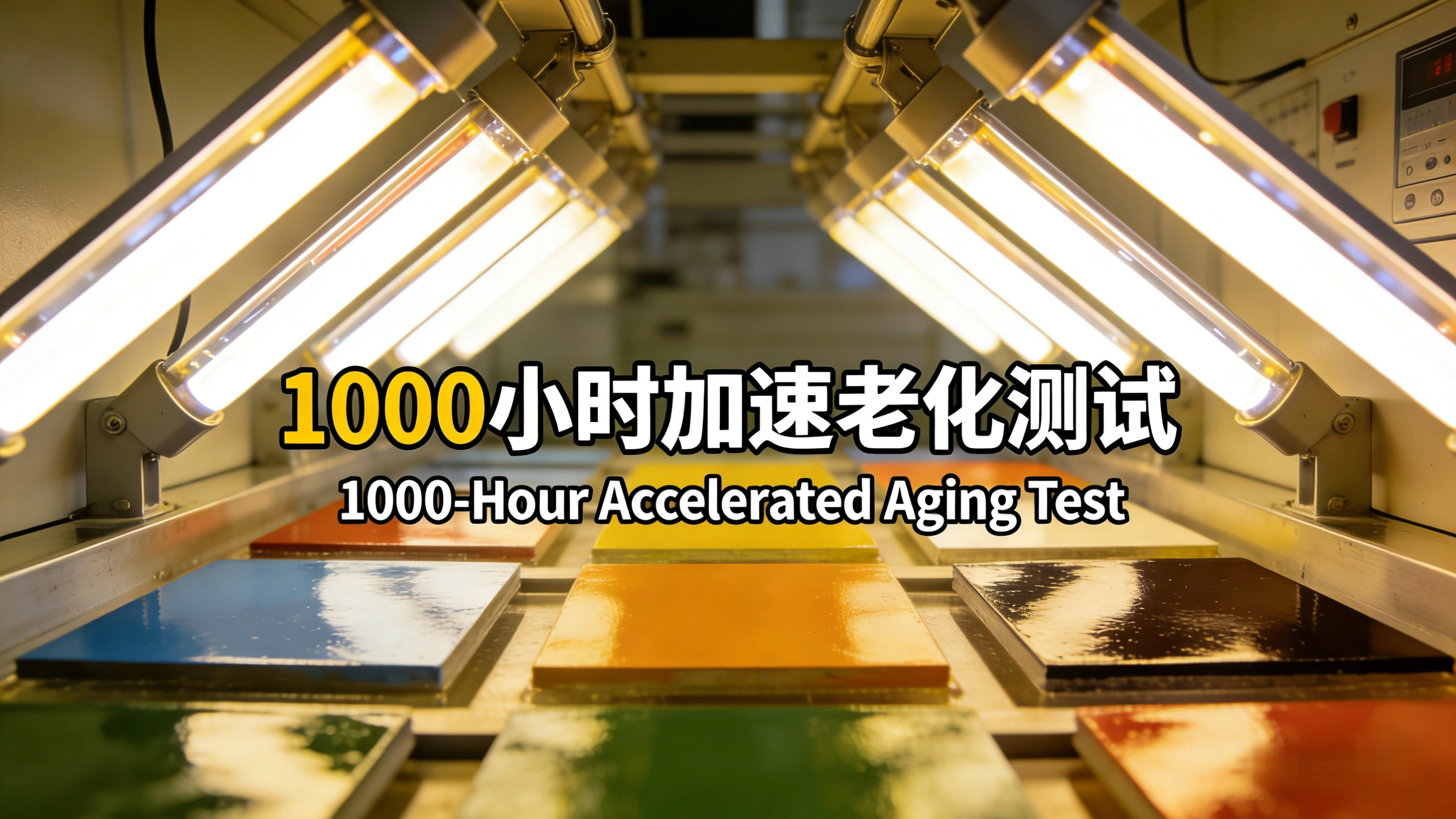
- For exterior work, cite standard classes only, never a number of years: xenon-arc ageing per GB/T 1865-2009 for 1000 h or 4000 h, and natural weathering classes of 1 year/3 years/5 years with gloss retention not below 50%.
1. Drawing the boundary: where the three finishing routes part company
Behind one and the same "wood grain effect" there may be three entirely different interface structures, and criteria, equipment and failure modes cannot be borrowed from one route to another.
1.1 Thermal sublimation transfer: the grain lands inside the coating
The substrate first goes through primer or powder basecoat application and curing; the transfer paper or film printed with wood grain ink is then applied to it, held in contact by the negative pressure of a vacuum bag or by platen pressure, and heated in an oven or under a press. The ink sublimes in the 180–200 ℃ range and migrates into the surface layer of the coating, and after the carrier is stripped the grain has become part of the coating. The weathering ceiling of this route is fixed by the resin system of the coating underneath: the transfer pattern does not adhere to the aluminium or to the board at all, it adheres to the coating, so coating formulation, degree of cure and film thickness together decide how long the pattern lives.
1.2 Transfer printing on lacquer films: low temperature, short cycle, different criteria
Transfer printing onto waterborne or UV topcoat films runs on shorter heat exposure and lower temperature (the film-supplier figures given in public sources are 140–180 ℃ for 10–30 s, and 160–180 ℃ for 18–25 s on platen equipment); heat penetration is small and the grain stays in the shallow part of the coating. The risk here lies not in weathering but in colour bleed and in the recoat window: transfer before the topcoat has finished cross-linking lets the ink dissolve backwards into the lacquer, and topcoating straight after transfer lets the sealing layer push the low-boiling residues that have not yet escaped into pinholes — the mechanism is the one described on pinholes and boils in furniture coatings.
1.3 Foil lamination and impregnated paper: the interface is in the adhesive layer
With PVC/PP vacuum foil lamination and with hot-pressed melamine impregnated paper, the grain sits inside the film layer or the paper layer, and adhesion and weathering are decided by the adhesive and the pressing parameters. How edge density differences in engineered boards affect decoration adhesion, and how grain raising and its control behave, are already worked out on the two pages furniture coating on engineered-board substrates and grain raising in waterborne wood coatings; this article does not repeat them and touches only the overlap with transfer in section 6 — the contact voids at edges and in recesses.
| Item | Thermal sublimation transfer (the main line here) | Transfer printing on a lacquer film | Foil lamination/impregnated paper |
|---|---|---|---|
| Where the grain sits | within the top 40–60 µm of the cured coating | shallow coating layer, little penetration | inside its own film or paper layer, interface in the adhesive |
| Typical thermal window | 180–200 ℃, dwell 12–18 min | 140–180 ℃ for 10–30 s, or 160–180 ℃ for 18–25 s | set by press temperature and adhesive type, no transfer window applies |
| How contact is made | vacuum bag negative pressure −0.09 ~ −0.1 MPa, or platen | platen, silicone membrane, continuous roller | vacuum membrane press, hot press |
| Main failure modes | insufficient transfer, ghosting, blocking back, chalking | colour bleed, pinholes, interlayer delamination | blisters, adhesive opening, edge lifting |
| Acceptance basis | coating standards plus transfer reference panels | lacquer film resistance standards (GB/T 4893 series) | GB/T 15102-2017 decorative panel figures |
Writing all three routes into a single process sheet is a frequent error: the temperature, the time and the criteria come from different routes, so the shop floor follows the sheet faithfully and still matches the failure signature of none of them.
2. The temperature—time—vacuum window: settling the disagreements in the published figures first
2.1 The six temperature-time combinations found in public sources
The transfer windows given in the literature and in supplier documents do not agree with one another. That is not somebody writing it down wrongly; it is the consequence of different machine types, profile wall thicknesses, primer resin systems and film-and-ink systems. The table below sets the six figures side by side and states the conditions each one rests on; none of them can be copied straight into another plant's process sheet.
| Source of the figure | Temperature | Time | Conditions under which it holds |
|---|---|---|---|
| Test study at an aluminium profile plant (paper) | 190–200 ℃ | 15 min | vacuum-bag transfer, polyester-type powder basecoat, one fixed ink paper |
| Failure boundary of the same test study | ≥195 ℃ | stretched to 20 min | paper and film block back onto the part, so a dwell upper limit is needed |
| Company work procedure | 180–200 ℃ | 12–18 min | higher temperature means shorter time, oven record deviation ±3 ℃ |
| Film and equipment supplier data | 220 ℃ | 3 min | continuous transfer line, thin-wall profiles, penetration of 40–60 µm claimed |
| Working example in an invention patent | 200–220 ℃ | 20–30 min | combined process with alkali-etched relief and an electrodeposition undercoat |
| Platen flat-panel transfer | 160–180 ℃ | 18–25 s | PET film pressed down, flat decorative face, not the vacuum-bag route |
What matters when reading this table is not picking one number but settling three things. First, whether the temperature quoted is the oven display value, the hot-air temperature, or the metal temperature of the profile — curing and transfer alike should be referenced to the metal temperature of the workpiece, and on thick-wall and hollow sections oven temperature and part temperature can differ by 10–20 ℃. Second, when the clock starts: on a continuous line, the gap between entering the oven and reaching the lower temperature limit is large enough to put a whole batch out of colour. Third, the temperature difference between stations inside one oven; the work procedure requires every temperature zone to be logged each hour with a deviation from set point not exceeding ±3 ℃.
2.2 Failure at both ends of a temperature deviation
Too low a temperature shows up as incomplete sublimation: the grain looks soft, the shade runs pale, adhesion drops, and the diagnosis shares its root with the "insufficient transfer yield" type of colour difference explained on colour difference control of furniture coatings. Too high a temperature shows up as yellowing of the coating and lateral spreading of the ink until the lines run together into a blur, and the coating can even soften a second time and block onto the carrier film, tearing as the film is pulled off during cooling. Dark powder basecoats absorb more heat than light ones, so one and the same temperature curve is not equivalent on a dark and a light shade, and any colour change requires a fresh set of stepped test panels.
2.3 Vacuum level and uniformity of contact
The criterion on the vacuum-bag route is "uniform contact pressure", not "the harder the pull, the better". The work procedure requires drawing down to −0.09 ~ −0.1 MPa and holding that negative pressure for 3–5 min while watching whether the reading falls back, and that is how air tightness is judged; another public source describes the negative pressure the film can withstand as lying in the 0.3–0.8 MPa range. Where the vacuum is insufficient, the film loses contact locally with the coated surface and leaves blank patches or a ghost image. Sections with recesses and ribs need a more elastic silicone membrane plus a sensible layout of evacuation points; simply raising the negative pressure usually ends with the film punctured at the sharp corners.
3. Transfer yield and definition: reading it from test panels, not from eye experience
3.1 Six driving variables
Transfer yield is governed by six things at once: the release behaviour of the carrier film (PET normally 12–25 µm, thickness tolerance ±1 µm), the molecular weight of the ink and the pigment particle size, the porosity and absorption capacity of the coating, contact pressure and vacuum uniformity, pass overlap and grain layout, and the cooling rate. The influence of the coating itself is regularly underestimated: a pure polyester powder with poor flow leaves pronounced micro-relief, and pattern definition comes out lower than with a hydroxyl-functional polyurethane powder system. A film that is too thin under-covers, while one that is too thick develops pinholes and orange peel during the transfer heat as internal stress is released; public sources therefore hold the transfer basecoat at 60–80 µm, whereas another test study on aluminium profiles places the quality ceiling nearer 70–90 µm.
3.2 How to judge it: reference sample on the same panel plus stepped-temperature test panels
The correct practice is to keep both a "standard reference sample" and a "stepped test panel" on the same surface: run one and the same profile through 3–5 temperature steps at 5 ℃ each, or draw one and the same batch out at time steps, and compare them under the same light source at the same illuminance. Inspection should be done at 600–800 lux and at a viewing distance of 0.5–1.0 m, and when checking whether the pattern edges bleed use a magnifier instead of moving your eye closer. The supplier figures "transfer yield ≥95%" and "pattern definition grade 4 or better" are incoming-material criteria: they belong on the goods-inward acceptance line and cannot replace performance judgement of the finished coating.
| Defect | What it looks like on the floor | Main cause | Action and whether it can be reworked |
|---|---|---|---|
| Insufficient transfer | pale grain, base colour shows through | temperature too low or time too short, thin ink layer, basecoat too thick | one further transfer pass is allowed within the same base-colour system, but the reference must be redone |
| Ghosting and misregistration | doubled image, pattern offset | wrapping slipped, evacuation too fast, uneven paper tension | cannot be re-transferred; grind off the coating, re-spray the basecoat and start again |
| Mottling and clouding | local light and dark patches | uneven vacuum, creasing film, temperature difference inside the oven | check contact and temperature zones first, then decide on scrap |
| Local colour loss | colour patches appear when wiping | under-cured coating, pigment rated below 200 ℃ | treat as a primer batch problem and quarantine the whole batch |
| Fibre tearing from the carrier | hair-like marks on the surface | peel angle too large, film pulled before cooling | peel only after cooling below 40–50 ℃; light cases can be covered by the topcoat |
| Blushing after topcoat | grain looks fogged, gloss lost | low boilers not driven off, topcoat applied too early, pinholes | handle per the criteria on pinholes and boils |
The pigment has to be selected for a high-temperature step as well: public sources require transfer pigments to withstand at least 200 ℃ and to reach a light-fastness grade not below 7, otherwise a shade shift already appears during the hot phase of transfer and there is no point discussing weathering afterwards. The film suppliers give light fastness of grade 6 or better for exterior grades and grade 4 or better for interior grades, and the two must not be swapped.
4. The topcoat: whether one is needed, what to use, and how much
4.1 Three topcoat routes
Above the transfer surface there are three transparent layers in common engineering use: a clear powder topcoat (which can share the oven with the transfer but needs a matched cure window), a waterborne UV topcoat (mechanism and oligomer selection are covered on waterborne UV-curable coatings), and an excimer UV soft-touch topcoat (see excimer UV soft-touch wood furniture coating). The three differ widely in how they trade scratch resistance, stain resistance, gloss and hand feel: UV reaches a high cross-link density and takes a mar well, but it seals so fast that it drives solvent into pinholes; clear powder is thick and forgiving but levels away the texture of the grain; excimer gives a fine matte soft touch but is thin and asks a great deal of substrate wetting. Film-thickness uniformity in roller and curtain coating is not repeated here; see roller coating of flat furniture panels.
| Route | Matching window | Criteria available | Specific risk |
|---|---|---|---|
| Clear powder topcoat | same cure system as the basecoat, a second heat pass required | indentation hardness, Erichsen cupping, weathering class | the second heat pass lets the grain diffuse once more |
| Waterborne UV topcoat | high-energy cure after touch dry, watch oxygen inhibition | liquid, stain and scratch resistance | sealing too early causes pinholes and blushing |
| Excimer UV topcoat | thin film, high wetting demand | 60° gloss, scratch resistance, hand feel | sensitive to the polarity of the transfer surface, local loss of keying |
| No topcoat | shipped as it is | only the criteria of the coating and of the transfer layer itself | no margin on stain or scratch resistance |
4.2 The recoat window and the lifting risk
The topcoat must be applied only once the transfer layer has cooled properly and the low boilers have been driven off; the recoat window after transfer is the same one as the blocking window of the waterborne topcoat, and the criteria are set out on blocking resistance and recoat window of waterborne wood topcoats. The risk of lifting — topcoat solvent re-lifting the transfer ink — tracks the cross-link density of the primer directly: where the primer is under-cured, the ink has already penetrated too deeply during transfer, and one more solvent pass from the topcoat blurs the pattern edges.
5. Adhesion and the order of the process steps
What transfer demands of the primer surface is written into two operations. The first is sanding and grit grading: the micro-flatteness of the basecoat surface sets the ceiling on pattern definition, and the sanding practice and removal of sanding residue are covered on sanding practice in wood finishing, while the sanding window and the metal-soap risk of a sandable sealer are covered on sandability criteria for sanding sealers. The second is curing fully before transfer: the coating must have built a dense cross-linked network, and an under-cured coating that is "dry on the surface, uncured inside" softens further as soon as transfer heat arrives, so the ink penetrates too deeply, the pattern edges blur, and long-term weathering resistance drops with them. Adhesion is judged by the cross-cut test (GB/T 9286-2021, 2 mm spacing) at grade 0; the figure given by the work procedure, "detached area not greater than 5%", corresponds to grade 1, and the two must never be written interchangeably. The profile side carries a stricter set of interface criteria: dry adhesion, wet adhesion (immersion at 38 ℃±5 ℃ for 24 h) and boiling-water adhesion (boiled for 20 min) are all required at grade 0.
6. Edges, recesses and differences between substrates
Engineered board and aluminium behave at the edge in a way that has nothing in common with the flat face. The edges of particleboard and MDF are low in density and take up a large volume of coating, so the transfer film cannot follow them and you get blank strips and angle-dependent gloss loss. On aluminium profiles the film is pulled up over external corners and bridges hollow across recesses — an inherent weakness of the vacuum-bag route, which public sources address by using a more elastic silicone membrane and repositioning the evacuation points. Substrate moisture content and panel temperature matter just as much: the work procedure puts the shop environment at 10–35 ℃ and relative humidity 60%–70%, and damp transfer paper must be pre-heated to drive off moisture first, otherwise the water flashes to steam under heat and forms blisters directly. Detailed criteria for decoration and edge adhesion on engineered boards are on furniture coating on engineered-board substrates, and how grain raising behaves during the coating stage is on grain raising in waterborne wood coatings.
7. Key figures at a glance
- Basecoat thickness for transfer: not less than 40 µm locally on the decorated face, average thickness preferably 60 µm~120 µm (GB/T 5237.4-2017); public sources for the transfer step suggest 60–80 µm or 70–90 µm.
- Temperature and time: 180–200 ℃ with 12–18 min dwell on the vacuum-bag route; the ideal point from the test study is 190–200 ℃ for 15 min; at ≥195 ℃ with a dwell over 20 min the paper or film blocks back.
- Vacuum: draw down to −0.09 ~ −0.1 MPa and hold the negative pressure 3–5 min to check tightness; the negative pressure the film can withstand is given elsewhere in public sources as 0.3–0.8 MPa.
- Ink penetration depth: after transfer the grain sits 40–60 µm inside the coating (publicly available sources), so the weathering resistance of the coating itself sets the ceiling on pattern life.
- Pigment selection: temperature resistance not below 200 ℃, light fastness not below grade 7; PET carrier film normally 12–25 µm with a thickness tolerance of ±1 µm.
- Interior lacquer film resistance: wet heat and dry heat both at 70 ℃ for 20 min (GB/T 4893.2-2020, GB/T 4893.3-2020); the liquid resistance test uses 10% acetic acid and 10% sodium carbonate for 24 h each (GB/T 4893.1-2021).
- Decorative panel figures: abrasion wear value ≤80 mg/100 r, plain colour with no show-through after 350 r; light fastness reaches grey scale grade 4 with blue wool reference 6 (GB/T 15102-2017).
- Exterior accelerated weathering: xenon-arc per GB/T 1865-2009, method 1 cycle A, with test durations of 1000 h (class I and class II) and 4000 h (class III) for coating performance; natural weathering classification runs over 1 year, 3 years and 5 years (GB/T 5237.4-2017).
8. Weathering and chemical resistance criteria: keep the indoor and the outdoor basis apart
Interior furniture faces and building exteriors follow two different logics, and mixing them writes both kinds of wrong commitment at once.
8.1 Indoors: lacquer film resistance and the decorative panel standard govern
The service loads on interior cabinet doors and table tops are cold liquids, hot cups, stains and abrasion. The test methods sit in the GB/T 4893 series: resistance to cold liquids (GB/T 4893.1-2021, with 10% acetic acid and 10% sodium carbonate acting for 24 h each), resistance to wet heat and to dry heat (.2-2020 and .3-2020, both at 70 ℃ for 20 min), resistance to temperature shock (.7-2013: 1 h at 40 ℃±2 ℃ with relative humidity 95%±3%, then 1 h at −20 ℃±2 ℃, 3 cycles in total), impact resistance (.9-2013, drop height 50 mm), abrasion resistance (.8-2023, 60 r), scratch resistance (.10-2024) and cross-cut adhesion (.4-2023). On the decorative panel side GB/T 15102-2017 adds its own quantified lines: wear value ≤80 mg/100 r, plain colour with no show-through after 350 r, patterned surfaces retaining more than 50% of the pattern after 100 r, scratch resistance ≥1.5 N with no continuous scratch above 90%, stain resistance of grade 4 or better for plain colour and grade 5 or better for patterns, dry heat and cigarette-burn resistance grade 4 or better, resistance to steam and to cracking grade 4 or better, and light fastness reaching grey scale grade 4 with blue wool reference 6. Flooring-grade products use the abrasion-revolution classes of GB/T 18102-2020 (commercial class I ≥12000 r, commercial class II ≥9000 r, domestic class I ≥6000 r, domestic class II ≥4000 r, a modified adoption of EN 13329:2016) and must not be quoted alongside door components.
8.2 Outdoors: the coating system class governs, and no year commitments are written
Pattern life on an exterior profile depends on the powder basecoat system. GB/T 5237.4-2017 grades coating performance into class I, class II and class III from the accelerated weathering result, and class I is supplied where nothing is stated: accelerated weathering is xenon-arc ageing per GB/T 1865-2009, method 1 cycle A, for 1000 h (class I and class II) or 4000 h (class III), with class III requiring gloss retention not below 75% and colour difference ΔEab not above 3; damp-heat resistance follows GB/T 1740 at 47 ℃±1 ℃ for 1000 h (class I and class II) or 4000 h (class III); salt-spray resistance follows GB/T 10125 acetic acid salt spray for 1000 h (class I and class II) or 2000 h (class III), with undercut corrosion measured from each side of the scribe not exceeding 4 mm. Natural weathering follows GB/T 9276 with classification test durations of 1 year, 3 years and 5 years, and every grade requires gloss retention not below 50%.
Supplier documents commonly carry statements such as "keeps 5–8 years outdoors without fading" or "fluorocarbon systems last 10 years and more"; those are experience figures rather than verifiable criteria. This article writes no year commitments and clarifies two things only: which test-duration class the chosen system corresponds to, and that the weathering ceiling of the pattern can never exceed that of the basecoat system itself. The test study adds one useful comparison: under UVB313 lamps with 9 h of light per day, 3 weeks running for 189 h in total at 60–65 ℃ inside the chamber, a sample combining a fluorocarbon powder basecoat with ultra-durable wood grain paper reached grade 4 on the fading grey scale, while the ordinary polyester samples from the same set came out clearly lower.
8.3 Chemical and stain resistance
The exterior criteria are written into the test methods of GB/T 5237.4-2017: hydrochloric acid resistance with 10 drops of a 1+9 hydrochloric acid solution held for 15 min at 18 ℃~27 ℃; mortar resistance at 38 ℃±3 ℃ and relative humidity 95%±5% for 24 h; detergent resistance by immersion in a 30 g/L solution at 38 ℃±1 ℃ for 72 h; and solvent resistance by the wipe method of GB/T 8013.3, where the result should be grade 3 or grade 4. On the interior furniture side the basis is 10% acetic acid and 10% sodium carbonate for 24 h under GB/T 4893.1-2021, plus the everyday stain media. The reagent resistance of the transfer layer was verified separately in the test study: 10% hydrochloric acid, 10% sodium hydroxide and ethanol each left in place for 48 h and then wiped off produced no visible change on the surface of a well-made system.
8.4 Hazardous substances and environmental figures
For finished furniture, GB 18584-2024 Limits of harmful substances in furniture applies; it was issued on 2024-06-25 and became effective on 2025-07-01, and it covers formaldehyde, benzene series and TVOC, migratable harmful elements and phthalates. Formaldehyde emission from the engineered-board substrate follows GB 18580-2017 (E1 limit 0.124 mg/m³), and classification follows GB/T 39600-2021 with E0 at 0.050 mg/m³ and ENF at 0.025 mg/m³. The environmental points of the transfer step itself lie in the ink and the carrier film: the printing stage meets the volatile organic compound content limit of GB 38507-2020, and waste paper and film are collected separately as recyclable waste.
9. Where the rework line sits: what may be re-transferred and what must be sanded and recoated
The decision sequence begins by asking "which layer is the interface in". With the grain inside the coating, an under-transfer means too little penetration, and a second pass inside the same base-colour system is permitted — but a new reference sample and comparison sample must be laid in, and the extra heat pass lifts overall saturation, so the colour code has to carry "one step darker permitted" on the process sheet. Ghosting, fibre tearing and blank strips inside the film are contact and handling defects: re-transferring will not remove an overlapped image, so the coating has to be ground off and the basecoat re-sprayed. Local colour loss and overall chalking are primer batch problems, and the response is to quarantine the whole batch and trace back the cure curve rather than run a second transfer on it. Rework costing must state how many process passes are involved: sand and recoat means sanding, basecoat, cure and transfer all over again, four passes in total, whose cost basis sits far above a second transfer pass, while the quality risk is lower than masking a defect with a topcoat.
10. Acceptance and cost: turn the price per m² into the cost of a good part
First-article approval is the primary lever of reliability for the transfer step. Fix three things at the same time: the sealed approval sample (with standard light-source card and a defined viewing distance), the stepped-temperature test panel (redone at every colour or film change), and the retained sample (from the same batch, exposed to natural sunlight, photographed periodically with ΔE recorded). For sampling, write transfer yield, definition and ΔE as three separate items — far more workable than "appearance satisfactory": incoming film is accepted against the supplier figures of transfer yield ≥95% and definition grade 4 or better, and the finished part against the GB/T 4893 series or against the classes of GB/T 5237.4. The boundary of the cost calculation has to be stated just as clearly: replace "price per m²" with "cost per m² of good parts = material + energy + topcoat consumables + amortised rework rate"; one move in the rework rate swallows the entire price gap between films and coatings, which is also why the unit cost of the transfer step should not be used for external quoting. Commercial terms stay B2B, and delivery terms are agreed as EXW or FOB only.
11. Frequently asked questions (FAQ)
Q1 Does wood grain heat transfer printing put the grain into the wood itself?
It does not. The object of transfer is the coating, not the wood or the engineered-board substrate; the sublimed ink penetrates the surface layer of an already cured coating, and the publicly given penetration depth is 40–60 µm. Repairability of the grain therefore follows coating logic: sand the coating off and the pattern is gone. That is a completely different failure and rework path from staining solid wood or applying wood veneer, so quotations and acceptance documents must not reuse one and the same wording.
Q2 Should the transfer temperature be set from oven temperature or from part temperature?
From the metal temperature of the part. Thick-wall profiles and hollow sections lag visibly behind the oven air before the core comes up to temperature; with the oven displaying 200 ℃ the centre of the section may still be at 180 ℃, and conversely a short high-temperature zone on a continuous line can overheat thin walls. Log the real curve with an oven temperature profiler, take "the moment the metal reaches the lower limit" as the start of the clock, and require hourly records of every zone with deviation inside ±3 ℃ — that is more reliable than copying some 195 ℃ figure onto the process sheet.
Q3 Why are the two ends of the same profile paler than the middle?
In most cases this is a contact and heat-field problem, not an ink problem. Near the vacuum taps at the ends the film pressure is lower than across the middle, sublimation gas accumulates locally and transfer falls short; at the same time the difference between oven mouth and oven centre can reach 5–10 ℃. Deal with it by checking the layout of the evacuation points and the condition of the seals, then confirm with a stepped test panel whether contact or temperature caused the difference, instead of changing film supplier whenever something appears.
Q4 Must a topcoat always follow transfer?
That depends on the service load. Where interior cabinet doors face hot cups, stains and frequent friction, a topcoat supplies a real margin of scratch and stain resistance, judged per GB/T 4893.3-2020, .10-2024 and .1-2021. A transfer surface without a topcoat leaves the ink layer directly exposed and is more likely to show gloss loss after wiping in a stain test. On exterior profiles a separate topcoat is normally left out, because the powder basecoat system is already designed to the classes of GB/T 5237.4-2017, and adding a clear powder layer would mean a second heat pass and the risk of the grain diffusing again.
Q5 After the topcoat the grain looks hazy, as if fogged — is the topcoat lacquer at fault?
Check timing and outgassing before changing the lacquer. If a sealing layer goes on before the part has cooled and before the low boilers have escaped, fine pinholes and light scattering form under the film, and that is exactly the "layer of fog" that is seen; the mechanism is the one on the pinholes and boils in furniture coatings page. The second cause is solvent lifting: where the primer is under-crosslinked, topcoat solvent re-lifts the ink and the pattern edges blur. The first is corrected by adjusting cooling and dwell time; the second means going back to the cure curve.
Q6 Can a supplier's "no fading outdoors for N years" be quoted as an acceptance clause?
Not advisable. A year commitment depends on the specific exposure site, the installation orientation, cleaning frequency and basecoat batch, and there is no reproducible test condition behind it; once written into a contract it can be neither accepted nor arbitrated. The version that can be written cites standard classes instead: accelerated weathering of 1000 h or 4000 h with the matching gloss retention and ΔEab limits, or the natural weathering classification durations of 1 year/3 years/5 years, plus a separate agreement on third-party testing and on who rates the result.
Q7 Are transfer paper and PET film interchangeable?
Partly on the platen route; on the vacuum-bag route they are not a simple substitution. Paper and PET carriers differ in release temperature, heat-shrink behaviour and stiffness: public sources give PET carrier film as normally 12–25 µm thick with a heat shrink of not more than 2% after 30 min at 150 ℃, and one and the same ink reaches different transfer yields on the two carriers. Changing the carrier means new stepped test panels and new reference samples — the original process sheet cannot be carried over.
Q8 What decides pass or fail in a stain-resistance check on a transfer surface?
For interior parts use the media of GB/T 4893.1-2021 (10% acetic acid, 10% sodium carbonate) with 24 h of exposure, combined with the scratch criterion of GB/T 4893.10-2024; the decorative panel line in GB/T 15102-2017, "grade 4 or better for plain colour and grade 5 or better for patterns", may be referenced, rated against a grey scale and viewed under a standard light source at 600–800 lux. The point of the verdict is to record gloss loss and colour change as two separate conclusions — writing only "no obvious change" leaves a re-test with nothing to compare against.
12. References and note on the data basis
1. GB/T 5237.4-2017 Wrought aluminium alloy extruded profiles for architecture — Part 4: Powder coating profiles, issued 2017-10-14, effective 2018-05-01, replacing GB/T 5237.4-2008; the film thickness, adhesion, chemical resistance and the accelerated and natural weathering classification data in this article are taken from publicly reprinted copies of that text.
2. GB/T 1865-2009 Paints and varnishes — Artificial weathering and exposure to artificial radiation — Filtered xenon-arc radiation, GB/T 1740, GB/T 10125, GB/T 9286-2021, GB/T 6739-2022, GB/T 8013.3, GB/T 9276.
3. Currently effective editions of the GB/T 4893 series on the physical and chemical properties of furniture surface coatings: .1-2021, .2-2020, .3-2020, .4-2023, .7-2013, .8-2023, .9-2013, .10-2024.
4. GB/T 15102-2017 Fibreboard and particleboard decorated with impregnated decorative paper, and the related decorative panel standard GB/T 34722-2017; GB/T 18102-2020 Laminated wood flooring with impregnated paper (modified adoption of EN 13329:2016).
5. GB 18584-2024 Limits of harmful substances in furniture (issued 2024-06-25, effective 2025-07-01), GB 18580-2017, GB/T 39600-2021, GB 38507-2020.
6. Test studies on wood grain heat transfer printing for aluminium profiles (the ideal window of 190–200 ℃/15 min, the blocking boundary at 195 ℃ and 20 min, 70–90 µm film thickness, 189 h under UVB313 and 10% reagents for 48 h) come from publicly reprinted industry technical papers; their conditions depend on specific powder grades and ink papers, so they must be re-verified before being cited.
7. Public material from film and equipment suppliers (12–25 µm carrier film, 140–180 ℃/10–30 s, transfer yield ≥95%, light fastness grade 6/grade 4, ΔE ≤1.5 after 500 h QUV, penetration 40–60 µm, 5–8 years outdoors, and so on). Every figure labelled "from publicly available sources" in this article has not been re-checked in a third-party laboratory; it is offered for process screening only and must not be used as a contract acceptance clause.
8. Related pages on this site: colour difference control of furniture coatings, roller coating of flat furniture panels, waterborne UV-curable coatings, excimer UV soft-touch wood furniture coating, blocking resistance and recoat window of waterborne topcoats, sanding practice in wood finishing.
Last updated: 2026-11-14. The technical content of this article was compiled by the technical team of Kexin New Materials (Guangdong) Co., Ltd., and external attribution is made under that name. This article addresses manufacturing customers; sampling and quotation follow B2B practice and delivery terms are agreed as EXW or FOB. All standard numbers refer to their currently effective editions, figures taken from publicly available sources are not an acceptance basis, and the actual product matching and criteria are governed by the technical agreement between both parties.