Key Takeaways:
1. EV battery nano fireproof coating systems integrate three functional layers — aerogel nano-insulation (0.013-0.018W/mK, 1300°C/2h), intumescent fireproof coating (1200°C, 51% thermal runaway delay), ceramizing silicone rubber encapsulation (1300°C/>30min).
2. Nanjing Tech University’s ceramic aerogel “firewall” at only 0.09 inches (2.3mm) thickness, exposed to 1000°C/5 min, keeps backside temperature below 100°C — adopted by CATL, BYD, Xiaomi SU7 in mass production.
3. GB 38031-2025 mandates ≥5 minutes post-thermal-runaway escape time; next-gen regulations target 120 minutes — driving nano fireproof materials from “optional” to “mandatory.”
The proliferation of electric vehicles has transformed “battery thermal runaway” from a laboratory safety test topic into a public concern. When lithium-ion batteries trigger thermal runaway due to internal short circuits, overcharging, or mechanical damage, individual cell temperatures can soar to 600-1000°C within seconds, triggering chain reactions in adjacent cells through thermal conduction, radiation, and hot particle ejection. EV battery pack nano insulating fireproof coatings constitute the core material system for building thermal barriers between cells and modules.
Thermal Runaway Propagation Physics — How Demanding Is the Operating Environment?
Direct Answer: Single-cell thermal runaway peak temperatures reach 800-1200°C (NCM ternary lithium: up to 1200°C; LFP: ~600-800°C), lasting 30 seconds to several minutes. Fireproof coatings between adjacent cells must maintain structural integrity and insulating function under flame and high-temperature gas flow impact of at least 1000°C — far exceeding traditional building fireproof coating operating conditions (typically <800°C/30min).
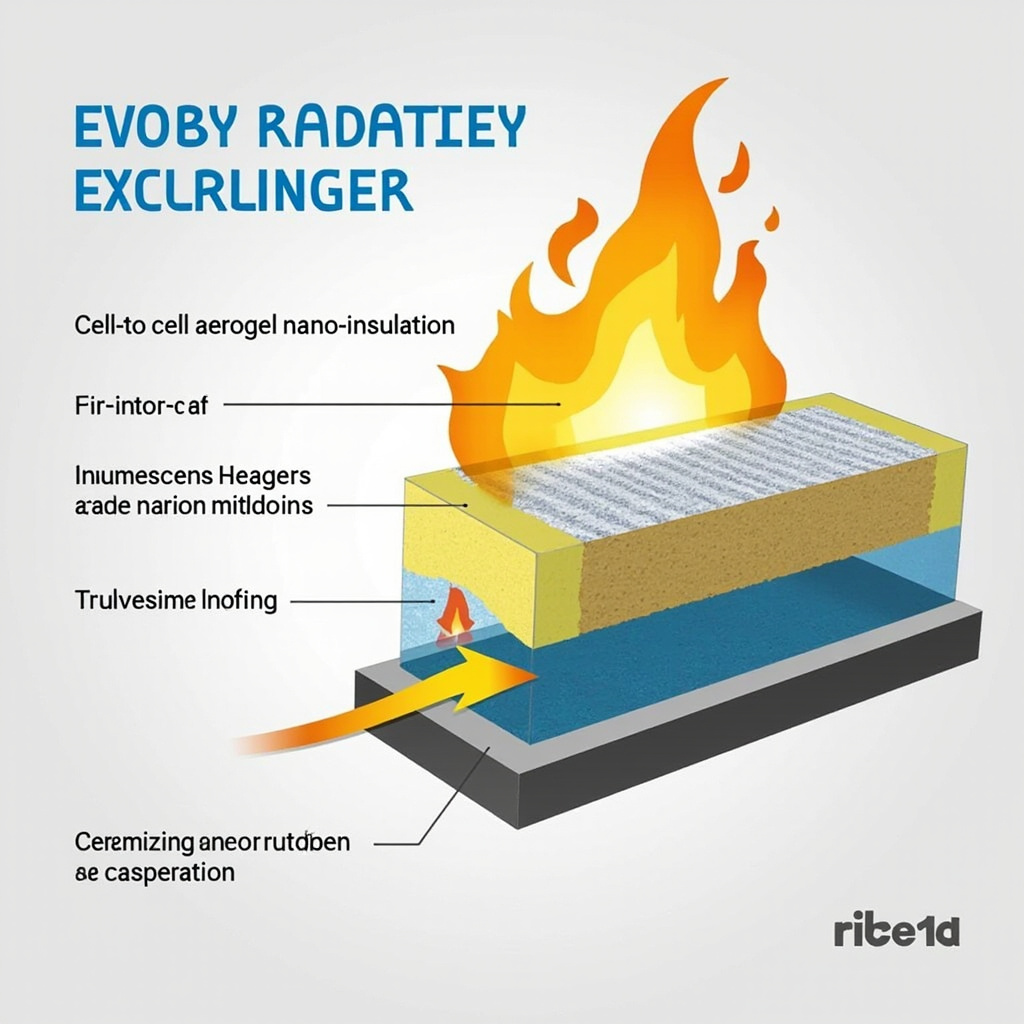
The three thermal runaway propagation pathways: (1) Thermal conduction — blocked by ultra-low thermal conductivity nano-insulation pads between cells (aerogel or SUPHIP® nanocomposite, 0.013-0.04W/mK — 1/5000 of aluminum alloy). (2) Thermal radiation — 1200°C cell surface radiative heat flux ~200kW/m², blocked by IR reflective/absorptive nano-fillers (TiO2, ATO, SiC) in insulation coatings. (3) Hot particle ejection — safety vent opening releases high-temperature electrolyte vapor and molten metal particles (>660°C Al, >1085°C Cu), blocked by intumescent coating expanding 20-50× to form porous carbonized layer.
Data Support: GB 38031-2025 mandates: after thermal runaway triggering, no external flame or explosion within ≥5 minutes. UN GTR No.20 and EU ECE R100.03 have similar requirements. Next-gen regulations (projected 2027-2028) target 30-120 minute escape time — demanding qualitative leaps in fireproof coating performance.
Sources: GB 38031-2025, UN GTR No.20, IDTechEx Fire Protection Materials Report 2025
Four-Layer Nano Fireproof Architecture
Layer 1: Nano-Aerogel Insulation Core. SiO2 aerogel — “solid smoke” — lowest thermal conductivity among known solids (0.013-0.018W/mK), >95% porosity, 2-50nm pore size (smaller than air mean free path ~70nm, effectively suppressing gaseous conduction). Nanjing Tech University’s 2025 breakthrough: (1) supercritical CO2 drying with 99.5% ethanol reuse reducing production cost >50%; (2) fiber reinforcement and elastic structure design (>90% elastic recovery) solving traditional aerogel brittleness — can withstand repeated cell expansion/contraction cycles.
Layer 2: Intumescent Fireproof Coating. EP/MAP-Cu system (epoxy/modified ammonium polyphosphate-copper ion) — 2025-2026 NSFC-supported frontier research. Working principle: high-temperature MAP decomposition → phosphoric acid catalyzes epoxy carbonization → Cu2+ catalyzes carbon layer cross-linking → carbon layer thickness 20-50× original coating. Experimental: 1.5mm coating exposed to 1200°C butane flame, backside temperature only 93°C (36% temperature rise reduction), thermal runaway onset delayed 51%.
Layer 3: Ceramizing Silicone Rubber Encapsulation. Under 800-1300°C flame, nano-mica/kaolin fillers and platinum catalyst in silicone rubber synergize: silicone side chain decomposition → SiO2 residue sinters with nano-fillers forming dense ceramic protective shell — in-situ transformation from flexible elastomer to rigid ceramic barrier. >30min 1300°C flame penetration test with zero failure.
Sources: Nanjing Tech University/Interesting Engineering (2025), NAGASE SUPHIP®, MDPI Gels (Oct 2025)
FAQ
Q: How much weight does nano fireproof coating add to battery pack?
Aerogel insulation pad areal density: ~200-400g/m²; 80kWh pack (~200 cells, ~8m² inter-cell area): ~1.6-3.2kg added — <1% of total pack weight. Intumescent coating adds ~0.5-1.0kg. Weight penalty negligible compared to fire safety benefit gained.
Q: Does fireproof coating affect battery heat dissipation?
Nano-insulation coating design targets “directional insulation” — blocking inter-cell thermal runaway propagation (normal direction) without affecting normal heat dissipation paths (tangential direction) at cell bottom or sides. Selective coating application (only between cell large faces) enables precise thermal management control.
Q: Does LFP battery need fireproof coating?
Yes. Although LFP (LiFePO4) thermal stability exceeds NCM/NCA (onset ~250°C vs 180°C, peak ~600-800°C vs 1000-1200°C), once thermal runaway triggers, LFP cells also eject hot gases and particles. Module-level propagation risk still exists. LFP systems can use relatively thinner coatings (1-2mm vs 2-4mm for NCM).
References: GB 38031-2025, Nanjing Tech University (2025), NAGASE SUPHIP®, MDPI Gels (Oct 2025), IDTechEx 2025-2035
Published: July 6, 2026 | Category: Technical Knowledge