Key Takeaways:
1. Matte self-healing nano finishes achieve SiO2-free controlled matting (60° gloss <10GU, zero haze) via carboxylic-functional PUD + carbodiimide chemistry, breaking the traditional matte system's "high haze + low scratch resistance" paradox.
2. Memory polymer nano-scale heat-activated reflow enables scratch self-healing — swirl marks and light scratches disappear under 60°C/2h or direct sunlight exposure, with >90% gloss recovery rate.
3. Matte self-healing is the fastest-growing automotive coatings sub-segment — ~$1.8B global market in 2025, driven by premium EV matte color trends from Tesla Cybertruck, BMW i-series Frozen editions, and Porsche Taycan Satin options.
Matte paint finishes are experiencing an unprecedented renaissance in automotive design. From Tesla Cybertruck’s stainless steel matte base to BMW i-series “Frozen” limited editions to Porsche Taycan’s Satin options — matte is no longer synonymous with cheap “solid paint” but has become a core element of premium personalized design language. However, matte finishes have one critical engineering pain point: once scratched or swirled, they cannot be restored by polishing like gloss finishes — polishing destroys the microscopic surface roughness structure, turning matte into irregular “semi-gloss patches.” Matte self-healing nano finishes were developed precisely to resolve this contradiction.
How Is Matte “Made”? — From SiO2 Matting Agents to Filler-Free Chemical Matting
Direct Answer: Traditional matte clear coats achieve their effect by adding micron-scale SiO2 matting agents (2-10μm) to transparent resin — SiO2 particles protrude from the coating surface creating microscopic roughness that causes diffuse rather than specular reflection. However, SiO2 matting agents introduce three problems: (1) elevated haze from refractive index mismatch (SiO2 1.46 vs resin 1.50); (2) reduced scratch resistance — protruding SiO2 particles become stress concentration points; (3) impossibility of self-healing — SiO2 particles possess zero repair capability.
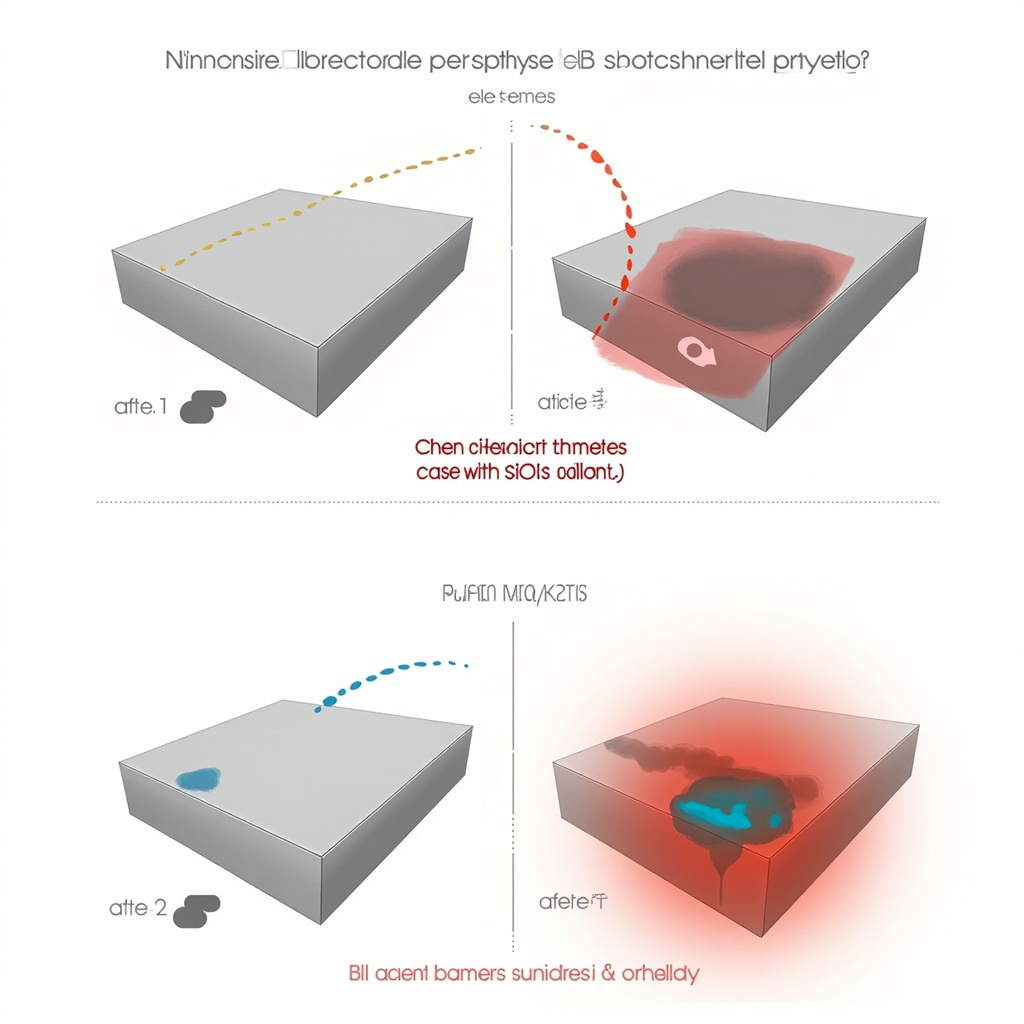
Mechanism — Carboxylic-Functional PUD Chemical Matting: Stahl’s 2025 technical breakthrough (PCI Magazine) represents a paradigm shift. The core innovation: instead of external SiO2 particles, carboxylic-functional polyurethane dispersions (PUDs) crosslinked with carbodiimide spontaneously form nano-micro scale phase-separated structures during curing. Carboxyl groups (-COOH) react with carbodiimide (-N=C=N-) forming N-acylurea cross-links. Local heterogeneity in cross-link density produces ~0.5-2μm irregular microdomains whose refractive index differences (Δn ~0.02-0.05) generate sufficient diffuse reflection for the matting effect, yet without discrete particles, the coating maintains high transparency (zero haze).
Data Support: Stahl experimental data: 60° gloss precisely controllable 5-30GU range, haze <5% (traditional SiO2 systems 15-25%), Taber abrasion (CS-10 wheel, 500g, 1000 cycles) weight loss only 8mg (vs 25-35mg for SiO2 systems). Chemical resistance: sunscreen (4h), ethanol (1h), hot coffee (24h) — all zero visible effect.
Sources: PCI Magazine (April 2025), Stahl Technical Data
Self-Healing Chemistry — How Do Memory Polymers “Reflow” at the Nanoscale?
Direct Answer: The core material of self-healing nano coatings is “memory polymer” — a polymer network with dynamic covalent bonds or supramolecular interactions. When the coating surface is scratched, polymer chain segments at the scratch site are stretched or cleaved. Upon external stimulus (heat, light, or solvent), dynamic bonds (Diels-Alder adducts, disulfide S-S bonds, hydrogen bonds, or metal-ligand coordination) undergo re-exchange or reorganization — polymer segments “reflow” to fill scratch depressions, restoring surface planarity.
Feynlab’s 2025 self-healing ceramic nano coating (SiO2+Si3N4+SiC ternary system) provides a commercial case study: (1) Flexible polymer segments (low Tg ~ -20 to 0°C) embedded between nanoparticles remain elastomeric at room temperature — stretching but not breaking when scratched; (2) Heating (>40°C, achievable via direct sunlight) accelerates thermal motion of polymer segments, stretched segments retract toward equilibrium — scratches macroscopically “disappear”; (3) Si3N4 and SiC nanoparticles (hardness far exceeding SiO2) provide structural framework preventing coating collapse during reflow.
Data Support: Stahl matte self-healing 85° gloss recovery: initial 13.6GU → post-scratch 13.6GU → 24h recovery 12.7GU (near-complete). Feynlab coating 60°C/2h recovery: 20° gloss recovery rate 92-97%. pH 1-14 chemical resistance (industrial grade), water contact angle >110°.
Sources: Feynlab Technical Press Release (2025), PCI Magazine (April 2025)
FAQ
Q: Matte self-healing paint vs. matte PPF wrap — difference?
Matte PPF achieves matting through TPU film surface microstructure — strong physical protection but “plastic feel.” Matte self-healing paint uses chemical matting via liquid coating — more natural surface feel and gloss transition. PPF replacement cost: ~$3,000-8,000/vehicle; paint: OEM factory or professional refinish application.
Q: Does self-healing function degrade over time?
Yes. Memory polymer dynamic bonds experience “repair fatigue” — irreversible damage accumulates with each repair cycle. After ~50 repeated scratch-repair cycles, repair efficiency drops to 60-70% of initial. Under normal use (monthly wash-induced swirls), repair function maintains >80% over 3-5 years.
Q: How to maintain matte paint daily?
Three absolute prohibitions: never use abrasive polishes (irreversibly destroys matte structure); never use silicone-oil gloss enhancers (creates irregular shiny patches); avoid automatic car wash brushes. Recommended: pH-neutral rinse-less wash + microfiber towel gentle wiping.
References: PCI Magazine (April 2025), Stahl PUD Technical Data, Feynlab Press Release (2025), Smart and Functional Coatings (De Gruyter, 2025)
Published: July 6, 2026 | Category: Technical Knowledge