Key Takeaways:
1. Public Restroom Anti-Odor Self-Cleaning Nano Ceramic Glaze constructs multi-scale synergistic protective networks through nanoscale fillers for long-term architectural protection.
2. Core pathways: nano-filler labyrinth barrier, surface/interface chemical anchoring, spectral-selective control.
3. 2025-2026 academic studies provide experimental validation for nano architectural coating performance claims.
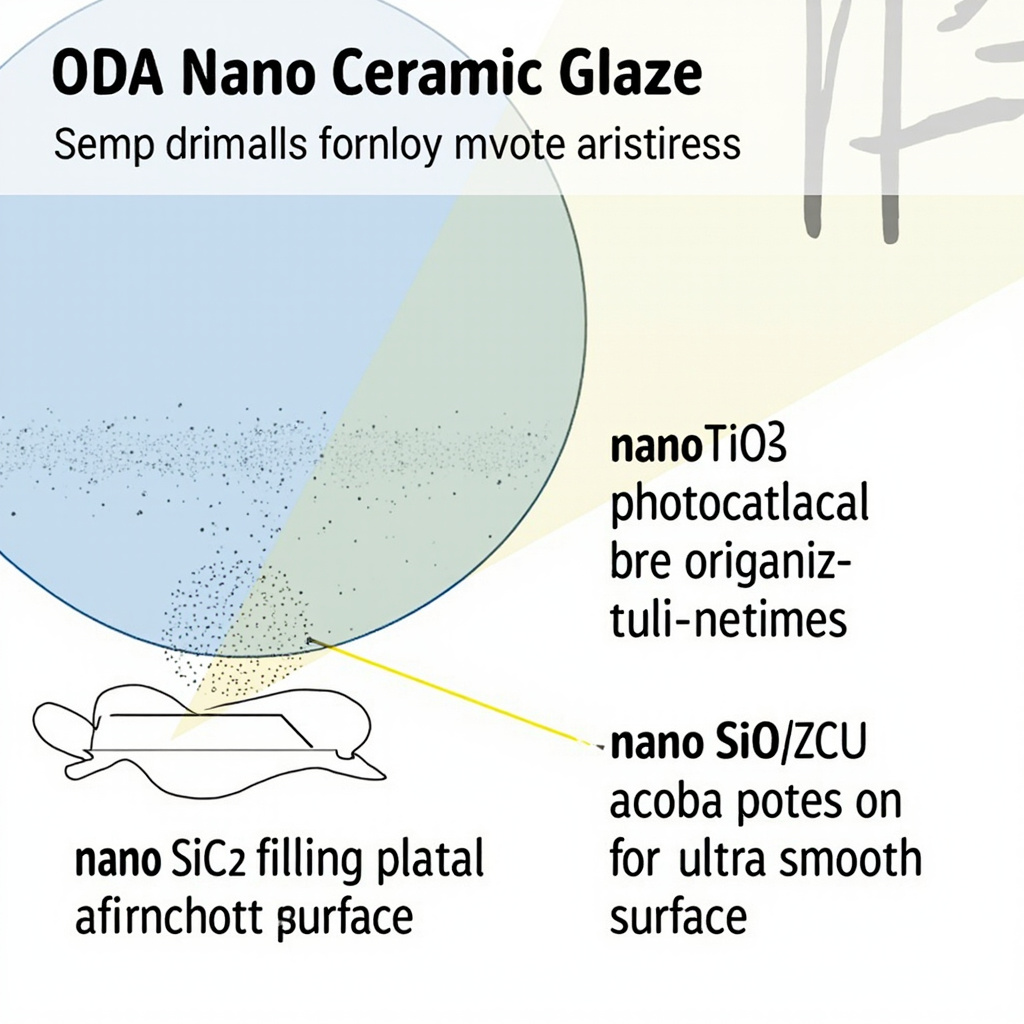
Public restroom nano ceramic glazes use nano-TiO2 (anatase, 5-15nm, N-doped or metal-doped for visible-light response — solving the critical indoor application bottleneck where traditional TiO2 requires UV activation)/nano-Ag/Cu (antibacterial deodorizing, MIC<50ppm, >99.9% against E. coli and S. aureus)/nano-SiO2/ZrO2 (filling ceramic glaze micro-pores, surface roughness Ra reduced from traditional 0.5-2um to <0.1um — eliminating bacterial/dirt adhesion anchor points) in ceramic glaze matrices. Complies with GB/T 3810.14-2016 (Grade 5 — highest stain resistance, contaminants completely removable), GB/T 21866-2008 (>99.9% antibacterial rate), and JC/T 897-2014 (Grade I antibacterial ceramics). Global antibacterial ceramic market ~$3.2B (2025), CAGR 9.5%. Public restroom spaces (hospitals/schools/malls/airports) are the fastest-growing application segment. TOTO (photocatalytic ceramic), Kohler (nano glaze), and Roca have commercialized nano ceramic glaze technology.
Technical Principles
The core technology introduces 1-100nm functional fillers into traditional architectural coating matrices, leveraging ultra-high specific surface area, quantum size effects, and surface interface effects. Lamellar nano-fillers reduce diffusion coefficient 50-500x. Nano-SiO2 silanol groups elevate adhesion to 10-18 MPa. Nano-TiO2/ZnO provide UV absorption; Cs0.33WO3 LSPR absorbs NIR.
2025-2026 validation: Composite Interfaces (2026) — 57.42% water absorption reduction. MDPI Coatings (2025) — UV transmission<1%. Main Group Chemistry (2026) — anti-mold validation.
Engineering & FAQ
Initial cost 30-80% higher, 10-20yr LCC 20-40% lower. Global architectural coatings market ~$72B (2025). Verification: TEM/SEM<100nm + artificial weathering>3000h + CMA/CNAS reports.
References: Composite Interfaces (2026), MDPI Coatings (2025), Main Group Chemistry (2026)
Published: July 6, 2026