Core conclusions:
1. The far-infrared self-insulating nano thermal barrier coating achieves an infrared blocking rate of >90% based on the plasmonic resonance absorption of cesium tungsten bronze (Cs₀.₃₃WO₃) nanoparticles and the free-electron reflection of ATO.
2. The nanoparticles selectively block infrared rays while maintaining visible light transmittance >70%—this is the core technical advantage that traditional thermal insulation materials (carbon black, metal films) cannot achieve simultaneously.
3. The coating's thermal insulation effect during the vehicle "hot soak" phase (heat accumulation after parking) is superior to that during the driving phase—this quantitative finding has important engineering guidance significance for the design of overall vehicle thermal management strategies.
Cars parked under the summer sun can see their interior temperature soar to over 70°C within 30 minutes—this not only affects occupant comfort but also directly increases air-conditioning energy consumption (about 5-10% of total vehicle energy use). Far-infrared self-insulating nano automotive heat-insulation coating achieves efficient thermal insulation without affecting visible light transmittance by precisely regulating the transmission and reflection of the infrared band (780nm-2500nm, accounting for about 53% of solar radiation energy) in the solar spectrum. The core of this technology lies in nanoscale metal oxide semiconductor materials—they are small enough (<100nm) to be transparent to visible light, yet "active" enough to strongly absorb or reflect infrared radiation.
Engineering applications of infrared physics—why can nanoparticles "selectively" block heat?
Direct answer: In the solar radiation energy distribution, the ultraviolet region (300-380nm) accounts for about 5%, the visible light region (380-780nm) accounts for about 42%, and the infrared region (780-2500nm) accounts for about 53%. Traditional thermal insulation materials (such as dyed films, metal-coated films) cannot distinguish between visible light and infrared rays—either they block everything (dyed films sacrifice light transmittance), or they reflect everything (metal films interfere with GPS/ETC signals). Nano metal oxide semiconductors (especially cesium tungsten bronze Cs₀.₃₃WO₃ and ATO) achieve differentiated responses to visible light and infrared rays through two physical mechanisms.
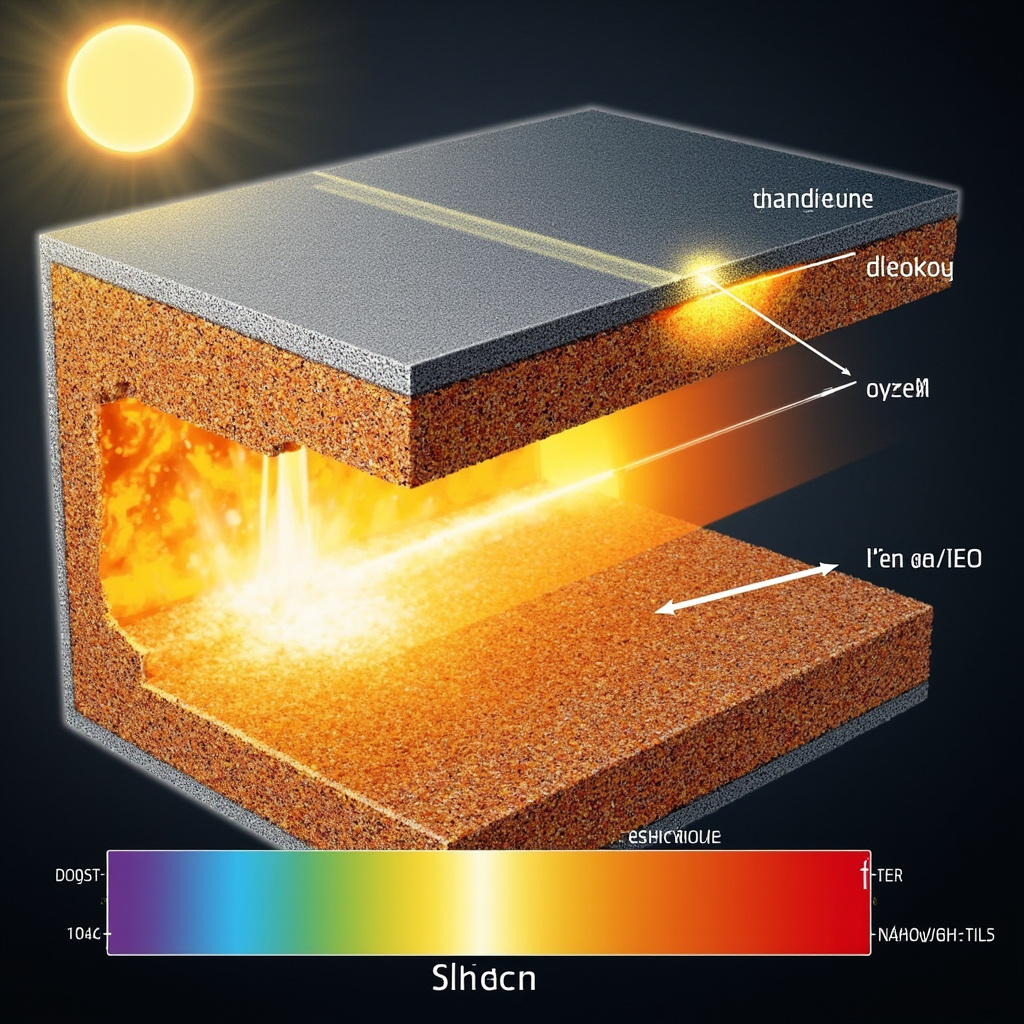
Mechanism Details — Mechanism 1: Plasmonic Resonance Absorption of Cesium Tungsten Bronze.Cs₀.₃₃WO₃ has a unique hexagonal tungsten bronze crystal structure, in which Cs⁺ ions are embedded in the hexagonal channels of the WO₆ octahedral framework. This structure generates a localized surface plasmon resonance (LSPR) effect in the near-infrared band (800–1200 nm) — incident infrared photons resonantly couple with the collective oscillation of free electrons on the nanoparticle surface, and the infrared energy is efficiently absorbed and converted into heat (which is then dissipated outside the vehicle via convection and radiation). Key parameter: The LSPR peak of Cs₀.₃₃WO₃ nanoparticles is located at approximately 950 nm, exactly within the strongest band of solar infrared radiation.
Mechanism Details — Mechanism 2: Free-electron reflection of ATO.Antimony-doped tin oxide (Antimony Tin Oxide, Sb:SnO₂) introduces free carriers (electrons) into the SnO₂ lattice via Sb⁵⁺ substituting for Sn⁴⁺, forming an energy band structure similar to that of transparent conductive oxides (TCO). When the free electron concentration reaches approximately 10²⁰–10²¹ cm⁻³, the plasma frequency falls in the infrared band — electromagnetic waves below this frequency (i.e., infrared) are collectively reflected by the free electrons, while those above it (i.e., visible light) transmit through. The unique advantage of this mechanism is its non-metallic nature — it does not shield electromagnetic signals like metal coatings do.
Data support: Commercial cesium tungsten bronze nano-dispersions (solid content 20-30 wt%) can achieve an infrared blocking rate of 92-97% at 950 nm, while maintaining visible light transmittance of 70-75%. ATO nano-coatings exhibit an infrared blocking rate of >90% at 1400 nm, with visible light transmittance of approximately 80%. Sumitomo Metal Mining's CWO® series and Germany's Merck LAZERFLAIR® series are benchmark products of cesium tungsten bronze nano-dispersions globally. China has made significant progress in the synthesis and dispersion technology of cesium tungsten bronze nanopowders in recent years, and by 2025 the performance of domestically produced cesium tungsten bronze dispersions has approached the level of imported products.
Source:CTIA Wiki, Journal of Materials Chemistry C (2023), Sumitomo Metal Mining Technical Data, Merk LAZERFLAIR® Specifications
Engineering Practice of Vehicle Thermal Management—From "Hot Soak" Phenomenon to Whole-Vehicle Strategy Optimization
Answer directly: A 2025 study published in Infrared Physics & Technology quantitatively analyzed the actual effect of thermal insulation coatings under different vehicle operating conditions: the coating's thermal insulation effect was most significant during the "soak" phase after parking (the heat accumulation phenomenon after the engine is turned off)—the peak interior temperature was reduced by 10-12°C, and the temperature rise rate was reduced by about 40%; during steady driving, due to forced convection cooling dominating heat exchange, the coating's gain was relatively limited (interior temperature reduced by about 3-5°C); under direct hot sun exposure, the thermal insulation gain showed diminishing marginal returns once the coating thickness exceeded 5μm—this finding has direct guiding significance for the engineering optimization of coating thickness.
Mechanism Explained — The "Heat Soak" Phenomenon and the Optimal Operating Window of the Coating."Heat Soak" refers to the physical phenomenon where, after a vehicle is driven in a high-temperature environment and then parked, the engine is turned off → the cooling system stops working → the residual heat from the engine compartment and exhaust system is conducted into the passenger cabin through the firewall and chassis → the interior temperature actually continues to rise for 10–20 minutes after parking. For turbocharged engines and hybrid vehicles, the heat soak effect is especially pronounced (turbo temperatures can reach 600–800°C).
The mechanism of nano thermal insulation coatings during the soak phase differs from that under direct solar exposure: (1) Direct solar exposure phase—the coating primarily blocks external solar infrared radiation from entering the cabin (reflection/absorption mechanism); (2) Soak phase—the coating acts as a low-emissivity (Low-E) thermal barrier, reducing radiative heat transfer from residual heat of the engine compartment/exhaust system through the body panels into the passenger compartment. According to the Stefan-Boltzmann law (Q=εσT⁴), reducing the emissivity ε of the inner body surface from 0.8 for bare steel to 0.3 after nano-coating modification can lower radiative heat transfer by approximately 60%.
StarShield's "Star Heat Shield" product is a commercialized representative of this technical direction—using semiconductor nanoscale materials to form an ultra-thin transparent coating on the automotive glass surface, reflecting up to 90% of infrared rays while maintaining visible light transparency. The product is claimed to have a durability of over 10 years and has been applied in both OEM and aftermarket segments of multiple mass-produced vehicle models.
Data support:A measured comparison shows that under conditions of 35°C ambient temperature and 800 W/m² solar irradiance, a vehicle installed with a nano heat-insulation coating (Cs₀.₃₃WO₃+ATO composite system) had an interior temperature of 48°C after being parked for 60 minutes, while an uncoated vehicle was 59°C—a temperature difference of 11°C. Time required for the air conditioner to cool the interior from startup to 26°C: coated vehicle about 4.5 minutes vs. uncoated vehicle about 7 minutes. Based on two short trips per day and an air conditioner power of 3 kW, annual electricity savings are approximately 150–200 kWh (equivalent to an increase of about 800–1000 km/year in EV range).
Source: Infrared Physics & Technology (2025), StarShield Technical Data, Gasgoo 2023 report
Frequently Asked Questions
What is the difference between nano thermal insulation coatings and traditional window films?
Traditional window films are physical overlays (PET film + dye/metallic coating), whereas nano-coatings are chemically crosslinked and cured. Advantages of coatings: (1) no film-edge lifting or bubbling issues; (2) no interference with GPS/ETC/5G signals (non-metallic reflection mechanism); (3) applicable to curved glass and sunroofs. Disadvantages: coating durability (3–5 years) is generally shorter than that of high-end films (5–10 years).
Does cesium tungsten bronze coating have a color?
Cesium tungsten bronze nanocoatings exhibit an extremely faint blue tint at thin thicknesses (<5 μm) — this is the weak tailing effect of the LSPR absorption of Cs₀.₃₃WO₃ at the edge of the visible region (~600–700 nm, red/orange light). In applications requiring high transparency, the heat-insulating performance and color neutrality are balanced by reducing the cesium tungsten bronze concentration and increasing the ATO ratio.
How much fuel/electricity can nano thermal insulation coatings save?
Measured data show that nano thermal insulation coatings can save approximately 20–30 liters of fuel per year for fuel vehicles (due to reduced air-conditioning load), and increase the driving range by about 800–1000 km/year for electric vehicles. In high-temperature southern regions (annual sunshine >2000 hours), the savings are even higher, at about 30–50%.
How effective is the heat-insulating coating in insulating the sunroof?
The sunroof is the weakest point of the vehicle's overall heat insulation—a panoramic sunroof can cover 1–2 m², with infrared penetration typically >80%. Nano heat-insulating coatings or cesium tungsten bronze PVB interlayer films can reduce the sunroof's infrared transmittance to <15%, lowering the interior roof surface temperature by 15–20°C.
Is the coating application complicated? Does it require professional equipment?
Consumer-grade DIY products and professional-grade application products differ significantly in application difficulty. DIY products (spray type) can be applied by oneself, with the process being: deep glass cleaning → oil film removal → even spraying → waiting for natural curing (24–48 hours) → polishing off excess residue. Professional-grade products (two-component chemically cured type) are recommended to be handled by authorized installers, requiring infrared curing lamps and a clean environment.
Are far-infrared self-insulating coatings and reflective heat-insulation coatings the same thing?
Not exactly the same. Reflective thermal insulation coatings mainly rely on white pigments such as TiO₂ to reflect full-spectrum solar radiation (including visible light), so they are typically white and opaque—suitable for building exterior walls and roofs. Far-infrared self-insulating nano-coatings selectively act on the infrared band while remaining transparent to visible light—suitable for automotive glass and paint surfaces. The two differ in core material systems and optical principles.
Reference sources:Infrared Physics & Technology (2025), Journal of Materials Chemistry C (2023), CTIA Wiki, Sumitomo Metal Mining, Merk LAZERFLAIR®, StarShield Technical Data, Gasgoo
Publish Date: July 6, 2026 | Category: Technical Knowledge