Key Takeaways:
1. Nano anti-rust primers use <1μm nanoparticles penetrating 50-100μm deep into tight rust, chemically converting iron oxides into stable FePO4 — upgrading from "covering rust" to "converting rust."
2. High-pressure water washing (3000-3500psi) replaces traditional sandblasting (Sa2.5) — reducing surface preparation cost by 60-80% and processing time by 50-70% while eliminating silica dust environmental and occupational health hazards.
3. Conductive polymer nanodispersion (CPND) primer (Rust-Legend™) achieves heavy-metal-free heavy-duty anti-corrosion (zero chromate/lead/zinc) with 6× longer service life versus conventional primers.
Heavy-duty trucks operate under the most punishing conditions on the road — chassis and frames are continuously exposed to mud, de-icing salts (NaCl/CaCl2), stone impact, and chemical corrosion. Traditional anti-rust primers (alkyd, epoxy zinc-rich) rely on “barrier” logic — forming a dense coating layer preventing water and oxygen from reaching the substrate. However, under truck vibration, stone impact, and thermal cycling, coating micro-cracking is inevitable — once cracks penetrate to the substrate, barrier-type primers lose all protective function. Heavy-duty truck wear-resistant anti-rust nano primers upgrade anti-corrosion logic from passive defense to active protection through a “chemical conversion + nano penetration + dense barrier” triple mechanism.
Rust Conversion Chemistry — How Do Nanoparticles “Turn Rust Into Asset”?
Direct Answer: Steel corrosion products — Fe2O3 (red rust, hematite) and Fe3O4 (black rust, magnetite) — are loose, porous, non-protective oxides with density only 1/4-1/3 of metallic iron; volume expansion is the primary cause of coating cracking and delamination. Active ingredients in nano anti-rust primers (phosphoric acid/phosphate nanoparticles + organic chelating agents) penetrate rust layer pores and chemically react: Fe2O3 + 2H3PO4 → 2FePO4 + 3H2O and Fe3O4 + 4H3PO4 → Fe3(PO4)2 + FePO4 + 6H2O. The reaction product FePO4 (iron phosphate) is a dense, water-insoluble, stable compound — unlike Fe2O3, it does not catalyze further corrosion but forms a protective “rust conversion layer.”
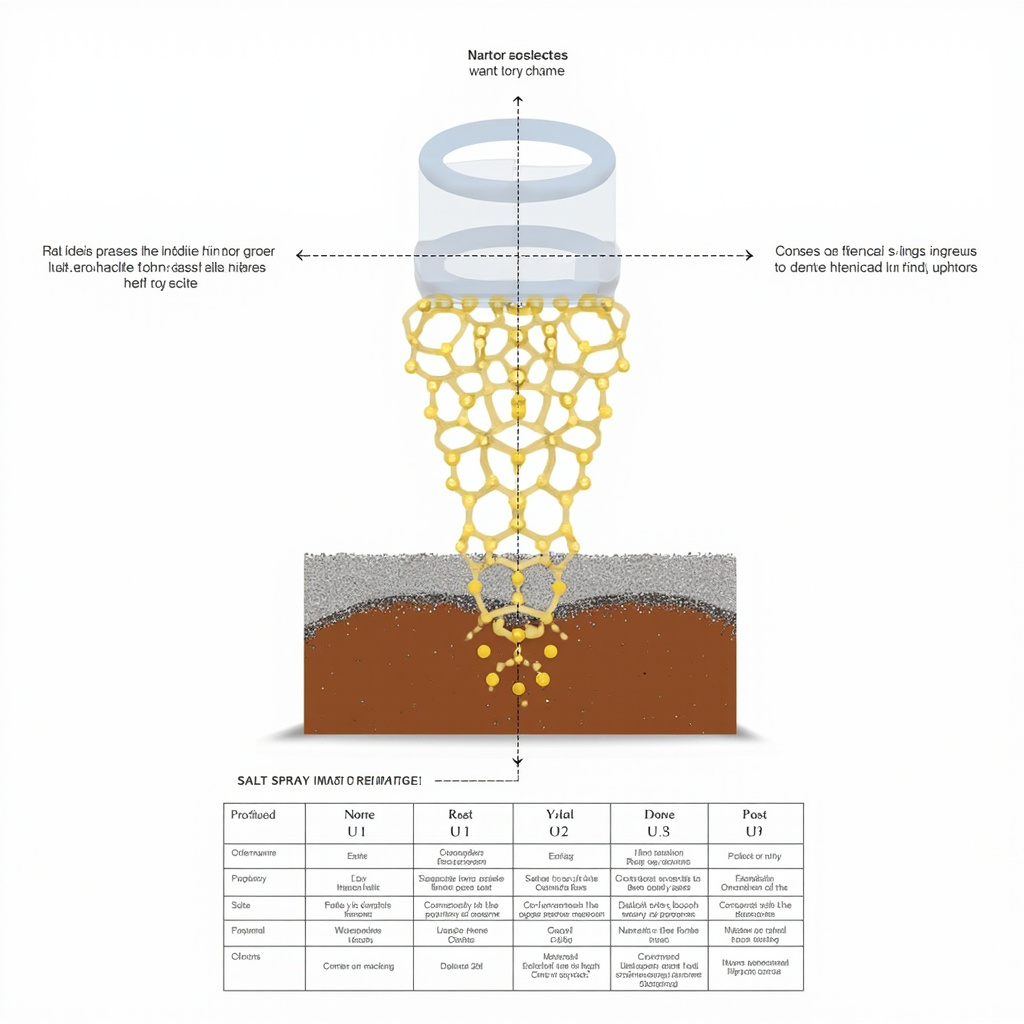
Mechanism — Nano Penetration Fluid Dynamics: Traditional primer pigment particle sizes (5-20μm) far exceed tight rust pore diameters (0.5-5μm), preventing effective penetration — coating merely covers the rust surface while corrosion continues “latently” beneath. The nano primer breakthrough: (1) nano-scale active particles (<1μm, typically 50-500nm) are smaller than tight rust pores, driven by capillary forces (per Washburn equation, penetration depth ∝ (γcosθ·r·t/η)^½) to spontaneously penetrate deep into tight rust; (2) ultra-low viscosity (~10-30cP, approaching water's ~1cP) and low surface tension (<30 mN/m) further enhance penetration driving force; (3) high-pressure water washing (3000-3500psi, ~20-24MPa) not only removes loose surface rust but also opens micro-pore channels in tight rust, creating "entry points" for nanoparticle penetration.
Data Support: Rezisafe NanoPrep field data: after 3000psi pressure washing, single nano primer coat at 80-120μm DFT achieves >50μm penetration into 100μm tight rust layer (SSPC Vis 1 Rust Grade C/D heavy rusting). Post-treatment salt spray (ASTM B117) >3000h zero red rust, versus <500h for traditional alkyd primer under equivalent surface preparation. Rust-Legend™ CPND primer third-party testing confirms 6× longer service life versus conventional chromate-free primers with zero heavy metal content.
Sources: Rezisafe NanoPrep TDS, Rust-Legend™ Technical Data, ASTM B117
Surface Preparation Paradigm Shift — From Sandblasting to Pressure Washing
Traditional steel structure anti-corrosion surface preparation standard (ISO 8501-1 Sa2.5 “Near White Blast”) is the costliest, most polluting, and least efficient process in industrial coating — silica dust (crystalline SiO2) generated by sandblasting is an IARC Group 1 carcinogen. Nano primer’s “sandblasting-free” application — pressure washing only to remove loose rust while retaining tight rust layer (to be converted by nanoparticles) — transforms surface preparation from coating’s “bottleneck process” into “value-added process.”
Economic comparison (per heavy truck chassis ~40m² coating area): traditional sandblasting (Sa2.5) + epoxy zinc-rich primer (80μm) surface preparation cost ~$8-12/m²; nano primer pressure wash (3000psi) + nano primer ~$2-3/m² — 60-80% savings. Processing time: traditional ~3-4 hours; pressure wash ~1 hour — 50-70% savings. Critically, nano primers tolerate much wider application environments — applicable at >85% RH (traditional epoxy requires <85% RH to prevent amine blush from amine-CO2 reaction), ideal for outdoor heavy truck maintenance coating scenarios.
Sources: Rezisafe NRX Application Notes, ISO 8501-1, SSPC Vis 1
FAQ
Q: Can nano primer completely replace sandblasting?
For heavy rusting (SSPC Vis 1 Rust Grade D, >50% rusted area, >1mm deep pits): recommend localized mechanical grinding to remove thick rust scale first, then pressure wash + nano primer. For light-to-moderate rusting (Grade B-C): direct pressure wash + nano primer — no sandblasting needed.
Q: How long does nano primer anti-rust protection last?
In typical heavy truck service environments (coastal/high humidity/winter de-icing salt): nano primer + PU/polyurea topcoat system design life 10-15 years. Dry inland regions: 15-20 years. Accelerated aging tests (ASTM B117 + ASTM D5894 cyclic corrosion) support these lifetime predictions.
References: Rezisafe NanoPrep/NRX, Rust-Legend™, ASTM B117/D5894, ISO 8501-1
Published: July 6, 2026 | Category: Technical Knowledge