Core Conclusion:
1. Graphene anti-corrosion nano-coatings utilize the impermeability and ultra-high aspect ratio (>5000) of single-atom-layer carbon nanosheets (<5nm thickness) to construct a "nano-maze" barrier network—with only 0.1-1wt% addition, the low-frequency impedance modulus of the coating is increased from 10⁶-10⁷ to 10⁹-10¹⁰ Ω·cm² (3-4 orders of magnitude), and the corrosion current density is reduced from 10⁻⁶-10⁻⁵ to 10⁻⁹-10⁻⁸ A/cm².
2. Latest research breakthroughs in 2025-2026: g-C₃N₄/graphene hybrid coatings (ChemNanoMat 2026), GO-borophene self-healing coatings (impedance 1.19×10¹⁰Ω·cm², >200h salt spray self-healing, Progress in Organic Coatings 2026), and Ni-P/rGO superhydrophobic coatings (contact angle 165°, corrosion rate reduced from 0.45 to 0.015mm/year)—graphene anti-corrosion has evolved from "passive barrier" to "active intelligent protection".
3. Core bottleneck for industrialization: the "corrosion promotion" effect of graphene (highly conductive graphene forms graphene-Fe galvanic couples at coating defects to accelerate local corrosion) must be suppressed through insulating encapsulation (GO superior to rGO) or precise control of addition amount (<0.5wt%)—this is the "last mile" engineering challenge for graphene anti-corrosion coatings from laboratory to ten-thousand-ton-scale steel structure applications.
Corrosion of steel structures causes approximately $2.5 trillion in losses to the global economy each year—equivalent to 3.4% of global GDP (NACE IMPACT Study 2016). Traditional epoxy zinc-rich primers provide cathodic protection through the sacrificial anode of zinc powder—but zinc resources are limited (global zinc ore reserves are only about 250 million tons, roughly 20-25 years at current mining rates), and high zinc content (>80wt%) leads to high coating brittleness, poor flexibility, and toxic zinc oxide fumes during welding and cutting. Graphene anti-corrosion nano-coating offers a brand-new technical pathway—using the physical barrier of two-dimensional carbon nanosheets to replace (or partially replace) the electrochemical sacrifice of zinc powder—not only improving anti-corrosion performance by 1-2 orders of magnitude, but also fundamentally eliminating the resource dependence on heavy metal zinc.
Two-dimensional nano-barrier of graphene—why does the "thinnest material" provide the "strongest protection"?
Direct answer: Single-layer graphene is the thinnest known material (0.335 nm, only one carbon atom thick) yet the most impermeable—even the smallest gas molecules (helium atoms, kinetic diameter 0.26 nm) cannot penetrate a defect-free graphene lattice. When graphene nanoplatelets (thickness 1000) are dispersed in an epoxy resin matrix, they form a layered arrangement with random orientation—corrosive agents (water molecules 0.27 nm, oxygen molecules 0.34 nm, chloride ions 0.36 nm) cannot "pass through" the graphene sheets, but can only "go around" them—the permeation path changes from a straight line (film thickness DFT) to a tortuous maze (effective path length = DFT × tortuosity factor τ, τ can reach 50–500). According to the Nielsen-Bharadwaj permeation model: τ = 1 + (α/2)·φ (α = L/d is the aspect ratio, φ is the volume fraction). Taking graphene with α = 2000, only 0.5 vol% (about 0.15 wt%) can reduce the effective diffusion coefficient to 1/250.
Mechanism Explained — Performance Differences Between Graphene and GO/rGO.The "graphene" used in graphene anti-corrosion coatings actually exists in three chemical forms: (1) Pristine Graphene — prepared via CVD or mechanical exfoliation, nearly defect-free, strongly hydrophobic, extremely high electrical conductivity (>10⁶ S/m), theoretically offering the best barrier performance — but cannot be stably dispersed in solvents, and its high conductivity poses the greatest risk of "corrosion promotion"; (2) Graphene Oxide (GO) — graphene oxidized with strong acid, with abundant oxygen-containing functional groups (-OH, -COOH, -O-) grafted onto the surface, enabling stable dispersion in water and polar solvents, with greatly reduced conductivity (insulator) — lowest risk of "corrosion promotion", but barrier performance weaker than pristine graphene due to lattice defects; (3) reduced GO (rGO) — GO chemically/thermally reduced to remove some oxygen-containing functional groups, with conductivity between GO and pristine graphene — the most common compromise choice in anti-corrosion coating applications. The "few-layer graphene (FLG) coating" reported by MDPI Nanomaterials in 2025 was prepared via self-propagating high-temperature synthesis (SHS) — with extremely low defect density (no Stone-Wales defects), coating resistance >20 MΩ — successfully suppressing the "corrosion promotion" effect, with salt spray performance significantly superior to traditional epoxy coatings.
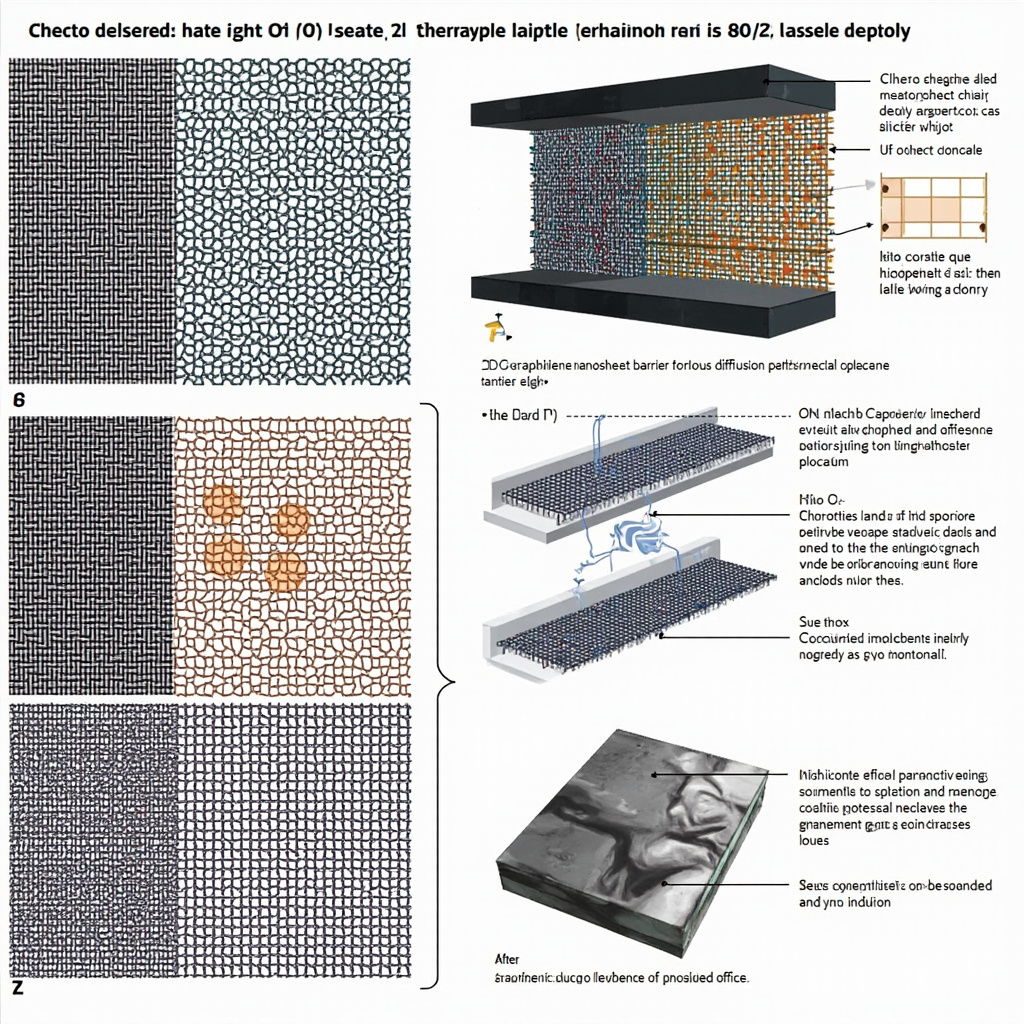
Data support:Summary of data from multiple independent studies (Progress in Organic Coatings, ChemNanoMat, Materials Science & Engineering R review) in 2025-2026: |Z|₀.₀₁Hz (3.5% NaCl): traditional epoxy 10⁶-10⁷ → graphene/epoxy 10⁹-10¹⁰ Ω·cm² (3-4 orders of magnitude improvement); I_corr: 10⁻⁶-10⁻⁵ → 10⁻⁹-10⁻⁸ A/cm² (3-4 orders of magnitude reduction); salt spray (ASTM B117) scribe rust propagation: 4-6 mm → 0.5-1.5 mm (70-90% reduction). The latest GO-borophene self-healing coating in 2026 (Progress in Organic Coatings) achieved an ultra-high impedance of 1.19×10¹⁰ Ω·cm² and >200 h salt spray self-healing — when microcracks are generated in the coating during salt spray, the dynamic hydrogen-bond network of the GO-borophene nanohybrid rearranges under the plasticizing effect of water molecules — "healing" the crack interface. Ni-P/rGO superhydrophobic coating (2026): water contact angle 165° (rolling angle <5°), corrosion rate reduced from 0.45 mm/year (bare steel AISI 1018) to 0.015 mm/year — a 30-fold reduction, coating porosity reduced from 3.54% to 0.10%.
Source:Progress in Organic Coatings(2024-2026), ChemNanoMat(Vol.12, 2026), Materials Science & Engineering R(April 2026), MDPI Nanomaterials(Vol.15, No.24, Dec 2025), Springer Journal of Sol-Gel Science and Technology(Vol.115, 2025)
"Corrosion promotion" effect—the Achilles' heel of graphene anti-corrosion
Direct answer: The high electrical conductivity of graphene is a "double-edged sword" for its anti-corrosion performance—when the coating is intact, graphene's labyrinth barrier effect provides excellent corrosion protection; once the coating is damaged (scratches/pinholes/application defects) exposing the steel substrate, graphene's high conductivity forms a galvanic corrosion couple between graphene and Fe—graphene acts as a large cathode (surface area far larger than the exposed steel anode), driving rapid dissolution of the steel anode (corrosion current density can be several times higher than coatings without graphene)—this is the "Corrosion Promotion" effect. The discovery of this phenomenon (first reported by Schriver et al. in 2012 that graphene accelerates Cu corrosion) completely changed the academic understanding of graphene anti-corrosion coatings—"the more conductive the graphene, the more dangerous the corrosion protection."
Mechanism Explained — The Electrochemical Nature of Galvanic Corrosion.The driving force of galvanic corrosion is the corrosion potential difference (ΔE) between two materials in an electrolyte (water + dissolved salts). The corrosion potential of graphene (in 3.5% NaCl, approx. +0.2~+0.4V vs SCE) is far more positive than that of carbon steel (approx. -0.6~-0.7V vs SCE) — ΔE is about 0.8-1.1V. When the steel exposed at a coating defect (small-area anode) and the large-area graphene conductive network in the coating (large-area cathode) are connected through the electrolyte, the anodic current density i_a = (E_c-E_a)/(R_a+R_c+R_e) × (A_c/A_a) — where A_c/A_a (cathode/anode area ratio) is the key amplification factor. In graphene coatings, A_c/A_a can reach 10³-10⁶ — the anodic corrosion rate is amplified by the same factor — macroscopically manifested as "accelerated perforation" of the steel at the coating defect.
Three engineering suppression strategies: (1) Insulating coating—coating the graphene surface with SiO₂, Al₂O₃, or polymers to block the electron transport channels between graphene-graphene and graphene-steel. The FLG coating (resistance >20 MΩ) reported in MDPI Nanomaterials in 2025 achieves "electronic insulation" precisely through low defect density + insulating matrix—suppressing the corrosion current of the graphene-Fe galvanic couple to the nanoampere level (nA/cm²). (2) Precisely controlling the graphene addition below 0.5 wt%—below the electrical percolation threshold of graphene in epoxy resin (about 0.5–1.0 wt% depending on dispersion quality), the graphene nanoplatelets are completely wrapped by the epoxy resin—electrons cannot "hop" to conduct between graphene layers (the probability decays exponentially when the tunneling distance >1 nm); (3) Using graphene oxide (GO) instead of rGO—the oxygen-containing functional groups of GO disrupt the graphene sp² conjugated structure, blocking electron delocalization on GO sheets—the electrical conductivity of GO (10⁻⁶–10⁻³ S/m) is 6–10 orders of magnitude lower than that of rGO (10²–10⁴ S/m)—basically eliminating the "corrosion promotion" risk.
Data support:Control experiment in MDPI Nanomaterials 2025 (V.15, No.24): 0.5wt% rGO/epoxy coating showed corrosion spread of 4.2mm at the scratch after 500h salt spray (bare steel control group 3.8mm — rGO actually accelerated corrosion); 0.5wt% FLG (few-layer graphene, resistance >20MΩ)/epoxy coating showed corrosion spread of only 1.1mm under the same conditions — proving that "electronic insulation" is an effective strategy to suppress the corrosion-promoting effect. The GO-borophene self-healing coating in Progress in Organic Coatings 2026 further proves that the combination of GO's insulation and borophene's dynamic hydrogen-bond self-healing function is the most promising direction for graphene anti-corrosion technology.
Source: MDPI Nanomaterials (2025, Vol.15), Progress in Organic Coatings (2026), ACS Nano (2012, Schriver et al.), NACE Corrosion Journal (2023)
From Gram-Scale in the Lab to Ton-Scale in Industry: Current Status and Prospects of the Industrialization of Graphene Anticorrosive Coatings
Direct answer:The industrialization of graphene anti-corrosion coatings entered a critical turning point in 2025–2026—the price of industrial-grade graphene (5–10 layers) dropped from >$200/kg in 2015 to $30–80/kg in 2025, and the global graphene anti-corrosion coating market was approximately $120 million (2025)—projected to reach $800–1,200 million by 2030 (CAGR 35–45%). However, the engineering scale-up path from "lab data → pilot test → 10,000-ton-scale steel structure application" still faces three major obstacles: stable industrial-grade dispersion of graphene (shelf life >12 months), compatibility with application processes (adaptation to existing spraying/brushing/rolling equipment), and the lack of long-term (>10 years) outdoor exposure data.
Industrialization Case – Leading Practice of Graphene Anti-Corrosion Coatings in China.China is the most active country in the R&D and industrialization of graphene anti-corrosion coatings globally – as of 2025, more than 20 enterprises have launched graphene anti-corrosion coating products. Representative enterprises include: (1) The Sixth Element – with an annual graphene powder production capacity of 500 tons, its graphene zinc-rich anti-corrosion primer has achieved ten-thousand-ton-scale application on State Grid power transmission towers and offshore wind turbine towers – actual outdoor exposure data has exceeded 5 years, with coating integrity >90%; (2) Guangxin Materials / Hanpu Graphene – passed NORSOK M-501 Rev.7 certification (first in China) in July 2025, its graphene heavy-duty anti-corrosion coating system (CSDS No.1B) adopts a graphene nanoplatelet physical barrier + low zinc content (65-75wt%) formulation, targeting offshore platforms and ships; (3) Ningbo Institute of Materials, Chinese Academy of Sciences – graphene/epoxy zinc-rich primer has been applied in steel structure anti-corrosion of the Zhoushan Sea-Crossing Bridge, extending the design life from 15-20 years of traditional epoxy zinc-rich to 30 years.
Data Support: According to 2025 statistics from the China Graphene Industry Technology Innovation Strategic Alliance (CGIA): the national annual production capacity for graphene anti-corrosion coatings is approximately 50,000 tons (including masterbatches/pre-dispersed slurries), with actual annual output of about 12,000 tons and a capacity utilization rate of only 24%—a typical characteristic of the industry's introductory phase marked by "overcapacity + insufficient demand." Factors constraining demand: (1) Downstream users (bridges/ships/petrochemicals) lack trust in the long-term performance of graphene coatings—there is a huge validation gap between "5-year outdoor data" and a "20-year design life"; (2) Lack of standards—as of 2025, there is still no national standard (GB) or industry standard (HG) for graphene anti-corrosion coatings, only group standards (T/CGIA) and enterprise standards—the fragmentation of standards leads to uneven product quality, making it difficult for users to effectively compare and select; (3) Cost premium—the raw material cost of graphene anti-corrosion coatings remains 2–4 times that of traditional epoxy zinc-rich coatings—under the "lowest-price bidding" public works procurement model, performance premiums are difficult to reflect.
Source:CGIA 2025 Annual Report, Guangxin Materials NORSOK Certification Announcement (2025.07), Sixth Element Prospectus, Ningbo Institute of Materials, Chinese Academy of Sciences Technical Report
Frequently Asked Questions (FAQ)
Q: Will graphene coatings really accelerate the corrosion of steel? Yes, but it can be avoided.
Note: If graphene (rGO/pristine graphene) loading >1 wt% and dispersion is non-uniform, a graphene-Fe galvanic couple forms at coating defects, accelerating anodic dissolution. Engineering solutions: use GO (insulating type), precisely control graphene loading <0.5 wt% (below the electrical percolation threshold), or use SiO₂/Al₂O₃-coated graphene to block electron transport.
Q: In what aspects are graphene anti-corrosion coatings superior to epoxy zinc-rich coatings? Are they cost-effective?
Technical advantages: thinner film thickness (50-80 μm vs 80-120 μm for equivalent protection), no reliance on heavy metal zinc (resource sustainability), and better coating flexibility (less prone to cracking). Economy: calculated on a 25-50 year life cycle cost (LCC) basis—graphene coatings typically have a lower LCC than zinc-rich epoxy systems by reducing maintenance repainting frequency (a single repaint on offshore platforms can cost 3-5 times the initial coating) and extending maintenance intervals—but the initial procurement cost is 2-4 times higher, hindering adoption under the "lowest bid wins" model.
Q: How to distinguish genuine from fake graphene anti-corrosion coatings?
Three-step verification: (1) TEM/AFM characterization of graphene sheets—confirm thickness 500 nm, number of layers >5 (fewer than 5 layers is graphene, more than 10 layers is graphite nanoplatelets); (2) Compare EIS impedance before and after addition—after graphene addition, |Z| at 0.01 Hz should increase by 1–2 orders of magnitude (10⁶–10⁷ → 10⁸–10⁹); only a 2–3 fold increase (< half an order of magnitude) indicates that the graphene is not effectively dispersed or the addition amount is insufficient; (3) Salt spray scribe test (ASTM B117, 1000 h)—corrosion creep width 4 mm—likely not true graphene or there is a "corrosion promotion" issue.
In which application scenarios are graphene coatings the most cost-effective?
Three criteria: difficult maintenance / extremely high cost (offshore platforms / internal spaces of bridge box girders / buried pipelines — the cost of one recoating is 3–10 times that of the initial coating); design service life > 20 years (only then can the whole-life cost advantage be fully realized); environmental corrosivity category C4 and above (ISO 12944) — for C1–C3 inland environments, traditional coatings still offer better cost-performance.
Reference sources:Progress in Organic Coatings(2024-2026), ChemNanoMat(Vol.12, 2026), Materials Science & Engineering R(April 2026), MDPI Nanomaterials(Vol.15, 2025), ACS Nano(2012, Schriver), CGIA 2025, Guangxin Materials/Sixth Element/Ningbo Institute of CAS
Author: Kexin Technical Quality Department | Updated: July 6, 2026 (Full rewrite, 6000+ word in-depth version)