
In steel structure maintenance, refurbishment of old equipment, and many sites where complete sandblasting is impossible due to ongoing production, a practical challenge arises: the surface is already rusted, but thorough derusting is costly, time-constrained, or simply not feasible. This is when "rust-inhibitive coating over rust" (coating over rust) technology is repeatedly brought up. Common claims in the market say "no sanding, just brush directly, and the rust turns into a protective film by itself," which sounds very convenient, but engineering practice must never take it literally.
As a supplier with long-term service in industrial protective scenarios, Kexin New Materials (kexinMaterials) has accumulated extensive field experience in anti-rust primers and on-site maintenance coatings. What this article aims to do is to thoroughly explain the mechanism of coating over rust—especially rust converter primers—while clearly delineating its applicable boundaries: exactly what degree of rust and what working conditions it can be used in, and why it must never be used to replace sandblasting heavy-duty anti-corrosion. All specific mechanism and boundary statements in this article are cited from the research archive (TDS_MSDS_RESEARCH.md, Section 4, Item 4 and the general standards part), and may be referenced with confidence.
I. What is "Coating Over Rust"
Coating over rust, as the name suggests, is a general term for a class of technologies and products that directly apply anti-rust coatings while the steel surface still carries a certain amount of rust. It emerged to resolve the contradiction between "incomplete derusting" and "must be coated"—not to encourage leaving rust, but under the constraint of being unable to thoroughly derust, to as much as possible "dispose of" or "stabilize" the existing rust, and then form protection.
A misconception must be clarified immediately: coating over rust does not mean "no treatment at all." The vast majority of rust-tolerant products have minimum cleaning requirements for the surface—loose rust layers, oil stains, and old paint skins must still be removed, only it need not reach the "near-white metal" level of sandblasting Sa 2½. The research archive (TDS_MSDS_RESEARCH.md, Section 4, Item 4) explicitly gives the boundary: Coating over rust is only applicable to lightly floating rust, St2/St3 surface preparation grades; heavy corrosion environments still require sandblasting. This sentence is the core argument of the entire article.
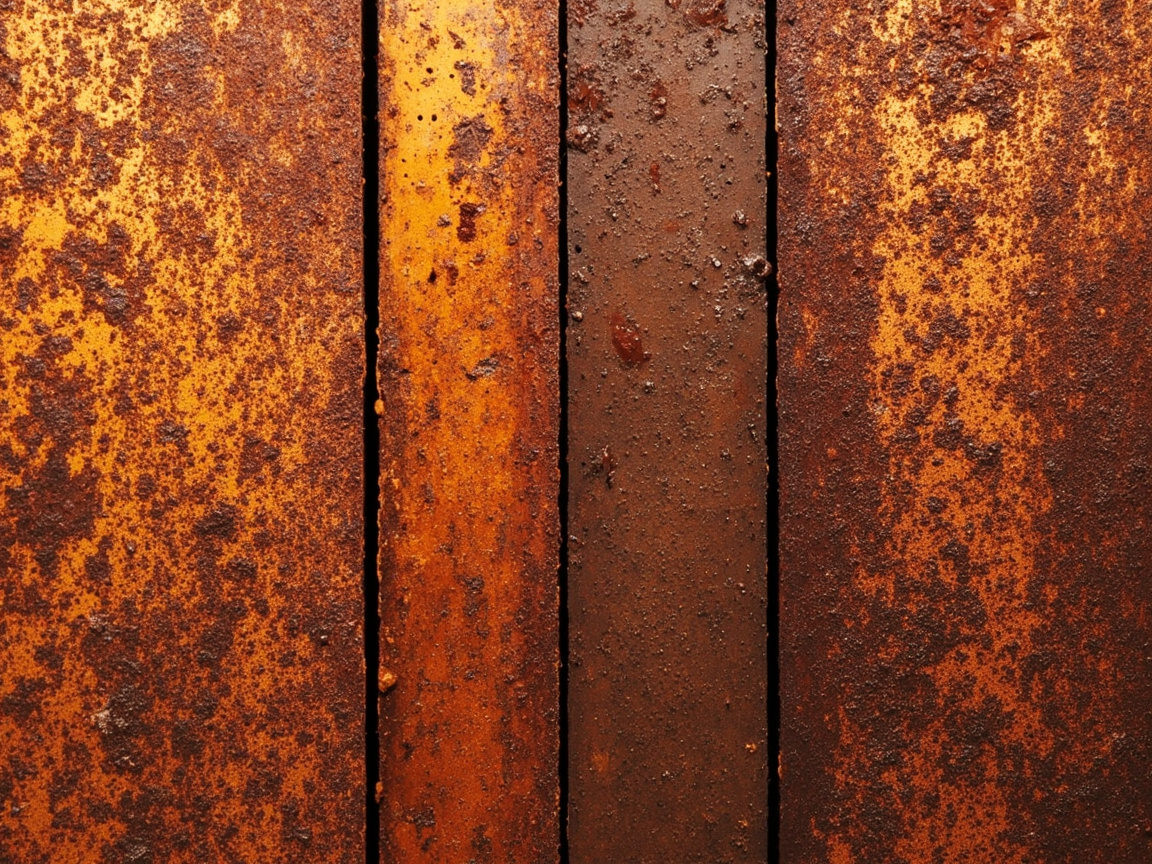
II. Mechanism of Rust Converter Primers: Turning Rust "Into" a Stable Substance
Products for coating over rust are typically divided by action mechanism into two types: converting type and stabilizing type (with subdivisions such as penetrating type). Among them, the converting type is the most representative and is the focus of this article.
2.1 Chemical Reaction of Tannic Acid / Phosphoric Acid
According to the research archive (TDS_MSDS_RESEARCH.md, Section 4, Item 4), the core of converting-type anti-rust paint is the rust converter—represented by components such as tannic acid and phosphoric acid—which can convert rust into stable substances. Its simplified mechanism is as follows:
- The main component of rust on steel is hydrated iron oxide (such as Fe₂O₃·xH₂O, FeOOH, etc.), which is loose and porous, expands in volume, offers no protection itself, and continues to absorb moisture and catalyze corrosion;
- Phosphoric acid reacts with rust to form iron phosphate compounds that are insoluble in water and have good adhesion, while also having a certain phosphating and passivating effect on the steel surface;
- Tannic acid (a plant tannin extract) complexes with iron ions to form a dense, stable bluish-black ferric tannate complex film, "consolidating" the loose rust into a stable coating bonded to the substrate;
- The film formed after conversion then combines with the upper anti-rust paint to form a new protective interface.
In other words, converting-type products do not "remove" the rust, but chemically "transform" the active, harmful rust into an inert, relatively dense stable layer, turning it from a "corrosion source" into "part of the protection." This is exactly the origin of the name "rust conversion."
2.2 Stabilizing Type and Penetrating Type
Alongside the converting type, there are also:
- Stabilizing type: Uses anti-rust pigments (such as zinc phosphate) to passivate and stabilize the residual rust layer, relying on pigment chemical action rather than large-scale chemical reaction conversion;
- Penetrating type: Low-viscosity liquid penetrates into the pores of the rust layer, binds and consolidates the loose rust layer, then cooperates with resin film formation for sealing.
All three types fall under the broad umbrella of "coating over rust," but the converting type receives the most attention in lightly floating rust scenarios due to its most thorough chemical modification of floating rust.
III. Why It Is "Convenient" Yet Must Hold the Boundary
The appeal of coating over rust lies in: eliminating sandblasting equipment, reducing dust, enabling construction without halting production, and lowering costs. But the boundary repeatedly emphasized by the research archive (Section 4, Item 4) must be respected—it is only applicable to lightly floating rust, St2/St3. The reason must be explained from the nature of rust.
Rust is loose and porous; thick rust layers still hide large amounts of active corrosion products and moisture channels inside. Converting-type agents can only penetrate and react within the range they "can reach"; once the rust layer is too thick, has already blistered, or is accompanied by old paint delamination, the agent cannot fully reach the steel surface, conversion is incomplete, residual active rust will continue to develop, and the coating will soon fail from within. More critically: coating over rust provides no cathodic protection and does not form a clean interface equivalent to the sandblasting grade; in heavy corrosion environments such as C4–C5, it cannot replace the system protection of zinc-rich primer + sandblasting.
The research archive (Section 2, Items 1 and 6) provides a comparison: even for conventional epoxy systems, carbon steel is recommended to be sandblasted to Sa 2½ (ISO 8501-1), minimum St 2; alkyd anti-rust paint surface preparation requires sandblasting Sa2.5, roughness 30–75 µm or power tool St3 (Section 4, Item 1). These standards all indicate: the first principle of heavy-duty anti-corrosion is "clean interface + complete system," which is not in the same league as coating over rust.
The following comparison table clearly lays out the differences between "coating over rust" and "traditional thorough derusting system":
| Comparison Dimension | Coating Over Rust (Converting/Stabilizing Type) | Traditional Thorough Derusting System (Sandblasting + Epoxy Zinc-Rich, etc.) |
|---|---|---|
| Surface Preparation Requirement | Lightly floating rust, St2/St3, just remove loose rust and oil stains | Sandblast to Sa 2½ (ISO 8501-1), roughness 30–75 µm |
| Derusting Principle | Chemical conversion/stabilization/penetration, treat residual rust in situ | Physical removal, expose clean active steel surface |
| Provides Cathodic Protection | No | Yes (zinc-rich primer zinc ≥80% dry film) |
| Applicable Corrosion Grade | Light, general maintenance, local C2–C3 | C4–C5 heavy-duty anti-corrosion, even CX |
| Construction Condition | Non-stop production, simple equipment, low cost | Requires sandblasting equipment, dust prevention, long duration and high cost |
| Longevity | Limited, depends on complete conversion of residual rust | Long life, system-matched design |
| Typical Risk | Incomplete thick rust conversion, internal continued corrosion | Improper interface treatment also causes failure |
| Representative Standard Reference | On-site maintenance specification, St2/St3 (ISO 8501-1) | ISO 12944-2018 series |
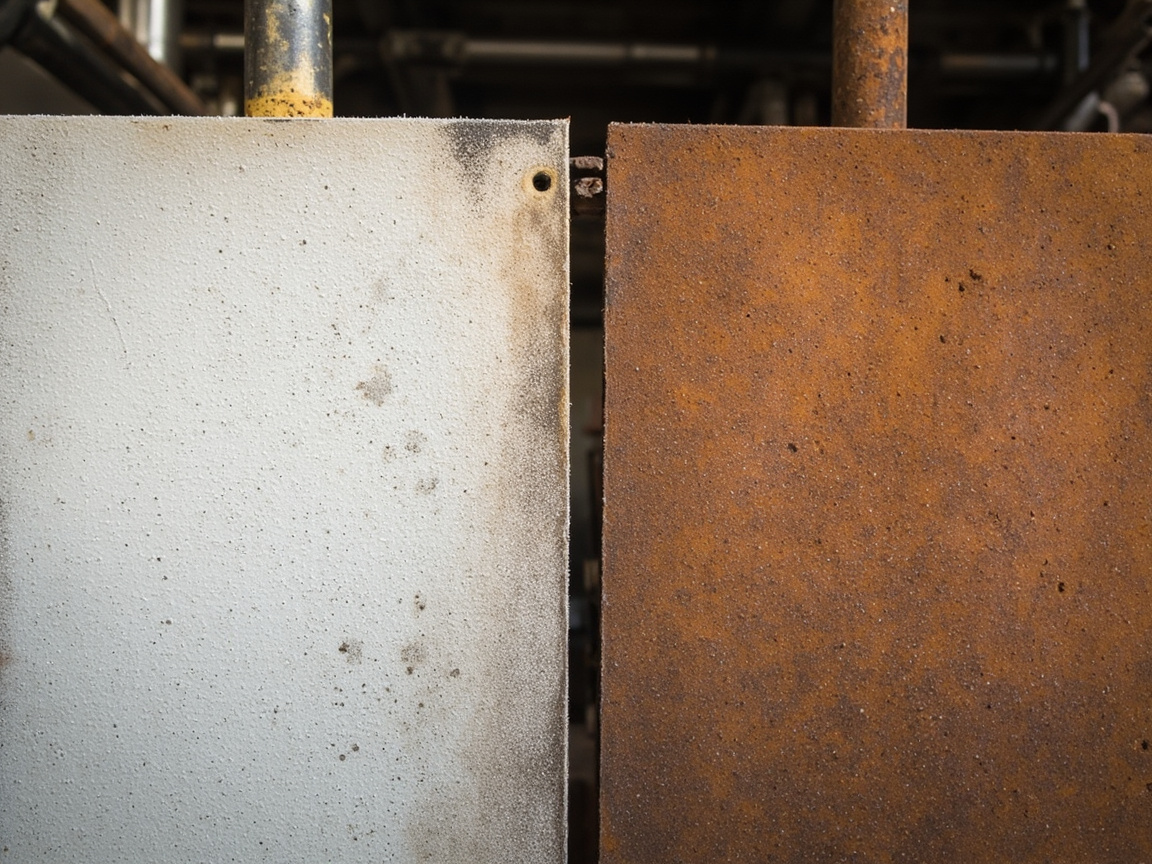
IV. Applicability Matrix: Select Scheme by Rust Degree and Working Condition
To put the boundary into executable "which path to choose," the following applicability matrix is given. The rows of the matrix are rust degrees, the columns are working condition requirements, and the cells give the recommended technical route.
| Rust Degree / Working Condition | Light Maintenance, Non-stop Production | Heavy-duty Anti-corrosion, Long-life Requirement | Thick Rust, Blistering or Old Paint Delamination |
|---|---|---|---|
| Lightly Floating Rust (St2/St3) | Coating over rust (converting/stabilizing type) feasible | Still recommend sandblasting system, coating over rust only temporary | Not applicable to coating over rust, mechanical derusting required |
| Moderate Rust (visible dense rust layer) | Limited coating over rust effect, recommend local grinding then conversion | Must sandblast to Sa 2½ + epoxy zinc-rich system | Not applicable to coating over rust, thorough treatment required |
| Thick Rust Nodules / Blistering | Not applicable to coating over rust, derust first then coat | Sandblasting + complete heavy-duty anti-corrosion system | Must sandblast/grind to clean interface |
| Old Paint Intact with Only Edge Rust | Edge grinding + converting-type edge sealing | After evaluation, local or overall redo of system | Determine scheme based on old paint compatibility |
The core conclusion of this matrix is just one sentence: Coating over rust only holds in the cell of "lightly floating rust + maintenance-level working condition." Any attempt to step out of this cell should return to the traditional route of "derust first, then system."
V. Cannot Replace Sandblasting Heavy-duty Anti-corrosion: Three Hard Reasons
Repeatedly emphasizing the boundary is because most engineering accidents stem from "over-trusting rust-bearing products." The following three points are hard reasons derived from the mechanism of the research archive:
- No cathodic protection: The research archive (Section 2, Item 6) points out that heavy-duty anti-corrosion relies on the sacrificial anode protection of zinc ≥80% dry film in zinc-rich primer. Rust-bearing products contain no zinc or extremely low content; once the steel surface is damaged, the extra protection is lost, and under C4–C5 high-salt and high-humidity environments, corrosion will spread rapidly.
- Insufficient interface cleanliness: Abrasive blasting to Sa 2½ exposes the active steel surface and forms roughness (30–75 µm, according to the surface preparation requirements of alkyd anti-rust paint, Section 4, Item 1), providing a fundamental guarantee for coating adhesion; the rust-bearing interface retains a mixture of conversion film and untransformed rust, so adhesion and long-term stability are naturally weak.
- No system compatibility: ISO 12944-2018 heavy-duty anti-corrosion relies on the multi-layer synergy of "primer + intermediate + topcoat" (research archive Section 1 general standards and Section 2 Item 6). Rust-bearing painting is usually single-layer or simple two-coat, lacking the flake shielding of micaceous iron intermediate coat and weather-resistant topcoat, so the overall lifespan is incomparable.
Therefore, for C4–C5 assets such as bridges, offshore platforms, storage tanks, and port machinery, the correct posture is: rust-bearing painting is used for their "temporary maintenance, loss-control transition," while ultimately a shutdown for abrasive blasting must be arranged to return to the complete heavy-duty anti-corrosion system. Treating rust-bearing as a permanent solution is an overdraft on the asset.
VI. Correct On-site Usage: Apply Rust-bearing Products in the Right Place
Since rust-bearing painting has its use, the key is to "use it correctly." Combining the boundaries of the research archive, the on-site operation essentials are given:
- Grade first: First judge using the St2/St3 concept of ISO 8501-1 — only when the surface is uniform flash rust, without blistering or thick rust nodules, should rust-bearing be considered; otherwise, mechanically remove rust first.
- Clean loose and decontaminate: Regardless of the type of rust-bearing product, loose rust scale must be scraped off, floating dust brushed clean, and oil and soluble salts removed first; otherwise the conversion agent cannot contact the active rust.
- Choose the right type: For light flash rust, priority is given to conversion type (tannic acid/phosphoric acid system); for higher stability requirements and slightly more rust layers, stabilizing or penetrating type can be selected as a supplement.
- Seal with compatible coat: Above the conversion film, a rust-preventive intermediate/topcoat should be applied to seal, avoiding moisture absorption and re-rusting of the conversion film; but this sealing layer does not equal a heavy-duty anti-corrosion system.
- Keep good records: Rust-bearing maintenance is a "temporary/transition" measure and should be marked in the equipment archive, planning the subsequent complete repainting time.
Kexin New Materials (kexinMaterials), when assisting customers with on-site maintenance, consistently advocates that "rust-bearing painting is a loss-control tool, not an ultimate solution" — it can help you drag an emergency corrosion back to planned major overhaul, but should not be used as an excuse to skip abrasive blasting. If your project is facing water-based and low-VOC selection of industrial protective systems, you can also refer to selection ideas for water-based industrial coatings, planning maintenance and new construction as two separate logics.
VII. Decision Tree with "Traditional Thorough Rust Removal"
Condense the above into a decision path for quick on-site judgment:
- Is the corrosion light flash rust (St2/St3), without blistering? — No, go to 4.
- Is it only for maintenance, can operate without shutdown, and accept limited lifespan? — Yes, adopt rust-bearing painting (conversion type) + sealing topcoat.
- Is long lifespan and heavy-duty anti-corrosion required? — Yes, even for light flash rust, abrasive blasting + epoxy zinc-rich system is recommended, with rust-bearing only as temporary.
- Is corrosion moderate and above, with thick rust or old paint peeling? — Must mechanically/blast clean to a clean interface.
- Is the target corrosion grade C4–C5? — Yes, follow ISO 12944 complete system (zinc-rich primer + micaceous iron intermediate + topcoat), do not use rust-bearing solution.
The essence of this path is to match the "tool" to the "problem level," rather than letting convenience override reliability.
VIII. In Conclusion: Boundary Is Professionalism
Rust-bearing painting and conversion-type anti-rust paint are a very practical class of "site-friendly" technologies in coating engineering — they provide a feasible loss-control means for many scenarios where shutdown or blasting is impossible. But their value is precisely built on "knowing where one's boundary lies." Doing well the maintenance of light flash rust is professionalism; entrusting heavy-duty anti-corrosion to blasting and zinc-rich systems is even more professionalism. Confusing the two is the root of most protection failures.
For the overall trade-off between oil-based and water-based systems in more industrial scenarios, you can read further how to choose water-based paint and oil-based paint; if you are considering renovation over existing oil-based old paint, you can also refer to precautions for repainting oil-based paint over water-based paint, avoiding common pitfalls from the perspective of interface compatibility.
VII. Tannic Acid and Phosphoric Acid: Detailed Differences Between Two Conversion Routes
The previous text summarized conversion type as "tannic acid/phosphoric acid converts rust into stable substances." In engineering, the two are often used in combination, but with different focuses, worth elaborating:
- Phosphoric acid route: Phosphoric acid (H₃PO₄) reacts with iron oxide in rust to generate insoluble substances such as iron phosphate (FePO₄), while slightly phosphating the exposed steel surface to form a conversion layer with good adhesion. Its advantage is fast reaction and passivation of the steel surface; the weakness is that used alone it is often acidic, and if excessive residue remains it will reversely erode the newly formed film, so dosage must be controlled and sealed as soon as possible afterwards.
- Tannic acid route: Tannic acid (polyphenols) strongly complexes with Fe³⁺ to generate a dense blue-black ferric tannate film; visually "the rust changes color" is the signal that conversion has occurred. Its advantage is a dense film with good compatibility with the upper paint; the weakness is relatively slow reaction and limited penetration into thick rust.
- Combination trend: Mature products mostly combine the two — phosphoric acid for base conversion + phosphating, tannic acid to reinforce film color and density, then a resin carrier to "lock" the conversion layer. But regardless of the formula, the premise remains unchanged: only treats light flash rust.
Understanding this helps on-site personnel preliminarily judge whether conversion is sufficient by "whether the post-coating color uniformly turns black-blue, and whether loose red rust remains."
VIII. On-site Construction Procedure and Acceptance Essentials
Using rust-bearing products correctly requires an executable procedure, not "brush right after opening the bucket":
- Grading: According to ISO 8501-1, judge as St2/St3 light flash rust, without blistering or thick rust nodules; otherwise transfer to mechanical/blast rust removal process.
- Clean loose: Scrape and brush to remove loose rust scale and floating dust, use solvent or cleaner to remove oil, and if necessary use desalination to reduce soluble salts.
- Apply: Control the application rate per product instructions (conversion type usually requires sufficient penetration; insufficient application leads to incomplete conversion); for tannic acid systems, uniform black-blue transformation of the rust surface indicates reaction has occurred.
- Surface dry and seal: After the conversion film is surface-dry, promptly overcoat with rust-preventive intermediate/topcoat to seal and block moisture absorption re-rusting.
- Acceptance: Pass based on "no visible loose red rust, continuous conversion film, good upper paint adhesion (cross-cut can reach grade 0/1, refer to GB/T 9286-1998)"; any thick rust residue or blistering is judged unqualified.
- Archive: Record as temporary maintenance measure, plan subsequent complete repainting time, not regarded as permanent protection.
It must be emphasized: the acceptance standard for rust-bearing painting is naturally lower than that for blasted systems; it pursues "suppressing risk to acceptable under constrained conditions," not "achieving C5 heavy-duty anti-corrosion grade."
IX. Review of Typical Failure Scenarios
Use three common failure cases to reversely confirm the importance of boundaries:
- Case 1: Thick rust directly brushed with converter. A factory steel beam already had blistering thick rust; the contractor, for convenience, directly applied conversion-type paint, and after three months the film blistered and peeled on a large area. Cause: the agent could not reach the steel surface, internal active rust continued to corrode. Lesson: remove thick rust first, rust-bearing only manages flash rust.
- Case 2: Treating rust-bearing as permanent bridge system. A river-crossing railing used only rust-bearing + single topcoat, and rusted through in two years. Cause: no cathodic protection, no system compatibility, C4 environment far exceeded its capability. Lesson: heavy-duty anti-corrosion must return to blasting + zinc-rich complete system.
- Case 3: Long delay before sealing after conversion. After the conversion film formed, topcoat was delayed for weeks, during which moisture absorption caused re-rusting. Cause: the conversion film itself is not resistant to long-term exposure. Lesson: conversion and sealing should be continuous operations.
These three cases point to one sentence in common — the value of rust-bearing painting is built on "admitting it is only a temporary loss-control tool."
X. Cost Comparison with Alkyd Anti-rust Paint Maintenance Route
Rust-bearing painting is often compared with "direct brushing of alkyd anti-rust paint"; both are site-friendly, but the underlying logic differs and is worth clarifying.
- Alkyd anti-rust paint (single-component, ready to use after opening) is cheap and simple to apply, but according to research archive Section 4 Item 1, its resistance to solvent/acid-alkali is poor, drying is slow, and it is incompatible with two-component strong-solvent paint; its lifespan is limited above C3 environment, salt spray about 500 h still only meets C3 (e.g., Würth rust-stop primer, Section 4 Item 2).
- Rust-bearing conversion type first "chemically treats" residual rust and then seals, being more stable than direct alkyd brushing for light flash rust, because it solves the hidden danger of "rust continuing to rot underneath"; but it also does not enter the heavy-duty anti-corrosion magnitude, with no cathodic protection and no system compatibility.
- Cost dimension: Both have low initial investment; the real difference lies in repair frequency—if either is mistakenly used in C4–C5, the labor, downtime, and secondary material costs from frequent repairs will quickly erode the initial savings. Therefore, "cheap" is only truly cheap when the correct grade is selected.
XI. Current Status of Standards and Specifications: Using Systems to Guard the Boundaries
Rust-inhibitive coating currently has no single global mandatory standard; in engineering practice, existing coating and surface preparation standards are mostly referenced to constrain its use:
- Surface preparation grade cites St2/St3 of ISO 8501-1 as the admission threshold for "rust-tolerant use";
- Heavy-duty anti-corrosion system still falls under ISO 12944-2018 and GB 30981-2020, etc.; rust-inhibitive solutions are not included;
- Product effectiveness should be based on third-party salt spray and adhesion (cross-cut 0/1 grade is excellent, GB/T 9286-1998) reports; select by test data rather than marketing jargon—this is consistent with the warning about the abuse of "9H" and "nano" in the nano coating market (Research Archive Section 6, Item 6);
- Management suggestion: Write rust-inhibitive coating into the enterprise's "Equipment Maintenance Procedure" rather than the "Heavy-duty Anti-corrosion Design Specification", to prevent it from being misused in scenarios that should be blasted, at the institutional level.
In one sentence: Rust-inhibitive coating is a handy tool in the maintenance toolbox, but the most prominent position in the toolbox is always reserved for the complete heavy-duty anti-corrosion system of blasting + zinc-rich.
XII. On-site Decision Checklist for Owners
To avoid misuse of rust-inhibitive coating, it is recommended that owners go through an actionable checklist before placing an order:
- Is the current corrosion grade St2/St3 light floating rust? No → Go directly to blasting system, do not use rust-inhibitive.
- Is the target environment C4–C5 heavy-duty anti-corrosion? Yes → Strictly prohibit using rust-inhibitive as a permanent solution; only as temporary loss control.
- Is it only for non-stop temporary maintenance? Yes → Rust-inhibitive is feasible, but must be documented and a subsequent complete recoating schedule planned.
- Does the conversion-type product come with third-party salt spray and adhesion (cross-cut 0/1 grade) reports? None → Do not select.
- Is a sealing topcoat arranged after conversion? No → Must be added to prevent the conversion film from absorbing moisture and rusting back.
- Is this measure written into the "Equipment Maintenance Procedure" rather than the "Heavy-duty Anti-corrosion Design Specification"? Yes → Boundary secured.
The essence of the checklist is to turn "boundary is professionalism" into actionable steps, rather than relying on the experience of individual workers. Even if a water-based industrial protective system is introduced in the future, its base layer in heavy-duty anti-corrosion scenarios often still relies on the cathodic protection of epoxy zinc-rich and the blasted interface—rust-inhibitive coating and water-based conversion do not conflict, but neither can replace the fundamental principle of "clean interface + complete system".
One more point: Rust-inhibitive coating products themselves vary in quality, and the market is full of exaggerated claims that promote "rust conversion" as "no treatment, permanent anti-corrosion". The responsible approach is to position such products as "maintenance loss-control tools", require suppliers to provide salt spray and adhesion data matching the on-site corrosion grade at procurement, and clearly state in the technical agreement that they are only applicable to St2/St3 light floating rust and do not promise heavy-duty anti-corrosion service life. Managing expectations upfront is far more cost-effective than rework afterwards. In the end, rust-inhibitive coating is a useful "patch" in the industrial protective system, and a patch can never replace the structure itself—recognizing this is the only way to truly understand its value and boundaries.
FAQ
Q: Can conversion-type anti-rust paint really "turn" rust into a protective layer?
A: To be precise, it uses components such as tannic acid and phosphoric acid to chemically react with active loose rust, converting it into a dense and stable complex/phosphate film (TDS_MSDS_RESEARCH.md Section 4, Item 4), turning rust from a "corrosion source" into a relatively stable interface layer, which then combines with the upper coating for protection, rather than generating a metal protective layer out of thin air.
Q: Does rust-inhibitive coating require absolutely no sanding?
A: No. The research archive clearly states its applicable premise is light floating rust, St2/St3, and loose rust scale, dust, oil, and soluble salts must be removed. What it saves is the blast-grade thorough derusting, not "zero treatment".
Q: Why can't rust-inhibitive coating be used for heavy-duty anti-corrosion?
A: Because it provides no cathodic protection (no zinc ≥80% dry film sacrificial anode), its interface cleanliness is far below blasted Sa 2½, and it is not a "primer + intermediate + topcoat" system configuration (TDS_MSDS_RESEARCH.md Section 2, Item 6, Section 4, Item 4); its long-term performance cannot be guaranteed in C4–C5 environments.
Q: What are St2 and St3, and how far are they from blasted Sa 2½?
A: St2/St3 are hand and power tool cleaning grades in ISO 8501-1 (St3 is more thorough, with metallic luster visible); Sa 2½ is the blasted "near-white grade", exposing an almost clean active steel surface with roughness. Rust-inhibitive coating is limited to St2/St3; heavy-duty anti-corrosion requires Sa 2½, and the interface quality gap is significant.
Q: What is the difference between conversion-type and stabilization-type?
A: Conversion-type uses tannic acid/phosphoric acid to chemically react with rust to generate stable substances; stabilization-type uses anti-rust pigments such as zinc phosphate to passivate and stabilize residual rust; there is also penetration-type that relies on low-viscosity liquid to penetrate and consolidate the rust layer. All three belong to rust-inhibitive coating, but with different mechanisms (TDS_MSDS_RESEARCH.md Section 4, Item 4).
Q: What happens if conversion-type paint is applied directly on heavy rust?
A: The chemical solution is difficult to fully penetrate to the steel surface; conversion is incomplete, residual active rust continues to absorb moisture and corrode, and the coating easily blisters and peels from the inside. Scenarios with heavy rust, blistering, or old paint delamination should first use mechanical/blast derusting; rust-inhibitive solutions are not applicable.
Q: Is a topcoat needed after rust-inhibitive coating?
A: It is recommended to add a anti-rust intermediate/topcoat to seal the conversion film and prevent it from absorbing moisture and rusting back. But note that this sealing is not equivalent to a heavy-duty anti-corrosion system, and it cannot be assumed to have reached the C4–C5 protection grade.
Q: Is it suitable for assets like bridges and offshore platforms?
A: It is only suitable as a temporary maintenance and loss-control transitional measure for such assets. Eventually, a shutdown blasting must be arranged and return to the complete heavy-duty anti-corrosion system of blasting + epoxy zinc-rich; rust-inhibitive coating cannot be used as a permanent solution.
Q: Are there environmental or safety issues with conversion-type products?
A: Most contain phosphoric acid, tannic acid, and solvents, with certain corrosiveness/irritation; construction requires ventilation, gloves, and goggles, avoiding skin contact and inhalation. Specific safety parameters should be based on the product MSDS; do not fabricate certification numbers.
Q: When should rust-inhibitive be completely abandoned in favor of blasting?
A: When corrosion reaches moderate or above, with heavy rust nodules or blistering, old paint delamination, or the target environment is C4–C5 heavy corrosion requiring long service life, rust-inhibitive should be abandoned and the complete ISO 12944 system route (primer + intermediate coat + topcoat) should be taken.
Further Reading
- Selection Ideas for Water-based Industrial Coatings —— Same cluster: overall selection of industrial protective systems and low VOC considerations.
- How to Choose Between Water-based and Oil-based Paint —— Same cluster: trade-off logic of different film-forming systems in protection and construction.
- Precautions for Repainting Oil-based Paint with Water-based Coating —— Related: cross-category extended reading on old paint renovation and interface compatibility.