Key Takeaways:
1. PPF nano anti-fouling coatings construct 102-110° hydrophobic/oleophobic nano-layers on TPU film surfaces, maintaining 95°+ contact angle after 5,000 wet scrub cycles.
2. The critical formulation challenge is water-based transition — current commercial products remain >90% solvent-based, with waterborne systems lagging 10-15% in long-term durability.
3. Premium nano anti-fouling coatings must deliver three functions simultaneously: hydrophobicity/oleophobicity + non-interference with PPF self-healing + UV-stable anti-yellowing.
Paint Protection Film (PPF) has become the mainstream solution for premium automotive paint protection, with the global PPF market projected to exceed $1.5 billion by 2025. However, PPF itself only provides physical protection (stone chip resistance, light scratch prevention), leaving a gap in chemical protection and surface anti-fouling — TPU resin films are naturally oleophilic, readily absorbing road tar, bug splatter, and tree sap. PPF-specific nano anti-fouling coatings were developed precisely to address this pain point.
How PPF Nano Anti-Fouling Coating Works — Hydrophobicity Without Blocking Self-Healing
Direct Answer: PPF nano anti-fouling coating is a 0.5-2μm functional nano-layer applied atop the TPU base film, using nano-SiO₂ particles + fluorocarbon/silane modifiers to create a low-surface-energy interface achieving 102-110° water contact angle and 60-80° oil contact angle, while preserving the TPU film’s intrinsic self-healing capability.
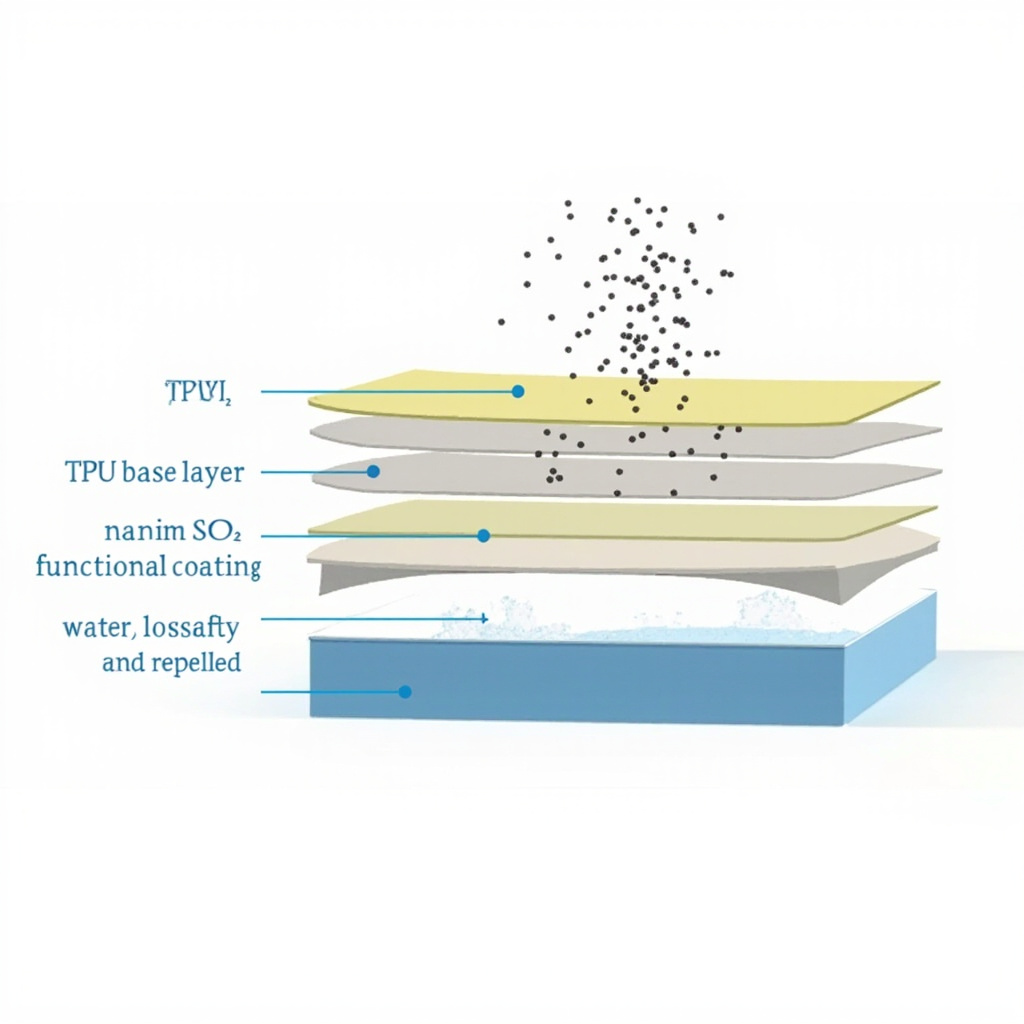
Mechanism: The core technical challenge is “achieving both” — the coating must be sufficiently cross-linked to provide anti-fouling barrier properties, yet cannot completely seal the TPU surface, which would block TPU molecular chain thermal mobility and eliminate PPF’s critical self-healing function (scratches disappearing under heat).
This requires a “semi-interpenetrating polymer network (semi-IPN)” structural design: nano-SiO₂ provides hard segment cross-linking points forming a dense barrier layer (anti-fouling function), while flexible silicone chain segments interpenetrate to maintain molecular mobility channels (preserving self-healing). Korean MTK’s optical coating technology, developed over 11 years of R&D iteration, achieves this balance through precise SiO₂/silicone ratio control (typically 30:70 to 50:50).
Data Support: Nasiol FCC product shows initial water contact angle of 102°, maintained at ~95° after 5,000 wet scrub cycles (>93% anti-fouling retention). Korean MTK PPF coating achieves 108-110° water contact angle with ΔYI <1.5 after 1,000 hours QUV accelerated aging.
Sources: Nasiol FCC Technical Specifications, MTK Korea Product Data, tradekorea.com
Water-Based Transition: Challenges and Progress
Direct Answer: Over 90% of current commercial PPF nano anti-fouling coatings remain solvent-based (alcohol/ketone solvents). Water-based transition faces three technical barriers: water’s surface tension (72 mN/m) far exceeds organic solvents, hindering nanoparticle wetting and spreading; slow water evaporation causes nanoparticle aggregation during film formation; aqueous cured systems typically achieve lower cross-link density than solvent-based, compromising durability.
Breakthrough directions include: reactive emulsifiers replacing traditional small-molecule emulsifiers to reduce hydrophilic residues; self-crosslinking acrylic/polyurethane hybrid emulsions to increase film compactness; core-shell structured nanoparticles (e.g., SiO₂@fluorocarbon polymer) pre-dispersions to solve aggregation issues. A few laboratory-grade waterborne PPF anti-fouling coatings have demonstrated initial performance approaching solvent-based levels, but long-term durability data remains under accumulation.
Data Support: A comparative study shows waterborne PPF nano coatings achieve ~98-105° initial contact angle (vs. 102-110° for solvent-based), but after 1,000 hours QUV aging, waterborne contact angle decay is ~12-15%, while high-performance solvent-based systems decay only 5-8%.
Sources: Nasiol Technical White Papers, MTK PPF Product Specifications, Progress in Organic Coatings (2024)
FAQ
Q: Does the anti-fouling coating affect PPF self-healing?
Premium products using semi-IPN architecture do not block TPU molecular chain thermal mobility. Inferior hard coatings completely seal the TPU surface, causing self-healing function loss.
Q: Does PPF anti-fouling coating need maintenance?
Yes. Apply dedicated maintenance spray every 6-12 months to replenish surface hydrophobicity. Avoid alkaline car wash soaps (pH>10) on PPF surfaces.
Q: How does water-based compare to solvent-based?
Current waterborne systems achieve ~90-95% of solvent-based initial performance and ~75-85% of durability. However, VOC advantage is definitive — waterborne <50g/L vs. solvent-based typically >400g/L.
Q: What’s the difference between PPF coating and ceramic coating?
Ceramic coating bonds directly to paint, 9H hardness, 3-5 year protection. PPF anti-fouling coating bonds to TPU film surface — hardness is unnecessary (the film provides physical protection); core functions are hydrophobicity, anti-contamination, 1-2 year durability.
Q: Will the coating yellow over time?
Yellowing in low-end PPF primarily originates from the TPU base film (aromatic TPU), not the anti-fouling coating. Premium PPF uses aliphatic TPU + nano anti-fouling coating, with ΔYI <2 over 5 years.
References: Nasiol FCC Technical Specifications, MTK Korea Product Data, Progress in Organic Coatings (2024), tradekorea.com
Published: July 5, 2026 | Category: Technical Knowledge