Industrial protective coatings are undergoing a "subtraction revolution" driven by environmental regulations: while meeting the same or even higher anti-corrosion service life, the volatile organic solvents in the formulation are removed as much as possible and replaced with higher solid content. Solvent-free epoxy and ultra-high solids (UHS) epoxy are the core technical routes of this revolution. Their common goal is to increase volume solids, suppress VOC (volatile organic compounds), and leverage the high viscosity and high filler loading brought by high solids to achieve, in a single spray, the dry film thickness (DFT) that traditional solvent-based coatings would need multiple coats to build up. For critical assets such as bridges, storage tanks, offshore structures, and chemical equipment that often require hundreds of microns of protective layer, "less volatilization, thicker film formation" almost simultaneously solves the two challenges of compliance and construction schedule.
As a technical provider of industrial protective and heavy anti-corrosion coatings, Kexin New Materials (kexinMaterials) has accumulated a large amount of practical engineering experience in the formulation and application process of ultra-high solids epoxy zinc-rich primer, solvent-free epoxy intermediate coat, and matching topcoats. The data cited in this article are all from public TDS and national standards, combined with actual working conditions to provide selection and matching recommendations, helping engineers find a balance between compliance and cost reduction.
I. What Are Solvent-Free Epoxy and Ultra-High Solids Epoxy
To clarify emission reduction, we must first distinguish two often-confused concepts: solvent-free (Solvent-Free / 100% Solids) and ultra-high solids (UHS).
- Solvent-free epoxy: Theoretically the solid content is close to 100% (by mass or volume), with almost no or only a very small amount of reactive diluent (reactive diluent) added to the formulation, and no conventional volatile organic solvents are released during construction. Its VOC is usually reflected as an extremely low mass fraction and is often classified as "near-zero VOC".
- Ultra-high solids epoxy (UHS): Volume solids usually reach above 80%, still retaining a small amount of solvent to adjust application viscosity, but VOC is already far lower than traditional solvent-based products. It is not completely solvent-free, yet it has crossed the "high solids" threshold and entered the main force range of emission reduction.
Taking Jotun Barrier 80 UHS (ultra-high solids epoxy zinc-rich primer) from the research archive as an example: according to its TDS, the product's VOC mass fraction < 10%, weight solids 95 ± 2%, volume solids 85 ± 2%, VOC (measured per GB 30981 / GB/T 34682) is 134 g/L, and recommended DFT is 60–150 µm. This set of data is itself direct evidence of "high solids → low VOC" — when volume solids stand above 85%, the space left for solvent volatilization has been compressed to extremely low.
And Epoxy.com Product #406 (low VOC two-component polyurethane topcoat, industrial flooring) provides another perspective: according to its TDS, solids (volume) are 54.26% clear / 66.46% pigmented, VOC is 187 g/L clear, 166 g/L pigmented, mix ratio A : B = 3 : 1 (volume), viscosity (25℃) 125–150 cps. Although it is polyurethane rather than epoxy, as a representative of low VOC two-component topcoats, its "solids–VOC" relationship can also be used for comparative illustration: each step up in volume solids brings a clear step down in VOC.

II. Relationship Between Solids and VOC: Why "High Solids" Equals "Low Emissions"
The essence of VOC limits is to restrict the portion of organic matter in the formulation that "does not participate in film formation and volatilizes into the air after application". At a given density, the higher the volume solids, the smaller the volume space left for solvent, and the lower the VOC naturally is. An approximate engineering relation can be used to understand:
VOC (g/L) ≈ (1 − volume solids) × coating density × 1000 (rough estimate, ignoring differences of reactive diluent and water)
Although this formula is not precise, it reveals three key facts:
- Volume solids is the first lever of VOC. Barrier 80 UHS has volume solids of 85%; even with higher density, VOC is still pressed to 134 g/L; whereas traditional solvent-based epoxy with only 50–60% volume solids often easily exceeds 300–500 g/L VOC.
- Weight solids and volume solids are not the same thing. Weight solids are greatly affected by filler density (e.g., high-density zinc powder in zinc-rich paint raises weight solids), while volume solids is closer to "how much film is left on the workpiece after coating". Barrier 80 UHS has weight solids 95% and volume solids 85%, both high, indicating it is both "heavy material" and "thick film forming".
- VOC regulations are measured in "g/L" rather than "percentage", because actual emissions depend on the absolute mass volatilized into the air. This is also why, with the same nominal "high solids", VOC values of different formulations can differ significantly — one must look at the measured g/L on the TDS, not the verbally promoted "high solids".
Evidence from comparison data in the archive: Jotun Jotacote Universal N10 (universal abrasion-resistant epoxy paint) has volume solids 72 ± 2%, VOC per GB 30981 239 g/L; while Barrier 80 UHS has volume solids 85%, VOC 134 g/L — volume solids increased by about 13 percentage points, VOC dropped by nearly 44%. This is the quantified benefit of the "subtraction revolution". Looking horizontally, automotive refinish 2K clear coats often have higher VOC (e.g., AkzoNobel Lesonal 288 HS mixed material VOC 538 g/L, BASF Glasurit 923-666 about 419 g/L), which further highlights the technological progress of industrial protective systems in pressing VOC down to the 134–239 g/L range through high solids.
III. Regulation Driven: GB 30981 and the Emission Reduction Baseline for Industrial Coatings
The VOC of industrial protective coatings is not voluntarily lowered by enterprises, but "constrained" by mandatory national standards. GB 30981-2020 "Limit of Harmful Substances in Industrial Protective Coatings" sets clear upper limits for VOC and heavy metals (lead ≤ 90 mg/kg, cadmium ≤ 75 mg/kg, etc.) of industrial protective paints. The research archive points out that VOC determination is based on standards such as GB/T 23985-2009, GB/T 23986-2009 (GC-MS method), ISO 11890; industrial protective paints apply to GB 30981-2020 limits, while vehicle paints have separate GB 24409-2020.
The chain reaction brought by regulations is:
- Traditional solvent-based high-VOC products are gradually withdrawn from key projects and government procurement lists;
- Ultra-high solids and solvent-free systems become the first choice for new and maintenance projects;
- Design institutes directly specify "VOC ≤ XXX g/L" in the specification documents, forcing the supply chain to upgrade;
- Export or foreign-involved projects must also stack stricter limits such as EU 2004/42/EC, CARB/SCAQMD Rule 1113.
Barrier 80 UHS's 134 g/L is a compliant value within the GB 30981 framework; while Epoxy.com #406's 166–187 g/L also falls in the low-VOC topcoat range. For owners, "compliance" has changed from a bonus item to a bidding threshold; choosing the wrong system may directly lead to failure of acceptance.

IV. Film Thickness in One Coat: The Application Dividend Brought by High Solids
The most underrated advantage of solvent-free and ultra-high solids epoxy is achieving thick film in a single spray. Traditional solvent-based epoxy is limited by viscosity; although a single wet coat can be sprayed thick, the shrinkage from solvent volatilization limits the dry film, often requiring 2–3 coats to reach heavy anti-corrosion thickness above 200 µm.
High solids / solvent-free systems, due to high solids and little solvent:
- Single coat can achieve DFT of 150–1000 µm or even thicker (depending on product and application equipment);
- Fewer coats → less inter-coat treatment, less schedule, less labor and scaffolding cost;
- Reduce risk of "multi-coat interlayer contamination/pinholes", better overall layer continuity;
- Easier to complete in one pass on vertical surfaces and complex nodes, reducing sag repair.
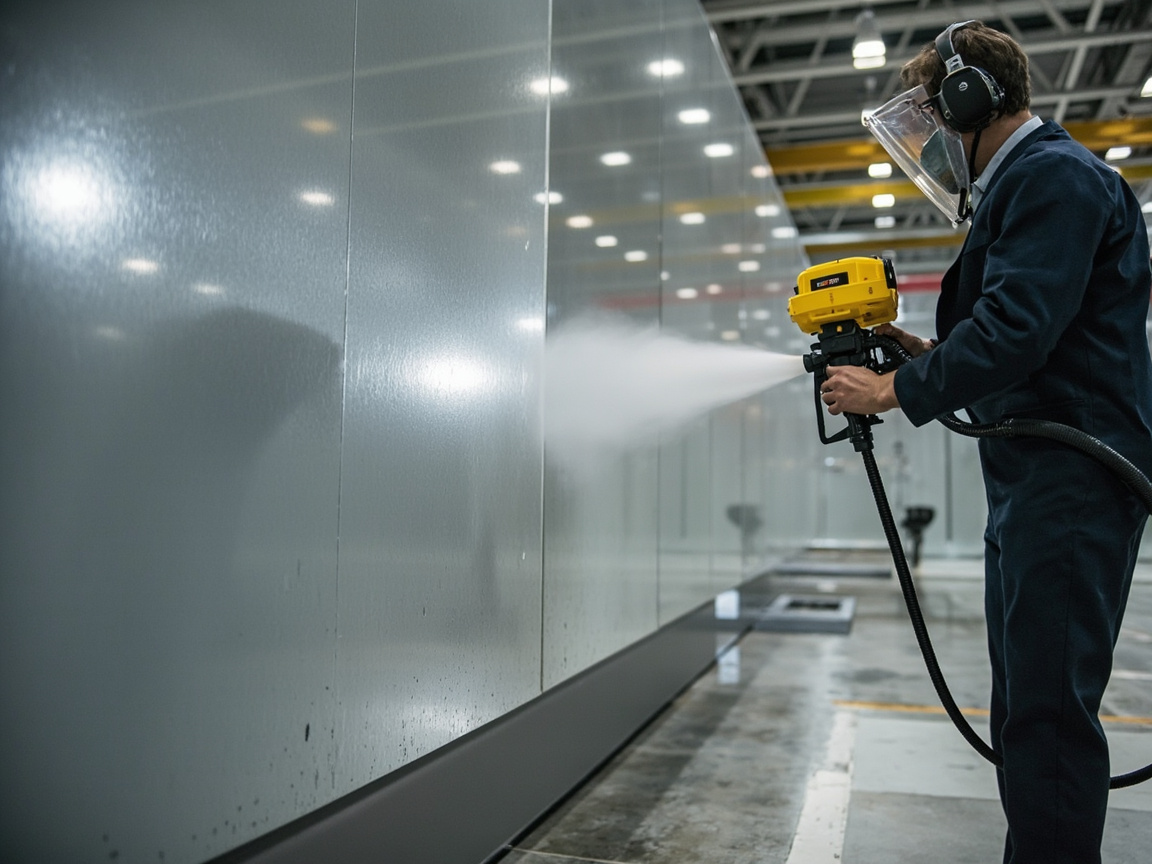
Back to the data: Barrier 80 UHS has a DFT range of 60–150 µm (single-coat recommendation as zinc-rich primer), theoretical coverage 14–5.6 m²/L; while Epoxy.com #406 as a topcoat, although slightly lower solids, is still a low-VOC system, tack-free 10–14h, recoat 12–16h, light traffic 16h, full cure 5–10 days (@25℃). It must be emphasized here: "thick film in one coat" does not mean "spray thick at will"—Airless spraying equipment must be used as a mandatory配套, temperature and humidity must be controlled, and the product's pot life must be observed; otherwise, sagging, pinholes, and incomplete curing will occur. Ultra-high solids systems can usually still be applied with conventional airless spraying; truly solvent-free epoxy often requires heated airless (or two-component heated) equipment to convey high-viscosity materials.
V. Traditional Solvent-based vs Solvent-free/Ultra-high Solids: A Summary Table
| Comparison Dimension | Traditional Solvent-based Epoxy (e.g., Jotacote N10 type) | Ultra-high Solids Epoxy (Barrier 80 UHS) | Solvent-free Epoxy |
|---|---|---|---|
| Volume Solids | Approx. 72% | 85 ± 2 % | Close to 100% |
| Weight Solids | — | 95 ± 2 % | Very high |
| VOC (g/L) | 239 (GB 30981) | 134 (GB 30981) | < 50 typical |
| VOC Mass Fraction | High | < 10% | Extremely low |
| Single-coat Achievable DFT | Medium (multiple coats required) | 60–150 µm (primer) | High (hundreds of µm level) |
| Environmental Compliance | Restricted | Compliant | Optimal |
| Application Equipment | Conventional spraying | Airless/hot airless | Dedicated heated airless/two-component heated |
| Material Cost | Low | Medium | High |
| Application Scenario | General protection, maintenance | Heavy anti-corrosion, compliant projects | Severe heavy anti-corrosion, zero-emission requirements |
Below is a low-VOC system comparison from primer to topcoat:
| Product | Type | Volume Solids | VOC | Mixing Ratio | Remarks |
|---|---|---|---|---|---|
| Jotun Barrier 80 UHS | Ultra-high solids epoxy zinc-rich primer | 85 ± 2 % | 134 g/L | Two-component polyamine cured | VH rating under C5 |
| Epoxy.com #406 | Low VOC two-component polyurethane topcoat | 54.26%–66.46% | 166–187 g/L | A:B = 3:1 | Industrial floor/equipment topcoat |
As can be seen, from primer to topcoat, the entire system can follow the "high solids + low VOC" route, keeping the emissions of the whole system within the regulatory red line without sacrificing the anti-corrosion grade.
VI. Mechanism: How High Solids Balances Anti-corrosion
Emission reduction must not come at the expense of anti-corrosion. The anti-corrosion mechanism of ultra-high solids epoxy zinc-rich primer remains the classic combination:
- Cathodic protection (sacrificial anode): The zinc dust in Barrier 80 UHS complies with ASTM D520 Type II; the zinc content in the dry film is sufficient to form electrochemical protection on the steel substrate, and rust spot expansion is "preempted" by the anodic reaction. This requires the zinc content in the dry film to reach a sufficient proportion, otherwise the cathodic protection efficacy is insufficient.
- Barrier effect: The ultra-high solids epoxy body is dense, and when combined with the flake structure of the subsequent epoxy micaceous iron intermediate coat (micaceous iron oxide), it lengthens the diffusion path of corrosive media (water, oxygen, chloride ions), making it difficult for the media to reach the steel surface directly.
- Passivation and adhesion: Epoxy has strong adhesion to blast-cleaned steel surfaces (cross-cut 0/1 grade is excellent, per GB/T 9286), forming a stable interface.
The配套 principle is always: primer (anti-corrosion/adhesion) + intermediate coat (thickening/barrier) + topcoat (weather resistance/decoration). According to its TDS, Barrier 80 UHS complies with ISO 12944-5 composition requirements and SSPC Paint 20 Level 2, achieving the "Very High (VH)" durability rating in the C5 environment tested by ISO 12944-6, and is suitable for carbon steel, inorganic zinc silicate repair, worn galvanized steel, and corrosion environments below CX. This also explains why it can be used in offshore, bridges, and chemical plants—emission reduction and performance are not in conflict.
VII. Selection and Application Recommendations (including配套)
To implement the technology into projects, it is recommended to make decisions according to the following steps:
- Calculate the VOC red line first: Check the project tender documents or local environmental requirements to determine the maximum allowed VOC (g/L), then back-calculate the minimum usable volume solids. For example, if VOC ≤ 150 g/L is required, then Barrier 80 UHS (134 g/L) is acceptable, while ordinary 72% solids epoxy (239 g/L) is rejected.
- Prioritize ultra-high solids epoxy zinc-rich primer: For heavy anti-corrosion carbon steel, prioritize Barrier 80 UHS type (85% volume solids, 134 g/L), balancing cathodic protection and compliance; also suitable for worn galvanized steel and inorganic zinc silicate repair.
- Topcoat with low VOC two-component polyurethane or epoxy: Epoxy.com #406 type (166–187 g/L) can be used as floor/equipment topcoat; for outdoor weather-resistant topcoat, select aliphatic polyurethane system separately to resist UV yellowing.
- Upgrade application equipment: Solvent-free systems must use heated airless spraying; conventional air spraying cannot convey high-viscosity materials. Ultra-high solids systems can use conventional airless, but heating is recommended to reduce viscosity and improve leveling.
- Environmental control: Substrate temperature at least 3℃ above dew point, relative humidity ≤ 80% (see surface preparation related articles), to avoid slow curing, blushing, and reduced adhesion caused by low temperature and high humidity.
- Film thickness management: Use both wet film gauge and dry film thickness gauge for dual control, to avoid single-coat excessive sagging or insufficient barrier.
In the selection of "oil-to-water/high solids" for industrial protective coatings, if your project is still wavering between solvent-based and water-based, you can refer to Industrial Protective Coatings Oil-to-Water Selection Guide; and for the overall trade-off framework of "water-based vs oil-based", Water-based Paint vs Oil-based Paint Selection Comparison provides more systematic decision dimensions.
Kexin New Materials (kexinMaterials) provides a complete solution from ultra-high solids epoxy zinc-rich primer to low VOC topcoat in the "primer–intermediate–topcoat"配套, and provides配套 film thickness and application process cards according to ISO 12944 corrosion grades (C2–CX), helping engineering parties pass both VOC acceptance and salt spray durability assessments at one time. For retrofit projects of existing solvent-based systems, it can also provide a "low-disturbance, compliant" transition配套.
VIII. Storage, Safety, and Pot Life
High solids/solvent-free epoxy is mostly two-component (resin + polyamine/amide hardener), and must be strictly mixed in proportion before application and used up within the pot life:
- Barrier 80 UHS is a two-component polyamine-cured epoxy; after mixing, it must be applied within the specified pot life, otherwise it gels and is scrapped;
- Epoxy.com #406 mixing ratio A:B = 3:1, applicable temperature 10–38℃, minimum substrate 4℃ requires low-temperature curing type;
- Contains epoxy resin and hardener components; nitrile gloves and goggles are required for skin contact, with good ventilation; hardener is irritating to skin/respiratory tract, avoid direct contact.
- Store in a cool, ventilated place at 5–35℃, hardener sealed against moisture; shelf life is usually 12 months.
Do not arbitrarily increase the hardener or add non-recommended solvents just to "save trouble"—this will destroy the crosslink density, raise VOC, degrade performance, and run counter to the original intention of emission reduction.
IX. Application Process Chain: From Mixing to One-coat Heavy Build
The reason why solvent-free and ultra-high solids epoxy can achieve "one-coat heavy build" lies in the coordination of the entire set of equipment and processes, and it is by no means simply pouring the paint into a ordinary spray gun.
(1) Precise two-component mixing. Ultra-high solids epoxy such as Barrier 80 UHS is two-component polyamine cured, and must be mixed in proportion using mechanical stirring with static mixing tube, or pre-mixed and then inducted; solvent-free systems are often equipped with two-component heated spray machines (plural component), where the base and hardener are heated separately, metered and pumped separately, and mixed before the gun, ensuring uniform crosslinking under high viscosity and avoiding local non-curing.
(2) Heating to reduce viscosity. Solvent-free epoxy has extremely high viscosity at room temperature and needs to be heated to 50–70℃ (depending on product) to reduce viscosity before it can be atomized by airless nozzle; ultra-high solids systems can be applied by airless at room temperature, but heating can improve leveling, reduce orange peel, and lower the burden on the high-pressure pump.
(3) Nozzle and pressure. One-coat heavy build commonly uses large-orifice airless nozzles (e.g., 0.021–0.035 inch class) with higher pump pressure to ensure sufficient single-coat wet film thickness; at the same time, control gun travel speed and overlap rate to avoid sagging and uneven thickness.
(4) Environmental window. 5–35℃, RH ≤ 80%, substrate 3℃ above dew point remain hard constraints; high solids systems are more sensitive to low temperature, curing slows significantly below 10℃, requiring heating or switching to low-temperature curing type, otherwise slow surface dry and poor adhesion will occur.
X. Heavy-build Defect Prevention and Control
| Defect | Cause | Countermeasure |
|---|---|---|
| Sagging | Single coat too thick / low viscosity / low temperature | Control thickness, heat to increase viscosity, use appropriate formulation to thicken |
| Pinholes / bubbles | Air entrapment, substrate porosity, curing off-gassing | Add defoamer, seal substrate pores, apply thin multiple coats |
| Incomplete curing | Incorrect ratio, low temperature, uneven mixing | Strict ratio control, maintain temperature, mechanical mixing |
| Orange peel | Poor atomization, long gun distance, unsuitable viscosity | Adjust nozzle pressure, heat, control distance |
| Intercoat delamination | Recoat beyond window / surface contamination | Control recoat interval, clean and sand |
This table condenses the risk points of "single thick coat" into an actionable checklist, which should be written into the work instruction in engineering practice and linked with wet film/dry film thickness measurement.
XI. Full Life Cycle Account: Benefits Beyond Emission Reduction
High-solid/solvent-free systems have a higher material unit price than traditional solvent-based coatings, but the overall account is often more economical:
- Reduced number of coats → labor, scaffolding, and downtime decrease simultaneously;
- Low VOC → ventilation energy consumption, environmental penalties, and occupational health costs decrease;
- Film thickness achieved in one pass → longer protective life, maintenance cycle delayed.
Taking Barrier 80 UHS as an example, a single coat of 60–150 µm can fulfill the role of a zinc-rich primer. Compared with the traditional two-coat stacking system, the construction period and comprehensive cost advantages are obvious. When selecting, do not only look at the price per liter, but at the two core indicators of "cost per micron of protection + full-cycle maintenance cost".
XII. Common Misconceptions
Misconception 1: High-solid = solvent-free. Wrong. Ultra-high-solid still contains a small amount of solvent, VOC is only lower; only truly solvent-free approaches 100% solids, and their construction thresholds also differ.
Misconception 2: Low VOC = poor performance. Wrong. Barrier 80 UHS achieves VH grade under C5, proving that emission reduction and anti-corrosion can be achieved together; low VOC does not mean low performance.
Misconception 3: Single thick coat saves trouble. Wrong. Thick coating has higher requirements for equipment and environment; blindly increasing thickness will cause sagging, pinholes, and incomplete curing, leading to rework instead.
Misconception 4: Any spray gun can spray it. Wrong. Solvent-free systems require dedicated heated airless equipment, and operators need training; using wrong equipment will cause gun clogging and uneven delivery.
Misconception 5: Nominal "high-solid" means compliant. Wrong. You must look at the TDS measured VOC (g/L) and the executed standard; verbal claims cannot be used as acceptance basis.
XIII. Typical Engineering Scenarios and Process Examples
Implementing the above principles into replicable processes makes it easier to land on the engineering side:
Scenario 1: Interior of chemical storage tank (solvent-free epoxy)
- Blast cleaning Sa2.5, roughness 40–75 µm, and use high-pressure fresh water to remove salt to specified limits;
- Environment confirmation: substrate temperature 3℃ above dew point, relative humidity ≤ 80%;
- Two-component heated airless spray solvent-free epoxy, single coat 300–500 µm;
- Accept after curing and thickness inspection. Throughout the process VOC is extremely low, tank ventilation burden is small, and operation is safer.
Scenario 2: Cross-sea bridge steel box girder (ultra-high-solid epoxy zinc-rich)
- Blast cleaning Sa2.5 and immediately apply shop primer to prevent flash rust;
- Apply Barrier 80 UHS type ultra-high-solid epoxy zinc-rich primer, single coat 60–150 µm, providing cathodic protection;
- Epoxy micaceous iron oxide intermediate coat to increase thickness and shielding, extending medium diffusion path;
- Aliphatic polyurethane topcoat for weather-resistant clear coat. The entire system controls VOC within the GB 30981 framework, and can reach VH grade under C5.
Scenario 3: In-service equipment maintenance (St3 + rust-tolerant epoxy)
When shutdown for blast cleaning is impossible, use power tools to grind to St3, with rust-tolerant epoxy primer, strictly controlling film thickness and environmental window. This is the correct way to use St2/St3 as a "minimum threshold", rather than forcibly applying ordinary thin topcoat.
XIV. Key Inspection and Acceptance Indicators (per national standards)
According to the general standard table in the research archive, the common acceptance items for high-solid/solvent-free systems are as follows, forming a complete compliance evidence chain:
- Neutral salt spray: GB/T 1771-2007, ASTM B117, ISO 9227, usually 500h no blistering / unilateral rust ≤ 1–2mm, heavy anti-corrosion can reach 1000–3000h; Barrier 80 UHS achieves "Very High (VH)" durability grade under C5 environment.
- Adhesion: GB/T 9286 cross-cut 0–5 grade, 0/1 grade is excellent (falloff ≤ 5%).
- Pencil hardness: GB/T 6739, ISO 15184, B–H grade range.
- Abrasion (Taber): GB/T 1768, ASTM D4060, ≤ 10–50 mg/1000 rev (depending on grade).
- Drying time: GB/T 1728, surface dry ≤ 4h, hard dry ≤ 24h (common for industrial paint).
Write these indicators together with the VOC measured report into the acceptance sheet, which proves both "emission reduction compliance" and "no performance drop", avoiding disputes between both parties.
XV. Boundary Between High-Solid/Solvent-Free and Water-Based
Engineering parties often ask: since high-solid can suppress VOC to 134–239 g/L, is it necessary to switch to water-based industrial coating? The answer is scenario-dependent; the two are not mutually exclusive:
- Choose high-solid/solvent-free: When single thick film, heavy anti-corrosion (C4–CX) is needed, and there is heated airless equipment on site, high-solid/solvent-free is the most balanced between performance and emission reduction; cathodic protection of zinc-rich primer also relies on the density of high-solid epoxy body.
- Choose water-based industrial coating: When odor and occupational health are the primary contradiction (such as indoor equipment, food/pharmaceutical workshops), and film thickness requirement is not extreme, water-based system has lower VOC and less odor, but is more sensitive to temperature/humidity and freeze-thaw, with narrower construction window.
- Hybrid route: Bottom layer uses high-solid epoxy zinc-rich to ensure cathodic protection and adhesion, top layer uses water-based polyurethane to reduce odor, which is also a feasible combination, balancing compliance and working environment.
For related trade-offs, refer further to Selection guide for oil-to-water conversion of industrial protective coatings. The key is not "who is more advanced", but "whose constraints better match your working conditions". Regardless of which route is chosen, the three essentials of "qualified substrate treatment + controlled film thickness + VOC measurement" cannot be omitted.
XVI. Terminology Clarification: Triangular Relationship of Solids, VOC, and Density
To avoid misreading, finally clarify three often-confused quantities:
- Volume Solids: Percentage of dry film volume to wet film volume, directly determines "how much film remains from how much wet film sprayed", and is the first lever of VOC. Barrier 80 UHS volume solids 85%, meaning nearly 90% of wet film eventually becomes protective layer.
- Weight Solids: Percentage of dry film mass to wet film mass, greatly affected by filler density; zinc-rich paint is significantly higher due to heavy zinc powder (Barrier 80 UHS weight solids 95%).
- VOC (g/L): Mass of organic matter volatilized into air per liter of coating after application, a regulatory unit. Rough estimate VOC ≈ (1 − volume solids) × density × 1000; for example, an epoxy with density 1.4 kg/L, volume solids 85%, rough value about (1−0.85)×1400 ≈ 210 g/L, but actual measured only 134 g/L due to reactive diluents and formulation optimization — showing measured is often lower than rough estimate, and TDS measured value must prevail.
Remember one sentence: Look at VOC by g/L, look at film formation by volume solids, look at "heavy material" by weight solids. All three high (volume 85%, weight 95%, VOC 134 g/L) is truly high-quality ultra-high-solid epoxy; looking at only one item will mislead.
XVII. Three Questions for Procurement Acceptance
Give owners and supervisors a minimal acceptance checklist: when getting TDS, ask three questions first:
- What is the volume solids? — Determines film thickness and VOC space, the first lever of emission reduction.
- What is the measured VOC g/L, and by which standard? — Determines whether it passes GB 30981, must have measured report rather than promotional language.
- What are pot life, mixing ratio, recommended DFT? — Determines whether it can truly be implemented on site, rather than paper compliance.
If the three questions are answered clearly, the product is reliable; if only "high-solid" three words are reported and g/L and standard are avoided, caution is advised. This is also why Kexin New Materials (kexinMaterials) insists on attaching complete TDS and test basis at delivery — returning the choice to verifiable data.
FAQ
1. What is the difference between solvent-free epoxy and ultra-high-solid epoxy?
Solvent-free epoxy solids content is close to 100%, almost no volatile solvent; ultra-high-solid epoxy volume solids usually above 80%, still contains a small amount of solvent but VOC is greatly reduced. The former has higher equipment requirements (needs heated airless), the latter is the compromise main force balancing emission reduction and process, more commonly used in engineering.
2. Which affects VOC more, volume solids or weight solids?
Volume solids more directly determines the film volume left on the workpiece after application and solvent volatilization space, having the greatest impact on VOC (g/L); weight solids is pulled up by high-density fillers (such as zinc powder), cannot be directly equated with film amount. Both high means "both heavy material and thick film", such as Barrier 80 UHS weight solids 95%, volume solids 85%.
3. Why can Barrier 80 UHS VOC be as low as 134 g/L?
According to its TDS, the product VOC mass fraction< 10%, volume solids 85 ± 2%, weight solids 95 ± 2%. The high solids leave very little room for solvent, so the VOC measured according to GB 30981 / GB/T 34682 is only 134 g/L, which falls within the compliant range, and reaches VH durability grade under C5.
4. What is the appropriate single-coat film thickness for one application?
Taking Barrier 80 UHS as an example, the recommended single-coat DFT is 60–150 µm (as a zinc-rich primer role); solvent-free epoxy topcoat/intermediate coat can be higher. But the specific upper limit depends on the product, equipment, and environment. Always follow the manufacturer's process card, and use both wet film/dry film thickness measurement for dual control to avoid sagging and pinholes.
5. What are the VOC requirements of GB 30981 for industrial paint?
GB 30981-2020 "Limit of Harmful Substances in Industrial Protective Coatings" sets mandatory upper limits for VOC and heavy metals in industrial protective paint. VOC determination is based on GB/T 23985, GB/T 23986, etc. Compliance is the regulatory threshold for new industrial construction and maintenance projects; both bidding and acceptance must provide measured reports.
6. Is the anti-corrosion mechanism of high-solids epoxy the same as traditional epoxy?
Yes. It still centers on cathodic protection (zinc-rich sacrificial anode), barrier (dense epoxy body + micaceous iron oxide lamellae), and system compatibility (primer + intermediate + topcoat). Barrier 80 UHS complies with ISO 12944-5 and SSPC Paint 20 Type II, and can be used as a primer in heavy-duty anti-corrosion systems.
7. What are the solids and VOC of Epoxy.com #406?
According to its TDS, solids (by volume) are 54.26% clear / 66.46% pigmented, VOC is 187 g/L clear and 166 g/L pigmented, mixing ratio A:B = 3:1. It is a low-VOC two-component polyurethane topcoat, suitable for industrial floor coating and equipment topcoat.
8. Must solvent-free epoxy application use heated airless spraying?
Essentially yes. Solvent-free systems have extremely high viscosity and cannot be delivered by conventional air spraying. Dedicated heated airless (or two-component heated) equipment is required, along with trained operators and temperature control measures; otherwise issues such as gun clogging, orange peel, and poor curing are likely.
9. Can high-solids systems completely replace traditional solvent-based coatings?
In most heavy-duty anti-corrosion and industrial protective scenarios, yes, and they are more compliant; but in some maintenance conditions requiring very low-viscosity penetration or with limited on-site equipment, traditional solvent-based coatings still have their place. Selection should be based on the VOC red line and application conditions, rather than a blanket judgment.
10. What can Kexin New Materials provide in solvent-free / ultra-high-solids epoxy?
Kexin New Materials (kexinMaterials) provides a complete system from ultra-high-solids epoxy zinc-rich primer to low-VOC topcoat, gives film thickness and process cards according to ISO 12944 corrosion grades, assists projects in passing VOC acceptance and salt spray durability tests, and offers compliance retrofit solutions for existing solvent-based systems.
Further Reading
- Selection Guide for Water-Based Industrial Coatings Replacement of Oil-Based: From resin systems to applicable conditions, helping you judge the boundary between high-solids/solvent-free and water-based.
- Selection Comparison of Water-Based Paint and Oil-Based Paint: Establishes an overall decision framework of "emission reduction—performance—cost" to supplement the regulatory and selection perspectives of this article.
- Drying and Curing Mechanism of Water-Based Paint: Understand the curing logic of different systems, which is referential for environmental control in high-solids application.