Key Takeaways:
1. Nano hydrophilic anti-fog coatings achieve <5° contact angle superhydrophilicity via TiO2 UV-activated photocatalysis or nanocellulose hydrogel water absorption, spreading moisture into transparent films eliminating Mie scattering from discrete droplets.
2. Global superhydrophilic anti-fog coating market ~$773M (2025), projected $1.13B by 2032. Automotive mirrors and onboard cameras represent the fastest-growing application segments.
3. Durability remains the industrialization bottleneck — latest hyaluronic acid hydrogel coatings achieve 120h water immersion + 300 abrasion cycles + 10-second self-healing; cellulose/ZnO coatings demonstrate 240+ day anti-fog storage stability.
During rainy and foggy weather, microscopic water droplets (<50μm diameter) condensing on rearview mirror surfaces cause severe Mie scattering that compromises driver visibility — a direct contributor to increased wet-weather accident rates. Traditional electric mirror heating (~50-150W per mirror) requires minutes to become effective and continuously consumes power. Anti-fog nano hydrophilic coatings for automotive mirrors offer a passive solution requiring zero external energy — through fundamental materials surface chemistry design, preventing moisture from ever condensing into scattering droplets.
The Physics and Chemistry of Superhydrophilic Anti-Fogging — Why Does Water “Disappear” on Coated Surfaces?
Direct Answer: The fundamental physical principle of anti-fogging is eliminating Mie scattering from discrete water droplets. When surface water contact angle <5° (superhydrophilic state), condensed moisture spreads into a uniform thin film (<1μm thickness) rather than discrete hemispherical droplets — the film thickness is far below visible light wavelengths (380-780nm), light passes through with virtually zero scattering, perceived by human eyes as "completely transparent without fog."
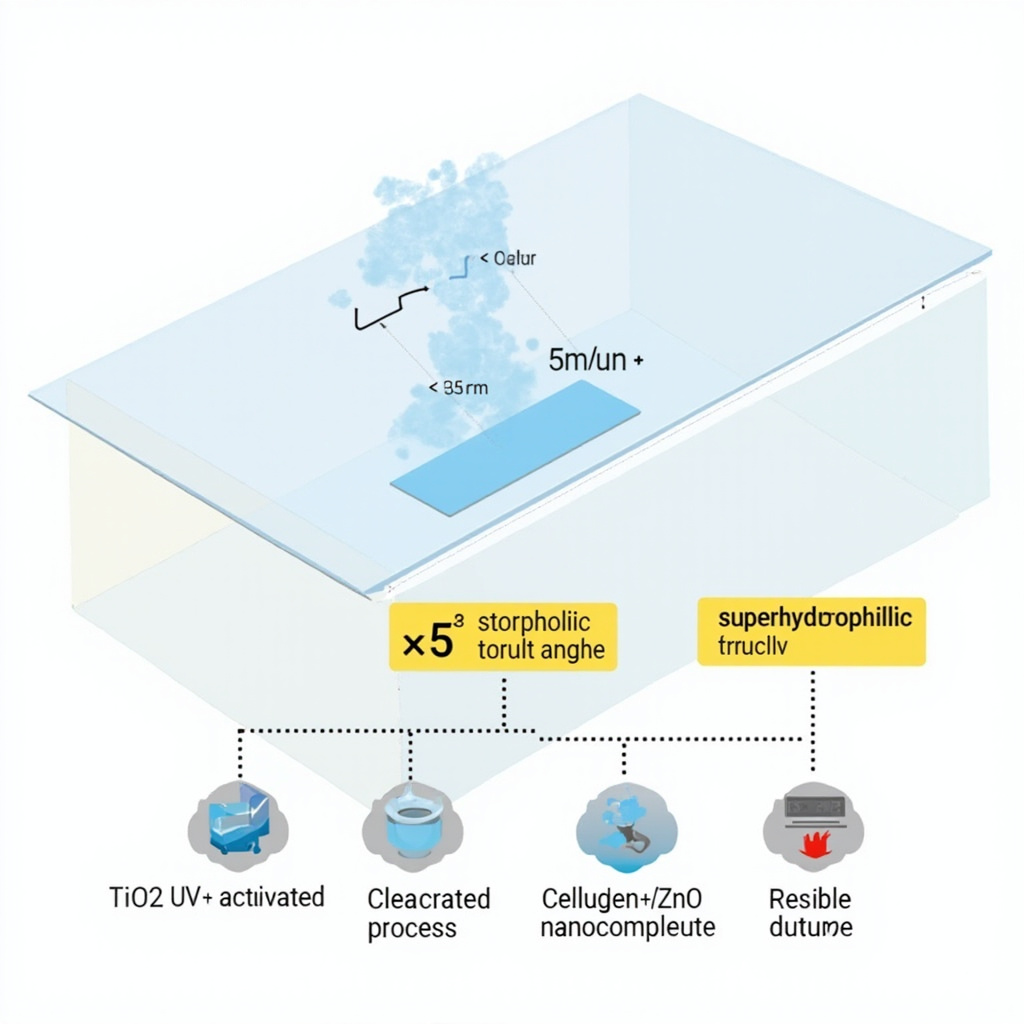
Two Superhydrophilic Technology Pathways: Pathway 1: TiO2 photocatalytic-induced superhydrophilicity. Anatase nano-TiO2 (5-20nm) under UV (<387nm) generates electron-hole pairs. Electrons reduce Ti⁴⁺ to Ti³⁺; holes oxidize bridging O²⁻ releasing O₂, creating oxygen vacancies on TiO2 surfaces. These vacancies rapidly adsorb atmospheric water molecules forming surface hydroxyl groups (-OH), dramatically elevating surface energy above 72 mN/m (water surface tension) → water droplets completely spread (contact angle → 0°). Critical characteristic: superhydrophilic state requires UV "activation"; in darkness, surface -OH groups are gradually covered by contaminants over hours to days, requiring periodic light exposure to maintain function.
Pathway 2: Nanocellulose/Hydrogel Water Absorption. Two 2025 studies in Progress in Organic Coatings represent the latest durability breakthroughs: (1) Hyaluronic acid-glycerol-FeCl₃-ZnO nanoparticle hydrogel coating — biomimetic “tear film” design, 120h water immersion without anti-fog degradation, contact angle maintained <5° after 300 sandpaper abrasion cycles, scratches self-heal within 10 seconds (Fe³⁺-HA dynamic ionic cross-link reorganization). (2) Sodium carboxymethyl cellulose (CMC) + ZnO nanoparticles + FeCl₃ + glycerol system — 240+ day ambient storage without anti-fog decay, maintained functionality after 100h xenon lamp aging + 80h water immersion.
Sources: Progress in Organic Coatings (Vol.198/206, 2025), ScienceDirect (2025), QYResearch 2026
Durability — The Achilles’ Heel of Anti-Fog Coatings
Anti-fog coating failure modes include: water immersion leaching of hydrophilic components (plasticizers/glycerol/surfactant loss), mechanical abrasion (wiping/wiper friction) physically removing coating, UV aging degrading organic components. 2025 breakthroughs focus on chemical cross-linking (covalent anchoring of hydrophilic groups), inorganic-organic hybridization (nanoparticle reinforcement), and self-healing functionality (dynamic bond reorganization). HPMC/HEC (hydroxypropyl methylcellulose/hydroxyethyl cellulose) anti-fog coating: one-step green fabrication (water-only solvent, zero organic solvents or fluorinated compounds), >90% transmittance, withstands 3,000 fabric abrasion cycles, 1-year -20°C storage without anti-fog degradation — among the highest durability data reported for cellulose-based anti-fog coatings.
Sources: Progress in Organic Coatings (2025), Pellucere Technologies (2025)
FAQ
Q: Hydrophilic anti-fog vs. hydrophobic water-repellent — same thing?
Completely opposite. Hydrophilic (CA<10°) spreads water into film — ideal for fog (micro-condensation). Hydrophobic (CA>150°) makes water roll off — ideal for rain (large droplets). Optimal mirror solution: zoned or dual-layer design.
Q: Does TiO2 anti-fog coating fail in tunnels (no UV)?
Yes. TiO2 superhydrophilicity requires UV activation — in darkness, surface -OH becomes contaminated within hours, hydrophilicity decays. Solution: TiO2+SiO2 composite (SiO2 intrinsic hydrophilicity as UV-dark “backup”) or cellulose/hydrogel route (UV-independent).
Q: How long does one application last?
Consumer spray: 3-6 months. Professional coating: 1-2 years. OEM-grade CVD/sputtered TiO2 (some premium vehicles): 5-10 years but cost an order of magnitude higher.
References: Progress in Organic Coatings (2025, Vol.198/206), ScienceDirect (2025), QYResearch 2026
Published: July 6, 2026 | Category: Technical Knowledge