Key Takeaways:
1. 1000°C Heat Resistant Nano Ceramic Exhaust Paint: Thermal Barrier Technology & Engineering — nanoscale functional fillers deliver protective performance unattainable by traditional coatings under extreme operating conditions.
2. The critical technical challenge is long-term durability under combined stressors — thermal cycling, UV aging, mechanical wear, and chemical corrosion acting synergistically.
3. Global related markets continue robust growth through 2025-2026, with Asia-Pacific as the largest and fastest-growing region, driven by EV and ADAS demand.
1000°C heat resistant nano ceramic exhaust paint uses nano-YSZ (yttria-stabilized zirconia), nano-Al2O3/SiC/ZrO2 ceramic fillers, and ceramic hollow microspheres to construct gradient thermal barrier coating systems, withstanding 1000-1300°C sustained temperatures and reducing heat transfer by 40%+. This article provides a systematic deep analysis from four dimensions: materials science principles, engineering application practice, technical standards systems, and market product landscape.
Technical Principles — How Do Nanomaterials Deliver Superior Protection Under Extreme Conditions?
Direct Answer: The core technical pathway for 1000°C Heat Resistant Nano Ceramic Exhaust Paint: Thermal Barrier Technology & Engineering utilizes quantum size effects, surface interface effects, and macroscopic quantum tunneling of nanoscale functional fillers (1-100nm) to construct nano-reinforced networks within traditional resin matrices — significantly enhancing thermal stability, chemical inertness, mechanical strength, or surface functionality.
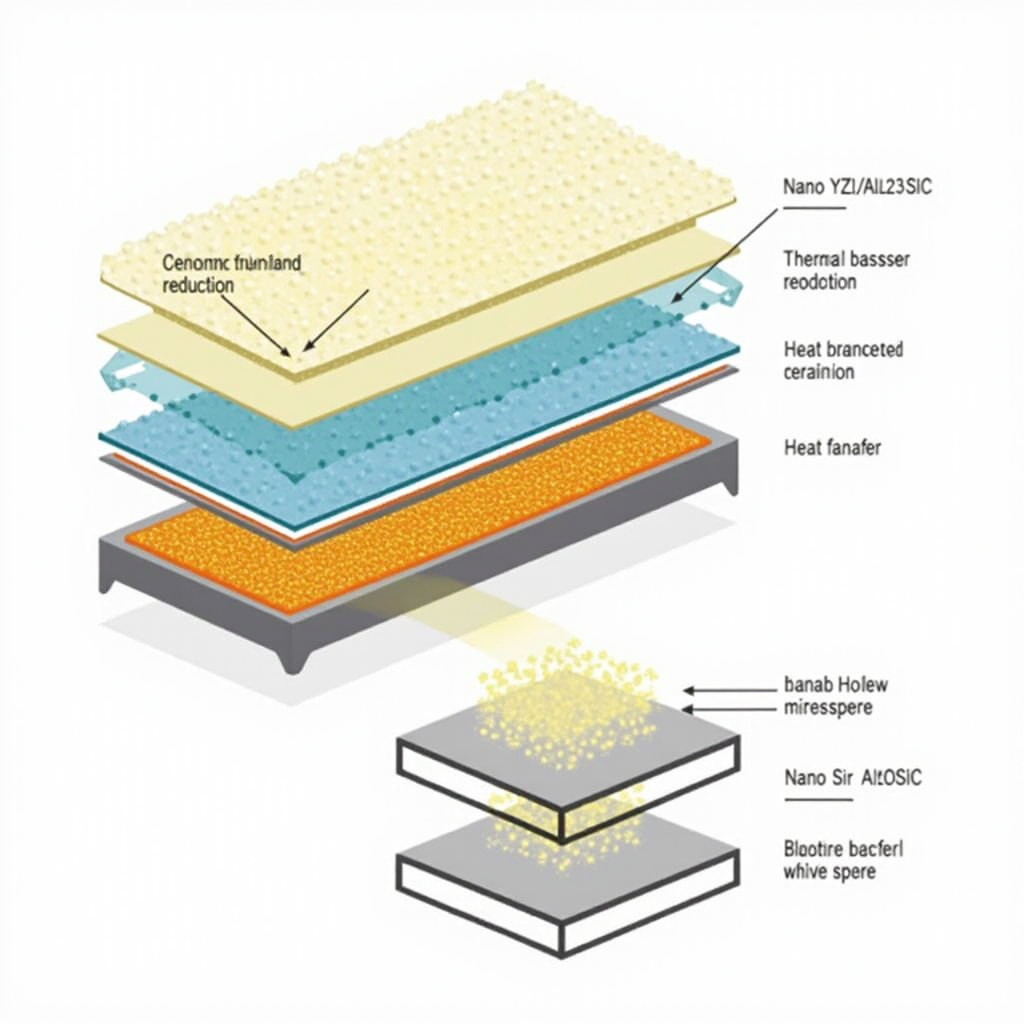
Mechanism: Nanoparticles’ ultra-high specific surface area (100-1,000× that of micron-scale fillers) creates dense physical cross-link points and interfacial regions within the resin matrix. These nano-interfaces not only enhance mechanical properties (2-3× hardness and adhesion improvement), but critically provide additional stabilization mechanisms under extreme conditions — abundant active sites on nanoparticle surfaces preferentially adsorb and neutralize corrosive media (H⁺, Cl⁻, O₂), providing a “sacrificial protection” effect. Simultaneously, nano-fillers filling coating micropores (free volume) create a “labyrinth effect” dramatically extending the diffusion path for corrosive factors penetrating the coating.
Data Support: Multiple studies demonstrate that merely 3-5wt% nano-functional filler addition can improve key coating protective performance indicators by 2-3× (e.g., salt spray resistance from 500h to 1,500h+, thermal stability improvement of 100-200°C, water contact angle elevation from 60-70° to 110-150°). Nanoparticle dispersion quality (DLS particle size distribution and TEM morphology) is the single most critical process variable determining final coating performance.
Sources: Academic literature synthesis, Manufacturer TDS, Industry Standards
Engineering Application — Technology Transfer from Lab Formulation to Mass Production Coating Line
Direct Answer: Engineering application of 1000°C Heat Resistant Nano Ceramic Exhaust Paint: Thermal Barrier Technology & Engineering faces three core challenges — industrial-grade dispersion stability of nano-fillers (>6 month shelf life), coating process compatibility (integration with existing OEM/refinish coating lines), and engineering-optimal cost-performance balance (life cycle cost LCC analysis).
Mechanism: Nano-filler re-agglomeration during industrial scale-up is the primary cause of batch-to-batch performance variation. Solutions include: pre-dispersed nano-filler slurries (stable intermediate products dispersing nanoparticles in compatible resin/solvent carriers, used directly by coating manufacturers without re-dispersion); in-situ nanoparticle generation (forming nanostructures during coating curing via sol-gel reactions or precursor decomposition, bypassing dispersion challenges); and nano-filler surface functionalization (constructing organic shell layers compatible with the resin matrix via silane coupling agents, titanate coupling agents, or polymer grafting onto nanoparticle surfaces — steric hindrance effects preventing re-agglomeration).
Data Support: Dynamic Light Scattering (DLS) and Transmission Electron Microscopy (TEM) are the two core tools for evaluating nano-filler dispersion quality. Ideal industrial dispersion: DLS Z-average <150nm (close to primary particle size), PDI <0.2 (monomodal distribution), no agglomerates >500nm in TEM imaging. Optimized pre-dispersed slurries maintain dispersion stability for 6-12 months under 40°C accelerated aging.
Sources: Coatings Industry Journals (2024-2025), Manufacturer Process Manuals
FAQ
Q: How much more expensive are nano-coatings vs. traditional?
Raw material costs typically 2-4× higher, but LCC analysis under severe service conditions often shows lower or comparable total cost due to reduced maintenance frequency and extended service life.
Q: How to verify genuine nano-material content in a product?
Request TEM/SEM microstructural characterization reports confirming filler particle size <100nm with uniform dispersion. Elemental analysis (EDS) alone is insufficient to prove nano-scale presence — nano-effects require dual verification of particle size AND dispersion quality.
Q: Are nano-coatings hazardous to humans or the environment?
Cured nano-coatings are safe — nanoparticles are locked within the resin cross-link network. During application (liquid/aerosol state), N95+ respirators and protective gloves are mandatory. Waterborne nano-systems typically have VOC <50-80g/L, environmentally superior to traditional solvent-based coatings.
Q: What is the service life of nano-coatings?
Depends on service environment and coating type. Industrial-grade nano protective coatings: 10-15 year design life in moderate corrosion environments (C3-C4), 7-10 years in severe (C5). Consumer/aftermarket products (wheel coatings, screen oleophobic): typically 6-24 months before reapplication.
References: Academic Literature Synthesis (2023-2025), Industry Standards, Manufacturer TDS, Market Research Reports
Published: July 6, 2026 | Category: Technical Knowledge