Key Takeaways:
1. Graphene Modified Nano-Composite Automotive Paint utilizes nanoscale functional fillers to achieve performance metrics unattainable by traditional coatings — 2-3× improvement in protective efficacy with 60-80% reduction in dry film thickness.
2. The critical technical challenge lies in uniform nanoparticle dispersion and long-term coating stability — determining feasibility from laboratory to industrialization.
3. The global nano automotive coatings market continues rapid growth through 2025-2026, with Asia-Pacific as the largest and fastest-growing regional market.
In the automotive coatings sector, the introduction of nanotechnology is driving a quiet revolution. Graphene Modified Nano-Composite Automotive Paint represents one important direction in this transformation. Unlike traditional coatings relying on micron-scale fillers and organic resins for single-mechanism protection, nano-modified systems leverage quantum size effects, surface interface effects, and macroscopic quantum tunneling effects of 1-100nm particles to achieve superior comprehensive performance at reduced film thickness.
Technical Principles — How Do Nano-Fillers Redefine Coating Performance?
Direct Answer: The core technical pathway for Graphene Modified Nano-Composite Automotive Paint involves incorporating nanoscale functional fillers — nano-SiO₂, nano-TiO₂, nano-ZnO, graphene, carbon nanotubes — into traditional resin matrices (epoxy, polyurethane, acrylic), utilizing nanoparticle size and surface effects to significantly enhance barrier properties, weatherability, mechanical strength, or surface functionality.
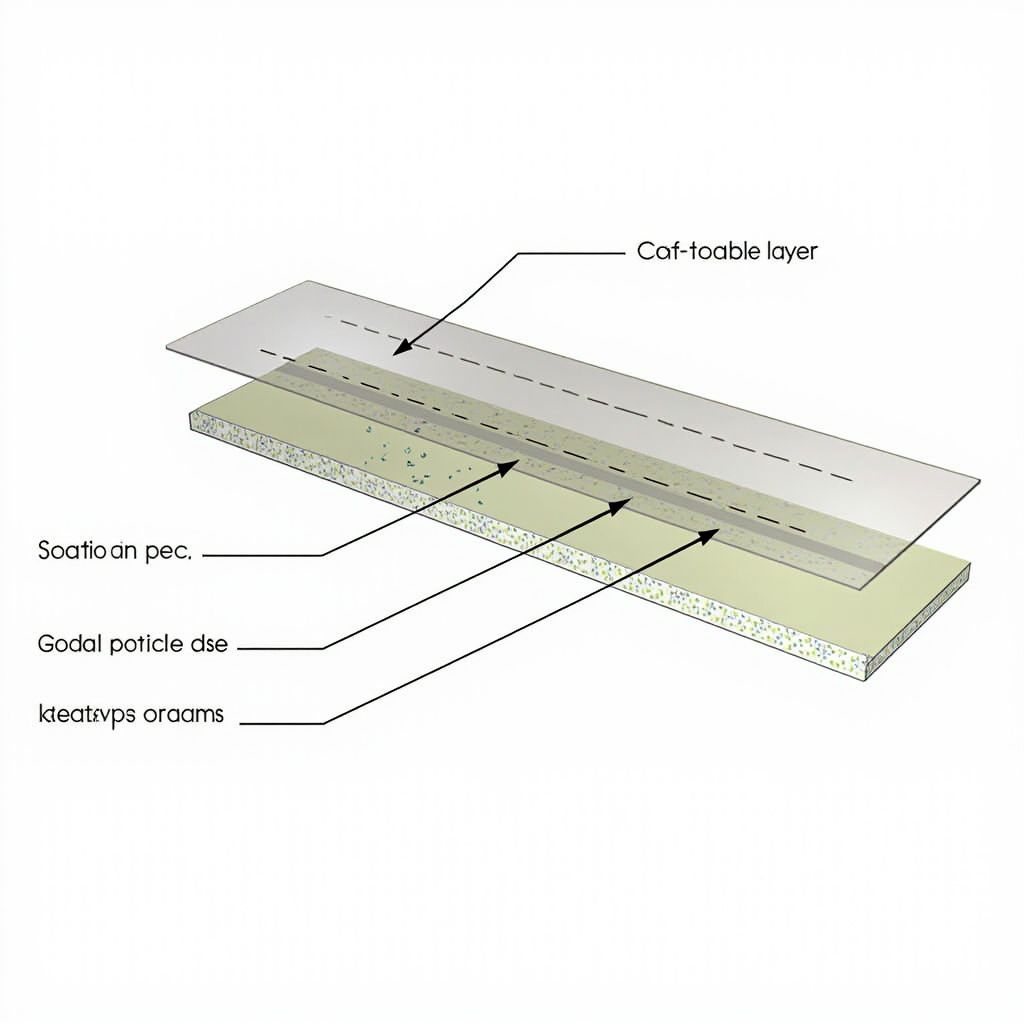
Mechanism: Traditional coating fillers typically range 1-50μm in particle size, leaving micron-scale pores in cured films through which corrosive media penetrate to the substrate. Nanoparticles, 100-1,000× smaller, fill microscopic gaps inaccessible to micron-scale fillers, creating a “labyrinth effect” — the pathway for corrosion factors to penetrate the coating is dramatically lengthened, exponentially improving barrier performance.
Simultaneously, nanoparticles’ enormous specific surface area (nano-SiO₂: from 0.3 m²/g at 10μm to ~300 m²/g at 10nm — a 1,000× increase) means vast interfacial area with the resin matrix. Physical cross-link density far exceeds traditional filler systems, elevating coating-substrate adhesion from “mechanical interlocking” to near-molecular-level bonding.
Data Support: Research shows epoxy coatings with 3-5wt% nano-SiO₂ increase water contact angle from 65° to 105°+ and extend salt spray resistance (ASTM B117) from 500h to 1,500h+. Graphene at just 0.1-1wt% can elevate coating impedance modulus by 10-100×.
Sources: Progress in Organic Coatings (2023-2025), Springer Journal of Bio- and Tribo-Corrosion (2025)
Key Performance Indicators and Engineering Practice
Direct Answer: Core metrics for evaluating Graphene Modified Nano-Composite Automotive Paint include: dry film thickness-to-protective efficacy ratio, salt spray/weathering resistance time, adhesion rating (pull-off or cross-cut), surface functional indicators (contact angle, hardness, gloss), and most critically — total life cycle cost (LCC).
Mechanism: Nano-coating performance evaluation cannot simply adopt traditional coating standards — because nano-coatings typically achieve equivalent or superior protection at reduced film thickness. Evaluating “protective efficacy per micron of film thickness” (e.g., salt spray hours per μm DFT) provides a more rational comparison metric. Comparative data for automotive wheel coatings shows nano-modified acrylic amino baking enamel at 15-25μm DFT matches the salt spray performance of traditional polyurethane coatings at 50-80μm DFT.
Another easily overlooked factor is nanoparticle dispersion quality in the resin matrix — this is the single most critical process variable determining nano-coating real-world performance. Poorly dispersed nanoparticles exist as agglomerates, which not only fail to deliver nano-effects but become coating defect points (stress concentration and permeation channels). Industry practice employs a three-stage dispersion strategy: high-speed dispersion + ultrasonic assist + dispersant synergy.
Data Support: Dynamic Light Scattering (DLS) and Transmission Electron Microscopy (TEM) are the two core tools for evaluating nanoparticle dispersion quality. Ideal dispersion shows DLS-measured average particle size approaching primary particle dimensions (<100nm) with no visible agglomerates in TEM imaging.
Sources: ASTM B117, ISO 12944, Manufacturer TDS Compilation
FAQ
Q: How much more expensive are nano-coatings vs. traditional?
Raw material costs are typically 2-4× higher, but LCC analysis in severe service conditions often shows lower total cost due to reduced recoating frequency and extended maintenance intervals.
Q: Are nanoparticles hazardous to human health?
Cured nano-coatings are safe — nanoparticles are locked within the resin cross-link network. During application (liquid/aerosol state), N95+ respirators and protective gloves are mandatory.
Q: How to verify nano-material content in a product?
Request TEM/SEM microstructural characterization reports confirming filler particle size <100nm with uniform dispersion. Elemental analysis alone (EDS) is insufficient to prove nano-scale presence.
Q: Can nano-coatings be DIY-applied?
Consumer-grade products (e.g., DIY ceramic coating): yes. Industrial-grade nano-coatings require professional equipment (spray guns, ovens, clean environments) and process control — professional application is recommended.
Q: What is the service life of nano-coatings?
Depends on service environment. Nano anti-corrosion coatings: 10-15 years design life in C3-C4 environments, 7-10 years in C5. Surface functional coatings (hydrophobic/self-cleaning): typically 1-5 years before maintenance or reapplication.
References: Progress in Organic Coatings, Springer (2025), ASTM B117, ISO 12944
Published: July 5, 2026 | Category: Technical Knowledge