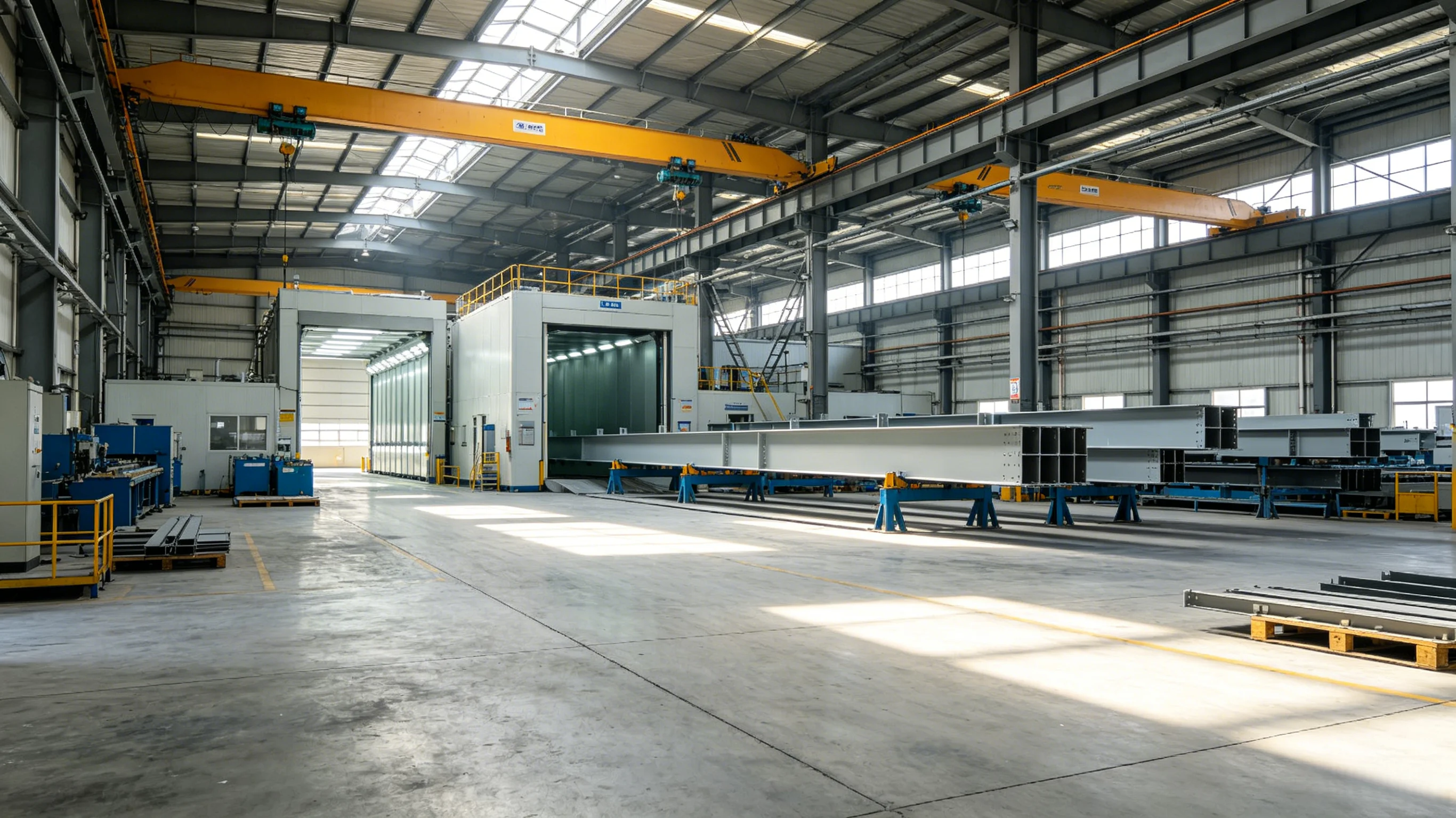
Corrosion protection of steel structures in livestock buildings means coating design for beams, trusses, purlins, frames and supports exposed to a combination of ammonia, hydrogen sulphide, daily condensation and repeated disinfection. The difference from a normal factory hall is not simply "more humidity": the aggressive medium is an alkaline gas combined with periodic oxidising disinfectants. Urea in urine is hydrolysed by urease and releases ammonia, which dissolves in the water film on the steel and raises its pH. Zinc and aluminium are amphoteric, so their protective layers dissolve in alkali and the corrosion products are kept in solution by ammonia complexing.
TL;DR — key numbers
- GB/T 17824.3-2026 replaced the 2008 edition on 2026-09-01 and tightened the ammonia ceiling for growing and finishing houses from 25 mg/m3 to 15 mg/m3, and for farrowing and nursery houses from 20 mg/m3 to 12 mg/m3; hydrogen sulphide in boar houses dropped from 10 mg/m3 to 3 mg/m3. Tighter air-quality control means more ventilation, more condensation cycles and more washing, so coatings face higher alkaline and wet-abrasion loads.
- First-year reference corrosion of carbon steel, ISO 9223 / ISO 12944-2: C3 200–400 g/(m2·a) (about 25–50 µm/a), C4 400–650 g/(m2·a) (about 50–80 µm/a), C5 650–1500 g/(m2·a) (about 80–200 µm/a). Corresponding zinc rates: C3 0.7–2.1 µm/a, C4 2.1–4.2 µm/a, C5 4.2–8.4 µm/a.
- The accelerating reaction is complexing: Zn2+ + 4NH3 → [Zn(NH3)4]2+. The protective basic zinc carbonate film is converted into a soluble species, so the coating metal moves from self-passivation to continuous dissolution.
- ISO 12944-2 warns that local micro-climates can corrode two to three classes faster than the structure around them. Slurry-channel ends, evaporative cooling-pad zones, the air above scraping routes and the eaves condensation band must be classified separately.
- For indoor members targeted at C3/C4 with high durability (H, 15–25 years to first maintenance), the nominal dry film thickness of the system usually lands at 200–280 µm. Where the classification is uncertain, take the next higher class.
- Site limits per ISO 12944-7 / GB/T 30790.7: relative humidity no higher than 85 %, steel temperature at least 3 °C above dew point, primer within 4 h after blast cleaning.
- Zinc-rich primer must not be applied onto intact hot-dip galvanising. It assumes Sa 2 1/2 bare steel. Over galvanising, use an epoxy mica-oxide sealing primer compatible with zinc — this is the core of a duplex system.
1. What actually attacks the steel
1.1 Ammonia: alkaline film plus zinc complexing
Ammonia is released continuously from urine and undigested protein. Carbon steel in an alkaline film does not corrode as violently as in acid, but zinc and aluminium coatings behave differently: both are amphoteric, their solubility rises with pH, and ammonia holds the dissolved ions in solution. The practical consequence is that galvanised members inside a house reach white rust far earlier than an outdoor corrosivity class would suggest, and copper alloys suffer a different fate — ammonia is a classic cause of stress corrosion cracking in brass fan bushes and valve parts.
1.2 Hydrogen sulphide and organic acids
Above slurry tanks, collection pits and compost pads the atmosphere is reducing. Hydrogen sulphide forms loose sulphide films, drives pitting and can perforate thin sections; volatile fatty and lactic acids make the condensate mildly acidic and consume zinc dust in silicate and epoxy zinc-rich primers. Design for chemical attack and wet-dry cycling at the same time.
1.3 Disinfectants and washing
Biosecurity dictates at least one disinfectant wash per week. Sodium hypochlorite and peracetic acid attack the resin network by oxidation; sodium hydroxide and lime wash saponify ester-bearing resins; high-pressure hot water adds wet abrasion. A coating selected only on a salt-spray hour count typically loses gloss and starts chalking within six months.
1.4 Condensation: the factor that stretches every other one
In the deductive classification of ISO 9223, corrosion rate is driven by time of wetness, sulphur dioxide deposition and chloride deposition. Night-to-day temperature swings, winter insulation and summer negative-pressure ventilation keep the top surfaces of beams and purlins, and the zone around fasteners, above the critical humidity for most of the year — a longer time of wetness than the same steel outdoors.
2. Classifying the building zone by zone
ISO 12944-2 classifies environments from the first-year weight loss of standard specimens, not from how strong the smell is. The average indoor environment of a house usually sits in C3, while the slurry end or the cooling-pad wall behaves like C4 or worse. Split the building into micro-environments before choosing a system.
| Zone | Dominant aggressors | Class | Durability target | Design note |
|---|---|---|---|---|
| Main beams, trusses, purlins (dry part) | ammonia + condensation | C3 | High (H, 15–25 y) | about 200 µm NDFT; edges and welds decide the life |
| First 3–5 m of slurry channels, above scraping routes | ammonia + H2S + organic acids | C4 (C5 if conservative) | High (H) | one extra barrier coat, shield-type system |
| Cooling pads and extract-fan band | long time of wetness + water wash | C4 | Medium–high | wet abrasion resistance; avoid high-gloss topcoats |
| Underside of roof sheets, eaves condensation band | sustained condensation + thermal cycling | C3–C4 | High (H) | detail design and ventilation outrank extra film build |
| Slurry store, lagoon, manure shed | mainly H2S + acidic condensate | C4–C5 | High (H) | on concrete, a separate acid-resistant lining applies |
| Outdoor frames, fencing, canopies | deposited salts + UV | C3–C5 depending on coast | Medium–high | weatherable aliphatic polyurethane or fluoro topcoat |
| Disinfection corridor and change-room steelwork | short, concentrated chemical shocks | C4 | High (H) | qualify the system against the actual disinfectant list |
Three rules summarise the process: look at time of wetness first, then at which gases are present, then classify each zone separately. When only sensory information is available, take the higher class — the extra film thickness is cheap compared with a re-spray inside a producing building. If the owner wants a life estimate, ISO 9224 gives indicative service times: at the C4 mid-range of roughly 65 µm/a, bare steel loses about 455 µm of section in ten years, while a 240 µm system with a zinc-rich primer fails not when the average thickness is consumed but at its pinholes, edges and weld damage.
3. Six failure patterns to look for
- Cut edges and punched holes. Cold-formed sections lose their coating at sheared edges; the exposed steel becomes a small anode on a large cathode and red rust runs within months. ISO 12944-3 asks for arrises broken to R ≥ 2 mm plus a stripe coat.
- Welds and heat-affected zones. Welding burns back the zinc and the primer, and spatter creates protruding anodes. Grind, measure the film thickness and touch up where the local value falls more than 30 % below the parent coat.
- Bolted laps and crevices. Oxygen depletion inside the gap makes it anodic. Continuous welding or seam sealant beats extra paint.
- White-rust band with scattered red rust. The sign that zinc is in rapid consumption; sealing it under a fresh topcoat traps an active interface.
- Chalking and gloss loss. Wipe with a wet cloth: visible colour difference or powder on the finger means the barrier has gone.
- Blistering with rust spots. Puncture a blister and test for soluble salts; contamination is the usual cause and must be fixed at the pretreatment stage, not painted over.
4. Three protection routes
Route 1 — bare metallic coating (hot-dip galvanising, Zn-Al-Mg)
Lowest first cost and no site painting, suitable for dry, low-wetness members. The limitation is repairability: once the zinc enters the complexing-dissolution stage, the member is replaced, not restored.
Route 2 — duplex system (galvanising + sealing primer + topcoat)
The recommended option for primary indoor steelwork. Its value is not "two extra coats" but interrupting the complexing reaction: an epoxy mica-oxide primer that adheres to zinc isolates the ammonia, and a polyurethane topcoat carries the disinfectant and gloss-retention duty. Degrease, remove white rust and rinse chlorides first — zinc soap left on the surface is the leading cause of intercoat peeling.
Route 3 — Sa 2 1/2 blasting with zinc-rich primer, barrier coat and polyurethane topcoat
For new slurry-zone structures and for heavily corroded stock being brought back. Design at 240–280 µm NDFT. Apply only to bare or blasted steel, never over intact galvanising.
| Criterion | Bare hot-dip galvanising | Duplex system | Sa 2 1/2 heavy system |
|---|---|---|---|
| First cost and programme | lowest | medium | highest |
| Film control | coating mass set by the mill | ≥160 µm NDFT recommended | 240–280 µm NDFT |
| Behaviour in ammonia | relies on zinc passivation, weakened by complexing | barrier action slows zinc consumption | cathodic plus barrier mechanisms |
| Disinfectant resistance | poor | good (topcoat dependent) | good |
| Maintainability | member replacement | localised re-coating in place | re-blasting needed, expensive |
| Main execution risk | transport damage, untreated cuts | inadequate cleaning of galvanised surface | flash rusting beyond the 4 h window |
| Typical use | secondary members, fencing | indoor beams, trusses, roof beams | slurry zone, manure sheds, refurbishment |
5. Chemistry, materials and the working window
5.1 Resin selection logic
Rank the requirements for an indoor topcoat as disinfectant resistance > wet abrasion > colour retention > price. Crosslinked two-component systems (epoxy, aliphatic polyurethane) hold up best to alkali and oxidisers. Alkyd and amino resins are cheaper but saponify and chalk under alkaline disinfectants and peracetic acid, so keep them for dry outdoor sections. Factory-applied stoving or UV-cured coatings are efficient for prefabricated parts, not for site work.
| Disinfectant | Typical use level | Main attack | Compatibility |
|---|---|---|---|
| Sodium hypochlorite | 500–2000 mg/L available chlorine | oxidative resin degradation, pitting of zinc | epoxy/polyurethane good; alkyd dulls and chalks |
| Peracetic acid | 500–1000 mg/L | strong oxidation, embrittlement over time | two-component epoxy/polyurethane good; dilute per label |
| Quaternary ammonium | per label | surfactant residue holds soiling | most systems, rinse thoroughly |
| Sodium hydroxide | 2–3 % solution | saponification of ester-bearing resins | alkyd/polyester poor; epoxy/polyurethane good |
| Glutaraldehyde | per label | mild, mainly staining | most systems |
| Lime wash, quicklime | applied or dusted | high pH plus mechanical abrasion | thick barrier system plus regular removal |
5.2 Application and acceptance
- Blast carbon steel to Sa 2 1/2 (ISO 8501-1 / GB/T 8923.1) with Rz 40–80 µm; on galvanised steel use power-tool cleaning and degreasing without damaging the zinc.
- Do not paint above 85 % relative humidity or when the steel is less than 3 °C above dew point; avoid sun-heated surfaces in summer and overnight dew in winter.
- Primer within 4 h of cleaning; respect the recoat interval from the technical data sheet and extend it in cold or humid weather.
- Break sharp arrises to R ≥ 2 mm and stripe-coat edges, welds and bolt heads before the full pass.
- Accept dry film thickness on the 80/20 rule of ISO 12944-7: the mean is at least the nominal value, no single reading below 0.8 × nominal.
- Record pull-off adhesion (ISO 4624) for duplex work and refurbishment; cross-cut testing (ISO 2409 / GB/T 9286) is adequate for new blasted systems.
6. Refurbishment decision
Trigger maintenance on condition, not on calendar. Enter the refurbishment workflow when white rust spreads and red streaks appear, when a wet wipe leaves powder, when blisters or rust spots reach a countable density, or when section loss is visible at edges and welds.
- Document: photograph, measure film thickness, grade the rusting according to GB/T 8923.1 classes A–D.
- Prepare the interface: degrease, remove white rust, extract soluble salts, abrade to a sound surface, blast where iron is exposed.
- Re-coat with the same chemistry as the existing system, or prove an unknown one on a test panel with adhesion and disinfectant wipe checks.
- Verify and file: film thickness, adhesion and appearance become the baseline for the next inspection.
A workable budget split concentrates full recoats on primary indoor steelwork, local build-up at slurry ends and connections, and simple cleaning plus a topcoat on secondary members — so the two hard numbers, film thickness and adhesion, are spent where risk is highest.
FAQ
How long does a galvanised truss last inside a pig house? It depends on zinc thickness and time of wetness. ISO 12944-2 gives zinc rates of 0.7–2.1 µm/a in C3 and 2.1–4.2 µm/a in C4, but ammonia complexing pushes actual consumption higher, which is why dense white rust within three to five years followed by local red rust is common. Treat galvanising indoors as a coating with a service life, not as permanent protection.
Can zinc-rich primer be applied over hot-dip galvanising? No. Zinc-rich primers assume blasted bare steel; on intact zinc they suffer adhesion problems and make zinc consumption unpredictable. Use an epoxy mica-oxide sealing primer designed for galvanised surfaces.
Is a fluorocarbon topcoat worth it indoors? Rarely. Indoors the governing properties are chemical resistance and wet abrasion, where an aliphatic polyurethane is sufficient; fluorocarbon or polysiloxane pays off on sun-exposed outdoor steel.
Will disinfectants damage the coating? Oxidative degradation and alkaline saponification are the two mechanisms. Qualify the system against the farm's actual disinfectant list and write the rinsing requirement into the cleaning procedure.
Why do cooling-pad zones fail first? They combine the longest time of wetness with water wash that strips corrosion products, so no protective film can establish. Raise the local class, add barrier thickness and fix water retention by design.
Does ventilation matter if the coating is good? More than extra film thickness. Tightening ammonia and hydrogen sulphide limits in GB/T 17824.3-2026 already forces better ventilation; that removes the driving force of corrosion, while the coating only blocks the path to the substrate.
How do we write this into a tender? State the class and durability target for each zone; specify surface preparation, roughness and soluble-salt limits; give nominal and per-coat film thickness with the 80/20 acceptance rule; and require tested system documentation plus site records, with batch re-checks of thickness and adhesion on delivery.
What is the most cost-effective refurbishment move? Spend on interface preparation rather than on one more coat. Full degreasing, white-rust removal, salt extraction and abrasion to a sound surface before recoating normally outlasts an extra topcoat on an unprepared film.
References
- GB/T 17824.3-2026 Environmental parameters and environmental management for scale pig farms (in force 2026-09-01).
- NY/T 388-1999 Environmental quality standard for livestock and poultry farms; GB 14554 Emission standards for odour pollutants.
- ISO 12944-2:2017 (GB/T 30790.2) Classification of environments; ISO 12944-5 systems; ISO 12944-7 execution and site supervision.
- ISO 9223 / ISO 9224 atmospheric corrosivity and service lives of protective coatings.
- GB/T 8923.1 / ISO 8501-1 visual assessment of surface cleanliness; GB/T 9286 / ISO 2409 cross-cut adhesion; ISO 4624 pull-off adhesion.
- Related on-site reading: Steel rusting mechanisms and ISO 9223 classes, Galvanised steel pretreatment: zinc soap, white rust and duplex adhesion, Anti-corrosion system design and ISO 12944 film-thickness allocation.
Figures quoted are reference ranges from the published standards or accepted engineering practice; confirm them against the coating technical data sheet, measured site conditions and the project specification.
Last updated: 2026-10-17 · Kexin New Materials (Guangdong) Co., Ltd.