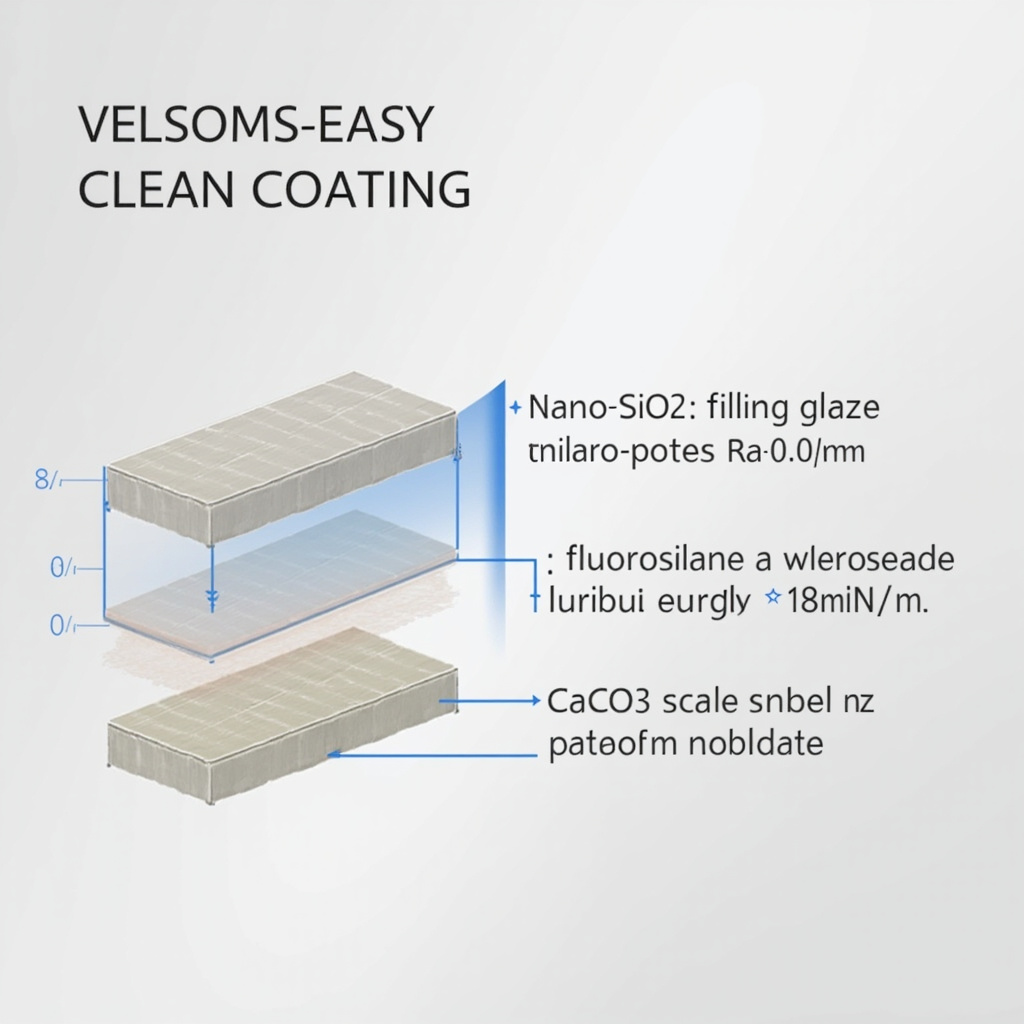
High-end sanitary ceramic anti-scaling and easy-to-clean nano-fluorine coating builds an easy-clean surface on ceramic glaze via nano-SiO2 (10-20 nm, filling glaze micropores, reducing Ra from 0.5-2 μm to <0.1 μm, ultra-smooth surface, no anchoring points for CaCO3/Mg(OH)2 scale attachment) + nano-TiO2 (5-15 nm, photocatalytic superhydrophilicity generating ROS to decompose organic dirt) / fluorocarbon silane (PFPE, surface energy <18 mN/m, or long-chain alkyl silane, PFAS-free). Scale formation chemistry: in hard water Ca2+/Mg2+ + HCO3-, upon heating or evaporation HCO3- decomposes to CO32-, CO32- + Ca2+ precipitates CaCO3 (calcite-type scale), which firmly adheres to traditional glaze (Ra 0.5-2 μm with abundant micropores) and requires acidic cleaners to dissolve and remove, damaging the glaze. The nano-fluorine coating (Ra <0.1 μm, surface energy 90% of scale without chemical cleaners. Hardness >6H, contact angle remains >105° after 5000 nylon brush cycles. GB/T 3810.14-2016 (stain resistance, grade 5 highest), JC/T 897-2014 (antibacterial grade I >99%), GB 25502-2017 (toilet water efficiency — easy-clean coating reduces flush volume). Global sanitary ceramic market ~USD 52 billion (2025, CAGR 4.5%); easy-clean self-cleaning antibacterial function grows >10% annually, TOTO/Kohler/Duravit have adopted nano easy-clean coatings as standard.