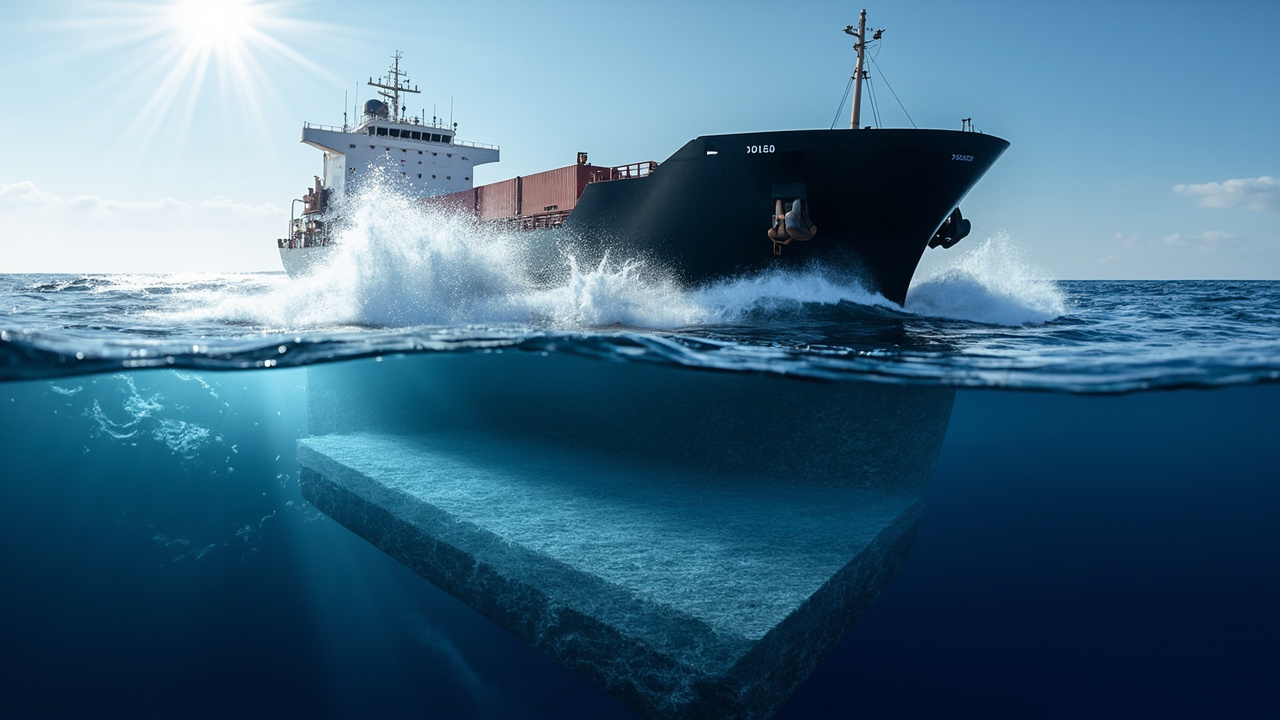
Why Hull Fouling Has Shifted from an Environmental Issue to a Dual Economic and Compliance Topic
When ships sail, barnacles, algae, tube-dwelling organisms and the like attach to the hull and form biofouling, which not only increases sailing resistance but also causes a 4% to 6% fuel penalty, directly eroding the profits of shipping companies. In 2026, as global maritime authorities upgrade their regulatory focus from "emission control" to "full-lifecycle hull management," antifouling coating has shifted from a mere maintenance item to a key variable in Carbon Intensity Indicator (CII) ratings.
Hull surface roughness is directly related to CII ratings—rough surfaces caused by fouling and coating degradation lower fuel efficiency and operational return on investment. This means that selecting a coating is no longer just about "anti-attachment," but a strategic decision to "reduce long-term environmental liability and safeguard operational efficiency."
IMO 2026: Biofouling Management Plan Becomes Mandatory

From January 1, 2026, the IMO's previously voluntary biofouling guidelines become mandatory for all vessels over 24 meters. Its core is the Biofouling Management Plan (BFMP), which becomes the primary audit basis during port state control inspections. Shipowners must provide complete hull maintenance logs, detailing each cleaning event and inspection, as evidence of their commitment to preventing the transfer of invasive alien species. Precise records of coating application and treatment of niche areas (such as seawater valve chests, thrusters) become baseline requirements for port access in high-sensitivity zones.
This shift marks a move in regulation from "wet paint chemical composition" to "full-lifecycle coating performance." The EPA's Vessel General Permit (VGP) and its 2026 revision focus on the cumulative impact of leached biocides and the incidental release of microplastics during underwater cleaning.
Regional Tightening: India, Hong Kong, California and REACH
At the regional level, multiple jurisdictions are simultaneously tightening rules, creating a complex global compliance environment:
– India: Issued the "Draft Merchant Shipping (Control of Anti-fouling System) Rules, 2026," replacing the 2016 version, implementing the standards of the International Convention on the Control of Harmful Anti-fouling Systems on Ships as domestic rules, applying initial and renewal surveys to international voyaging and Indian coastal ships above 400 gross tonnage. – Hong Kong, China: From April 27, 2026, supervises and approves the adoption of test methods specified in national standard GB 30981.2-2025 as an alternative method to determine the VOC content of solvent-based antifouling coatings without reactive diluents, aligning with the Air Pollution Control (Volatile Organic Compounds) Regulation. – California, USA: AB 773 introduces new restrictions on microplastics and leached biocides, specifically targeting the degradation of ablative coatings that release substances into water bodies. – Washington State, USA: Is finalizing its stance on copper-based antifouling ingredients, accelerating the shift to non-biocidal alternatives. – European Union: The REACH 2026 update will restrict multiple commonly used stabilizers and active substances, driving migration toward siloxane-based non-toxic technologies.
Meanwhile, GB 38469-2019 "Limit of Harmful Substances in Marine Coatings" as a mandatory national standard remains the core basis for compliance testing before June 1, 2026, setting strict limits on VOC and heavy metals (lead, cadmium, hexavalent chromium, mercury), with any detected benzene content resulting in failure.
Non-biocidal Siloxane: A Solution for a Ten-Year Lifecycle
Against the backdrop of accelerated phase-out of traditional biocides such as Zinc Pyrithione, siloxane-based non-biocidal coatings have become the mainstream direction. Their advantages lie in: achieving difficult attachment of fouling organisms through low surface energy, and being a zero-VOC-emitting permanent hard-film solution that eliminates the high cost of frequent dry-dock repainting and supports a 10-year hull protection lifecycle.
The core of such coatings is hydrodynamic optimization rather than chemical killing—it makes it difficult for organisms to colonize through a smooth, low-energy surface, and can be compliantly handled by "containment and capture" protocols during underwater cleaning, meeting the increasingly strict biofouling restrictions in waters such as Australia and Brazil.
As an important component of marine heavy anti-corrosion systems, Kexin New Materials (Guangdong) Co., Ltd.'s technical accumulation in nano-composite anti-corrosion and long-term protection is aligned with the demand direction of ships and offshore engineering for low-VOC, long-life coatings, and can provide material support for related protective solutions.
Comparison of Compliance Routes and Traditional Solutions
| Dimension | Traditional Ablative Antifouling | Non-biocidal Siloxane |
|---|---|---|
| Mechanism of Action | Biocide leaching and killing | Low-surface-energy physical anti-attachment |
| VOC Emission | Contains solvent, with release | Zero VOC |
| Lifecycle | Frequent repainting | About 10 years |
| Compliance Risk | Biocide restrictions, microplastics | Meets IMO/REACH |
| CII Impact | High roughness, fuel penalty | Low roughness, superior rating |
Thresholds for Shipowners and Coating Enterprises
First, BFMP documentation system building. From coating application to each underwater cleaning, a traceable digital log must be established, otherwise port access and fine risks are faced.
Second, matching of coating selection with routes. Different waters (tropical, frigid, freshwater) have different fouling pressures, requiring targeted selection of siloxane systems or hybrid solutions.
Third, compliance of underwater cleaning. Microplastic release from traditional underwater washing is heavily regulated and containment and capture equipment must be used.
Fourth, revaluation of cost structure. The initial cost of non-biocidal hard film is higher, but amortized over a 10-year lifecycle it is often lower than the total expenditure of frequent ablative repainting, and should be evaluated by full-lifecycle cost rather than unit price.
FAQ
Q: What are the main changes of IMO 2026 for antifouling coatings? A: The Biofouling Management Plan (BFMP) becomes mandatory for ships over 24 meters from January 1, 2026, with regulation shifting from wet paint chemical composition to the full-lifecycle performance of the coating, and is linked to CII ratings.
Q: Why are non-biocidal silicone-based coatings favored? A: They achieve physical antifouling through low surface energy rather than chemical killing, with zero VOC and an approximately 10-year lifecycle, avoiding the accelerated global phase-out risk of traditional biocides such as zinc pyrithione, and helping optimize CII ratings.
Q: What antifouling compliance requirements should Chinese shipbuilders pay attention to? A: Hong Kong will adopt GB 30981.2-2025 as an alternative VOC test method for antifouling coatings from April 27, 2026; the mainland still uses the hazardous substance limits of the mandatory national standard GB 38469-2019 as the core basis for compliance testing.
Further Reading
– Offshore Wind Power Moving to Deep and Far Seas: How Heavy-Duty Anti-Corrosion Coatings Withstand 25 Years of Salt Spray Erosion – Nano Composite Anti-Corrosion and Offshore Wind Protection – Industrial Protective Coating Product System