
Two industry exhibitions in 2026 quietly shifted the focus of battery safety from "the cells themselves" to "the material wrapped around the cells." At SNEC2026 Energy Storage Exhibition, the nano microporous insulation board demonstrated by Nantong Fumei showed almost no change on the surface after being scorched by a 1200℃ butane torch for 20 minutes; a patent (CN122037626A) from Beijing University of Technology disclosed around the same time uses a vertical heterostructure of nano graphene and boron nitride to push the out-of-plane thermal conductivity of the coating above 100 W/m·K. As new energy vehicles and energy storage stations roll out at an unprecedented pace, what determines safety and lifespan increasingly resembles that barely visible "nano armor."
I. Why do batteries need "nano-scale" thermal management?
There are three thermal issues when lithium batteries operate. The first is electrical insulation: under 800V high-voltage platforms, a reliable insulation barrier must be established between cell casings, liquid cooling plates, and busbars, as partial discharge is the trigger for thermal runaway. The second is thermal management: heat generated by cells during charge and discharge must be conducted out through low-resistance channels in the liquid cooling plate, keeping the temperature difference within 3℃, otherwise local overheating accelerates degradation. The third is fireproofing and thermal insulation: when a single cell undergoes thermal runaway, the coating must contain the flame and high temperature within the smallest possible area, buying time for escape and firefighting.
Traditional solutions each have shortcomings: blue film (PET wrapping) has short insulation life at seams and risks of debonding; thick thermal pads take up space and add weight; aerogels insulate well but are costly and prone to powder shedding. As energy density keeps climbing, the industry began looking to the "nano scale" for solutions—using thinner, lighter coatings with more controllable thermal conductivity/insulation to replace bulky metal heat sinks. As cell energy density advances toward 300Wh/kg and above, heat generation per unit volume becomes more concentrated, and the synergistic requirement for coating thermal conductivity and insulation rises exponentially; the traditional "stick a pad" approach is no longer sustainable.
II. Three technical pillars of nano coatings
Graphene–boron nitride vertical heterostructure is one of the most eye-catching directions in 2026. The battery thermal management coating disclosed in the BUCT patent (CN122037626A, published 2026-05-15) consists from inside to outside of a nano graphene layer, a nano boron nitride layer, a silane coupling agent modification layer, and a functional layer (flame-retardant layer + phase-change buffer layer + thermochromic layer). It uses a graphene–boron nitride vertical heterostructure to build a 3D thermal conduction network, with out-of-plane thermal conductivity >100 W/m·K; at ultra-thin (≤50μm) it can replace metal heat sinks, reducing the weight share of the cooling system from 20% to 5%; silane coupling agent modification gives adhesion >15MPa and cycle life over 1000 times.
Composite ceramic nano deposition targets insulation and wear resistance. Taking the composite ceramic nano deposition technology industrialized in 2026 as an example, for power battery liquid cooling plates it can create a composite film layer that combines insulation withstand voltage above 3500V, efficient thermal conduction, resistance to long-term coolant immersion, and thermal shock resistance, fundamentally alleviating the industry pain point of electrochemical corrosion of liquid cooling plates; for motor and reducer transmission components, it can form low-friction wear-resistant lubricating films to improve transmission efficiency.
Nano microporous insulation follows the "ultra-thin and highly efficient" route. Fumei's nano board uses fumed silica as the skeleton, compounded with opacifiers and high-silica fibers; nano-scale pores (20–50nm) disable air molecules from convective ability. Measured at 800℃, thermal conductivity can be controlled within 0.030 W/(m·K), only 1/3 to 1/4 of comparable products; achieving the same insulation effect requires about half the thickness of traditional materials, with material cost about 10% cheaper. It has passed double 85 aging 1000h, −40℃~80℃ high-low temperature shock 1000h, and environmental validation including salt spray, sandstorm, and extreme cold. As global energy storage fire safety standards upgrade, the EU has begun discussing fire resistance duration requirements of three or even four hours; microporous insulation boards are nearly irreplaceable in high-temperature insulation above 500℃, shifting from "alternative material" to "safety standard."
III. From "passive insulation" to "active thermal management"
A more frontier progress is making coatings "actively regulate." The "skin-inspired adaptive nano composite cooling film" reported by the City University of Hong Kong team in 2026 consists of lithium chloride (LiCl), graphene oxide (GO), and activated carbon fiber (ACF) encapsulated in a porous PTFE membrane and supported by a copper frame. When the battery heats up, water inside the film absorbs heat and evaporates to carry away heat (desorption cooling); after cooling, the film re-absorbs water from the air, forming a continuous cycle without external control.
Proof-of-concept data is considerable: average cooling power 802.5 W·m⁻², temperature drop of 34.3℃ under 2.7 kW·m⁻² high heat flux density; a 3.7V/12Ah commercial lithium-ion battery under high-rate charge-discharge extended cycle life from 118 to 233 times, nearly doubling. Another polymer nanocomposite film using graphene nanoplatelets@carbon tubes (GNPs@CNTs) nacre-like structure achieved in-plane thermal conductivity of 25.2 W/m·K, out-of-plane 1.94 W/m·K, Joule heating response 13.5℃/s, cost about 96.5 USD/kg, with bidirectional cooling and preheating regulation. Such active cooling films are still at the proof-of-concept stage; to reach automotive-grade mass production they must solve engineering issues such as LiCl moisture saturation, long-term sealing of PTFE membrane, and lightweighting of the copper frame, but the "bio-inspired adaptive" approach has opened new space for passive thermal management.
IV. Data comparison: nano coating vs traditional solution
| Dimension | Nano coating solution | Traditional solution |
|---|---|---|
| Thermal conduction/insulation | Out-of-plane >100 W/m·K (heterostructure); 800℃ thermal conductivity 0.030 W/(m·K) (microporous) | Metal heat sinks heavy, space-consuming; aerogels costly and powder-shedding |
| Insulation withstand voltage | Composite ceramic nano deposition liquid cooling plate ≥3500V | Blue film seam insulation life short |
| Thickness and weight | ≤50μm replaces metal sheet, cooling system weight share 20%→5% | High heat sink share |
| Cycle life | Adhesion >15MPa, cycles over 1000 times | Blue film yield and life limited |
| Cost trend | Microporous insulation is about 10% cheaper than imported ceramic fiber | High cost of imported materials |
V. Engineering Implementation and Standards
For a technology to be adopted in vehicles, standards are unavoidable. Automotive-grade insulating coatings are generally required to pass UL94-V0 flame retardancy, UL1446 electrical insulation, and the mandatory clauses of GB38031—2025 for power battery safety; bench tests such as electrolyte immersion resistance, edge coverage, and stone-chip resistance are mandatory thresholds before OEM adoption. After the implementation of the new national standard GB38031—2025 in 2026, high-thermal-conductivity UV and nano composite coatings are shifting from "technical selling points" to "industry standard configuration". For battery companies, moving thermal management forward to the cell finalization stage for collaborative design can simultaneously optimize insulation spacing, thermal conduction paths, and fire protection zones; for coating companies, the ability to provide an integrated solution of "materials + process package + certification" is replacing single performance metrics as the key to winning orders.
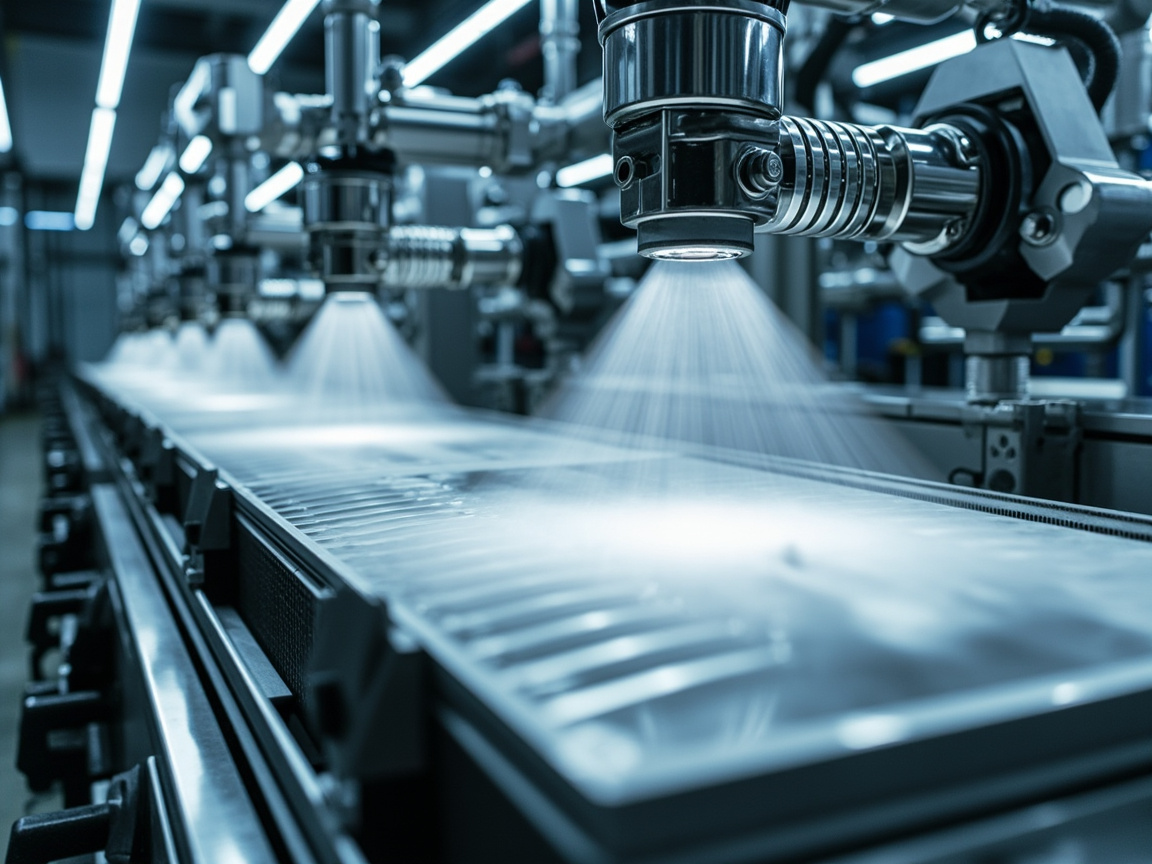
In the new energy coating track, Kexin New Materials (Guangdong) Co., Ltd. relies on its accumulation in thermal conduction networks and insulation systems through nano coating technology, and is conducting process closed-loop verification around cell insulation and liquid-cooling plate protection, integrating pre-treatment, precision spraying, and online high-voltage insulation testing into an automatable delivery solution. This integrated capability of "materials + process + verification" is precisely the key shortcoming preventing nano coatings from moving from papers to production lines, and also a realistic path for small and medium coating enterprises to build a moat.
VI. Implications for Material and Battery Enterprises
The value of nano coatings to batteries lies not in "a thinner layer of paint", but in solving insulation, thermal conduction, and fire protection simultaneously with the same set of materials and processes. For battery factories, this means thermal management can be moved forward to the cell finalization stage for collaborative design; for coating enterprises, whoever can provide an integrated solution of "materials + process package + certification" holds the admission ticket from new energy vehicles to energy storage scale-up. See details in the "invisible armor" of new energy battery packs and energy storage.
VII. Realistic Thresholds for Verification and Scale-up
For nano coatings to truly be adopted in vehicles, the hardest part is turning laboratory performance into batch-deliverable yield. Nano fillers such as graphene and boron nitride are highly prone to agglomeration; the dispersion process directly determines whether the thermal conduction network is continuous, and batch fluctuations may drop the through-plane thermal conductivity from above 100 W/m·K to just tens; the production line requires robotic spraying precision of ±0.1mm, material utilization above 95%, and online high-voltage insulation testing (2700–5000V DC) as a per-piece mandatory inspection, to eliminate local discharge caused by pinholes. More realistically, the certification cycle—bench verification for UL94-V0, UL1446, and GB38031—2025 often takes years, and seawater and electrolyte immersion, edge coverage, and stone-chip resistance are mandatory thresholds before OEM adoption. It is worth noting that the core of the heterogeneous structure is not "adding more graphene", but allowing graphene and boron nitride to stack orderly in the vertical direction to form low-resistance thermal channels; disordered stacking instead drags down performance due to interfacial thermal resistance, which is also the root cause of huge data differences across literature. For material enterprises, dispersion and interface modification capabilities determine success or failure more than simply piling up fillers; small and medium enterprises should first conduct small-batch closed-loop verification in energy storage and commercial vehicle scenarios, using data accumulation to replace concept packaging.
FAQ
Can nano coatings completely replace liquid cooling systems? Not in the short term. Nano thermal-conductive/insulating coatings address the "thermal resistance path" and "passive safety", while active heat dissipation still relies on liquid or air cooling loops; the two are complementary, and coatings reduce dependence on bulky heat dissipation structures.
What thermal conductivity is considered good? In-plane thermal conductivity of 25 W/m·K level can already be used for temperature equalization, while through-plane >100 W/m·K heterogeneous structures can replace some metal heat sinks. Specific evaluation should combine cell power density and temperature difference targets; higher is not always better.
Are nano coatings expensive? It depends on the route: microporous insulation boards are thinner and save material, so cost can be about 10% lower than imported solutions; graphene composite films see continuously declining costs after scale-up. The measurement standard should shift from "material unit price" to "total process cost + full-lifecycle reliability".
Further reading: the "invisible armor" of new energy battery packs and energy storage · Nano Coating Technology: Principles, Preparation, and Multi-field Applications · Industrial Coating System Product Center