
Introduction: When Size Shrinks to the Nanoscale, Materials "Transform Completely"
If the diameter of a human hair (about 80 μm) is viewed as a road, then 1 nanometer (nm) is merely a grain of fine sand on that road—one eighty-thousandth of the hair's diameter. When the characteristic size of a material shrinks to the 1–100 nm range, its physical and chemical properties undergo disruptive changes: melting point drops, strength surges, color shifts, catalytic activity explodes, and surface energy changes drastically. This "size-driven property transition" is the core appeal of nanotechnology and the fundamental difference between nano coatings and traditional coatings.
Nano coatings are not a single product, but a general term for a class of surface engineering technologies that "impart special functions through nanoscale structures/components." It can be a monomolecular layer only a few nanometers thick, or a tens-of-micrometers thick film containing nano fillers; it can make glass never wet, metals self-heal, surgical instruments antibacterial, photovoltaic panels self-clean, and aircraft reduce drag and save fuel. In Kexin New Materials' product system, nano coatings (hydrophobic, wear-resistant, heat-insulating, antibacterial, etc.) serve as high-value-added functional layers, often working synergistically with industrial protective primers/topcoats to provide differentiated protection for high-end equipment and consumer goods.
This article starts from the physical origin of nano effects, systematically sorting out the classification, preparation methods, characterization techniques, multi-domain applications, practical challenges, and future trends of nano coatings, to establish a complete cognitive framework for engineers and technical decision-makers. It should be specifically noted that nano coatings are a rapidly evolving interdisciplinary field; the technical parameters and cases in this article are based on current mainstream engineering practices, and specific selection should still be based on measured data and working-condition verification. Do not make decisions based solely on conceptual promotion.
Chapter 1: Three Major Effects at the Nanoscale
1.1 Small Size Effect (Volume Effect)
When particle size approaches or is smaller than certain physical characteristic lengths (such as electron mean free path, magnetic domain size, light wavelength), the macroscopic properties of the material are no longer determined by "bulk" laws. For example:
- The melting point of metal nanoparticles drops significantly (bulk gold melts at 1064°C, 10 nm gold particles can be below 300°C), facilitating low-temperature sintering;
- Ceramic nanopowders can be densified at lower temperatures;
- The superparamagnetic critical size of magnetism (e.g., Fe₃O₄ about 20–30 nm) makes particles have no remanence after removing the external field, used for targeted drug delivery and magnetic fluids.
1.2 Surface Effect (Specific Surface Area Effect)
Specific surface area is inversely proportional to particle size (sphere specific surface area ∝ 1/r). When particle size decreases from 1 μm to 10 nm, the specific surface area increases 100 times. The huge surface brings:
- Extremely high surface energy → strong adsorption, high activity, easy agglomeration (engineering must stabilize via surface modification);
- Surface atom ratio surges (10 nm particles can have 20%–30% surface atoms) → dense catalytic sites;
- For coatings, nano fillers can more efficiently fill microscopic defects and build dense barriers.
1.3 Quantum Size Effect
When particle size is smaller than the exciton Bohr radius (e.g., CdSe about 5–7 nm), electron energy levels change from continuous to discrete, and the optical band gap is tunable with size—this is the principle of "quantum dots" changing color with particle size (blue→green→red). This effect is mainly used in optoelectronic devices and displays, not protective coatings, but understanding it helps grasp "nano = designable."
Chapter 2: Definition and Functional Classification of Nano Coatings
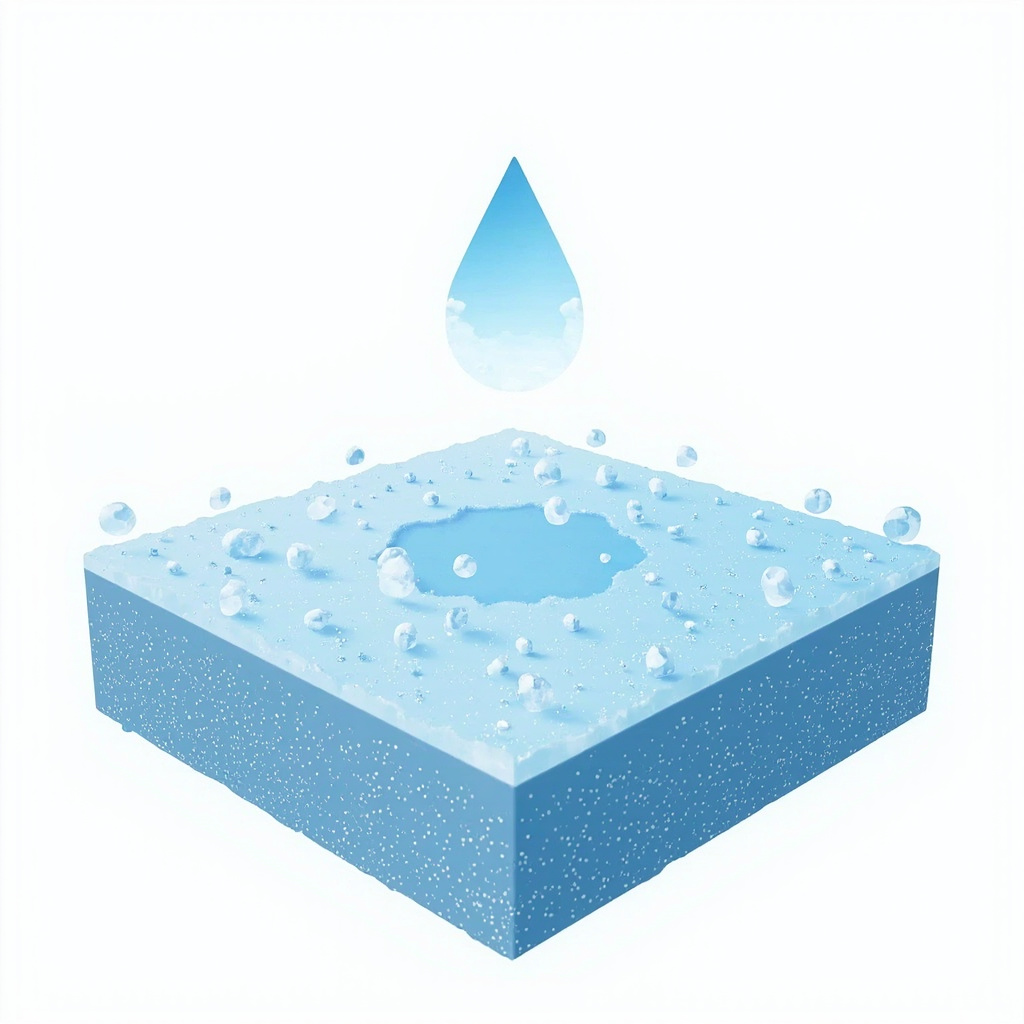
Strictly speaking, a "nano coating" should meet one of the following: ① The coating itself is nanoscale in thickness (such as self-assembled monolayers, DLC diamond-like carbon films); ② The coating contains nanoscale functional phases (such as SiO₂, TiO₂, ZnO, GO, CNT, nano silver); ③ The coating surface has nanoscale topological structures (such as lotus-leaf micro-nano dual structure achieving superhydrophobicity).
By function:
- Superhydrophobic/self-cleaning coating: contact angle > 150°, roll-off angle < 10°, water droplets roll off taking dust away ("lotus effect").
- Anti-corrosion nano coating: nano fillers extend diffusion paths + corrosion-inhibiting nanoparticles, superior to traditional shielding.
- Wear-resistant/hard coating: nano ceramics (Al₂O₃, SiO₂, TiN), DLC enhance hardness and wear resistance.
- Antibacterial coating: nano silver, CuO, ZnO, photocatalytic TiO₂ kill bacteria.
- Heat-insulating/energy-saving coating: nano hollow microspheres, infrared reflection (ITO, ATO) reduce heat transfer.
- Conductive/antistatic coating: CNT, graphene, nano silver networks provide conductive pathways.
- Optical/antireflection coating: nano porous SiO₂ reduces reflection, used for photovoltaics and lenses.
- Catalytic/photocatalytic coating: TiO₂ decomposes organic matter under UV (self-cleaning + air purification).
Chapter 3: Panorama of Preparation Methods
3.1 Sol-Gel Method
Metal alkoxides (such as TEOS tetraethyl orthosilicate) or inorganic salts are hydrolyzed and polycondensed to form a sol, which is then coated, aged, and heat-treated to obtain an oxide network (SiO₂, TiO₂, ZrO₂). Advantages: low temperature, uniform composition, easy doping; disadvantages: prone to cracking, need to control polycondensation kinetics. It is the mainstream soft-chemistry route for preparing glassy protective/antireflection/hydrophobic coatings.
3.2 Chemical Vapor Deposition (CVD)
Vapor precursors undergo chemical reactions on the substrate surface to deposit films (e.g., using TMOS to make SiO₂, methane to make DLC). Plasma-enhanced CVD (PECVD) can lower temperature, suitable for heat-sensitive substrates. Used in semiconductors, cutting tools, medical devices.
3.3 Physical Vapor Deposition (PVD)
Under vacuum, evaporating or sputtering (magnetron sputtering) deposits target atoms onto workpieces (such as TiN golden hard film, CrN). The film is dense and strongly bonded, used for cutting tools, molds, decoration.
3.4 Electrospinning
Polymer solution is stretched into nanofibers (diameter 50–500 nm) under high-voltage electric field, building porous membrane. Suitable for filtration, wound dressings, superhydrophobic structure templates.
3.5 Layer-by-Layer Self-Assembly (LbL)
Polyelectrolytes/nanoparticles with opposite charges are alternately adsorbed to build nano-thickness films layer by layer. Film thickness is controllable at nanoscale, suitable for multifunctional composites (e.g., antibacterial + barrier).
3.6 Spraying/Dip-Coating and Curing
Nano dispersions (nano SiO₂, fluorosilane-modified sol) are sprayed or dipped onto substrates, cured at room or low temperature to form hydrophobic/protective layers. Simple process, suitable for large areas and on-site construction, a key path for industrialization.
3.7 In-situ Growth and Etching
On metal/alloy surfaces, anodizing (such as anodized porous Al₂O₃ on aluminum), chemical etching build nano topology, then modify with low-surface-energy substances to form superhydrophobicity.
Chapter 4: Performance Characterization Techniques
- Morphology: SEM/TEM observe nano structure and thickness; AFM measures surface roughness and topology.
- Structure: XRD determines crystal type and particle size (Scherrer formula); FTIR/Raman identify chemical bonds; XPS measures surface element valence.
- Performance: contact angle meter measures wettability; scratch/nanoindentation measures hardness and adhesion; salt spray/electrochemistry (EIS) measures anti-corrosion; Taber measures wear resistance; antibacterial rate (GB/T 21866) measures antibacterial.
- Stability: accelerated aging (UV, humidity-heat, thermal cycling) evaluates durability.
Chapter 5: Industrial and Multi-domain Applications
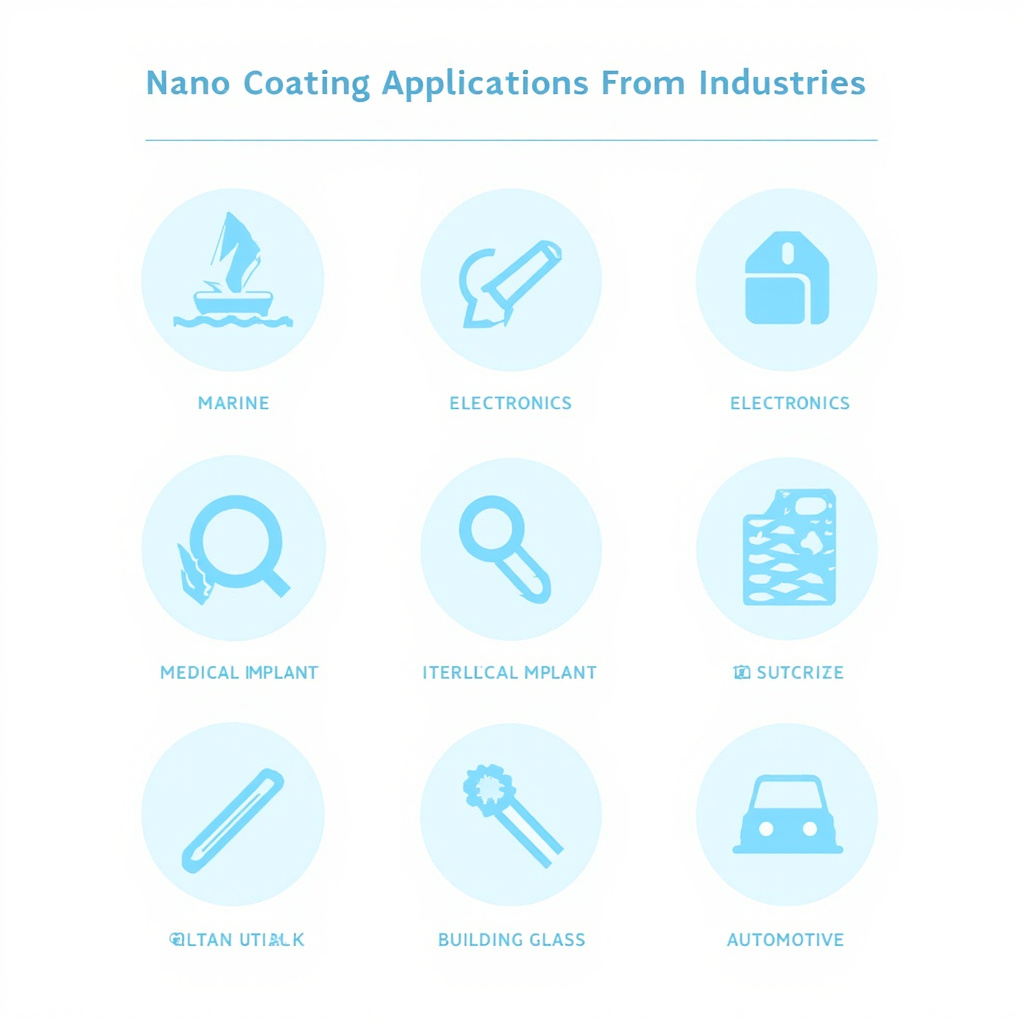
5.1 Marine Anti-corrosion
Introducing nano SiO₂, montmorillonite, graphene, nano ZnO into epoxy/polyurethane systems extends water/oxygen/ion diffusion paths ("maze effect"), and uses nano corrosion inhibitors for active protection. Nano-modified heavy-duty anti-corrosion coatings perform better than conventional systems in C5/CX environments, and can reduce film thickness.
5.2 Electronics and Semiconductors
- Low-k dielectric for chips, barrier layer (Cu diffusion);
- Displays: quantum dot color film, antireflection/anti-glare;
- Flexible electronics: transparent conductive nano silver wire/graphene film.
5.3 Medical and Biological
- Antibacterial devices (nano silver coated catheters, orthopedic implants);
- Drug sustained release (nano carriers);
- Biocompatible hard film (DLC for stents, artificial joints).
5.4 Architecture and Consumer Goods
- Self-cleaning glass/exterior walls (photocatalytic TiO₂ + hydrophobic);
- Anti-fingerprint phone screens (nano oleophobic layer);
- Easy-clean bathroom, anti-fog mirrors.
5.5 Automotive and Transportation
- Hydrophobic windows/side mirrors (raindrops slide quickly);
- Drag-reducing body (micro-grooves + nano structure, theoretical drag reduction 2%–5%);
- Wear-resistant interior, antibacterial steering wheel.
5.6 Energy
- Photovoltaic antireflection/self-cleaning (improve power generation 2%–5%);
- Lithium battery separator/electrode nano modification (improve rate and safety);
- Wind turbine blade hydrophobic anti-icing.
Chapter 6: In-depth Analysis of Superhydrophobic Self-cleaning Mechanism
Superhydrophobic = "micro-nano dual rough structure + low surface energy substance". In nature, the lotus leaf surface has micron-scale papillae (10–20 μm), on which there are nano-scale wax crystals (100–200 nm); air is trapped in the structures, and water droplets only have point contact (contact angle > 150°), rolling off with a slight tilt and carrying away dust and dirt—this is the "rolling anisotropy" self-cleaning. In engineering, nano/micro roughness is often first constructed (SiO₂ sol, etching), then modified with low surface energy using fluorosilane (e.g., 1H,1H,2H,2H-perfluorodecyltriethoxysilane). The difficulty lies in: mechanical wear and UV aging destroy the structure/chemical layer, causing failure; therefore, "durable superhydrophobic" is a key industrial breakthrough focus (e.g., using elastomer matrix to embed nano structures to improve wear resistance).
Chapter 7 In-depth Analysis of Nano Anti-corrosion Mechanisms
Traditional barrier coatings rely on density to block; the added value of nano modification comes from three points:
- Labyrinth effect: Flake/spherical nano fillers (graphene, montmorillonite, SiO₂) force corrosive media to take longer tortuous paths, exponentially extending permeation time.
- Corrosion inhibition activity: Nano ZnO, CeO₂, layered double hydroxides (LDH) can intelligently respond (release corrosion inhibitor ions when pH rises), achieving "self-repair at damage sites".
- Barrier reinforcement: Nano particles fill micron-scale defects, reduce pinhole rate, and improve adhesion.
Note: Dispersion of nano fillers is the key to success or failure—aggregation introduces defects and instead accelerates corrosion. Surface modification and ultrasonic/high-speed dispersion are indispensable.
Chapter 8 Real-world Challenges and Limitations
- Dispersion stability: Nano particles have high surface energy and easily aggregate, requiring surface modification and stable dispersion processes.
- Cost: High-purity nano raw materials and precision equipment drive up costs, limiting large-scale application.
- Scale-up effect: From gram-scale in lab to ton-scale, dispersion uniformity and batch stability are difficult to guarantee.
- Durability and wear: Functional nano structures (especially superhydrophobic) have weak mechanical strength and need matrix reinforcement.
- Safety and regulation: Ecological and health risks of some nano particles (e.g., free nano silver, CNT) remain controversial, requiring safety assessment per OECD guidelines and compliance with REACH and other filings.
- Lagging standardization: Functional evaluation methods (e.g., superhydrophobic durability, long-term antibacterial) standards are not yet unified, and the market is mixed.
Chapter 9 Standards, Safety and Compliance
Regulation of nano materials is tightening globally. EU REACH requires separate registration for nano forms; ISO/TC 229 develops nanotechnology terminology and safety standards; OECD launches nano material testing guidelines (physicochemical, environmental, toxicological). Before launching to market, enterprises should complete: composition and particle size characterization, release and exposure assessment, ecotoxicological screening, label and SDS compliance. Especially important for export products. Kexin New Materials follows the "safety by design" principle in nano coating development, prioritizing low-release, surface-terminated stable nano systems, and providing compliance technical documents.
Chapter 10 Future Trends
- Smart responsive coatings: pH/temperature/stress triggered release of corrosion inhibitors or self-repair, from "passive protection" to "active health management".
- Bionic structural coatings: Deeply replicate natural nano structures such as shells, shark skin, gecko feet, to achieve superhydrophobic, drag reduction, adhesion multifunction.
- Green nano manufacturing: Aqueous, low-temperature, fluorine-free (replacing PFAS) processes, reducing environmental and health burden.
- AI-assisted formulation: Machine learning predicts nano dispersion stability and performance, shortening R&D cycle.
- Cross-scale composite: Nano functional phase + micro structure + macro support, forming "gradient multifunctional" coating system.
- In-situ characterization and digital twin: Real-time observation of nano structure evolution, guiding life prediction.
Chapter 11 Common Nano Fillers One by One
- Nano SiO₂ (gas phase/sol): Inert, high hardness, easily surface silanized, is the mainstream additive for hydrophobic and reinforcement, also used as anti-reflection substrate.
- Nano TiO₂: Divided into anatase/rutile, strong photocatalytic activity (decomposes organics, antibacterial under UV), also used as UV shielding and self-cleaning; note that under light it may catalytically degrade organic matrix, requiring coating passivation.
- Nano ZnO: Antibacterial + UV shielding (wide bandgap 3.37 eV), more visible-light transparent than TiO₂, used in cosmetics and coatings; can serve as smart corrosion inhibitor.
- Montmorillonite (MMT) / layered silicate: Flake, after intercalation/exfoliation forms "brick wall" labyrinth, significantly improving barrier, cost-friendly.
- Graphene/Graphite oxide (GO): Large sheet diameter, high aspect ratio, extremely strong labyrinth effect, but dispersion and "corrosion galvanic couple" (graphene conductivity may accelerate local corrosion) need strict control, often synergized with corrosion inhibitors.
- Carbon nanotube (CNT) / nano silver wire: Conductive network, used for transparent electrodes and antistatic; CNT mechanical reinforcement prominent.
- Nano silver (AgNP): Broad-spectrum antibacterial, but release and environmental risks are under regulatory attention, requiring terminated stability.
- Nano CeO₂ / LDH: CeO₂ adsorbs chloride ions, LDH anion exchange slow-release corrosion inhibition, is the star of "smart anti-corrosion".
Core trade-off in filler selection: functional gain vs dispersion difficulty vs cost vs safety compliance. There is no universal filler, only matching for specific working conditions.
Chapter 12 Preparation Process Parameters and Mechanism Deep Dive
- Sol-Gel polycondensation kinetics: Hydrolysis rate controlled by pH, water/alcohol ratio, catalyst (acid/base). Acid catalysis yields linear oligomers (dense film), base catalysis yields highly branched (fast gel, easy cracking). Aging determines network maturity; heat treatment 100–500℃ removes organics and densifies (higher temperature denser but substrate limited).
- CVD reaction engineering: Precursor partial pressure, carrier gas flow, substrate temperature, pressure jointly determine growth rate and morphology. PECVD introduces plasma to lower activation energy, enabling DLC, SiO₂ to deposit on plastic at < 150℃.
- Magnetron sputtering: Ar⁺ bombards target to sputter atoms, reactive sputtering with N₂/O₂ generates TiN, CrN, oxides. Bias can regulate film density and stress.
- Electrospinning: Voltage (10–30 kV), feed rate, receiving distance determine fiber diameter and morphology; coaxial spinning can make hollow/core-shell nano fibers.
- LbL assembly: pH and ionic strength regulate polyelectrolyte conformation and adsorption amount; each bilayer thickness is nanoscale, ten layers can reach tens of nanometers.
- Spray curing: Nano dispersion viscosity, atomization pressure, curing temperature determine film thickness and uniformity; room-temperature curing formula (fluorosilane modified sol) suits field application, but crosslink density lower than heat treatment.
Chapter 13 Anti-corrosion Electrochemical Characterization (EIS) Details
Electrochemical Impedance Spectroscopy is the most powerful means to evaluate nano anti-corrosion coatings. Place coating/metal in electrolyte, apply small AC perturbation, measure impedance vs frequency:
- High-frequency region reflects coating capacitance and pores (density);
- Mid-low frequency region reflects interfacial reaction (corrosion activity);
- Low-frequency impedance modulus |Z| (e.g., 0.01 Hz) larger means better barrier (quality nano coating can reach 10⁹–10¹⁰ Ω·cm²);
- Capacitive arc/inductive arc reveals corrosion mechanism (e.g., diffusion limitation, adsorption).
Through accelerated immersion EIS decay over time, protective life can be quantitatively predicted—this is closer to "real service electrochemical behavior" than salt spray, and is the standard evaluation for high-end nano anti-corrosion R&D.
Chapter 14 Superhydrophobic Durability Evaluation Methods
The "lifeline" of superhydrophobic coatings lies in the stability of structure and chemical layer. Evaluations include:
- Mechanical wear: Taber abrasion, sandpaper friction (e.g., after N back-and-forth with 1000-grit sandpaper under load, measure contact angle retention);
- UV aging: Xenon lamp/UV irradiation then contact angle decay;
- Chemical immersion: Hydrophobicity after acid/alkali/salt solution immersion;
- Thermal cycling: -20℃↔80℃ multiple cycles;
- Actual outdoor exposure: Most severe and most real.
Industrialization threshold often uses "contact angle > 140° after 1000 wears" as reference line. Products meeting standard can be used in real working conditions.
Chapter 15 More Application Case Data
Case 1: Offshore wind turbine blade hydrophobic anti-icing
Blade leading edge sprayed with nano SiO₂/fluorosilane superhydrophobic layer, reducing ice adhesion by over 60%, combined with heating significantly reduces ice; meanwhile maintains power generation efficiency through anti-reflection/self-cleaning. Difficulty is wear resistance at high linear speed of blade tip, solved by elastomer embedding nano structures.
Case 2: Oil pipeline internal drag reduction
Oil pipeline inner coated with nano smooth ceramic layer (Al₂O₃ nano + low surface energy), roughness Ra < 0.2 μm, along-path resistance drops, pump consumption reduces, wax deposition slows. Need to balance oil swelling resistance and adhesion.
Case 3: Medical implant antibacterial
Titanium alloy orthopedic implant surface anodized + nano silver/drug-loaded layer, in vitro antibacterial rate > 99%, and can slow-release to promote osteogenesis. Regulatory focus is silver release dose and long-term biosafety.
Case 4: Cultural relic protection self-cleaning
Stone cultural relics coated with nano TiO₂/SiO₂ transparent layer, which photocatalytically decomposes surface pollutants, is hydrophobic and anti-seepage, and requires absolute colorless, reversible, and no damage to the substrate—the field of cultural heritage preservation has extremely high requirements for "minimum intervention".Case Five: Electronic Encapsulation Moisture-Proofing
PCB conformal coating doped with nano montmorillonite, water and oxygen transmission rate drops by an order of magnitude, circuit failure rate under salt spray significantly reduced.
Chapter Sixteen Industrialization Implementation Roadmap
To move nano coating from paper to factory, suggested path:
- Define functional goals (hydrophobic? anti-corrosion? antibacterial?) and quantitative indicators (contact angle, salt spray duration, antibacterial rate);
- Select filler + matrix + process combination, first do small-scale dispersion stability screening;
- Laboratory performance verification (EIS, contact angle, wear resistance, aging);
- Pilot sample/component testing, solve batch consistency;
- Real-condition hanging panel/trial operation, accumulate durability data;
- Compliance and safety assessment, complete SDS/label/declaration;
- Mass production processCuring (dispersion, coating, curing parameter SOP).
Each step should have data thresholds, avoid "claiming mass production upon concept verification".
Chapter Seventeen Composite Strategy of Nano Coating and Traditional Protective Coating
Single nano layer is often thin film, mechanically weak, hard to independently bear heavy anti-corrosion; a smarter approach is "nano functional layer + traditional protective system" composite:
- Primer nano-ization: Dope nano SiO₂, montmorillonite, graphene into epoxy zinc-rich/epoxy primer, enhance shielding and inhibition, increase life without reducing film thickness.
- Topcoat functionalization: Apply superhydrophobic nano clear coat on polyurethane/fluorocarbon topcoat surface, balancing weather resistance and self-cleaning (architectural curtain wall, wind turbine tower).
- Gradient structure: From inner (high-adhesion epoxy) → middle (nano-reinforced intermediate) → outer (low surface energy nano clear coat) forming functional gradient, each layer performing its own role.
- "Sandwich" wear-resistant: Substrate → hard nano ceramic (PVD/CVD) → oleophobic nano topping, used for cutting tools, molds, sanitary ware.
This composite idea exactly fits Kexin New Materials' product logic of "industrial protective matrix + nano functional surface", both securing baseline protection life and adding differentiated functions.
Chapter Eighteen Common Misconceptions and Purchasing Guide
- ❌ "Added nano means high-end": Improper doping, poor dispersion instead degrades; look at third-party test data not slogans.
- ❌ "Superhydrophobic = permanent": Structural wear/UV aging will fail, ask for wear and aging data.
- ❌ "Nano antibacterial = safe": Pay attention to silver/copper release dose and compliance, especially for human contact/food scenarios.
- ❌ "Thin film omnipotent": Thin nano layer hard to replace heavy anti-corrosion配套, composite is the right way.
- ❌ "More expensive the better": Matching working condition, verified data, calculate total cost of ownership (TCO) is rational.
- ✅ Purchasing checklist: Clarify functional indicators → request EIS/salt spray/contact angle/wear report → small sample hanging panel verification → check SDS and compliance → set SOP mass production.
Take "data speaks" as procurement iron rule, can avoid majority of nano concept bubbles in market.
Conclusion: Nano Coating is a "Functional Revolution" rather than a "Gimmick"
The reason nano coating is highly valued by industry is not because the word "nano" is fashionable, but because it reorganizes material structure and interface at nano scale, thus achieving superhydrophobic, self-cleaning, smart inhibition, ultra-high hardness and multi-functional mechanics that traditional coatings hardly reach. It also indeed faces real thresholds of dispersion, cost, durability and safety—these thresholds are exactly where engineering professional value comes into play.
Kexin New Materials (Foshan, Guangdong) deeply integrates nano technology with industrial coating, providing functional nano coatings such as hydrophobic, wear-resistant, thermal insulation, antibacterial, and can composite with epoxy/polyurethane protective systems, offering differentiated protection solutions for marine equipment, electronics, architecture and consumer product customers. Transform the clever thinking at nano scale into real competitiveness on your products.
If you need further technical selection support, welcome to contact us anytime.
Further Reading: Industrial Anti-Corrosion Paint Full Guide: How to Select Matching Systems for Steel Structures, Tanks, Pipelines? · Heavy Anti-Corrosion Coating System Design, Selection and Engineering Application