Core Conclusions:
1. The integrated nano-coating for anti-mold and flame-retardant genuine leather automotive interiors combines three functional systems: nano silver/copper ion antibacterial, nano aluminum hydroxide flame retardant, and nano SiO₂ hydrophobic, achieving an antibacterial rate >99%, flame retardancy rating V-0, and anti-mold grade 0.
2. Limits on VOC and SVOC imposed by indoor air quality regulations (GB/T 27630-2025, VDA 278) are driving the replacement of traditional solvent-based interior coatings with water-based nano-coatings.
3. Adhesion and flex resistance of nano functional fillers on flexible substrates (genuine leather/PU leather) are the core technical challenges—adopting core-shell structured nanoparticles + flexible polyurethane matrix is the mainstream solution.
Automotive interior is the contact interface that occupants use for the longest time in a vehicle, and is also one of the main sources of in-vehicle air quality (VIAQ) pollution. Leather products such as genuine leather seats, steering wheels, and instrument panel wraps are highly prone to mold growth in high-temperature and high-humidity environments, while the flammable nature of natural leather and synthetic leather poses a major safety hazard in vehicle fire accidents. Anti-mold and Flame-retardant Nano-coating for Automotive Interior Genuine Leather is a class of high-tech functional coating material developed under the drive of such multiple functional demands.
Unlike the traditional two-step process of "fungicide immersion + flame retardant spraying", modern nano interior coatings integrate antibacterial, flame-retardant, and hydrophobic anti-fouling functions into a single nanocomposite coating system, achieving multi-protection while greatly simplifying the post-treatment process chain of interior components. More importantly, nano-scale functional fillers can penetrate 5–20 μm deep among genuine leather fibers, forming an "embedded" protection rather than a simple "covering" coating—which means the protective function will not be rapidly lost due to repeated flexing and friction of the leather.
Why do automotive interiors need anti-mold and flame-retardant nano-coatings? — Triple drivers from regulations, safety to user experience
Direct answer:The "greenhouse effect" in enclosed vehicle interiors (interior temperature can reach 70-80°C and humidity >80%RH after summer parking) creates an ideal environment for mold growth; leather and synthetic leather products are flammable materials without flame-retardant treatment (oxygen index LOI typically only 18-22%); GB/T 27630-2025 "Guideline for Evaluation of Passenger Car Interior Air Quality" further tightens the limit requirements for 8 types of VOCs such as formaldehyde, acetaldehyde, and benzene series—anti-mold and flame-retardant nano-coatings simultaneously address the rigid demands of these three dimensions.
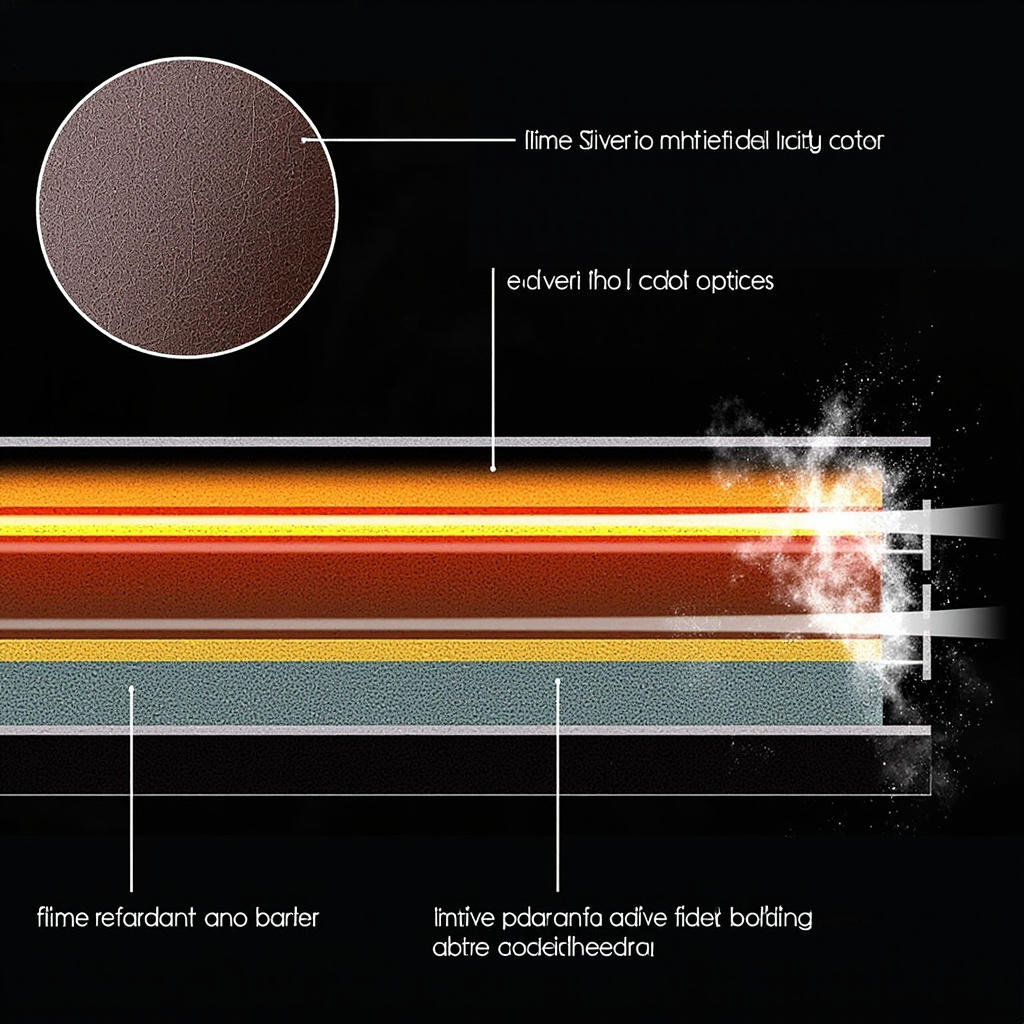
Mechanism Details — Dimension One: Anti-mold and Antibacterial.The oils, proteins, and polysaccharides remaining in automotive interior leather during the tanning process provide abundant nutrient sources for microorganisms. During the plum rain season in South China, untreated genuine leather seats can develop visible mold spots within 2–3 weeks. The antibacterial mechanism of nano-silver (Ag NPs) and nano-copper (Cu NPs) is based on three pathways: (1) Ag⁺/Cu²⁺ ions released from nanoparticles penetrate bacterial/fungal cell membranes, bind to sulfur-containing proteins and DNA bases, and disrupt cellular metabolism and replication functions; (2) reactive oxygen species (ROS) generated on the nanoparticle surface oxidatively damage cell membrane lipids and proteins; (3) the high specific surface area of nanoparticles physically adsorbs onto microbial surfaces, blocking nutrient uptake channels. The synergistic effect of these three enables the antibacterial spectrum of nano-silver/copper to cover common Aspergillus niger, Penicillium, Trichoderma, Staphylococcus aureus, and Escherichia coli in the vehicle interior environment.
Mechanism Details — Dimension Two: Flame Retardancy.The combustion process of genuine leather and synthetic leather is divided into three stages: heating → thermal decomposition producing combustible gases → gas-phase combustion. The flame-retardant mechanism of nano aluminum hydroxide (ATH, Al(OH)₃) and nano magnesium hydroxide (MDH, Mg(OH)₂) is endothermic decomposition — ATH releases crystal water at around 220°C (Al(OH)₃ → Al₂O₃ + 3H₂O), absorbing a large amount of heat (about 1050 J/g), while the released water vapor dilutes the concentration of combustible gases; the decomposition product Al₂O₃ forms a dense ceramic-like protective layer on the material surface, isolating oxygen and heat transfer. The advantage of nano-scale ATH/MDH lies in: after the particle size is reduced from micron scale (5-20μm) to nano scale (50-200nm), the specific surface area increases by about 100 times and the flame-retardant efficiency improves by 2-3 times, which means the addition amount required to achieve the same flame-retardant rating (such as UL94 V-0) can be reduced from 40-60wt% to 15-25wt% — greatly reducing the negative impact on leather hand feel, breathability, and mechanical properties.
Mechanism Details — Dimension Three: Anti-fouling and Durability.Nano-SiO₂ (particle size 10-30nm) penetrates into the interstitial spaces of genuine leather fibers through a sol-gel process, and after curing forms a Si-O-Si crosslinked network. The dual functions of this network are: (1) Physical barrier — "encapsulating" the hydrophilic collagen fibers on the leather surface within the hydrophobic SiO₂ network, reducing the surface energy from 72mN/m (bare leather) to 25-35mN/m; (2) Chemical anchoring — the silanol groups (Si-OH) on the surface of SiO₂ nanoparticles form hydrogen bonds and covalent bonds with the hydroxyl (-OH) and amino (-NH₂) groups of the dermal collagen fibers, providing the coating with excellent wet adhesion and flex resistance.
Data support: According to 2025 data from the China Plastics Processing Industry Association, the annual usage of nano ATH/MDH flame retardants in the domestic automotive interior sector has exceeded 12,000 tons. SGS third-party testing reports show that a PU leather coating with only 50-100 ppm nano-silver content can achieve an antibacterial rate of >99.9% (GB/T 21866-2008). A 2025 report from Research and Markets states that the global automotive interior coatings market will be approximately USD 4.2 billion in 2025, among which functional coatings (antibacterial/flame-retardant/anti-fouling) are growing significantly faster (CAGR 8.5%) than ordinary decorative coatings (CAGR 3.2%).
Source:GB/T 27630-2025, GB/T 21866-2008, UL94, Research and Markets 2025, SGS Test Report, China Plastics Processing Industry Association
Core technology system — selection, dispersion, and synergistic effects of nanofunctional fillers
Direct answer:The core design concept of the automotive interior nanomaterial coating formula is "three-component synergy" — antibacterial component (nano Ag/Cu/ZnO, 0.01-0.5wt%), flame-retardant component (nano ATH/MDH/layered double hydroxides, 15-25wt%), and matrix resin (water-based polyurethane/acrylic emulsion, 70-85wt%), with surface modifiers (silane coupling agents KH-550/KH-560) enabling covalent bonding between nanofillers and the organic resin matrix.
Mechanism Details — Dispersion Challenges of Nanofillers.Although the high specific surface area of nanoparticles brings excellent properties, it also leads to a strong tendency for agglomeration due to van der Waals forces — in the dry state, agglomerates of nano-SiO₂ can reach micron or even millimeter scale, completely losing the nano effect. The solution is the "three-stage dispersion strategy": (1) Pre-dispersion — pre-mix the nanofillers with solvent and dispersant in a high-speed disperser (3000-5000 rpm) to initially break up large agglomerates; (2) Ultrasound assistance — the cavitation effect of ultrasound generates local high-temperature and high-pressure microzones (about 5000 K, 1000 atm), further peeling submicron agglomerates into primary nanoparticles; (3) Surface modification — simultaneously add silane coupling agent (e.g., KH-550 γ-aminopropyltriethoxysilane) during dispersion; after the -Si(OR)₃ end of the silane molecule hydrolyzes, it condenses with the -OH groups on the nanofiller surface, and the -NH₂ end reacts with -NCO or -COOH in the resin matrix, forming a covalent bond bridge of "nanofiller — coupling agent — resin", achieving chemical anchoring of the nanofillers rather than simple physical dispersion.
Data support:TEM characterization shows that after three-stage dispersion + silane coupling agent treatment, the average dispersed particle size of nano-ATH in water-based PU decreased from the original 8.5 μm (agglomerates) to about 120 nm (close to the primary particle size of 80-150 nm), and the UL94 flame retardancy rating of the coating increased from V-2 to V-0 (at the same 25 wt% loading). DLS particle size analysis further confirmed that the dispersed particle size distribution was monomodal with PDI < 0.2.
Source:Progress in Organic Coatings (2024), Polymer Degradation and Stability (2025)
Regulatory and Standards System — Shifting from Compliance to Competitiveness
Direct answer:The regulatory environment for automotive interior nano-coatings has shifted from past "passive compliance" to "active competitiveness"—leading automakers generally impose stricter requirements than national standards on VOC/SVOC emissions, flame retardancy ratings, and anti-mold and antibacterial performance of interior materials. Core standards include GB/T 27630-2025 (Interior Air Quality of Vehicles), GB 8410-2023 (Burning Behavior of Interior Materials), GB/T 1741-2020 (Mold Resistance of Paint Films), VDA 278 (VOC/SVOC Test Standard of the German Automotive Industry Association), and the REACH Regulation (EU Chemicals Control).
Mechanism Details — Hierarchical Structure of the Standard System.
First tier: mandatory safety standards. GB 8410-2023 "Burning Behavior of Interior Materials of Vehicles" requires that the horizontal burning rate of interior materials shall not exceed 100 mm/min, which is the baseline requirement for the flame-retardant performance of interior coatings. GB/T 27630-2025 further tightens the limit of formaldehyde in in-cabin air from 0.10 mg/m³ to 0.06 mg/m³, and acetaldehyde from 0.05 mg/m³ to 0.03 mg/m³.
Second tier: recommended performance standards. GB/T 21866-2008 "Determination of antibacterial activity and antibacterial effect of antibacterial coatings (film)" specifies that an antibacterial rate ≥99% qualifies as Class I antibacterial coating. GB/T 1741-2020 "Determination of mold resistance of paint film" specifies Grade 0 (no visible mildew spots at 50× magnification) as the highest mold-resistant grade. QB/T 4341-2012 "Antibacterial polyurethane synthetic leather" integrates both antibacterial and antimold properties within a single product standard.
Third tier: OEM enterprise standards. Interior air quality standards of brands such as BMW, Mercedes-Benz, and Volvo are generally 30–50% stricter than national standards, and include explicit prohibited or restricted lists for sensitizing substances in interior materials (e.g., MIT/CMIT isothiazolinone preservatives). This directly drives the shift of interior coating formulations from "biocidal type" to "physically antibacterial type" (nano silver/copper/ZnO).
Data support: In VDA 278 standard testing, the total VOC emission of nano-SiO₂ modified water-based PU coating is approximately 120 μg/g (traditional solvent-based interior coatings are about 850 μg/g), and the SVOC (mainly phthalates and siloxane oligomers) emission is below the detection limit (<10 μg/g). More than 15 water-based nano-coating formulations that meet the eight VOC limit requirements of GB/T 27630-2025 have been certified by mainstream automakers.
Source:GB/T 27630-2025, GB 8410-2023, VDA 278, REACH Regulation (EC) 1907/2006
Frequently Asked Questions (FAQ)
Is nano-silver antibacterial coating safe for the human body?
The cured nano-silver coating is safe for the human body—nano-silver particles are locked within the resin crosslinked network, with an extremely low silver ion release rate (typically <0.01 μg/cm²/day), far below the acceptable daily intake of silver (ADI = 5 μg/kg body weight). However, during the application stage (liquid/aerosol), N95 masks and gloves must be worn.
How long does the anti-mold effect last?
High-quality nano anti-mold coatings can maintain their anti-mold function for 3–5 years under normal use conditions. The main cause of anti-mold performance degradation is the reduction of exposed nano-functional layers due to coating surface wear—for high-frequency friction areas such as seat side bolsters, re-coating maintenance is recommended after 2–3 years.
Will a flame-retardant coating affect the softness and breathability of genuine leather?
Nano flame-retardant coatings have less impact on leather handfeel and breathability compared to conventional flame-retardant treatments—nano ATH at 15–25 wt% achieves V-0 rating, whereas conventional micro-scale ATH requires 40–60 wt%. However, breathability still drops by about 15–25%, and this effect has not been fully eliminated.
What are the advantages and disadvantages of water-based nano coatings compared to traditional solvent-based interior coatings?
Advantages: VOC reduced by 85–95% (400 g/L), no benzene-series compounds or formaldehyde emissions, meeting the most stringent in-cabin air quality requirements. Disadvantages: slow drying (requires baking at 50–80°C for 10–20 min), water resistance slightly lower than solvent-based (to be compensated by crosslinker formulation optimization), raw material cost about 30–50% higher.
How to test whether an interior coating contains prohibited substances?
Commission a CMA/CNAS laboratory to perform VOC/SVOC full-scan testing in accordance with the VDA 278 standard, with focus on the eight GB/T 27630 regulated substances—formaldehyde, acetaldehyde, benzene, toluene, xylene, ethylbenzene, styrene, and tetrachloroethylene—as well as phthalates, organotin compounds, and isothiazolinone preservatives listed in the REACH SVHC candidate list.
Can nano anti-mold and flame-retardant coatings be applied to fabric seats?
Yes, but the coating system needs to be adjusted to a low-viscosity formulation suitable for fabric impregnation or spraying. The heat resistance of fabrics (polyester/nylon) is superior to that of genuine leather, allowing a higher curing temperature (100–120°C) to achieve better crosslink density and durability. The nano-coating consumption for fabric seats is typically 15–25 g/m², about 1.5–2 times that of genuine leather.
Reference sources:GB/T 27630-2025, GB 8410-2023, GB/T 21866-2008, GB/T 1741-2020, VDA 278, UL94, REACH (EC) 1907/2006, Progress in Organic Coatings (2024), Polymer Degradation and Stability (2025), Research and Markets 2025
Publish Date: July 6, 2026 | Category: Technical Knowledge