Wood-Plastic Composite (WPC) combines wood fibers or wood flour with thermoplastic plastics (PE, PP, PVC, etc.). It retains the texture and easy workability of wood while gaining the advantages of plastics such as corrosion resistance, insect resistance, and dimensional stability, and is therefore widely used in outdoor flooring, railings, wall panels, and landscape profiles. However, WPC has two unavoidable shortcomings: first, the poor interfacial compatibility between wood fibers and plastics leads to weak mechanical transfer and easy water absorption and swelling; second, outdoor use subjects it to continuous erosion and aging degradation from ultraviolet light, rain, and microorganisms. Nanomaterial modification is the key path to solving these two problems—through nano-fillers bridging the interface, shielding UV, enhancing rigidity, and inhibiting mildew, WPC moves from "usable" to "durable". This article follows the enhancement mechanisms described in Overview and Classification of Nanomaterials and clarifies the nano-modification routes, interface engineering, and standards for WPC.
Kexin New Materials (kexinMaterials) has long focused on the improvement of interface and weather resistance by nano-modification in the field of outdoor WPC and protective coating systems, and often collaborates with surface protective coatings (e.g., Architectural Facade Nano Protection) to form a complete system. Packaging matrix nano-reinforcement and surface nano-protection together is our consistent approach for outdoor profiles.
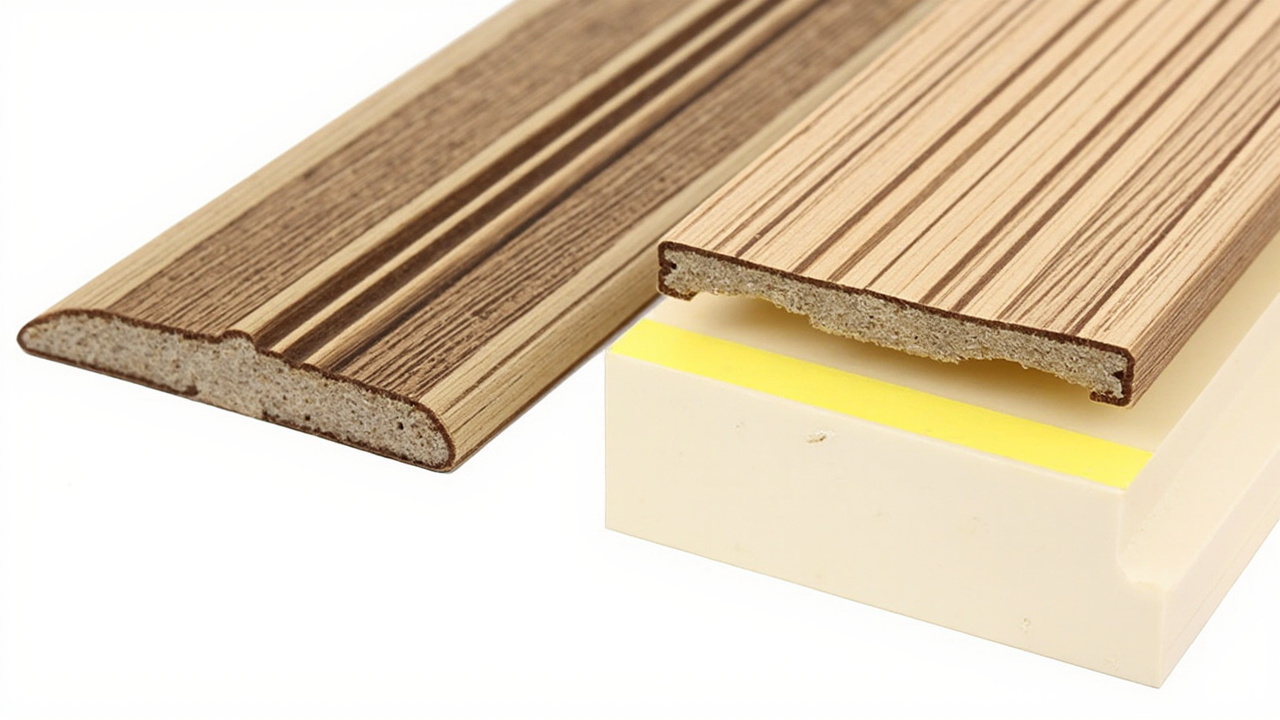
I. Structure and Inherent Contradictions of WPC
The typical formulation of WPC is: wood flour (mass fraction about 30% to 70%) plus thermoplastic resin (PE, PP, or PVC) plus coupling agent, lubricant, colorant, and additives, formed by extrusion or hot pressing. Wood fibers provide rigidity, texture, and natural degradability; plastics provide water resistance, formability, and insect resistance. But their different chemical natures lead to several inherent contradictions.
Interface incompatibility. Wood fibers are strongly polar, with surfaces rich in hydroxyl groups; whereas polyolefin plastics are non-polar. Their "affinity" is very weak, the interface easily debonds, stress transfer efficiency at the interface is low, and cracking from the interface easily occurs under load. This is also why ordinary WPC, when bent, often shows "wood fibers pulled out" rather than "wood fibers broken"—the interface fails to transfer the force, and the strength of the wood fibers is wasted. The value of nano-fillers and coupling agents is precisely to turn this weak interface into a force-transfer channel.
Water absorption and swelling. Wood fibers are hydrophilic and absorb moisture and swell, causing dimensional instability, surface fuzzing, and even freeze-thaw cracking; long-term humid environments also cause mildew. Water absorption can also carry soluble substances to the surface forming "blooming", affecting appearance. More seriously, water accumulating at the interface further weakens interfacial bonding, forming a vicious cycle of "water absorption—interface weakening—performance decline", which is one of the main mechanisms of early failure of outdoor WPC.
UV aging. Lignin and plastic molecules undergo chain scission and oxidation under UV light, manifesting as discoloration, chalking, and surface cracking, with mechanical properties declining accordingly.
Flame retardancy and heat resistance. Wood fibers are inherently combustible and require flame-retardant treatment; at the same time, wood fibers are heat-sensitive and the processing temperature cannot be too high, otherwise the wood flour carbonizes producing odor and black spots, affecting both appearance and performance.
The value of nanomaterials precisely targets these pain points: surface-modified nano-fillers can simultaneously "grab" wood fibers (via hydrogen bonds or chemical reactions) and plastics (via entanglement or compatibility), acting as interface bridges; nano TiO₂ and ZnO can shield UV; nano montmorillonite and other lamellae can enhance barrier and flame-retardant properties. In other words, nano-modification does not add an isolated function to WPC, but systematically reinforces its weak links.
From the application side, WPC usage in municipal landscapes, outdoor boardwalks, balcony railings, and interior wall panels has continued to grow in recent years, and owners' requirements for "no discoloration, no cracking, easy maintenance" are getting higher. Traditional WPC used for two or three years often shows surface graying, fuzzing, or even warping, which is the combined result of interfacial water absorption and UV degradation. If nano-modification is done correctly, it can significantly extend this cycle, giving WPC a real outdoor advantage of competing with solid wood while requiring less maintenance than solid wood. This is also why downstream profile manufacturers are increasingly willing to pay a premium for "nano-reinforced masterbatch".
II. Overview of Nano-Modification Routes
2.1 Nano SiO₂ Interface Reinforcement
Nano SiO₂ modified by coupling agents (such as silane KH-550, KH-560) or polymers (see Hydrophobic Modification of Nano SiO₂), with reduced surface energy and improved compatibility with plastics, can interact with both hydroxyl groups of wood fibers and plastic molecular chains, improving interfacial bonding strength, reducing water absorption, and enhancing impact and flexural properties. Hydrophobic modification can further reduce wood fiber moisture absorption. Numerous studies generally show that an appropriate amount of nano SiO₂ (about 1% to 5%) improves the mechanical and dimensional stability of WPC; but excess causes agglomeration and instead reduces performance, so there is an optimal addition window.
From the mechanism details, the role of nano SiO₂ is in two layers: the first is the physical layer, where ultrafine particles fill the microscopic voids between wood fibers and plastics, making the interface denser; the second is the chemical layer, where the silane coupling agent hydrolyzes and condenses with wood fiber hydroxyls, and the other end entangles with plastics, equivalent to building a chemical bridge at the interface. The superposition of these two layers turns the originally "two-layer" interface into a transition zone with chemical connections, allowing stress to transfer smoothly from plastic to wood fiber, and the overall strength increases. What needs to be controlled is particle size and dispersion: too coarse loses the nano effect, too fine is extremely difficult to disperse; usually a range of 20 to 60 nanometers is selected with a good dispersion process.
2.2 Nano Clay (Organically Modified Montmorillonite MMT) Intercalation
After organic modification (intercalation with cationic surfactant), montmorillonite can be exfoliated into nano-lamellae in the plastic matrix, forming a "polymer/clay nanocomposite (PCN)". These lamellae can significantly improve rigidity and heat deflection temperature, and lengthen the migration paths of water, oxygen, and small molecules, thereby improving barrier and flame-retardant properties. Introducing organoclay into WPC can simultaneously improve strength and water resistance, and montmorillonite raw material is low-cost and readily available.
It is necessary to distinguish between "intercalation" and "exfoliation": intercalation is when the surfactant enters the interlayer and expands the layer spacing, but the lamellae remain stacked; exfoliation is when the lamellae are completely separated and individually dispersed in the matrix. Only with full exfoliation are the reinforcement and barrier of the lamellae maximized. Factors affecting exfoliation include the amount of organic modifier, shear strength, and compatibility with the plastic. If exfoliation is insufficient, montmorillonite degenerates into an ordinary filler and loses its cost-performance advantage. Therefore, to evaluate organoclay WPC, it is best to use X-ray diffraction to see layer spacing changes and TEM to see whether the lamellae are exfoliated, rather than just looking at the fact that "montmorillonite was added".
2.3 Nano TiO₂ and ZnO for UV Resistance and Weathering
Nano TiO₂ (anatase) and ZnO are both efficient UV shielding agents (see Photocatalytic Self-Cleaning of Nano TiO₂ and Nano Antibacterial Materials Ag/ZnO respectively). They absorb and scatter UV light, slowing the photo-degradation of lignin and plastics, and delaying discoloration and chalking. ZnO also provides antibacterial and anti-mold effects, more suitable for humid outdoor environments. It should be noted that if TiO₂ is uncoated and on the surface of the organic matrix, its photocatalytic activity may also attack the matrix itself, so weather-resistant types should be selected or isolation treatment applied. The addition of both is usually controlled at 1% to 3%; too much causes paint film whitening due to scattering and affects wood grain texture.
2.4 Cellulose Nanocrystals (CNC/NCC) and Nano Lignin
Using wood-derived nanocellulose (CNC) or nano lignin to reinforce WPC is "homologous reinforcement", with naturally good interfacial compatibility, degradability, and excellent texture. CNC has high strength and modulus, and a small amount (about 1% to 3%) can significantly reinforce. Its high aspect ratio can form a network in the matrix, greatly helping rigidity and dimensional stability. But its hygroscopicity and dispersion difficulty are engineering challenges: CNC surface is rich in hydroxyl groups and itself easily absorbs water and agglomerates; directly adding it to hydrophobic plastics causes phase separation. The solution is to surface-esterify or silane-modify CNC to reduce polarity, or first make a water-dispersion masterbatch and then drain water during melt blending with plastics. This type of process has a high threshold and cost higher than inorganic nano-fillers, suitable for high-end scenarios with strong demand for "fully bio-based, recyclable"; ordinary profiles need not blindly pursue it.
2.5 Cost-Effective Fillers such as Nano CaCO₃ and Al₂O₃
Nano CaCO₃ is low-cost, suitable for toughening and reinforcement; nano Al₂O₃ can improve hardness and wear resistance. They are often used as cost-effective fillers, balancing cost and performance. Nano CaCO₃ surface also needs coupling treatment, otherwise the interface with plastic is weak and becomes a defect source; after treatment, it can improve rigidity and dimensional stability in low-end profiles at very low cost. Nano Al₂O₃ is more used in outdoor floor surfaces to resist foot traffic wear and sand scratches. Although these fillers have "single function", they win by being cheap, easy to disperse, and stable in supply, making them a very pragmatic choice in large-scale WPC production.
III. Interface Engineering: The Core of Nano Bridging
The performance ceiling of WPC is determined by the interface. The mechanisms by which nano-fillers enhance the interface can be broken down into four aspects.
Mechanical interlocking. Nano particles embed into wood fiber pores and the plastic phase, increasing contact area. The huge specific surface area of nanomaterials is directly converted into interfacial bonding force here.
Chemical coupling. Silane or titanate coupling agents connect to wood fiber hydroxyls at one end and plastics at the other; nano SiO₂ surface can also be grafted with coupling agents, becoming "coupling nodes" that chemically connect the two phases.
Stress transfer optimization. Cracks deflect, bridge, and blunt at nano particles (see the enhancement mechanisms in Overview and Classification of Nanomaterials), consuming fracture energy and improving toughness.
Reduce water absorption. Hydrophobic nano layers wrap wood fibers, slowing water intrusion and improving dimensional stability.
There is a key premise here: nano-fillers must be well dispersed, otherwise agglomerates become stress concentration points and reduce performance. In processing, a "nano masterbatch" is usually made first and then blended with wood flour and plastic to ensure uniform dispersion. Dispersion quality directly determines the success of modification; the relevant principles can be referred to in Dispersion Stability of Nanoparticles.
Whether the interface is truly improved cannot be judged merely by feel; it must be verified by characterization. Scanning electron microscopy (SEM) is used to see whether there are voids at the interface and whether nanoparticles are embedded; Fourier transform infrared spectroscopy (FTIR) is used to see whether the coupling agent forms chemical bonds; dynamic mechanical analysis (DMA) is used to see the glass transition and storage modulus changes brought by interfacial bonding; contact angle is used to see the hydrophilic-hydrophobic transition of wood fibers after hydrophobic modification. Only by linking these methods together can we confirm that the "bridge" is indeed built, rather than the filler merely being physically mixed in. Batch characterization of mass-produced products is also a necessary condition for stable supply.
IV. Quantification of Mechanical and Weathering Improvements
The performance improvements of WPC nano-modification are mostly given in qualitative plus range form in literature and industrial data; specific values should be subject to third-party testing. Common ranges are as follows.
Flexural and tensile strength. Appropriate amounts of nano-SiO₂ or CNC usually improve by 10% to 30% varying, and the improvement magnitude depends on dispersion quality and coupling process.
Water absorption. Hydrophobic nano-modification often reduces 24-hour water absorption by 20% to 50%, with obvious improvement in dimensional stability.
Heat deflection temperature. Organoclay PCN can improve by several degrees to over ten degrees, helping high-temperature application scenarios.
Weather resistance. Nano TiO₂ and ZnO can significantly slow color difference (ΔE) and chalking, evaluated according to GB/T 16422 (xenon lamp weathering) or ISO 4892.
It must be emphasized: the improvement magnitude highly depends on dispersion quality, addition amount, and coupling process; "adding nano increases by 30%" cannot be generalized. Excessive addition and poor dispersion may produce the opposite result.
Here is a easily overlooked point: the impact on the impact toughness of WPC by nano-modification is often not synchronized with flexural strength. Flexural strength is improved by interfacial bonding, while impact toughness is also affected by the modulus matching between particles and matrix. If the nanoparticles are too hard and bound too rigidly to the matrix, cracks cannot deflect to dissipate energy, and impact may instead decrease. Therefore, the formulation often needs to balance "reinforcement" and "toughening", and if necessary, compound elastomers or flexible coupling agents, rather than solely pursuing strength numbers. This is also why we value comprehensive mechanical property curves more than a single indicator.
V. Standards and Testing Methods
WPC finished products are supported by dedicated standards for quality judgment, and nano-modification cannot bypass these basic thresholds.
Product standards. GB/T 24137 "Wood-Plastic Decorative Panels", GB/T 29418 "Wood-Plastic Composites - Decking" etc. specify requirements for appearance, dimensions, mechanical properties, weather resistance, and flame retardancy.
Weathering tests. GB/T 16422 (xenon arc lamp weathering), ISO 4892 are used to evaluate discoloration and chalking; ISO 16925 etc. can be used for artificial weathering of topcoat.
Physical and chemical reference. Some methods of GB/T 17657 (Physical and chemical properties of wood-based panels) can be referenced for measuring water absorption and mechanics; related methods can also be used for preliminary testing of WPC.
Nano attributes are a "bonus", not an exemption from basic standards. Nano-modified WPC must still meet the mechanical and flame-retardant thresholds of corresponding standards.
In the acceptance stage, in addition to the above standards, actual projects often focus on several practical indicators: one is the coefficient of linear thermal expansion; if nano-modification reduces water absorption, it often also reduces dimensional changes caused by wet expansion and dry shrinkage; the second is surface hardness and abrasion resistance, as outdoor flooring is frequently stepped on, hard fillers such as nano Al₂O₃ are useful here; the third is color fastness, judged by ΔE after xenon lamp weathering and gray scale rating. It is recommended to include the mechanical retention rate "before aging—after aging" into acceptance, rather than only looking at initial strength, which better reflects real weathering service life.
VI. Comparison Table of Nano-Modification Routes
Different nano-fillers have different action mechanisms; the table below gives a horizontal comparison for easy selection.
| Nano filler | Main effect | Typical addition amount | Key risk | Applicable goal |
|---|---|---|---|---|
| Nano SiO₂ (modified) | Interface bridge, reduce water absorption, reinforce | 1%–5% | Agglomeration, excessive amount reduces properties | Mechanics and dimensional stability |
| Organomontmorillonite | Rigidity, barrier, flame retardant | 2%–5% | Hard to exfoliate, dispersion | Strength and flame retardancy |
| Nano TiO₂ | UV resistance and weather resistance | 1%–3% | Photocatalytic self-degradation (requires weather-resistant base) | Weather resistance and anti-discoloration |
| Nano ZnO | UV resistance plus antibacterial | 1%–3% | Agglomeration | Weather resistance and anti-mold |
| Cellulose nanocrystal | Homologous reinforcement | 1%–3% | Hygroscopic, dispersion | Green reinforcement |
| Nano CaCO₃ | Low-cost reinforcement | 2%–8% | Weak interface needs coupling | Cost-effective reinforcement |
VII. Process and Formulation Key Points
Couple first then blend. Wood fibers are first treated with silane or titanate, and nano-fillers are also pre-modified, then melt-blended with plastic, making interfacial bonding more reliable.
Masterbatch method. Nano powder is first made into high-concentration masterbatch to ensure uniform dispersion, then mixed with wood powder and plastic, avoiding poor dispersion caused by direct dry powder blending.
Temperature control. Wood fibers are heat-sensitive; processing temperature should not be too high to prevent pyrolysis causing bubbles and discoloration.
Waterproof topcoat. Even if the matrix is nano-modified, outdoor WPC is still recommended to be equipped with a weather-resistant topcoat (see Building Façade Nano Protection) to extend service life. The topcoat not only blocks UV but also seals surface micropores and reduces water penetration, equal to adding another insurance to the matrix. For high-end projects, we even recommend using nano clear coat for the topcoat as well, linking the nano protection of matrix and topcoat into a complete chain.
Flame-retardant synergy. If flame retardancy is needed, nano-clay, magnesium hydroxide, or intumescent flame-retardant systems can be added, paying attention to synergy and compatibility with nano-fillers. Montmorillonite layers can form a carbonized layer on the surface during combustion, delaying heat and flammable gas transfer, synergizing with intumescent flame retardants; but to achieve the flame-retardant grade required by building or engineering, it often still needs to be combined with main flame retardants; nano-fillers are "synergists" rather than "relying solely on them for flame retardancy". For outdoor profiles, flame-retardant priority is usually lower than weather resistance and water absorption; whether to apply flame retardancy depends on specific application scenarios and specification requirements.
Kexin New Materials (kexinMaterials) supporting idea is to package "matrix nano-reinforcement" and "topcoat nano-protection": the matrix solves mechanics and water absorption, the topcoat solves UV and fouling, forming an inside-out weathering system, especially suitable for high-end outdoor flooring and landscape profiles.
VIII-2. Extrusion Molding Process and Processing Window of Nano-Fillers
Nano-modified WPC ultimately relies on extrusion molding to be realized; the process window determines whether the laboratory formulation can become a stable product. Twin-screw extrusion is the most mainstream equipment, relying on strong shear to uniformly mix wood powder, plastic, and nano-masterbatch and achieve melt blending. Here are several process points directly related to nano-fillers.
Feeding sequence. Generally, pre-mix plastic and nano-masterbatch first, then feed wood powder on the downstream side to avoid premature heating and coking of wood powder; nano-masterbatch pre-dispersed can reduce re-agglomeration in the screw.
Shear and temperature. Too weak shear leads to uneven mixing, too strong may cut wood fibers and destroy nano-platelet exfoliation structure. Temperature should balance plastic melting and wood fiber thermal stability; PE systems are usually in the 180 to 200 °C range, PP slightly higher, PVC needs more caution to prevent decomposition.
Moisture control. Wood powder moisture content must be low enough, otherwise water vapor during extrusion causes pores and rough surface. Nano-fillers if hygroscopic also need pre-drying.
Screw configuration. Adjust residence time and mixing intensity through kneading blocks, reverse threads and other elements, balancing dispersion and temperature rise.
These parameters need to be repeatedly calibrated in combination with specific fillers and base materials, and cannot copy the process of ordinary WPC. Many nano-modified WPCs do well on lab machines but fluctuate once in mass production; the root cause is often that the screw process is not re-adapted.
VIII-3. Life Cycle and Environmental Considerations
Discussing WPC nano-modification cannot avoid the environmental dimension. First, wood fiber is a renewable natural component; WPC itself is lower carbon than pure plastic, and after nano-modification extends life, the carbon footprint per use cycle further decreases. Second, in terms of recycling, WPC containing PE and PP can theoretically be crushed and re-extruded, but the presence of nano-fillers and coupling agents affects recycled material properties, requiring control of addition amount and compatibility. Third, environmental release of nano-fillers is mainly in processing dust and waste crushing stages, and dust control should be done according to the requirements of Nano Material Safety and MSDS. Finally, if WPC contains PVC, also pay attention to chloride release at the end of its life cycle. Overall, the environmental account of nano-modification is that the benefit of "extending life and reducing replacement" is greater than the risk of "trace release of nano-fillers", but still requires regulation and monitoring.
VII-2. UV Aging Mechanism: How Light Step by Step Destroys WPC
To choose the right nano anti-UV solution, you must first understand the chain of aging. The most damaging part of sunlight to WPC is the UV band with wavelengths of 295 to 400 nm. UV photons have high energy; they can directly break the chemical bonds of plastic molecular chains, and can also excite lignin to generate free radicals, triggering auto-oxidative chain reactions. The results manifest as: surface lightening or yellowing (lignin degradation), chalking (resin matrix gnawed into powder), mechanical decline (chain scission, crosslink destruction), and surface cracking.
The essence of nano TiO₂ and ZnO against UV is to "intercept" this part of high-energy UV light: they have strong absorption of UV (TiO₂ bandgap about 3.2 eV, corresponding absorption edge in the UV region) and efficient scattering, greatly reducing the UV reaching the matrix. The difference is that after TiO₂ absorbs UV, electrons transition; if uncoated, it may transfer energy to adjacent organics causing photocatalytic damage; ZnO is relatively mild and also absorbs in the long-wave UV, plus it has antibacterial properties. Therefore, high-end outdoor WPC often chooses ZnO or coated TiO₂ rather than bare anatase. This also explains why simply "adding nano TiO₂" is not necessarily good; selection and coating are equally important.
7.3 Formulation Cost and Cost-Effectiveness Trade-off
Nano fillers are not the more expensive the better, but depend on cost-effectiveness and the main contradiction to be solved. If the main pain point is water-absorption deformation, prioritize cheap hydrophobic nano SiO₂; if strength is insufficient, organoclay and CNC are more targeted; if outdoor discoloration and chalking, ZnO or coated TiO₂ are the first choice; if both antibacterial and weather resistance are needed, ZnO kills two birds with one stone. Actual formulations are often a combination of "one main filler plus one functional filler" rather than piling up multiple types. Control total nano addition between 3% and 8%, to gain modification benefits without severely raising cost and processing difficulty.
8. Common Misconceptions
Misconception 1: WPC with wood flour added is eco-friendly, no need to care about nano. Wrong. Nano modification improves performance but requires dispersion and compliance; moreover, the WPC matrix may still contain PVC, etc., and eco-friendliness depends on the overall formulation and recycling path.
Misconception 2: More nano filler means stronger. Wrong. Excess causes agglomeration, interface deterioration, and processing difficulty; there is an optimal addition window.
Misconception 3: Nano-matrix means no topcoat needed. Wrong. Outdoor WPC is still subject to UV and fouling; surface protection can significantly extend service life.
Misconception 4: CNC being同源 (same source) must be the best. Wrong. CNC absorbs moisture, is hard to disperse, and has high process threshold; cost and stability must be evaluated.
Misconception 5: Nano TiO₂ in WPC only resists UV. Wrong. If uncoated, its photocatalysis may also attack the matrix; weather-resistant type or isolated use should be selected.
FAQ
FAQ
Q: Why does WPC need nano modification?
A: The wood fiber and plastic in WPC are interface-incompatible, prone to water swelling, and outdoor UV aging. Nano fillers can bridge interfaces, reduce water absorption, shield UV, and enhance rigidity and flame retardancy, turning "usable" into "durable".
Q: What role does nano SiO₂ play in WPC?
A: After coupling or hydrophobic modification, nano SiO₂ interacts with both wood fiber hydroxyl and plastic chains, enhancing interface bonding, reducing water absorption, and improving mechanics. For specific modification principles, see Hydrophobic Modification of Nano SiO₂.
Q: How does organo-montmorillonite reinforce WPC?
A: Organically modified montmorillonite can exfoliate into nano sheets in plastic, forming polymer/clay nanocomposites, enhancing rigidity, heat deflection temperature, barrier to water and oxygen, and flame retardancy. The key is whether exfoliation and dispersion are sufficient.
Q: What should be noted for nano TiO₂ used for UV resistance in WPC?
A: TiO₂ efficiently shields UV, but photocatalysis may attack the matrix; weather-resistant type or isolation/coating treatment should be selected. ZnO can replace or be used together, and also has antibacterial properties, see Photocatalytic Self-Cleaning of Nano TiO₂.
Q: What are the pros and cons of cellulose nanocrystals (CNC)?
A: CNC is same-source, high strength and modulus, degradable, good interface compatibility, and enhances with small amount; but it absorbs moisture, is hard to disperse, and has high process threshold, requiring cost and stability evaluation before use.
Q: Are there standards for WPC nano modification?
A: Finished products are judged by GB/T 24137, GB/T 29418, etc. for mechanics, weather resistance, flame retardancy; aging by GB/T 16422 or ISO 4892. Nano is a bonus, not exempting basic standard thresholds.
Q: Is more addition better performance?
A: No. There is an optimal window (e.g., SiO₂ about 1% to 5%); excess causes agglomeration, interface deterioration, processing difficulty, and performance drops instead.
Q: Does nano-modified WPC still need topcoat?
A: It is recommended to pair with a weather-resistant surface layer. Matrix modification solves mechanics and water absorption; surface layer solves UV and fouling, forming an internal-external system, see Nano Protection for Building Facades.
Q: How important is dispersion for WPC nano modification?
A: Decides success or failure. Agglomerates become stress concentration points, reducing performance instead. Commonly use masterbatch method to stabilize dispersion first then blend; criteria see Dispersion Stability of Nanoparticles.
Q: How does Kexin New Materials support WPC?
A: Kexin New Materials (kexinMaterials) packages matrix nano reinforcement and surface nano protection: matrix solves mechanics and water absorption, surface layer solves UV and fouling, forming an outdoor WPC weather-resistant system from inside to outside.
Further Reading
- Hydrophobic Modification of Nano SiO₂: Explains the hydrophobic SiO₂ modification principle for interface bridging and water reduction in WPC.
- Nano Protection for Building Facades: Understand the paired surface nano protection for outdoor WPC use, forming a complete weather-resistant system.
- Nano Composite Antirust Fillers: Laterally compare the shielding and reinforcement mechanisms of nano fillers in anti-corrosion systems, expanding nano modification knowledge.
- Industrial Paint Application: Airless Spray Parameters, Film Thickness Control and Coating Interval