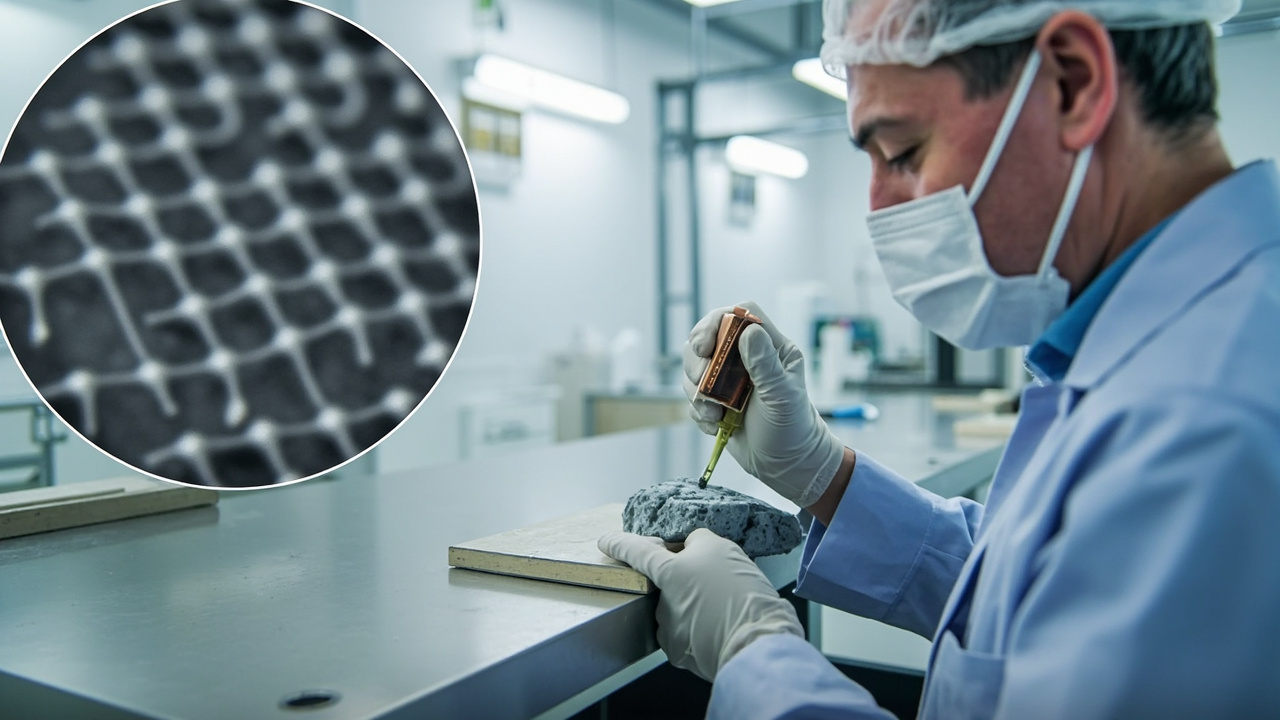
In the evolution of heavy-duty anti-corrosion and industrial protective coatings, the core question has always been "how to make a single paint film block water, oxygen, and corrosive ions for longer." Traditional approaches rely on a three-layer system: the sacrificial anode of zinc-rich primer, the lamellar shielding of epoxy micaceous iron oxide intermediate coat, and the weather-resistant sealing of the topcoat. In recent years, the emerging nano composite anti-corrosion coating introduces nano-scale SiO₂, TiO₂, and clay lamellae into film-forming resins such as epoxy and polyurethane, advancing the "densification" of the shielding layer to the nano level, significantly reducing water and oxygen permeability, thereby enhancing overall anti-corrosion service life without significant thickness increase. This article systematically analyzes the barrier and corrosion-inhibition enhancement logic of nano composite anti-corrosion from mechanisms, materials, system comparisons to engineering selection, and positions it within the coordinates of existing industrial anti-corrosion systems.
As a material supplier for industrial and automotive protective scenarios, Kexin New Materials (kexinMaterials) has long tracked the formulation and industrialization path of nano composite anti-corrosion. In the mechanism analysis and selection recommendation sections, this article will combine real working conditions and public technical data to provide a practical judgment framework, helping engineers find a balance between "upgrading anti-corrosion" and "cost control."
I. Clarification First: What Is Nano Composite Anti-Corrosion Coating
The so-called "nano composite anti-corrosion coating" refers to a coating in which solid particles (or lamellae) with at least one phase sized 1–100 nm are uniformly dispersed in an organic film-forming resin matrix (most commonly epoxy resin, polyurethane resin), utilizing special effects brought by the nano scale to improve the anti-corrosion, mechanical, and weather-resistant properties of the coating. According to the summary in the batch research archive (TDS_MSDS_RESEARCH.md, retrieved on 2026-07-27), common particles in nano coatings include TiO₂, SiO₂, ZnO, Ag, Cu, CaCO₃, etc., and their mechanism of action is based on three types of nano effects:
- Small size effect: When particle size enters the nano range, the specific surface area increases sharply, and the interfacial interaction area with the resin matrix increases by orders of magnitude, enabling more effective "crack filling" and reinforcement.
- Surface effect (high specific surface area): Nano particles have an extremely high number of surface atoms per unit mass and high surface energy, which brings both challenges in dispersion (see another article in this batch on dispersion stability) and strong interfacial capability to interact with corrosive media.
- Quantum size effect: Some semiconductor nano particles (such as TiO₂, ZnO) exhibit photocatalytic, antibacterial, and other additional functions under UV excitation.
In the anti-corrosion context, the most valued is the improved shielding density brought by the first two: when nano particles form a continuous or near-continuous barrier network in the paint film, corrosive media such as water, oxygen, and chloride ions must bypass countless nano obstacles to advance, significantly lengthening the diffusion path and reducing permeability.
2.4 Quantifying the Significance of "Upgrade" from Permeability
The essence of shielding is to reduce the steady-state permeability of corrosive media through the paint film. Lamellar fillers reduce the effective diffusion coefficient, and the reduction magnitude is related to the lamellar volume fraction, aspect ratio, and orientation: the more parallel the orientation, the larger the aspect ratio, and the higher the fraction, the more tortuous the maze. The aspect ratio of nano clay is much higher than that of micron mica, so at the same equivalent addition, a lower permeability can be obtained—this is exactly where nano composite upgrades from traditional lamellar shielding, and also the theoretical basis for maintaining high shielding under thin coating.
II. Core Mechanism One: How Nano Lamellae Improve Shielding
The shielding of ordinary epoxy or polyurethane paint films relies on the density of the resin body after film formation and the control of pigment volume concentration (PVC). But even so, molecular-level micropores and interfacial defects from curing shrinkage still provide "shortcuts" for water and oxygen. The idea of nano composite is to use lamellar nano fillers to block these shortcuts.
2.1 Clay Lamellae and the "Tortuous Path Effect"
The "clay lamellae" mentioned in the research usually refer to nano sheets of layered silicates such as montmorillonite after organic intercalation. These lamellae are only about 1 nm thick and have an extremely large aspect ratio. When they are dispersed with a certain orientation (such as parallel to the substrate surface) in the resin, corrosive media must repeatedly detour along the lamellar edges to penetrate the paint film, forming the so-called "tortuous path effect." According to the archive's section five "nano composite anti-corrosion" entry, it is clearly stated: nano SiO₂/TiO₂/clay lamellae improve shielding and reduce water and oxygen permeability; when compounded with epoxy/polyurethane, they can delay the path of corrosive media.
2.2 Filling and Reinforcement of Nano SiO₂
Nano SiO₂ particles are spherical with small particle size, and can be embedded into the free volume and micro-defects in the resin curing network, increasing crosslink density and film density. It also improves hardness and wear resistance, buffering anti-corrosion failure caused by mechanical damage during long-term service. SiO₂ has strong chemical inertness and good compatibility with the main resin, making it a nano filler that is relatively easy to engineer in industrial anti-corrosion systems.
2.3 Dual Role of Nano TiO₂
On one hand, nano TiO₂ has small particle size and high refractive index, which can improve the coating's UV aging resistance (absorbing/scattering UV); on the other hand, under UV excitation it has photocatalytic activity, which can degrade surface organic pollutants for self-cleaning. But the archive also warns: the photocatalysis of TiO₂ may accelerate the aging of adjacent organic resins, so in actual formulations it is often coated (e.g., SiO₂ coating) to isolate active sites and avoid "self-damage."

3.4 Quantifying "Corrosion-Inhibition Enhancement" by Electrochemical Methods
In engineering, electrochemical impedance spectroscopy (EIS) is commonly used to evaluate the evolution of the shielding layer with immersion time. Due to the tortuous path effect, nano composite coatings show slower decay of low-frequency impedance modulus |Z| and a wider phase angle platform, indicating longer shielding life. Combining EIS with salt spray (GB/T 1771) can distinguish between two mechanisms: "shielding failure" and "interfacial corrosion," which is closer to real service than simply looking at salt spray duration. This also reminds us: the "enhancement" of nano composite should be quantitatively verifiable, not just based on conceptual statements.
III. Core Mechanism Two: Corrosion-Inhibition Enhancement Is Not Just "Blocking," But Also "Passivating"
The "enhancement" of nano composite anti-corrosion lies not only in physical shielding, but also in corrosion-inhibition synergy:
- Inert barrier + active corrosion inhibition: When the surface of nano fillers is functionalized (e.g., loaded with corrosion-inhibiting groups, or carrying passivating components such as phosphate radicals on the surface), even if the medium locally breaks through the shielding layer, the corrosion-inhibiting substances released by the nano particles can form a passivation film at the metal interface, inhibiting anodic dissolution.
- Synergy with zinc powder: Introducing appropriate amount of nano SiO₂ or lamellae into the zinc-rich primer system can reduce zinc powder settling, improve coating uniformity, and lower porosity without reducing zinc content (the archive requires dry film zinc content ≥ 80% for zinc-rich primer, such as Jotun Barrier 80 UHS epoxy zinc-rich primer zinc complying with ASTM D520 Type II).
- Self-healing tendency: Some nano composite systems utilize the physical backfilling of lamellae at scratches and the diffusion of corrosion inhibitors to provide a certain "self-healing" buffer for micro-damage. Of course, this is not equivalent to true chemical self-healing, and should be viewed rationally in engineering.
It must be emphasized: the premise of corrosion-inhibition enhancement is that the nano particles are dispersively stable and well interfacially bonded. If agglomeration occurs, not only is the shielding network interrupted, but the agglomerates themselves may become the starting point of corrosion micro-cells. This echoes another article in this batch on dispersion stability—if dispersion is not done well, the advantages of nano anti-corrosion will reverse into defects.
3.5 Trend of Loading Corrosion Inhibitors
A further direction is to "load" corrosion inhibitors into nano containers (such as mesoporous SiO₂, layered double hydroxides), which are closed normally and released upon corrosion stimulation, achieving "on-demand corrosion inhibition." This belongs to the category of smart anti-corrosion. Although not yet popular in bulk industrial paint, it has verified potential in high-value equipment protection, and is a representative path for nano composite to move from "passive shielding" to "active protection," while also solving the problem that directly adding corrosion inhibitors would contaminate the paint film or be consumed prematurely.
IV. Compounding with Epoxy/Polyurethane: Why Choose These Two Resins
Nano composite anti-corrosion coating does not stand alone, but is superimposed on mature resin systems as a "functional modification component." The archive clearly states "compounded with epoxy/polyurethane to delay the path of corrosive media," and the reason is practical:
4.1 Epoxy Resin: Main Battlefield of Anti-Corrosion
Epoxy coating has strong adhesion, good chemical resistance, and high crosslink density after curing, making it the main force for primers and intermediate coats in industrial protection (ISO 12944 system). Adding nano fillers to epoxy can further enhance its already excellent shielding. Referring to Jotun Jotacote Universal N10 universal wear-resistant epoxy paint in the archive, with volume solids 72 ± 2 %, VOC per GB 30981-2020 at 239 g/L, dry film thickness DFT up to 75–300 µm, it is an ideal matrix for nano composite modification.
4.2 Polyurethane: Weather-Resistant Topcoat
Polyurethane (especially acrylic polyurethane) topcoat is weather-resistant, gloss-retaining, and wear-resistant, often used as the outermost layer of the system. Adding nano TiO₂ and SiO₂ to the polyurethane topcoat can balance UV resistance and hydrophobic self-cleaning. Referring to BASF Glasurit 923-666 HS varnish (2K acrylic polyurethane, high solids) in the archive, with solids 50–55 %, VOC ≤ 419 g/L, pencil hardness > 2H, it shows that polyurethane topcoat is already strong in hardness and durability, and after nano modification, anti-corrosion and decoration can be enhanced simultaneously.
4.3 Typical System: Where to Place the Nano Composite
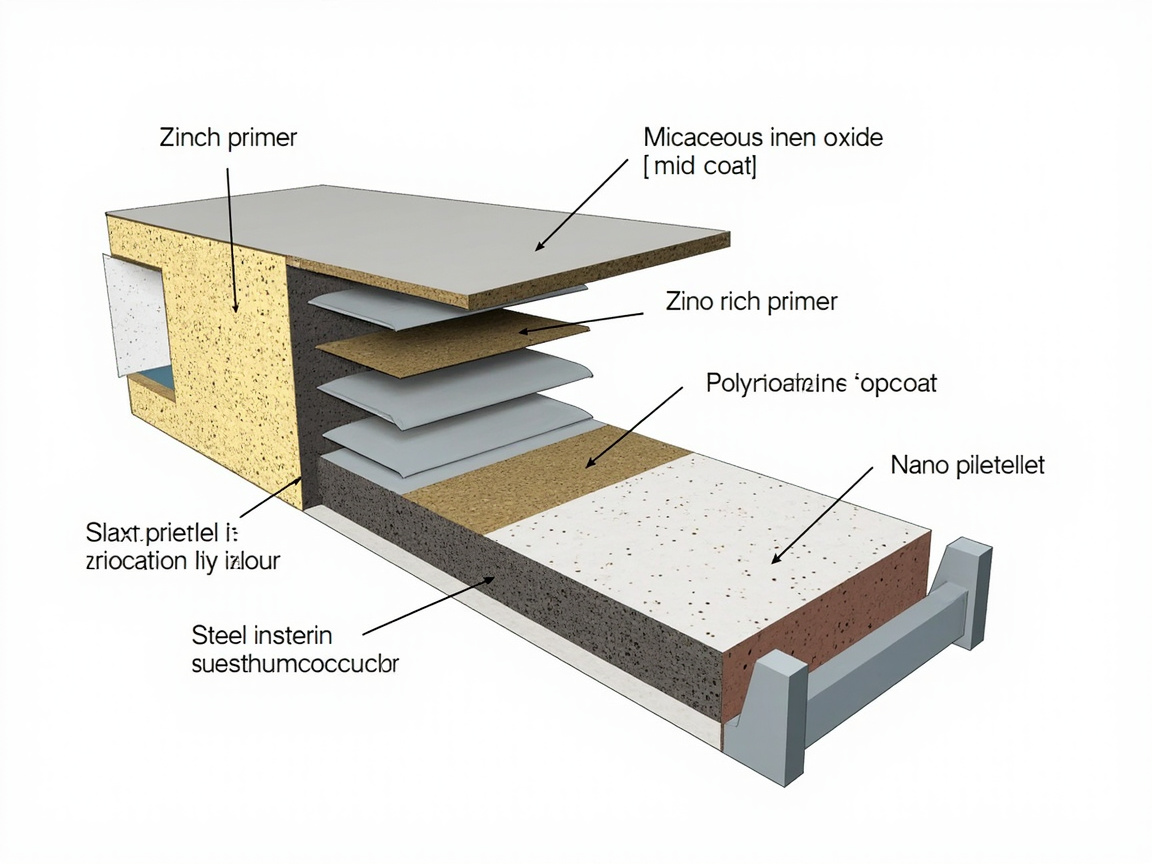
Traditional heavy-duty anti-corrosion system (according to the archive section two epoxy polyurethane topcoat parameter summary) is: epoxy zinc-rich primer (70–80 µm) + epoxy micaceous iron oxide intermediate coat (100–150 µm) + epoxy polyurethane topcoat (100–120 µm). Nano composite can be embedded in three ways:
- Primer nano-ization: Add nano SiO₂ to the epoxy zinc-rich primer to reduce porosity and improve workability;
- Intermediate coat lamellar-ization: Use nano clay/mica-type lamellae to replace or supplement part of micaceous iron oxide, strengthening the tortuous path effect;
- Topcoat functionalization: Polyurethane topcoat with added nano TiO₂/SiO₂ to enhance weather resistance and self-cleaning.
V. Relation to Traditional Mechanisms: Shielding/Cathodic Protection of Zinc-rich and Micaceous Iron Oxide
To understand where the nano-composite "upgrade" lies, one must first see clearly which mature mechanisms it inherits. According to Section 2 of the archive, "Key Mechanisms and Selection Points":
- Cathodic protection: Zinc powder (≥ 80% in dry film) in zinc-rich primer acts as a sacrificial anode, corroding preferentially to protect the steel substrate. Jotun Barrier 80 UHS epoxy zinc-rich primer has a weight solids content of 95 ± 2 % and VOC of 134 g/L (GB 30981 / GB/T 34682), and achieves the "Very High (VH)" durability rating under ISO 12944-6 test C5.
- Shielding effect: The micaceous iron oxide flakes in epoxy micaceous iron oxide intermediate coat lengthen the diffusion path of corrosive media—this shares the same essence as the "maze effect" of nano clay, only the flake scale drops from micron level (micaceous iron oxide) to nano level (clay), making the path more tortuous and permeability lower.
- Compatibility principle: Primer (anti-corrosion/adhesion) + intermediate coat (thickening/shielding) + topcoat (weather resistance/decoration), this is the skeleton of ISO 12944-2018 system design.
It can be seen that nano-composite anti-corrosion does not overturn tradition, but refines the dimension of "shielding" to a finer level: micaceous iron oxide is micron-flake shielding, nano clay is nano-flake shielding; the two can be stacked to form a cross-scale composite barrier. For designers, this is an incremental means of anti-corrosion upgrade, not a replacement that starts from scratch.
It should be added that cathodic protection and shielding are not isolated: after the zinc in the zinc-rich primer is consumed to a certain extent, its shielding effect weakens, and at this point the flakes in the intermediate coat (whether micron-scale micaceous iron oxide or nano clay) take over the shielding relay. Therefore, nano-composite is most suitable to be embedded in the "intermediate coat or topcoat" layer, as a link in the shielding relay, rather than replacing the sacrificial anode primer. Placing the nano-composite in the correct compatible position is the key to the success or failure of scheme design.
VI. Anti-corrosion Enhancement Comparison Table: Mechanisms and Data of Different Paths
The table below compares nano-composite with three types of traditional anti-corrosion paths on the same coordinates. The data are all from this batch of research archives, facilitating horizontal judgment during selection.
| Anti-corrosion path | Core mechanism | Representative material/system | Key data (per archive) | Applicable scenario | Relative shortcoming |
|---|---|---|---|---|---|
| Traditional physical shielding | Dense paint film blocks water/oxygen/ions | Alkyd/epoxy anti-rust paint | Alkyd primer salt spray approx. 500 h (ISO 12944 C3, e.g., Würth Rust Stop) | General atmospheric protection, transport primer | Shielding layer has molecular-level micropores |
| Zinc-rich cathodic protection | Zinc powder sacrificial anode | Epoxy zinc-rich primer | Dry film zinc ≥ 80%; Barrier 80 UHS VOC 134 g/L, C5 "Very High" | Heavy anti-corrosion, offshore/high corrosion | Limited weather resistance when used alone without topcoat |
| Micron-flake shielding | Micaceous iron oxide lengthens diffusion path | Epoxy micaceous iron oxide intermediate coat | Intermediate coat film thickness 100–150 µm | Compatible intermediate coat, thickening shielding | Flake scale at micron level |
| Nano-composite shielding | Nano SiO₂/TiO₂/clay flakes reduce water-oxygen permeability | Nano-composite epoxy/polyurethane | Extremely high aspect ratio of flakes, maze effect | Anti-corrosion upgrade, thin-coat high shielding | Depends on dispersion stability process |
This table shows: the differentiated value of nano-composite anti-corrosion lies in "achieving lower permeability with a thinner layer", especially suitable for scenarios with stringent requirements on film thickness, self-weight or appearance, while wishing to significantly extend service life. It can be used in combination with zinc-rich and micaceous iron oxide, not mutually exclusive.
VII. Engineering Selection: When to Adopt Nano-composite
Whether to adopt nano-composite anti-corrosion should return to specific working conditions, rather than "nano for nano's sake". Based on archive data and mechanisms, the following judgment checklist is provided:
- High corrosion grade (C4–C5 or CX): Traditional compatibility is already strained; nano-flake composite can serve as incremental reinforcement for intermediate coat or topcoat, forming a cross-scale barrier with zinc-rich primer.
- Film thickness limited: Such as certain precision components, pipeline internal repair joints, where thick coating is impossible; the "thin yet dense" advantage of nano-composite is obvious.
- Weather resistance and self-cleaning both important: Outdoor towers, bridges, tank exteriors; polyurethane topcoat with nano TiO₂/SiO₂ can balance UV resistance and easy cleaning.
- Cost-sensitive general atmospheric environment (C2–C3): Prioritize surface treatment (sandblasting Sa 2½, ISO 8501-1) and standard three-layer compatibility; the marginal benefit of nano-composite may not cover the premium.
Regarding surface treatment, the archive repeatedly emphasizes:
7.5 Nano-composite Embedding Suggestions by Corrosion Grade (ISO 12944)
| Corrosion grade | Environment example | Nano-composite embedding suggestion |
|---|---|---|
| C2 Low | Dry indoor, mild atmosphere | Generally not needed, standard three-layer compatibility suffices |
| C3 Medium | Urban, light industrial atmosphere | Optional topcoat with nano TiO₂ for anti-fouling self-cleaning |
| C4 High | Industrial, coastal | Intermediate coat with nano flakes for shielding reinforcement |
| C5/CX Very High | Offshore, chemical, high humidity | Zinc-rich primer + nano intermediate coat + nano topcoat cross-scale compatibility |
Following the corrosion grades (C2–CX) and compatibility design of ISO 12944-2018, first determine the grade accurately, then decide which layer the nano-composite embeds in—this is more economical than "full-system nano-ization" and better leverages the incremental value of "anti-corrosion upgrade". No matter how advanced the nano-composite, it cannot do without qualified substrate treatment. Carbon steel recommends sandblasting Sa 2½, roughness 30–75 µm; stainless steel requires non-metallic abrasive grinding to produce scratches to ensure adhesion. If nano-composite coating is applied directly on oil, flash rust or unstable old paint, the shielding network will collapse entirely due to adhesion failure.

VIII. Testing and Verification: Don't Be Misled by the Word "Nano"
The archive gives clear warnings in "Testing and Characterization of Nano Paint" and "Market and Standard Status": currently there is no single globally mandatory "nano coating" standard; purchase and evaluation should look at third-party test reports, focusing on film thickness, contact angle, salt spray and abrasion data. For nano-composite anti-corrosion, it is recommended to pay attention to:
- Salt spray resistance: According to GB/T 1771-2007 (equivalent to ASTM B117, DIN EN ISO 9227), observe the duration without blistering and with unilateral rust ≤ 1–2 mm; heavy anti-corrosion can look at 1000–3000 h level.
- Adhesion: Cross-cut method GB/T 9286, grade 0/1 is excellent (falloff ≤ 5%).
- Film thickness and permeability: Use step profiler/SEM cross-section to measure actual nano-layer thickness, if necessary use electrochemical impedance spectroscopy (EIS) to evaluate shielding evolution over time.
- Dispersion quality: Use particle size distribution and Zeta potential (dynamic light scattering DLS) to confirm whether nano particles are truly dispersed rather than false agglomeration.
Kexin New Materials (kexinMaterials), when providing anti-corrosion compatibility schemes, insists on requiring salt spray, adhesion and third-party characterization data as acceptance basis, to avoid "conceptual nano" misleading engineering decisions—what truly matters is the decrease in permeability and extension of service life, not whether the label prints "nano".
IX. Storage, Transportation, Construction and Quality Implementation Details
No matter how good the nano-composite anti-corrosion coating is, it must land on "stable transport, even application, accurate inspection". Combined with industrial paint construction and storage parameters in the archive, actionable details are given to avoid laboratory performance "zeroing out" at the site.
9.1 Packaging and Storage
Referring to archive epoxy polyurethane topcoat parameters: main agent 20 kg + curing agent 4 kg packaging, stored at 5–35℃, shelf life 12 months. If the nano-composite system is supplied as "nano slurry + main paint" two-component, pay more attention: nano slurry is sensitive to temperature and shear; during transport avoid severe jolting and high-temperature exposure; implement "first-in-first-out" upon warehousing, and if overdue, re-test Zeta potential and particle size distribution before release, because long-term standing may cause weak flocculation, invisible to the naked eye yet already affecting the shielding network.
9.2 Construction Environment
The specification clearly requires that the construction environment for industrial paint maintain a temperature of 5–35°C, relative humidity ≤ 80%, and substrate temperature at least 3°C above the dew point. Nano composite coatings are especially sensitive to condensation—once condensate water appears on the substrate surface, the interface between the nano flakes and the resin is severed by the water film, causing both adhesion and barrier properties to plummet. Therefore, during the plum rain season or at sites with large day-night temperature differences, it is essential to measure the dew point in practice and strictly control humidity; it is better to wait for a suitable window than to proceed recklessly.
9.3 Construction Method and Paint Mixing Sequence
Prioritize airless spray or air spray; brush and roller application are limited to small-area repair. The mixing sequence matters: first blend the nano slurry with the main paint base at low speed (to avoid high-shear-induced bubbles and new agglomeration), then add the curing agent per the instructions, and after induction filter and spray. Never directly dump nano powder into the main paint and stir at high speed—that only creates new hard agglomerates and wastes all previous effort.
9.4 Quality Release
In addition to routine DFT (dry film thickness, referencing the 75–300 µm range of Jotacote Universal N10 per design), cross-cut adhesion (GB/T 9286, grade 0/1 is excellent), it is recommended for nano composites to add a "first-piece micro-inspection"—after curing on a test panel, perform an SEM cross-section to confirm good flake orientation and no agglomeration before batch construction. Moving inspection to the first piece saves far more cost than reworking entire surfaces afterward.
9.5 Whole Life Cycle Cost Perspective
The premium of nano composite anti-corrosion mainly comes from nano fillers and surface modification processes. But the true cost of anti-corrosion failure (downtime, abrasive blasting and repainting, structural thinning) is often far higher than the paint price difference. Taking bridges or storage tanks in C5 corrosive environments as an example, if nano composites extend the major maintenance cycle from 8 years to 12 years, the cumulative savings in construction and production-stop costs usually cover several times the material increment. Therefore, evaluation must use life cycle cost (LCC) rather than unit price for decision-making, which is also the consistent position of Kexin New Materials in its scheme recommendations.
X. Common Misconceptions and Rational Expectations
- Misconception 1: "Nano paint must be ten times better in anti-corrosion than ordinary paint." Wrong. If dispersion is poor or substrate preparation is bad, nano instead introduces defects.
- Misconception 2: "Adding nano means you can skip zinc-rich primer." Wrong. Cathodic protection cannot be replaced by nano flake shielding; the two are complementary.
- Misconception 3: "Nano composite equals self-healing." Most are merely passive barrier enhancement; active self-healing requires additional microcapsule designs.
- Misconception 4: "Thicker nano layer is better." Excessive nano filler damages resin continuity and increases brittleness; there is an optimal addition window.
If you are evaluating a coating system for a specific project, you can first obtain a system-level judgment framework from our Industrial Water-based Coating Selection Guide, then combine it with the nano composite mechanism in this article to decide whether to add this incremental measure; when wavering between water-based and solvent-based routes, you can also refer to Water-based Paint vs Oil Paint Selection Comparison for overall trade-offs.
XI. Frequently Asked Questions
Q: Which has better anti-corrosion, nano composite anti-corrosion coating or traditional epoxy zinc-rich primer?
A: Their mechanisms differ and cannot be directly compared. Zinc-rich relies on zinc powder sacrificial anode (cathodic protection), while nano composite relies on flake labyrinth effect to reduce water/oxygen permeability (physical shielding). In engineering, nano SiO₂ is often added to zinc-rich primer to improve workability and density; they are synergistic rather than substitutive. For heavy anti-corrosion, the complete system of "zinc-rich primer + micaceous iron/nanocomposite intermediate coat + polyurethane topcoat" is still recommended.
Q: Can nano flakes really reduce water/oxygen permeability, and what is the basis?
A: The mechanistic basis is the "labyrinth effect": when clay, mica-type nano flakes are arranged parallel in the paint film, corrosive media must repeatedly detour along flake edges, greatly extending the effective diffusion path and thus reducing permeability. This batch of research archives clearly records "nano SiO₂/TiO₂/clay flakes enhance shielding and reduce water/oxygen permeability," which is an industry-consensus composite mechanism.
Q: Is nano composite anti-corrosion suitable for use on automobiles?
A: Yes, but it is more reflected in "functional anti-corrosion" parts such as chassis armor, battery pack housings, and structural component protection, rather than appearance topcoats. Automotive topcoats focus more on appearance and weather resistance; nano TiO₂/SiO₂ are mostly used for UV resistance and self-cleaning enhancement in polyurethane varnish. Vehicle painting should also comply with GB 24409-2020 VOC limits for vehicle coatings.
Q: Why is dispersion stability so critical for nano anti-corrosion?
A: Nano particles have large specific surface area and high surface energy, and agglomerate very easily. Once agglomerated, the flake labyrinth network breaks, and the agglomerates themselves may become starting points for corrosion micro-cells, reversing the anti-corrosion advantage into defects. Therefore, surface modification, dispersants, and ultrasonic/bead-milling processes are prerequisites for nano composite industrialization; another article in this batch, "Dispersion Stability of Nano Coatings," expands specifically on this.
Q: Is the VOC of nano composite anti-corrosion coating high?
A: VOC depends on the selected base resin and solid content, not on "whether it contains nano." For example, in the archives, Jotun Barrier 80 UHS epoxy zinc-rich primer has VOC 134 g/L (GB 30981), and BASF Glasurit 923-666 HS polyurethane varnish has VOC ≤ 419 g/L. Using high-solid epoxy/polyurethane as the base and controlling solvents, nano composites can also achieve low VOC, meeting GB 30981-2020 and GB 24409-2020.
Q: Are surface preparation requirements higher during construction?
A: Surface preparation requirements are consistent with ordinary heavy anti-corrosion: carbon steel recommends abrasive blasting Sa 2½ (ISO 8501-1), roughness 30–75 µm; stainless steel requires non-metallic abrasive grinding to create scratches. Nano composite coatings are more "afraid" of adhesion failure, because once the shielding network peels off with the old paint, it collapses entirely, so substrate preparation cannot be omitted.
Q: How to verify the supplier's claimed nano anti-corrosion effect?
A: Require third-party test reports, focusing on: salt spray resistance (GB/T 1771, duration and rating), adhesion (GB/T 9286 cross-cut 0/1 grade), film thickness and nano layer characterization (SEM/TEM, step profiler), permeability (EIS electrochemical impedance). The archives also note that there is currently no single global mandatory nano standard, so judge by data rather than labels.
Q: Is the cost increment of nano composite anti-corrosion roughly worth it?
A: It depends on the corrosion grade and life goal. For C2–C3 general atmospheric environments, a standard three-coat system is sufficient and the marginal benefit of nano composite is limited; for C4–C5, thickness-limited, or high-weathering self-cleaning demand scenarios, the life extension brought by nano composite's "thin-film high shielding" usually covers its material premium. It is recommended to evaluate by life cycle cost rather than unit price alone.
XII. Further Reading
The following three articles from the whitelist of published content let you continue deeper along the "system—selection—film formation" technical chain:
- Industrial Water-based Coating Selection Guide: Understand primer, intermediate, topcoat systems and corrosion grade matching at the system level, which is the prerequisite for evaluating whether to add nano composite.
- Water-based Paint vs Oil Paint Selection Comparison: Make overall trade-offs on the base resin route (water-based epoxy/polyurethane vs solvent-based), relating to the VOC and construction adaptability of nano composite.
- Science Principles of Water-based Wood Coatings: Cross-category understanding of film formation mechanisms and auxiliary effects, which is also enlightening for understanding the dispersion and interface of nano particles in the resin matrix.