Core conclusions:
1. Polysilazane (PHPS) is an inorganic Si-N backbone polymer—under room-temperature moisture or thermal action it hydrolyzes and condenses into a dense SiO₂ ceramic layer, with a hardness more than 10 times that of traditional organic polymer coatings (e.g., PMMA, PU).
2. PHPS coating achieves 7H pencil hardness after room-temperature curing, and its hardness surges to 13 GPa (approx. 1300 HV) after pyrolysis at 1000°C in nitrogen—approaching the hardness level of fused silica glass (≈8–9 GPa).
3. The core engineering challenge is cracking of thick films—the 15–30% volume shrinkage during PHPS conversion causes pure PHPS films thicker than 1–2 μm to develop crazing, and the introduction of nanofillers (nano-SiO₂, Al₂O₃) is a key technical route to solve this problem.
In the field of automotive paint protection, hardness is the primary indicator for measuring a coating's scratch resistance. Traditional organic polymer coatings—whether acrylic clearcoats (pencil hardness HB-2H) or polyurethane clearcoats (H-2H)—have their hardness limited by the inherent flexibility of C-C and C-O covalent bonds and the low chain packing density.Nano Polysilazane Ultra-Hard Automotive Coating Agent represents a completely different technical route: starting from an inorganic Si-N skeleton, through hydrolysis-condensation and pyrolytic transformation, it ultimately forms a ceramic protective layer close to pure SiO₂ glass—achieving a hardness leap from "organic polymer" to "inorganic ceramic".
The history of this technology can be traced back to the 1970s—polysilazanes were first developed as precursors for Si₃N₄/SiC ceramic fibers. It was only in the last decade, with the commercialization of room-temperature moisture-curing perhydropolysilazane (PHPS, Perhydropolysilazane) (Clariant Advanced Materials' NN 120-20 series and Anhui Iota Silicone Oil's IOTA 9118/9150 series), that this technology—originating from aerospace ceramics—truly entered the automotive aftermarket coating field.
Ceramic precursor chemistry — molecular transformation from Si-N to Si-O-Si
Direct answer: The core molecular structure of polysilazane is an inorganic backbone composed of repeating -Si-N- units—this is fundamentally different from traditional organosilicons (siloxanes/PDMS with -Si-O- backbones). Perhydropolysilazane (PHPS, [SiH₂NH]ₙ) contains no organic side groups; each Si atom is bonded to two H atoms and one NH bridging group. When exposed to moisture (H₂O in air) or heated, the Si-N and Si-H bonds undergo sequential hydrolysis and condensation, ultimately converting into a -Si-O-Si- crosslinked network—the chemical composition transforms from SiNₓHᵧ to SiO₂.
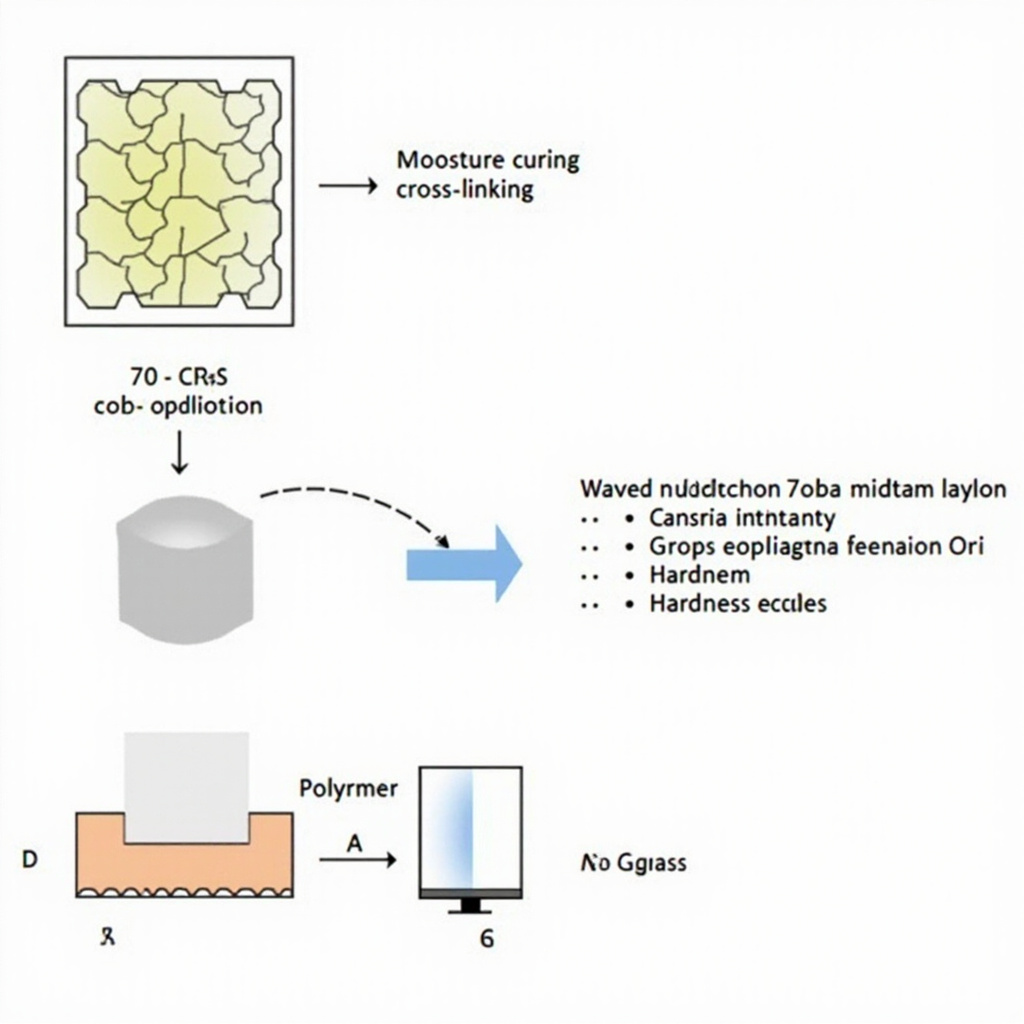
Mechanism Explained — A Three-Step Conversion Process.
Step 1: Hydrolytic activation. Water molecules in the air attack the Si-N and Si-H bonds of PHPS—this is the rate-determining step of the entire conversion process. Hydrolysis of the Si-N bond: -Si-NH-Si- + H₂O → -Si-OH + H₂N-Si-, generating silanol (Si-OH) and amine group (NH₂-Si). Hydrolysis of the Si-H bond: -Si-H + H₂O → -Si-OH + H₂↑, releasing hydrogen gas (this is also why PHPS coatings may produce micro-bubbles in the early stage of curing).
Step 2: Condensation crosslinking.The Si-OH groups generated by hydrolysis undergo a condensation reaction: Si-OH + HO-Si → Si-O-Si + H₂O. As the condensation proceeds, the linear or cyclic PHPS molecular chains gradually develop into a three-dimensional Si-O-Si crosslinked network, and the hardness and density of the coating increase synchronously. At room temperature (25°C, 50%RH), the typical time for this process to reach full crosslinking is 24–72 hours.
Step 3 (Optional): Pyrolytic Ceramization. At higher temperatures (500-1000°C) and under inert atmosphere (N₂/Ar), residual Si-H, Si-NH-Si, and organic impurities further thermally decompose, and the coating ultimately transforms into near-stoichiometric amorphous Si₃N₄/SiCNO/SiO₂ ceramics—with hardness jumping from about 2 GPa after room-temperature curing to 13 GPa. The regulation of the final ceramic phase composition and hardness by pyrolysis temperature is the most core scientific issue in the research of polysilazane ceramic coatings.
Data support:A key study indexed in ScienceDirect (Barhoum et al., 2012) systematically characterized the evolution of mechanical properties of PHPS coatings at different pyrolysis temperatures: cured at 100°C → hardness 0.8 GPa, 400°C → 3.5 GPa (organic groups begin to thermally decompose), 600°C → 7.2 GPa (Si-H and Si-NH-Si largely convert to Si-O-Si), 800°C → 10.5 GPa, 1000°C in N₂ atmosphere → 13 GPa / Young's modulus 155 GPa — reaching the performance level of engineering ceramics (e.g., amorphous Si₃N₄). A 2025 review published in Progress in Polymer Science further organized the complete structure-property relationship map of polysilazanes in coating applications.
Source:ScienceDirect (Barhoum et al., 2012), Progress in Polymer Science (2025), Clariant PHPS Technical Data, IOTA Polysilazane Specifications
Thick-film cracking issues and solutions with nano-fillers
Direct answer:The most fatal engineering limitation of pure PHPS coating is the "Critical Cracking Thickness (CCT)"—the CCT of pure PHPS under room-temperature curing conditions is only 1-2 μm; beyond this thickness the coating spontaneously cracks under drying shrinkage stress. Introducing nanofillers (nano-SiO₂, nano-Al₂O₃, nano-TiO₂, nano-BN) as an "internal scaffold" can increase the CCT to 5-10 μm or even higher, while additionally enhancing the mechanical properties and functionality of the coating.
Mechanism Explained — Sources and Control of Shrinkage Stress.Volume shrinkage during PHPS conversion mainly arises from two factors: (1) Mass loss — decomposition of Si-H and Si-NH-Si is accompanied by the escape of H₂ and NH₃, leading to a reduction in solid mass of about 15-25%; (2) Density increase — PHPS liquid density is about 1.0-1.2 g/cm³, while the density of cured amorphous SiO₂ is about 2.0-2.2 g/cm³ — volume shrinkage is about 20-30%. The combined total linear shrinkage can reach 15-25%; when the tensile stress generated by shrinkage exceeds the cohesive strength of the coating, cracks initiate and propagate.
The incorporation of nano-fillers alleviates this problem in three ways: (1) Physical skeleton effect—nano-particles occupy 15–30% of the coating volume, and their rigid skeleton shares part of the shrinkage stress, analogous to aggregate stones in concrete; (2) Interfacial slipping—the surface of silane-coupling-agent-modified nano-fillers retains a nanoscale interfacial slipping space with the PHPS matrix, allowing local stress release without cracking; (3) Reduced shrinkage rate—the nano-fillers themselves do not shrink during curing (<1% thermal expansion), directly diluting the overall shrinkage. Experiments show that PHPS coatings with 20 wt% nano-SiO₂ (particle size 20–50 nm) exhibit a CCT increase from about 1.5 μm to about 8 μm, while coating transparency remains unaffected (SiO₂ refractive index n≈1.46 closely matches n≈1.45 of cured PHPS-derived SiO₂).
Data support:Laser-assisted local pyrolysis technology (e.g., Nd:YVO₄ laser) provides another innovative approach to solving thick-film cracking—performing local high-temperature pyrolysis only in areas requiring ultra-high hardness (such as door handle grooves and lower front bumper edges), rather than uniformly heating the entire coating. A 2022 study published in Ceramics International demonstrated the feasibility of achieving local ceramization of polysilazane coatings on aluminum alloy substrates via laser pyrolysis—the coating did not delaminate in bending tests, and its hardness was 5–8 times higher than that of non-pyrolyzed areas.
Source:Ceramics International (2022), Progress in Polymer Science (2025), Cuvillier Verlag e-book
Application positioning in automotive paint protection – differentiated competition with SiO₂ ceramic coatings and PPF
Direct answer: The positioning of polysilazane coating in the automotive paint protection market lies between traditional SiO₂ ceramic coatings (9H, 3-5 years) and PPF paint protection film (physical protection, 5-10 years) — its hardness is higher than traditional coatings (can reach 7-9H+ with pyrolytic enhancement to 13GPa), its cost is lower than PPF (single application cost is about 1/3 to 1/2 of PPF), but its film thickness (Dry Film Thickness) is far lower than PPF (5-15μm vs 150-200μm), and it does not possess PPF's stone-chip impact protection capability.
This unique positioning makes polysilazane coatings particularly suitable for the following scenarios: (1) Show vehicles and collector cars with extreme requirements for paint hardness and scratch resistance—the 9H+ hardness provides significant swirl resistance during washing and daily maintenance; (2) Complex curved surfaces and edges—the low viscosity of PHPS (approximately 5–20 cP) allows it to uniformly cover complex curved surfaces that are difficult for PPF to perfectly conform to via spraying or wiping; (3) As a stacked protection layer on PPF surfaces—applying a PHPS coating over PPF combines the advantages of both: PPF provides physical impact protection, while PHPS delivers ultra-hard scratch resistance and a hydrophobic, easy-to-clean surface.
Data support:IOTA 9118 series PHPS products (20% solid content, dibutyl ether solvent) from Anhui IOTA Silicone Oil (IOTA) are currently the most widely used raw materials for automotive coating-grade polysilazane in China. Product properties: viscosity 5-15 cP, refractive index 1.38-1.40, water contact angle after curing 95-105°, room temperature surface dry time 15-30 minutes, full cure 24-72 hours. The PHPS consumption per vehicle (mid-size sedan) is about 15-25 mL (about 3-5 g in terms of pure PHPS). Based on the market price of IOTA 9118 (about 200-400 RMB/100 mL), the material cost per vehicle is about 30-100 RMB.
Source:IOTA Polysilazane Product Catalog, Clariant NN 120-20 Technical Data Sheet
Frequently Asked Questions
Q: Are polysilazane coatings and traditional SiO₂ ceramic coatings the same thing?
Not at all. Traditional SiO₂ coatings are nano-SiO₂ particles dispersed in an organic resin—the hardness comes from the SiO₂ filler, while the matrix remains an organic polymer. Polysilazane coating is where the entire coating is in-situ converted from Si-N polymer into inorganic SiO₂ ceramic—the whole coating (not just the filler) becomes ceramic. The former has a pencil hardness ceiling of about 9H, while the latter can reach 13 GPa (far beyond the pencil hardness scale).
What are the special requirements for PHPS coating application?
Three key points: (1) The substrate must be absolutely oil-free—PHPS is extremely sensitive to oil, and trace oil films cause cratering; (2) Application must be carried out in a humidity-controlled environment—excessively high humidity (>70% RH) causes the coating to surface-dry too quickly, leading to insufficient leveling, while excessively low humidity (<30% RH) slows the curing rate; (3) The coating must not come into contact with water during the 48–72 hour full curing period, otherwise it will turn hazy (competitive hydrolysis by water molecules produces a non-uniform SiO₂ network).
Will the PHPS coating yellow under sunlight?
No. The cured PHPS coating is purely inorganic amorphous SiO₂—containing no organic chromophores or conjugated structures, and is inherently non-yellowing. This is one of the core advantages of PHPS over organic polymer coatings.
What is the shelf life of polysilazane?
PHPS is extremely moisture-sensitive—once opened, it must be stored sealed under nitrogen protection; otherwise it will react with moisture in the air and gel, losing its effectiveness. Unopened original packaging typically has a shelf life of 6–12 months (depending on brand and formulation) when stored in a dry, cool environment. After opening, it is recommended to use it up within 1–2 weeks.
Reference sources:ScienceDirect (Barhoum et al., 2012), Progress in Polymer Science (2025), Ceramics International (2022), Clariant NN 120-20, IOTA Polysilazane 9118/9150, Cuvillier Verlag
Publish Date: July 6, 2026 | Category: Technical Knowledge