Core conclusions:
1. Racing-grade nano topcoat achieves aerodynamic drag reduction by lowering RMS surface roughness from 0.5-2μm of traditional clearcoats to <0.1μm — boundary layer thickness is reduced, and turbulent skin friction drag (accounting for about 20-30% of total vehicle aerodynamic drag) is lowered.
2. The EU SANAD project has conducted nano-coating drag reduction flight validation on British Airways aircraft — contact angle increased by 18-47%, boundary layer thickness reduced, and CFD + wind tunnel + actual flight three-level validation confirmed the drag reduction effect.
3. Only 0.25wt% nano SiO2 (gas-phase method, 7-40nm) + hydrophobic TiO2/ZnO is needed to achieve >150° superhydrophobicity and >31 days UV stability (US8258206) — the low nano additive amount makes the coating's transparency and mechanical properties almost unaffected.
In motorsport, every newton of aerodynamic drag means a loss in lap time. An F1 car at 300 km/h generates approximately 8000–10000 N of aerodynamic drag—of which about 20–30% (1600–3000 N) comes from turbulent skin friction drag on the body surface. Racing-grade low-drag ultra-smooth nano coating attempts to contribute additional gains to aerodynamic performance from the dimension of coating surface engineering—by reducing coating surface roughness to the nanometer level (<0.1 μm RMS), it decreases disturbance energy in the turbulent boundary layer, thereby lowering the skin friction drag coefficient (Cf).
Aerodynamic drag-reduction coating surface engineering—what does "nano-scale" smoothness mean?
Direct answer: The RMS surface roughness of conventional automotive clearcoats (2K PU or acrylic clearcoat) falls within the range of 0.5–2 μm — this "smoothness" already appears as a "mirror finish" to the human eye and touch, but from the perspective of the aerodynamic boundary layer, surface roughness elements >1 μm are sufficient to trigger premature transition to localized turbulent spots in high-speed airflow. The goal of nano-topcoats is to reduce RMS roughness to <0.1 μm — i.e., 1/10 to 1/20 of traditional clearcoats — so that the surface roughness elements are completely "submerged" within the viscous sublayer of the laminar boundary layer, producing no additional disturbance.
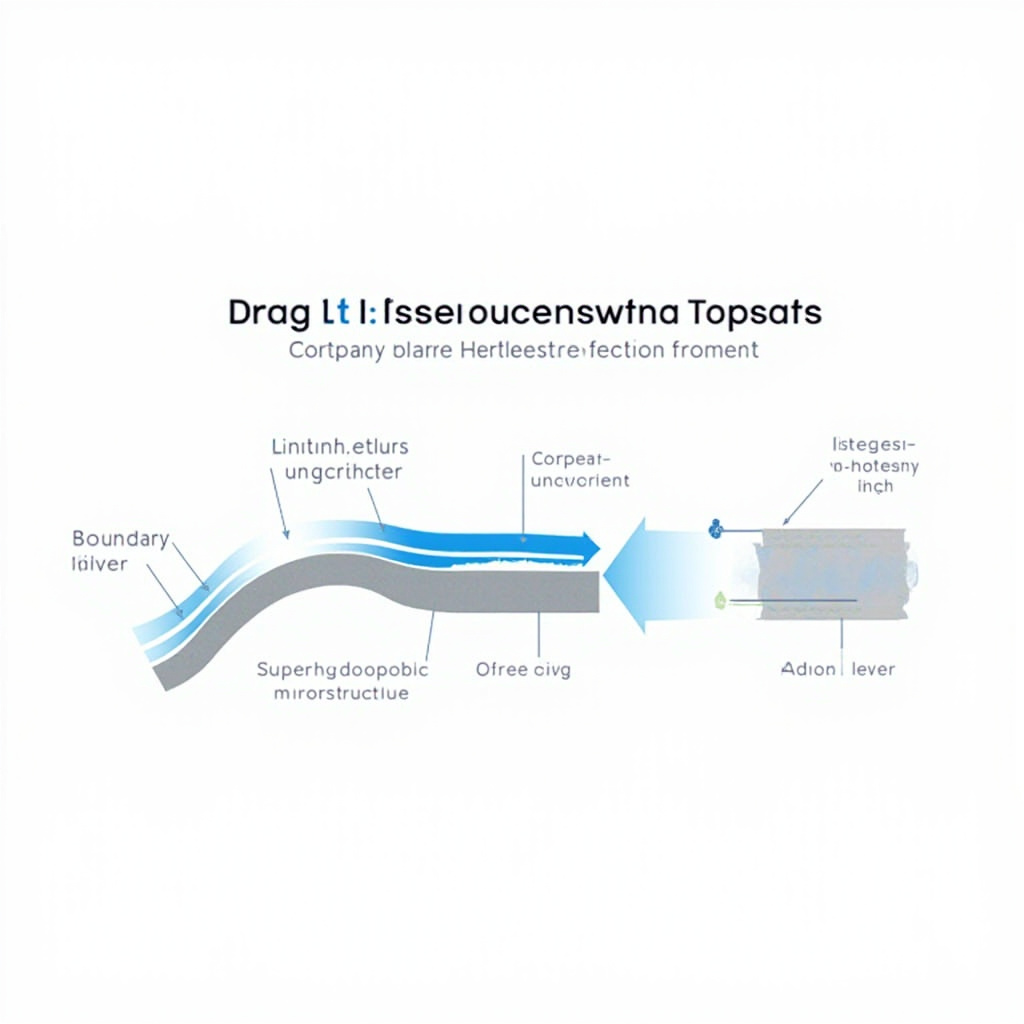
Mechanism Explained — Surface Roughness and Skin Friction Drag.For a turbulent boundary layer, there is a classic relationship between the skin friction drag coefficient Cf and surface roughness — when the dimensionless roughness k⁺ = uτ·k/ν < 5 (hydraulically smooth regime), roughness has no effect on Cf; when 5 < k⁺ 70 (fully rough regime), Cf depends only on roughness and is independent of the Reynolds number Re. At racing speeds (250–350 km/h, Re ≈ 10⁷–10⁸), with a clearcoat surface roughness element height k = 0.5–2 μm, friction velocity uτ ≈ 0.1–0.3 m/s, and air kinematic viscosity ν ≈ 1.5×10⁻⁵ m²/s — the calculated k⁺ ≈ 3–40, which lies in the critical range from the hydraulically smooth regime toward the transitional rough regime. Reducing k to < 0.1 μm gives k⁺ < 2 — safely within the hydraulically smooth regime, where Cf depends only on Re and is independent of surface roughness — which is precisely the physical objective of nano drag-reduction coatings.
Data support:The three-level validation results (CFD + wind tunnel + actual flight) from the EU SANAD project (Synthesis of Advanced top Nano-coatings with improved Aerodynamic and De-icing behavior, 2013-2017): Nano-coatings based on metal oxide/carbon nanotube/graphene filled epoxy or polyacrylic resin increased the water contact angle by 18-47% (vs standard aviation coatings), reduced boundary layer thickness, and wind tunnel tests + CFD simulations confirmed a reduction in turbulent skin friction drag. The optimal formulation has been applied as a topcoat to British Airways aircraft for drag validation under real flight conditions. US8258206 patent data: Only 0.25wt% fumed nano-SiO2 (AEROSIL R8200/R812S, 7-40nm) + hydrophobic TiO2/ZnO is needed to achieve a water contact angle of >150°, and UV stability (with 0.5wt% nano-ZnO added) improved from 31 days (under UV lamp irradiation conditions).
Source:EU SANAD Project (CORDIS), US8258206, AEROSIL Technical Data
Formulation design of nanocoatings — "minimum addition, maximum effect"
Direct answer:The formulation design principle of racing-grade nano topcoat is "achieving drag reduction without sacrificing basic properties" — the addition amount of nano fillers must be low enough (usually 0.25-5 wt%) to maintain the transparency, gloss, and mechanical properties of the clearcoat. Core formulation components: (1) Nano SiO2 (gas-phase method, hydrophobic type, 7-40 nm, 0.25-2 wt%) — provides surface nano-roughness and superhydrophobic function; (2) Nano ZnO (20-50 nm, 0.1-0.5 wt%) — UV absorption and free radical quenching, greatly extending outdoor durability; (3) Hydrophobic TiO2 (10-30 nm, 0.1-0.5 wt%) — auxiliary hydrophobicity and UV shielding; (4) Fluorocarbon-modified polyacrylic or trimethylsilyl-terminated siloxane resin — low surface energy matrix, synergizing with nano fillers to achieve superhydrophobicity (water contact angle >150°).
Mechanism Details — Aerosol Formulation for Spray Application (US8258206). The patent specifically emphasizes a spray-application formulation suitable for large surfaces (aircraft/racing cars) — using VOC-compatible solvents (e.g., acetone/butyl acetate mixture) to pre-disperse nanoparticles in the solvent to form a stable low-viscosity (<50 cP) aerosol suspension. Advantages of spray application: (1) uniform coating on vertical surfaces and complex curved surfaces; (2) nanoparticles are further dispersed during the flight of spray droplets — rapid solvent evaporation avoids re-aggregation of nanoparticles in the wet film; (3) ultra-thin film thickness (1–5 μm) — only 1/10–1/20 of traditional clear coats, with almost no impact on total vehicle weight and body panel gaps. With such a thin film, the coating's effect on gloss and color appearance is negligible.
Data support:Experimental data from patent US8258206 shows that 0.25wt% nano-SiO2 (R8200) + 0.5wt% nano-ZnO in a trimethylsilyl-terminated siloxane matrix yields a water contact angle of 155±3°, sliding angle 90% (vs. the matrix without nanoparticles). After spraying, the coating's RMS roughness (AFM measurement, 10×10μm scan area) is 12±3nm—already approaching molecular-level smoothness.
Source:US8258206, EU SANAD Project, AEROSIL R8200/R812S Technical Data
Frequently Asked Questions
Can the effect of nano drag-reduction coatings be demonstrated on mass-produced vehicles?
At legal speeds for production vehicles (<120 km/h), aerodynamic drag is dominated by pressure drag (determined by body shape)—skin friction drag accounts for <10%, so nano anti-friction coatings have limited impact on fuel/electricity consumption (100 km/h) conditions.
How long does the superhydrophobic performance of the nano topcoat last?
The durability of spray-applied nano topcoats (1-5 μm) is lower than that of conventional thick-film clearcoats (30-50 μm) — under normal use conditions (car washing 2-3 times per month), the superhydrophobic function (contact angle >150°) can last 6-12 months, after which it gradually decays to ordinary hydrophobicity (100-120°). Re-spraying (simply cleaning the surface and spraying again) restores it — similar to the "refresh" maintenance procedure that race cars undergo after each race.
Can nano-coatings be used on everyday road vehicles?
Technically feasible, but cost-effectiveness needs to be evaluated. Currently, the primary markets for nano drag-reduction coatings are motorsports (Formula 1/GT/endurance racing), supercars (OEM or aftermarket), and aerospace—sectors where the willingness to pay for marginal performance gains is extremely high. As nanomaterial costs decline and spraying processes become automated, penetration into high-end mass-produced vehicles (e.g., Porsche, Tesla Plaid) is possible within the next 5–10 years.
Reference sources:EU SANAD Project (CORDIS, 2013-2017), US8258206, AEROSIL Technical Data, CFD/Wind Tunnel Validation Reports
Publish Date: July 6, 2026 | Category: Technical Knowledge