Anti-corrosion protection of steel structures is not a piecemeal action of "buying a few buckets of paint and brushing them on", but an engineering project with standards, processes, and acceptance inspections. From the design institute issuing the supporting specifications, to sandblasting, coating, and inspection, every link has a basis to follow: environmental classification uses ISO 9223 / ISO 12944, surface preparation uses GB/T 8923.1 (ISO 8501-1), construction quality uses the relevant clauses of GB 50205 "Standard for Acceptance of Construction Quality of Steel Structures", and hazardous substances in coatings use GB 30981-2020. The significance of standards is to turn "anti-corrosion" from personal experience into an auditable, accountable, and reproducible engineering language. Whether a bridge, a storage tank, or a piece of plant steel structure can still avoid rust-through after ten, twenty, or even more years often does not depend on how expensive a certain coating is, but on whether the design, preparation, construction, and acceptance strictly follow the standards in a closed loop.
Kexin New Materials (kexinMaterials) always treats standards as the bottom line of delivery when participating in steel structure anti-corrosion projects. This article strings together the key points of the whole-process standards, and connects with the companion articles Anti-corrosion Coating System Matching Design, Steel Structure Corrosion Mechanism and Classification, and Rusty Surface Treatment for Coating, to help you establish a practical standards framework in engineering practice.

I. Standards Framework: From International Standards to National Standards
Steel structure anti-corrosion engineering is a multi-standard coordinated system, mainly based on the following:
| Standard No. | Scope |
|---|---|
| ISO 12944 (Parts 1–9) | Corrosion protection of steel structures by protective coating systems: environmental classification, design, surface preparation, system selection, application, laboratory/field assessment |
| GB/T 8923.1 (ISO 8501-1) | Rust grades and preparation grades of steel surfaces before application of paints (A–D, Sa/St/F1) |
| GB/T 8923.2/3 | Abrasives for blast cleaning and surface roughness |
| GB 50205 | Standard for Acceptance of Construction Quality of Steel Structures (including coating sub-items) |
| GB/T 13452.2 (ISO 2808) | Determination of film thickness (wet film/dry film) |
| GB/T 9286 | Cross-cut adhesion |
| GB/T 5210 | Pull-off adhesion |
| GB/T 1771 | Resistance to neutral salt spray |
| GB 30981-2020 | Limits of hazardous substances in industrial protective coatings (VOC, heavy metals, etc.) |
These standards together form a closed loop of "design—preparation—coating—inspection". It should be emphasized that international standards (ISO) and national standards (GB/T equivalent adoption) are highly consistent technically; engineering documents may reference either, but once determined, the same caliber must be maintained throughout the lifecycle to avoid disputes caused by "design using ISO, acceptance using GB". The essence of standards is not to list them, but to transform them into quantitative indicators and executable processes in design documents.
II. Phase 1: Design and Environmental Classification
The first step in standards is classification, which is the origin of all subsequent decisions. Recalling Steel Structure Corrosion Mechanism and Classification, corrosion is driven jointly by water, oxygen, ions, and non-uniformity, and the driving forces differ greatly in different environments:
- Determine environmental grade according to ISO 9223 (C1 very low, C2 low, C3 medium, C4 high, C5-I/C5-M very high, CX extreme);
- Clarify structure type (e.g., internal, external, immersed) and durability objective (low ≤ 7 years, medium 7–15 years, high 15–25 years, very high >25 years) according to ISO 12944-1;
- Select the matching system (S2–S5 series of ISO 12944-5) and total dry film thickness (DFT) accordingly;
- Determine surface preparation grade (heavy anti-corrosion Sa2.5, light anti-corrosion may be St2/St3 or rusty treatment).
Design documents must be quantified and cannot contain vague instructions like "apply anti-corrosion paint two coats". A qualified technical appendix should at least include: environmental grade, durability objective, rust removal grade, type and film thickness of each coating layer, total DFT, acceptance standard and sampling ratio, and construction environmental boundaries. Once classification is wrong, no matter how good the coating is later, it cannot be saved—designing a C5-M marine environment as C3 is doomed to early rust recurrence.
III. Phase 2: Surface Preparation Standards
Surface preparation accounts for 50%–70% of anti-corrosion life and is the strictest link in standards and most prone to corner-cutting:
- Blast cleaning Sa2.5: mandatory for heavy anti-corrosion (ISO 8501-1 / GB/T 8923.1), surface free of visible grease, mill scale, rust, only slight color spots allowed (not exceeding a small amount per square decimeter);
- Roughness: after blasting, profile Ra usually 40–70 µm (depending on abrasive and product), beneficial for mechanical interlocking and coating anchoring;
- Abrasive: clean, dry, oil-free, conforming to GB/T 8923.2 (ISO 11124/11125), with reasonable particle size gradation, avoiding excessive dust or insufficient cutting;
- Degreasing and desalination: soluble oil residues and soluble salts (especially chloride ions) must be controlled; coastal and chemical plant areas require desalination treatment, as salt residues cause osmotic blistering;
- Dew point control: substrate temperature above dew point by more than 3℃ (ISO 12944-3) to prevent condensation causing paint film blushing and abrupt adhesion drop;
- Time limit after preparation: after Sa2.5, coating should be done as soon as possible (generally within 4 h or per standard) to prevent rust recurrence and mill scale regeneration.
For in-service structures where blast cleaning is impossible, follow Rusty Surface Treatment for Coating with St2/St3 + conversion/stabilization, but degreasing, desalination, and roughness control are still required. If the surface preparation stage is not held, all subsequent efforts will be discounted.
IV. Phase 3: Coating and System Standards
The core requirements of standards for coatings and systems are "qualified, consistent, controllable":
- Qualified coating: with certificate of conformity, TDS, third-party test report (VOC compliant with GB 30981-2020, heavy metals limited, key performance met);
- Consistent system: strictly follow the designed primer—intermediate—topcoat system (see Anti-corrosion Coating System Matching Design), no unauthorized material change or coating omission;
- Mixing and induction: two-component according to TDS volume/mass ratio, mechanical stirring, standing to defoam, use within pot life, discard if expired;
- Film thickness control: each coat DFT and total DFT meet the standard, measure with GB/T 13452.2 (wet film controlled on site, dry film sampled), avoid single-coat sag from excessive thickness or weak shielding from insufficient total thickness;
- Recoating interval: observe shortest/longest interval between coats, if exceeded, need scarifying or sanding, otherwise interlayer adhesion drops;
- Batch management: record batch number, production date, avoid color difference and performance fluctuation caused by mixing different batches.
V. Phase 4: Construction Environment and Process
Construction is the site where design is implemented; standards are extremely specific about environmental boundaries:
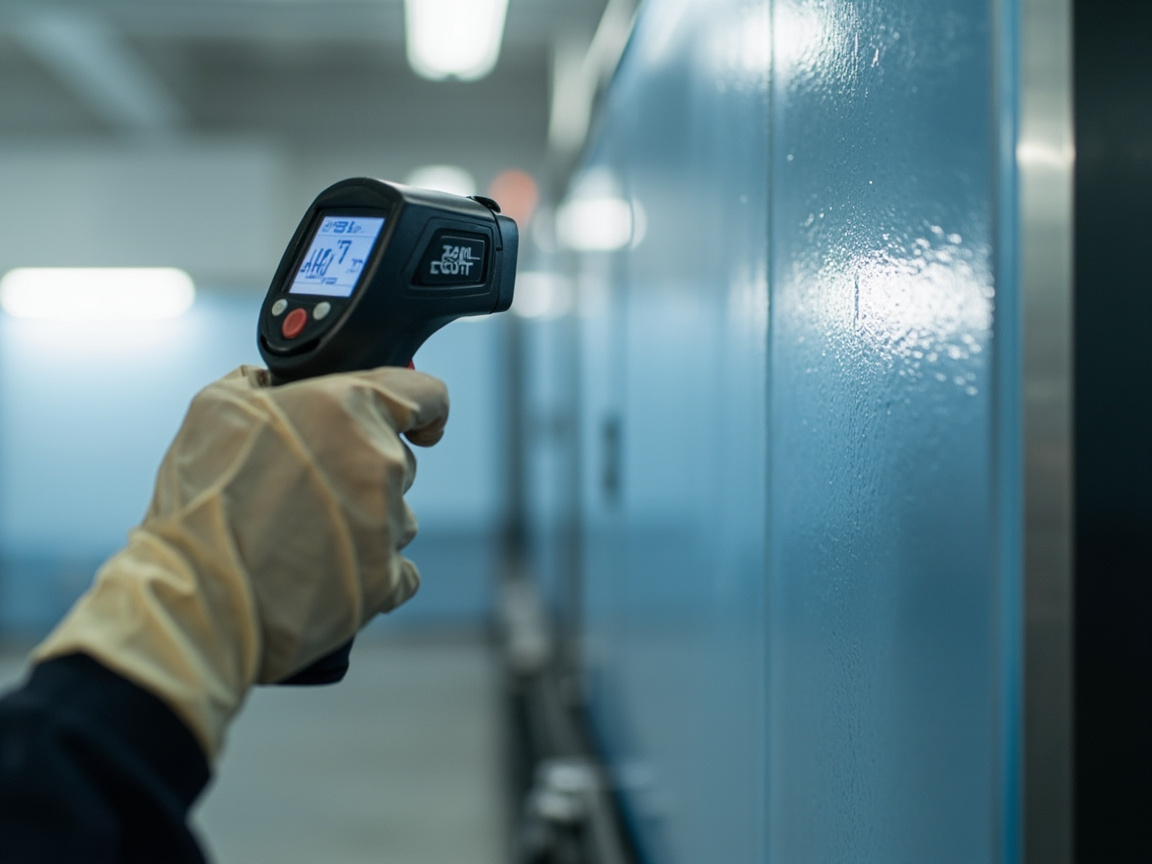
- Environment: temperature 5–35℃ (water-based systems lower limit, winter requires low-temperature curing type), RH ≤ 85%, substrate above dew point by 3℃;
- Method: heavy anti-corrosion mainly by airless spray (efficient, thick coating, good atomization), brush/roller for repairing edges/corners and hard-to-spray areas; spray gun parameters and pressure calibrated per TDS;
- Coats: accumulate by coats according to system, avoid single-coat sag from excessive thickness, control each coat's wet film to dry film conversion;
- Edge reinforcement: edges, welds, bolts, free edges pre-coated (stripe coat) first to prevent thin-spot early rust—these are high-corrosion areas;
- Ventilation and protection: forced ventilation in enclosed space construction, operators wear protection, waste paint and solvent disposed compliantly;
- Records: temperature/humidity, dew point, film thickness, mixing ratio, batch number, construction location recorded throughout for traceability.
VI. Phase 5: Acceptance Standards
Final acceptance shall be executed in accordance with the GB 50205 coating sub-item and product standards; release cannot be based on "looks pretty good":
| Acceptance Item | Inspection Basis | Pass Criteria |
|---|---|---|
| Appearance | Visual / GB 50205 | Uniform, no sagging, orange peel, pinholes, missed coating |
| Dry Film Thickness | GB/T 13452.2 | Average ≥ design, single point ≥ 90% of design (per specification and contract) |
| Adhesion | GB/T 9286 cross-cut / GB/T 5210 pull-off | Cross-cut grade 0/1, or pull-off reaching design tensile force |
| Missed coating / pinholes | Spark test (thick coating) / visual | No missed points, no pinholes |
| VOC / hazardous substances | GB 30981-2020 | Compliant with limits |
| Salt spray (spot check) | GB/T 1771 | Reach design hours and rating |
Film thickness judgment commonly adopts "average film thickness ≥ specified value, and the lowest point not less than 90% of the specified value (specifically per GB 50205 and design)", rather than point-by-point compliance. Adhesion spot checks shall be conducted at representative locations, and spark leak testing is used for high-build and linings. The acceptance report shall be attached with original records and third-party reports to form an archivable evidence chain.
VII. Maintenance and Repair Specifications
Steel structure anti-corrosion is a "full life cycle" project; delivery does not mean the end:
- Regular inspection (especially edges, overlaps, welds, areas prone to water accumulation, enclosed sections inside boxes);
- For local damage, first derust to St2/St3 or local Sa, then repair according to the original system (see rust stabilizer field application);
- Overhaul cycle is based on environmental grade and durability design (e.g., C4 high durability approx. 15 years); upon reaching age, conduct remaining life assessment to decide whether to fully repaint;
- Archive maintenance records to form a corrosion database, guiding the next design and maintenance;
- Establish an annual inspection system for critical structures (bridges, storage tanks, towers) to control minor rust at the budding stage.
VIII. Common Violations and Lessons
| Violation | Direct Consequence | Specification Correction |
|---|---|---|
| Insufficient derusting grade (using St instead of Sa2.5) | Early rust, delamination, halved service life | Mandatory blasting Sa2.5 + roughness inspection |
| Insufficient film thickness | Weak shielding, early rust | Quantitative control by DFT, on-site wet film measurement |
| Unauthorized change of primer type | Interlayer failure, lifting | Strictly follow design system; change requires justification |
| Construction under high humidity and condensation | Poor adhesion, blushing, bubbling | Control dew point >3°C, monitor temperature and humidity |
| No VOC compliance | Environmental liability, shutdown | Use GB 30981 compliant products and keep reports |
| Use beyond pot life | Non-drying, sharp performance drop | Estimate usage and mix accordingly; discard if overtime |
Kexin New Materials (kexinMaterials) holds the position that: specifications are not for "passing inspections", but the lowest-cost quality assurance. When we deliver coatings, we simultaneously provide process cards and acceptance templates compliant with ISO 12944 and GB 50205, enabling the contractor to "work by specification" rather than "by memory", locking quality fluctuation within the process.
IX. Recommendations for Specification Implementation
To bring specifications from paper to site, it is recommended to execute six measures:
- At design stage, determine grade and system, and write into contract technical appendix and drawing notes;
- Set dedicated inspection for surface preparation (Sa2.5 + roughness + degreasing and desalination + salt residue test);
- Upon coating arrival, verify TDS and VOC/performance test reports; reject unlicensed products;
- Record throughout construction: temperature, humidity, dew point, film thickness, mixing ratio, batch number, for traceability;
- Upon completion, accept by GB 50205 sub-item, with third-party salt spray/adhesion spot checks attached;
- Establish maintenance files, assess and repaint at age, forming corrosion–maintenance closed loop.
The difficulty in implementing specifications lies not in "having standards or not", but in "whether every process has someone responsible and records to check". Embedding responsibility and data into the process is the only way to guarantee the quality of anti-corrosion projects.
X. Cost-Performance Perspective of Specifications
Some think "working by specification" is too costly and slow; actually the opposite: one early-rust rework caused by insufficient derusting often costs several times the sandblasting money saved initially; one shutdown ordered due to VOC non-compliance loses far more than the coating price difference. Specifications use determined processes to hedge uncertain corrosion risks. For safety-related critical structures (bridges, storage tanks, towers), prefer over-protection rather than leaving hazards; for secondary, easily replaceable components, moderate simplification is allowed, but the baseline remains GB 50205 and GB 30981 compliance. Applying "spend where needed, save where possible" to quantitative judgment is the mature engineering economic view.
XI. Supplementary Specifications for Special Parts and Special Environments
In execution, specifications must set special provisions for "difficult parts", otherwise an average-qualified system will fail locally first:
- Welds and heat-affected zones: non-uniform structure, high stress, are anodic preferential corrosion points; must be blasted to standard and pre-coated for reinforcement;
- Bolted connections and overlap seams: crevice corrosion is frequent; should be continuously welded or sealed with sealant, ensuring coating penetration into seams during painting;
- Edges, free edges: should be chamfered or smoothed to avoid thin film at sharp corners;
- Box girders / enclosed cavities: poor ventilation, prone to condensation; design should reserve drainage and access channels, use long-life system if necessary;
- Splash zone and tidal range: wet-dry alternation is most severe; film thickness and system should be higher than atmospheric sections.
The specification for these parts is not "one extra coat", but writing corrosion mechanism into the process, achieving "thick where needed, sealed where needed".
XII. Coating Incoming Inspection and Document Management
Specification implementation cannot be separated from "certificate management". Upon coating arrival, verify:
| Document / Item | Requirement |
|---|---|
| Certificate and factory inspection report | Batch number, model, production date complete |
| Third-party test report | VOC compliant with GB 30981, key performance meets standard |
| Safety Data Sheet (SDS) | Includes health and environmental hazards, disposal |
| Retained sample and batch traceability | Retain same-batch sample for dispute retest |
Coatings without compliant reports shall not be used for main structures. Documents shall be archived into project data, saved together with construction records and acceptance reports, forming an auditable quality chain. For critical projects, it is recommended to retest adhesion and film thickness samples for each batch of primer, blocking risk before start.
XIII. Key Points of Design Document Template
An executable anti-corrosion technical appendix should include the following quantitative items; missing items are deemed unqualified:
- Environmental grade and basis (ISO 9223 / ISO 12944-2);
- Durability target (low/medium/high/very high and corresponding years);
- Surface preparation grade (Sa2.5 or St grade) and roughness range;
- Name, model, dry film thickness and total DFT of each coating layer;
- Construction environment boundaries (temperature, humidity, dew point);
- Acceptance standard and spot-check ratio (film thickness, adhesion, salt spray);
- Maintenance cycle and age assessment requirements.
Writing the above items into contract and technical appendix allows the contractor to "construct by drawing", and the supervisor to "accept by clause", avoiding responsibility vacuum caused by oral experience.
XIV. Responsibility Boundaries and Training for Specification Execution
Specifications are not paper systems, but responsibility allocation. The design party is responsible for grading and system; the material party for product compliance and data authenticity; the construction party for surface preparation and coating process; the supervisor for process and acceptance. If any party is absent, the loop breaks. It is recommended to conduct process disclosure and sample confirmation before project start, letting frontline workers understand "why Sa2.5, why control dew point, why not rush schedule". Training investment is minimal, yet can significantly reduce re-rust rate, being the most cost-effective part of specification implementation.
XV. Key Differences between Typical Domestic and International Specifications
ISO 12944 aligns with international standards; national standards mostly adopt it equivalently, but details still need attention: ISO 12944 uses environmental grades C1–CX and durability classification; GB/T gives correspondence based on domestic climate and material practice; surface preparation ISO 8501-1 is consistent with GB/T 8923.1; film thickness acceptance GB 50205 emphasizes dual control of average film thickness and minimum point; for VOC, GB 30981-2020 sets separate limits, with different focuses from EU eco-label and US EPA rules. Cross-border projects must clarify "which standard to accept by", avoiding calibration conflict from designing by ISO and accepting by GB. Understanding differences allows writing the "sole criterion" clearly in the contract.
XVI. Digital Inspection and Intelligent Acceptance
Standard execution is shifting from "manual recording" to "data-driven".联网 temperature, humidity and dew point meters record in real time and can alert on condensation risk; thickness gauges with Bluetooth automatically upload, and film thickness distribution can generate heat maps to promptly detect thin spots; adhesion and salt spray data enter the project database, forming a traceable quality archive. Digitalization does not replace standards, but turns every clause of the standard into a quantifiable, auditable data stream, making "doing it by the standard" truly verifiable and accountable.
17. Common Owner Misconceptions and Corrections
Misconception 1: "Two coats of anti-rust paint are enough." Wrong. It is necessary to define the grade, define the system, and define the film thickness; a casual two coats often have insufficient film thickness and a mismatched system.
Misconception 2: "Imported paint must be good." Wrong. No matter how good the paint, if used in the wrong environment or with wrong surface preparation, it will rust early; matching the working condition is more important than the brand.
Misconception 3: "Acceptance is based only on appearance." Wrong. Uniform appearance is just the entry level; film thickness, adhesion, and salt spray retesting are the guarantee of service life.
Misconception 4: "Recoating should be as fast as possible." Wrong. Rushing the schedule by compressing surface preparation and curing is burying the hidden risk of early rust.
Correcting these misconceptions relies on writing the standard into the contract, implementing it in the process, and verifying it with data.
18. Linkage Between Standards, Insurance, and Quality Warranty
In engineering practice, standards are not only technical documents but also the basis for responsibility and quality warranty. Many large projects write the coating standard into insurance contracts and quality guarantee letters; once early rust occurs, the insurance company and the owner will trace the responsibilities of the design, material, and construction parties according to the standard clauses. This means "doing it by the standard" is both a quality assurance and a legal risk firewall. The quantitative indicators in the standard (film thickness, adhesion, salt spray) are exactly the objective evidence in warranty disputes, more reliable than any verbal promise. Therefore, owners should make standard compliance a hard threshold in bidding, rather than just comparing prices; construction units should archive process data as proof of performance. Only when standard, insurance, and warranty interlock can a truly closed-loop engineering governance be formed.
19. Standardized Template for Training and Briefing
The last mile of standard implementation is people. No matter how perfect the document is, if front-line workers do not understand "why Sa2.5, why control dew point, why not rush the schedule", execution will go wrong. It is recommended to conduct standardized briefing before each project starts: use physical samples to compare qualified and unqualified surface preparation effects, use film thickness heat maps to explain the harm of thin spots, and use failure cases to warn against lifting and re-rust. The briefing should form sign-in and assessment records as part of the process archive. For labor-intensive coating operations, this low-cost training investment often has the highest return rate. "Translating" the standard into a language workers can understand is the key step from paper to steel plate.
20. Full-Process Penetration of Standards in EPC General Contracting
Under the EPC general contracting model, the anti-rust standard should not only appear in the construction phase, but should penetrate the whole life cycle of design, procurement, construction, commissioning, and operation & maintenance. In the design phase, define grade and system; in the procurement phase, verify coating compliance and test reports; in the construction phase, execute surface preparation and film thickness control; in the commissioning phase, do handover acceptance; in the operation & maintenance phase, conduct inspections and recoating according to the standard. As the unified responsible entity, the general contractor is most equipped to string the standard into a closed loop and should also bear the greatest warranty responsibility. Practice shows that if the standard is moved forward in EPC, later re-rust and disputes drop significantly. For owners, in bidding, standard compliance, test data delivery, and warranty period should be written into the contract as hard indicators, rather than just looking at the total price. Full-process penetration of the standard is the touchstone for measuring the professionalism of an engineering company.
21. Green Coating and Carbon Footprint Perspective
From the green coating perspective, anti-rust engineering is being incorporated into carbon footprint and environmental performance evaluation. Low-VOC coatings (water-based, high-solid, solvent-free) reduce organic solvent emissions, corresponding to lower VOC and occupational health risks; long-life systems reduce recoating frequency, which from a full life cycle view actually lowers resource consumption and waste coating generation; standardized surface preparation and film thickness control avoid premature failure, which is invisible carbon reduction. But at the same time, be wary of VOC-only theory—if a water-based system leads to frequent recoating due to insufficient durability, its full-cycle environmental burden may instead exceed. Therefore, the correct path for green coating is compliance with VOC, long-life system, and standardized construction proceeding in parallel, using life cycle assessment rather than a single indicator to measure environmental friendliness. This requires the standard itself to incorporate sustainability clauses, unifying environmental goals and protection goals in the technical standard.
22. Common Organizational Barriers and Solutions in Standard Execution
Standard implementation often encounters three types of organizational barriers: first, dispersed responsibility, where design, material, construction, and supervision each manage a segment, leaving a vacuum at the interfaces; the solution is to write quantitative indicators of the standard into the contract and technical attachments, clarifying each party's boundary and penalties. Second, cost pressure, where low-price winning bids squeeze surface preparation and testing budgets, leading to cutting corners; the solution is to introduce a full life cycle cost view, making the hidden cost of early rust repair explicit. Third, capability gap, where the front line lacks technical workers who understand the standard; the solution is standardized briefing and sample-led approach, translating the standard into executable actions. These three barriers are essentially "management problems", not technical problems. A truly professional project is often not about how beautifully the standard is written, but about turning the standard into everyone's daily action and organizationally covering every interface.
23. Integration of Standards with Digital Twin and Life Prediction
The anti-rust standard is integrating with digital twin technology, turning static standards into dynamic models. By deploying temperature, humidity, and corrosion sensors at key structural parts, continuously collecting environmental data, and combining with coating aging models, the remaining protection life can be predicted and maintenance warnings triggered. This "standard plus data" model allows the durability expectation of ISO 12944 to shift from a design assumption to real-time calibration during operation, making recoating decisions change from blind periodic to precise on-demand. For large bridges, storage tanks, and offshore structures, digital twin can significantly reduce the dual risks of over-maintenance and sudden failure. Of course, the model relies on high-quality data and accurate mechanisms; the foundation is still the standard discipline mentioned above. No matter how new the technology, the underlying requirements of surface preparation, film thickness, and system will not change; what changes is only the way we observe and decide.
FAQ
Q: What are the main standards for steel structure anti-rust?
A: Core includes ISO 12944 (environmental classification, design, surface preparation, system, construction, evaluation), GB/T 8923.1 (rust and derusting grades Sa/St), GB 50205 (construction quality acceptance), GB/T 13452.2 (film thickness), GB/T 9286 (adhesion), GB/T 1771 (salt spray), GB 30981-2020 (VOC and hazardous substances). Forms a design—preparation—coating—acceptance closed loop.
Q: Why is Sa2.5 mandatory for heavy-duty anti-corrosion instead of St?
A: Blast cleaning Sa2.5 (ISO 8501-1) can thoroughly remove scale, rust, and oil, leaving only slight color spots, ensuring the primer fully adheres to the substrate and avoiding residual active rust breaking the coating. Manual St grade cleaning is not thorough, only suitable for light anti-corrosion or rust-in-place maintenance; heavy-duty anti-corrosion life relies on Sa2.5 as the bottom line.
Q: Does every point need to meet the standard for film thickness acceptance?
A: Usually according to the standard, "average film thickness ≥ design value, and the lowest single point not less than 90% of the design value (subject to GB 50205 and design documents)", rather than point-by-point compliance, balancing construction fluctuation and statistical rationality. But key parts (edges, corners, welds) should not be lower than design.
Q: Why must the dew point be more than 3℃ above before construction?
A: If the substrate temperature is lower than the dew point, condensation occurs; the water film makes the coating blush, adhesion drops sharply, and rust accelerates. ISO 12944 stipulates that the substrate temperature must be more than 3℃ above the dew point, a hard boundary against condensation, and must be measured with a dew point meter before construction.
Q: What happens if the mixing ratio of two-component coating is wrong?
A: Too little hardener leads to insufficient cross-linking, soft and sticky and not chemical resistant; too much leads to brittle cracking and high free monomer. Must strictly follow the TDS volume/mass ratio with mechanical stirring, and use up within the pot life, see details in Anti-rust Coating System Matching Design.
Q: What to do after completion?
A: Establish a maintenance cycle according to environmental grade and durability design, regularly inspect edges/overlaps/welds, repair local damage according to the original system (can refer to Rust Stabilizer Field Construction), and conduct overall assessment and recoating at age, forming a corrosion archive.
Q: What position does VOC compliance occupy in the standard?
A: GB 30981-2020 sets limits on VOC and heavy metals for industrial protective coatings; coating entering site must have a compliance test report, otherwise faces environmental accountability. Selection should review VOC and performance in parallel, see details in Water-based Anti-rust Paint Formulation Key Points.
Q: How to handle in-service structures that cannot be blasted according to the standard?
A: According to rust-in-place maintenance standard: first determine rust grade (GB/T 8923.1), do St2/St3 cleaning + degreasing and desalination, then use rust converter/stabilizer and match with intermediate coat and topcoat (see Rust-in-place Coating Surface Treatment), acceptance also requires adhesion and film thickness to meet the standard.
Q: Why pre-coat edges and welds?
A: Edges, welds, and bolts are prone to thin film, sagging and missing, the "thin spots" where corrosion occurs earliest. Pre-coat (stripe coat) ensures these parts have sufficient film thickness and adhesion, a key detail in the standard to reduce local early rust.
Q: Is third-party random inspection necessary?
A: Very necessary. Self-inspection is easily affected by subjectivity and interest; third-party random inspection of salt spray, adhesion, and film thickness according to GB/T 1771, GB/T 9286, GB/T 13452.2 can objectively verify whether the system meets the design life expectation, and is also evidence for project accountability and warranty.
Further Reading
- Anti-rust Coating System Matching Design: Specific methods for "primer—intermediate—topcoat" system design and film thickness allocation in the standard.
- ISO 12944 Anti-corrosion Coating System Selection Guide: A complete framework mapping the standard clauses in this article to the standard system.
- Steel Structure Rust Mechanism and Classification: Understand why the standard starts from ISO 9223 environmental grading.
- Anti-rust Paint Salt Spray Test: DIN EN ISO 9227 and GB/T 1771