Key Takeaways:
1. Acid rain (pH<5.6) corrosion of automotive clear coats fundamentally involves H⁺-catalyzed hydrolysis of ester and ether bonds in clear coat resins — nano anti-acid rain clear coats achieve chemical inertness by replacing hydrolysis-sensitive bonds with -Si-O-Si- cross-links.
2. Nano-SiO₂/TiO₂ particles (5-20nm) form “free volume filling + UV absorption” dual protection in clear coat matrices — reducing water vapor transmission rate by 50-70% while absorbing/reflecting 95%+ UV radiation to protect underlying base coat.
3. BASF iGloss nano-hybrid clear coat represents the state-of-the-art in OEM factory paint — achieving optimal comprehensive performance balance through 90-95% organic (elasticity/weatherability) + 5-10% inorganic (hardness/scratch resistance) nano-hybridization.
In southern China and industrialized regions, acid rain (pH as low as 3.5-4.5) corrosion damage to automotive paint surfaces is a seriously underestimated long-term threat. Acid rain containing H₂SO₄, HNO₃, and organic acids (formic, acetic) undergoes dramatic concentration increase after water droplet evaporation on paint surfaces — a single pH 4.0 acid rain droplet, upon complete evaporation, can leave residual acid with localized pH below 1.0 — sufficient to form irreversible circular etching (acid rain spots) on clear coat surfaces within hours. High-gloss anti-acid rain nano clear coats fundamentally reconstruct coating hydrolysis resistance and densification from the cross-linking chemistry foundation of clear coat resins.
Acid Rain Corrosion Chemistry — Why Does Clear Coat Get “Eaten” by Acid?
Direct Answer: Traditional automotive clear coats (OEM and refinish) predominantly use melamine-acrylic (amino resin-acrylic) cross-linking systems — where melamine resin hydroxymethyl groups (-CH₂OH) condense with acrylic resin hydroxyl groups (-OH) to form ether cross-links (-C-O-C-). These ether bonds are highly susceptible to acid-catalyzed hydrolysis: -C-O-C- + H₂O →(H⁺)→ -C-OH + HO-C- — the coating cross-link network is “cut,” manifesting macroscopically as gloss loss, hazing, and irreversible etching spots.
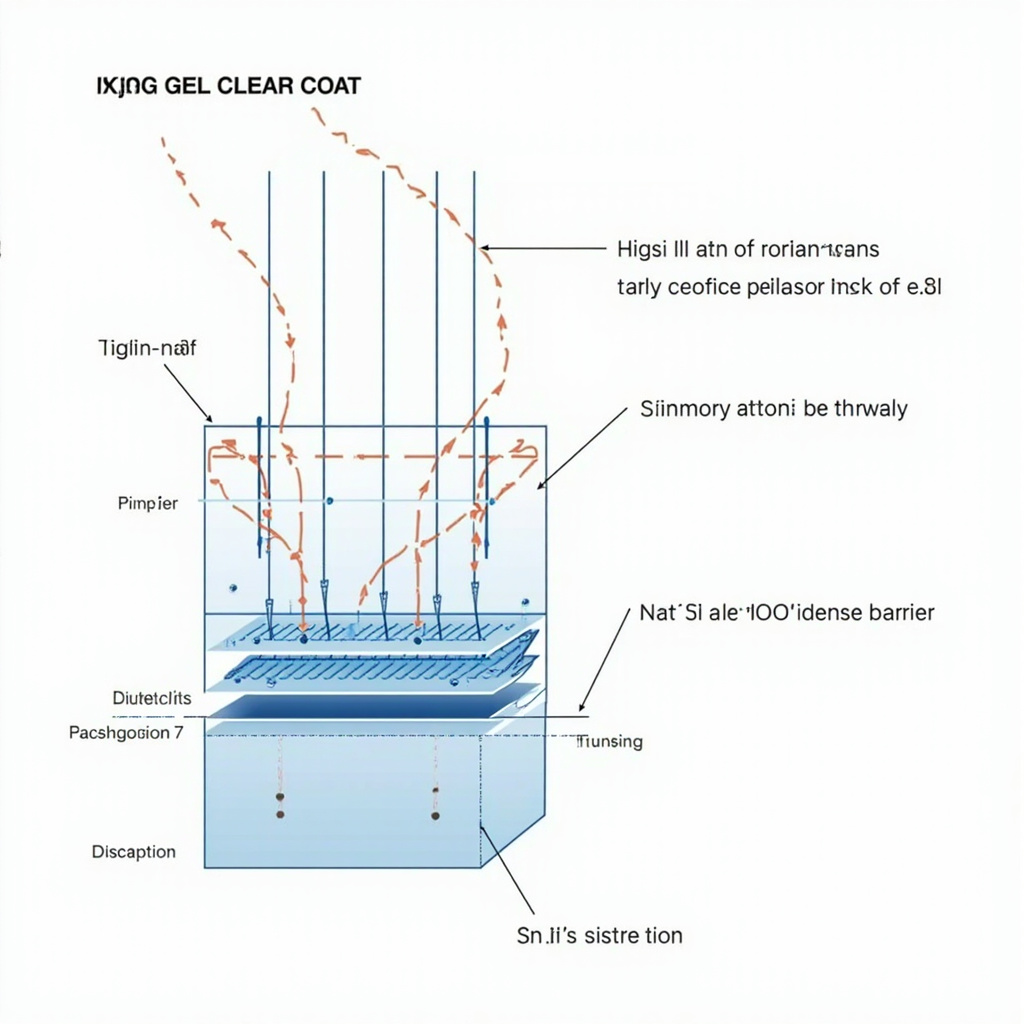
Data Support: China National Environmental Monitoring Centre 2025 data shows approximately 28% of cities nationwide have annual average precipitation pH below 5.6, with over 15 cities in southern and eastern China experiencing acid rain frequency exceeding 40%. A typical acid rain event (10mm rainfall, pH 4.0, 4-hour duration) on unprotected paint can produce visible etching spots within 24 hours at 40°C ambient temperature.
Sources: China National Environmental Monitoring Centre 2025, EP0484540A1, BASF iGloss Technical White Paper
Nano-Densified Protection — Triple Mechanism Anti-Acid Defense Line
Mechanism 1: Si-O-Si Chemical Inertness. Patent EP0484540A1 proposes an alkoxysilane-modified acrylic + amino resin hybrid cross-linking system — introducing -Si(OR)₃ functionalized acrylic monomers that hydrolyze and condense during curing to form -Si-O-Si- cross-link points. Unlike traditional -C-O-C- ether cross-links, Si-O-Si bond energy (~452 kJ/mol) far exceeds C-O (~358 kJ/mol), and Si-O-Si bonds do not undergo acid-catalyzed hydrolysis (Si-O-Si hydrolysis actually requires alkaline or F⁻-catalyzed conditions). This enables the coating to withstand 40% H₂SO₄/50°C/5h immersion with zero change.
Mechanism 2: Nano-SiO₂ Free Volume Filling and Barrier Enhancement. Organic polymer coatings contain abundant “free volume voids” at the microscopic scale — gaps between polymer chain segments, diameter ~0.5-2nm. Water molecules (kinetic diameter ~0.27nm) and H₃O⁺ ions can diffuse through these voids. Nano-SiO₂ particles (5-20nm) fill these free volume voids and form physical barrier networks, reducing WVTR by 50-70%. Experimental data shows acrylic clear coat with 10wt% nano-SiO₂ (15nm) reduces WVTR from ~25 g/m²/day to ~9 g/m²/day under 40°C/90%RH.
Mechanism 3: Nano-TiO₂/ZnO UV Shielding. UV radiation is acid rain etching’s “accomplice” — UV-generated free radicals attack clear coat C-H and C-C bonds, creating surface micro-cracks and polar groups (-COOH, -OH) that increase surface hydrophilicity and acid wettability. Nano-TiO₂ (rutile, 10-30nm, bandgap ~3.0-3.2eV) and nano-ZnO (20-50nm, bandgap ~3.3eV) provide efficient UV shielding. Nano-CeO₂ and HALS synergistically quench photo-oxidation free radicals, blocking radical chain degradation reactions.
Data Support: BASF iGloss — currently the only nano-hybrid clear coat achieving OEM mass production (3-wet integrated coating process) — delivers >25% scratch resistance improvement and 90% instant reflow recovery (60°C) on Mercedes-Benz and BMW models. Nanovere Nano-Clear® has passed 4,000-hour QUV accelerated weathering (equivalent to 20-year Florida exposure) with zero deterioration.
Sources: EP0484540A1, BASF iGloss, Nanovere Nano-Clear®, QUV ASTM G154
FAQ
Q: Anti-acid rain nano clear coat vs. ceramic coating — difference?
Ceramic coating is an additional SiO₂ protective layer (2-10μm) applied over clear coat — aftermarket add-on protection. Nano anti-acid rain clear coat integrates nanoparticles within the clear coat formulation itself — OEM factory or professional refinish system. Former’s acid rain resistance durability depends on add-on layer integrity (1-5 years); latter’s acid resistance is inherent to the clear coat chemistry.
Q: Can existing acid rain spots be repaired?
Light etching (depth <1μm): fine polishing removes ~0.5-1.5μm clear coat layer. Deep etching (>3μm): requires wet sanding + multi-stage polishing + clear coat respray — damage has penetrated most clear coat thickness; further polishing risks burning through to base coat.
Q: Does nano anti-acid rain clear coat affect color or gloss?
No. Nano-SiO₂ refractive index (1.46) closely matches clear coat acrylic resin (1.48-1.50), producing no visible scattering — DOI remains >90. In fact, nano-particles filling coating surface micro-defects typically slightly improve DOI and 20° gloss (2-5 units).
References: EP0484540A1, BASF iGloss, Nanovere Nano-Clear®, QUV ASTM G154, China Environmental Monitoring Centre 2025, Progress in Organic Coatings
Published: July 6, 2026 | Category: Technical Knowledge