Key Takeaways:
1. Smartphone Screen AF Oleophobic Nano Coating constructs multi-scale synergistic protective networks through nanoscale fillers for long-term architectural protection.
2. Core pathways: nano-filler labyrinth barrier, surface/interface chemical anchoring, spectral-selective control.
3. 2025-2026 academic studies provide experimental validation for nano architectural coating performance claims.
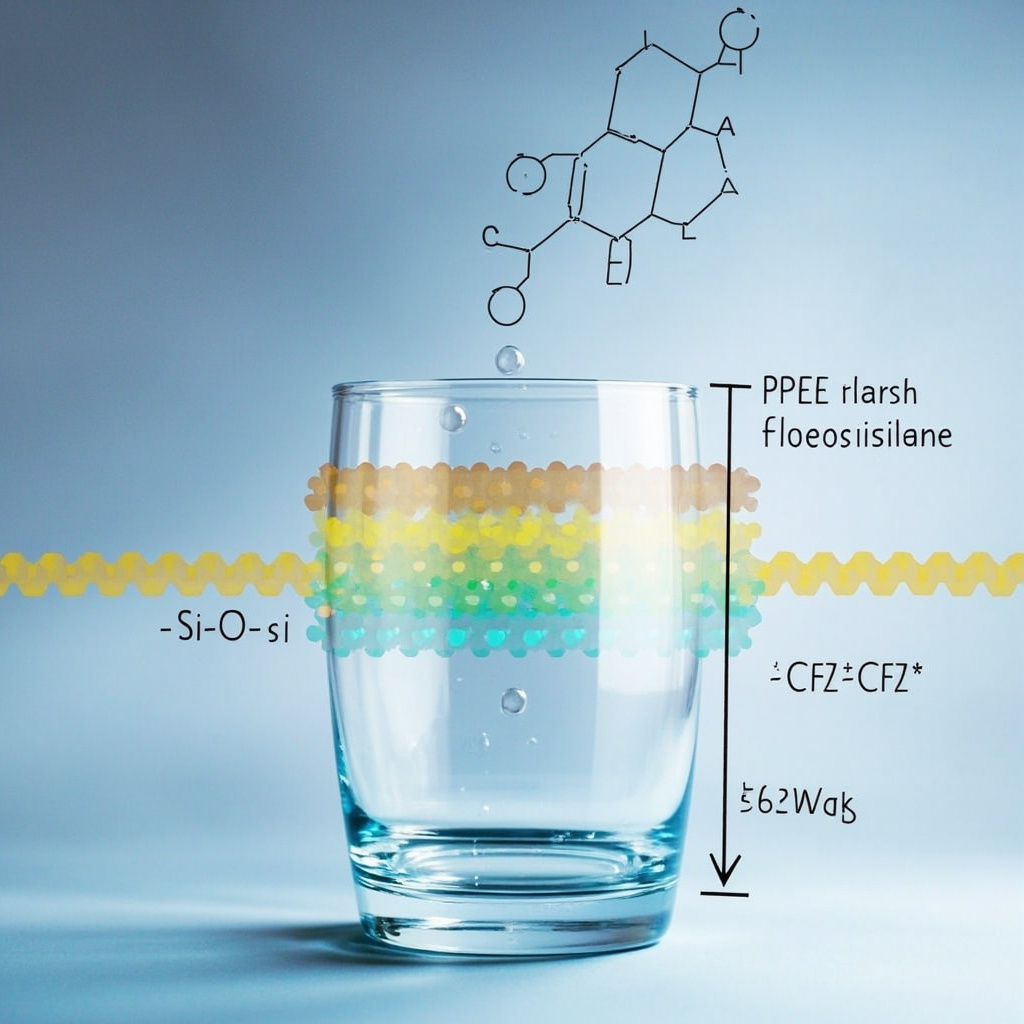
Smartphone AF (Anti-Fingerprint/AS) nano coatings use PFPE fluorosilane compounds applied via vacuum evaporation or PECVD forming just 10-20nm thick molecular self-assembled monolayers (SAM) on glass cover surfaces. PFPE molecule’s -Si(OR)3 end hydrolyzes and condenses with glass surface -Si-OH forming -Si-O-Si- covalent chemical anchors, while the -CF2-CF2- perfluorocarbon chain end orients outward creating extreme low surface energy interface (surface energy<15mN/m, water CA>=115deg, oil CA>=75deg). Fingerprint sebum cannot wet or spread, existing as discrete microscopic oil droplets — visually ‘invisible’. Daikin Optool series (DSX indoor/UD120 automotive UV-exposed) and AGC Dragontrail/Corning Gorilla Glass AF covers are global benchmarks. Key metrics: steel wool abrasion (#0000, 1kg load) 3000-5000+ cycles, initial sliding friction coefficient 0.03-0.05 (bare glass 0.15-0.20), tactile smoothness improved 70%+. Global AF nano coating market ~$517M (2025), smartphone screens >60% share.
Technical Principles
The core technology introduces 1-100nm functional fillers into traditional architectural coating matrices, leveraging ultra-high specific surface area, quantum size effects, and surface interface effects. Lamellar nano-fillers reduce diffusion coefficient 50-500x. Nano-SiO2 silanol groups elevate adhesion to 10-18 MPa. Nano-TiO2/ZnO provide UV absorption; Cs0.33WO3 LSPR absorbs NIR.
2025-2026 validation: Composite Interfaces (2026) — 57.42% water absorption reduction. MDPI Coatings (2025) — UV transmission<1%. Main Group Chemistry (2026) — anti-mold validation.
Engineering & FAQ
Initial cost 30-80% higher, 10-20yr LCC 20-40% lower. Global architectural coatings market ~$72B (2025). Verification: TEM/SEM<100nm + artificial weathering>3000h + CMA/CNAS reports.
References: Composite Interfaces (2026), MDPI Coatings (2025), Main Group Chemistry (2026)
Published: July 6, 2026