Core Conclusions:
1. Superhydrophobic basement moisture-proof and anti-mold nano-penetrating coating builds a multi-scale synergistic protection network through nano-scale functional fillers, achieving long-term protection and functional integration in the fields of construction and infrastructure.
2. Core technical pathways: labyrinth effect of nano-filler barrier, surface/interface chemical anchoring enhancement of nanoparticles, and spectral selective regulation of nano-functional fillers.
3. Multiple academic studies and commercial product data from 2025-2026 provide sufficient experimental verification and field application evidence for the performance of nano building coatings.
Superhydrophobic basement moisture-proof and anti-mold nano-penetrating coating constructs a superhydrophobic interface (contact angle >130°) on the concrete surface via nano-SiO2/TiO2/CuO particles combined with stearic acid or cyanoacrylate, and penetrates to a pore depth of 3–8 mm. A 2026 study published in Composite Interfaces confirmed that the coating reduced moisture absorption by 57.42%, while resisting chloride ions, sulfuric acid, and UV radiation; STA/TiO2 and STA/CuO coatings exhibited excellent resistance to microorganisms in wastewater. Research by Vo et al. (2026) published in Main Group Chemistry further verified the anti-mold performance of cyanoacrylate + ZnO/SiO2 nanoparticle coatings. Complies with GB 50108-2022 Technical Code for Waterproofing of Underground Works. The global basement waterproofing market was approximately USD 12.8 billion in 2025, and nano-coatings are the fastest-growing technology segment.
Technical principle
Direct answer:The technical core of superhydrophobic basement moisture-proof and mildew-resistant nano-penetrating coating is to introduce 1-100nm functional fillers into the traditional building coating resin matrix, and utilize the ultra-high specific surface area, quantum size effect, and surface interface effect of nanoparticles to achieve a performance leap.
Mechanism Details: (1) Physical barrier—sheet-like nano-fillers form tortuous permeation paths, reducing the diffusion coefficient to 1/50–1/500; (2) Chemical bonding—nano-SiO2 silanol groups form dual anchoring with the substrate and resin, with adhesion up to 10–18 MPa; (3) Spectral regulation—nano-TiO2/ZnO absorbs UV, cesium tungsten bronze LSPR absorbs NIR; (4) Surface functionalization—nano-Ag/Cu is antibacterial, nano-TiO2 is photocatalytic for self-cleaning.
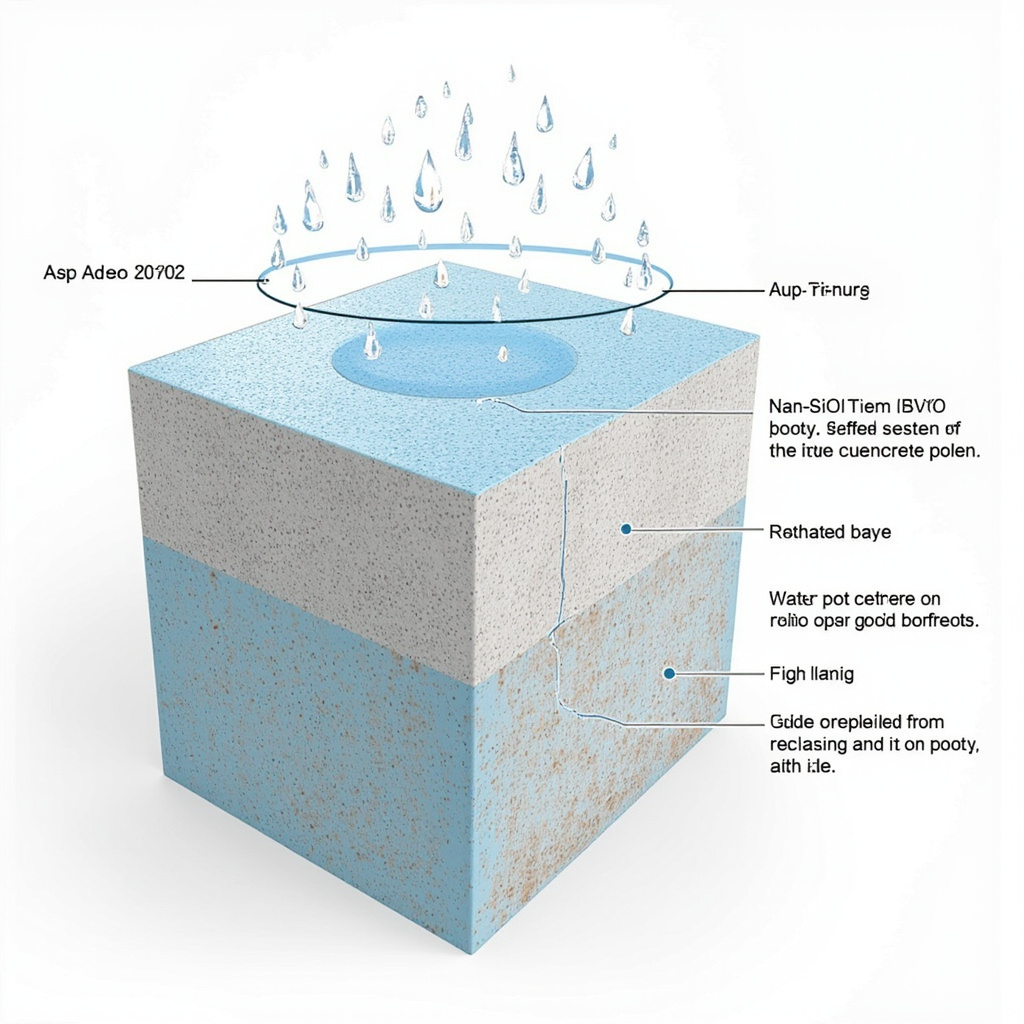
2025-2026 SCI validation: Composite Interfaces (2026) — nano-TiO2/CuO reduced concrete water absorption by 57.42%. MDPI Coatings (2025) — nano-ZnO + fluorocarbon UV transmittance <1%. Main Group Chemistry (2026) — nanoparticle anti-mold validation.
Engineering Applications & FAQ
Nano-coatings have 30–80% higher initial costs, but 20–40% lower LCC over 10–20 years. The global architectural coatings market is approximately $72 billion in 2025, with functional nano-coatings at a CAGR of 8–12%. Verification methods: TEM/SEM particle size 3000 h + third-party CMA/CNAS reports.
References: Composite Interfaces (2026), MDPI Coatings (2025), Main Group Chemistry (2026)
Release Date: July 6, 2026