Core Conclusion:
1. Superhydrophobic nano glass water repellent builds a 5-60nm rough structure + fluorocarbon chemical modification on the glass surface, with water contact angle over 150° and sliding angle below 10°.
2. When vehicle speed exceeds 60km/h, raindrops automatically roll off without the need for wipers; the global superhydrophobic self-cleaning glass market is projected to reach USD 698 million by 2034.
3. The core challenge lies in durability under wiper mechanical wear — a new generation of laser etching + micron-scale "armor" protection technology is breaking through this bottleneck.
When driving in rain, the water film on the windshield is the primary factor affecting the clarity of the driver's view. Traditional wipers clear rain through mechanical wiping, but suffer from issues such as noise, wear, and intermittent blurring of vision. Superhydrophobic Nano Car Glass Water Repellent offers a brand-new solution—making the glass surface itself "water-hating", so that raindrops cannot spread into a film, but automatically roll off under the action of gravity or wind.
The scientific principle of superhydrophobicity—why do water droplets "dance" on glass?
Direct answer:The core principle of superhydrophobic nano glass coating is the biomimetic "lotus effect" — constructing nanoscale micro-rough structures (5-60nm peaks and valleys) on the glass surface, trapping air in the grooves to form an "air cushion", reducing the actual solid-liquid contact area of water droplets to less than 10% of the apparent area, with a contact angle exceeding 150°.
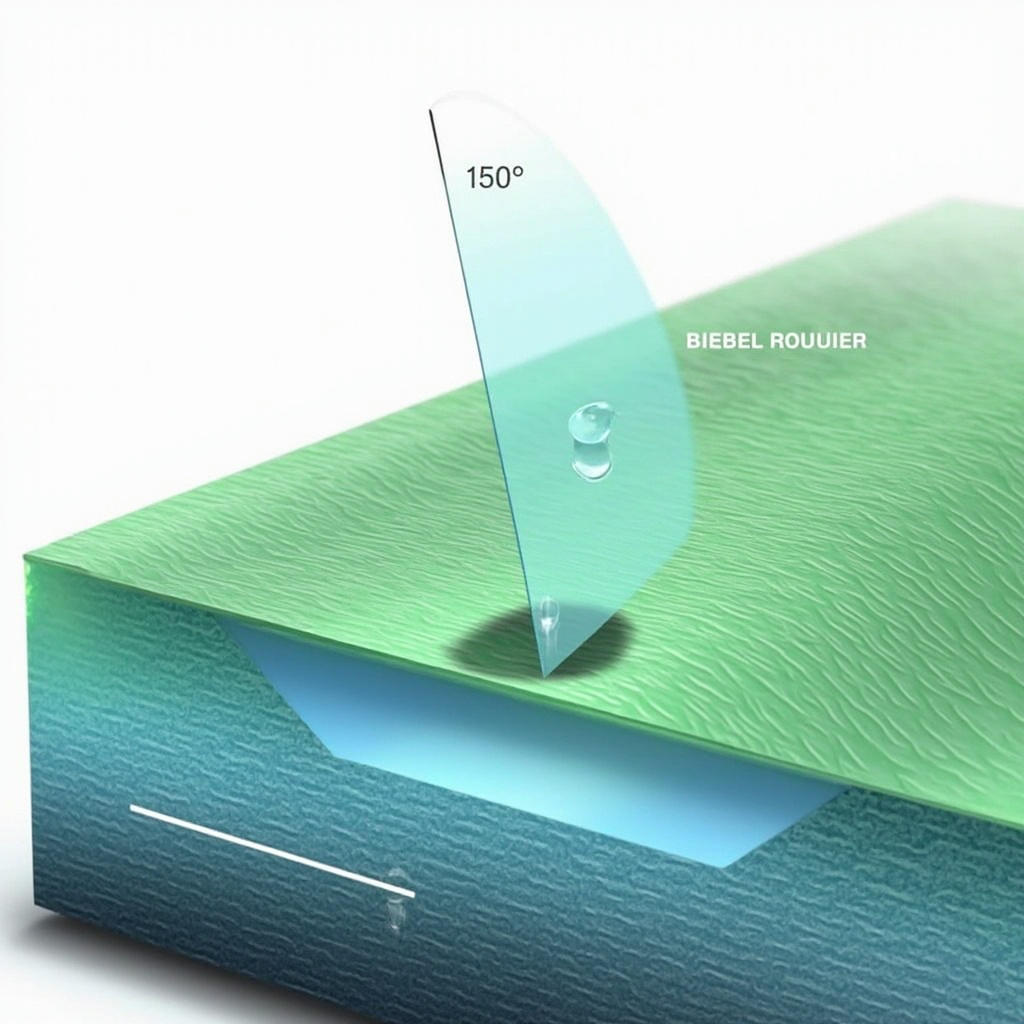
Mechanism Details:The superhydrophobicity of lotus leaf surfaces in nature originates from a hierarchical rough structure: micron-scale papillae (about 10 μm) overlaid with nanoscale waxy crystals (about 100 nm). Nano glass water-repellent agents replicate this strategy in engineering: nanoscale SiO₂ or polysilazane particles are deposited on the glass surface via the sol-gel method to form a lotus-leaf-like nanoscale undulating morphology. Subsequently, low-surface-energy chemical modification is performed using fluorocarbon silane (e.g., perfluorodecyltrichlorosilane) or PDMS (polydimethylsiloxane), reducing the surface energy from about 72 mN/m of ordinary glass to below 20 mN/m.
Sliding angle is a more practical performance metric than contact angle. For a high-quality superhydrophobic coating, the water droplet sliding angle is below 10°—meaning that on an inclined surface of only 10°, water droplets begin to roll off. Under the actual operating conditions of automotive windshields (typically inclined at 30–45°), rainwater will slide off automatically even when the vehicle is stationary.
Data support:A 2018 study by Tsinghua University published in Journal of Materials Chemistry used femtosecond laser etching to fabricate micro-pit arrays plus self-organized nanorods on quartz glass, achieving a 161° water contact angle, 92% transmittance, and withstanding 168-hour water immersion and 500°C high-temperature tests. A research team at the Chinese Academy of Sciences further developed a micron-scale "armor" protective framework, enabling the nanostructures to withstand sandpaper friction and high-pressure water jet impact.
Source:Journal of Materials Chemistry (2018), Physics World (2024), CAS Nanomaterials Laboratory
Product Form and Performance Comparison — Consumer-grade vs. Professional-grade
Direct answer: Commercially available products are divided into three categories: consumer-grade spray type (3-6 months lifespan), professional-grade coating type (1-2 years lifespan), and factory-grade CVD/laser etching type (permanent, available only as an option for high-end models).
Consumer-grade products, represented by Sinograce PF-304 and Rain-X, typically use alcohol-based quick-dry formulations with contact angles of about 100–110°; their advantage is DIY-friendliness, while their drawback is significant performance degradation after each car wash or wiper scraping. Professional-grade products, represented by Gtechniq G1/G5 and CarPro FlyBy Forte, adopt two-component chemically cured systems with contact angles up to 115–120° and durability of 1–2 years or 20,000 km. The most advanced OEM-level solutions—such as the "Moses effect" coating developed by Oak Ridge National Laboratory—use phase-separated glass powders to form permanent nano-rough structures that retain a micro-air layer on the surface even when fully immersed in water.
Data support: Third-party testing of Nasiol (Turkish nano-coating brand) products shows that after 5000 wet abrasion cycles, the water contact angle decreased from 102° to approximately 95°, still maintaining effective hydrophobicity. Experimental data from IOTA ST5 (Anhui IOTA Silicone Oil) indicates that under curing conditions of 50-100°C, the contact angle can remain stable above 115°.
Source:Sinograce Chemical technical data, Nasiol FCC product specifications, Oak Ridge National Laboratory 2024
Frequently Asked Questions (FAQ)
Does the water repellent affect the wiper?
High-quality water repellents will not damage wiper blades, but inferior silicone-oil-containing products may cause wiper chattering and abnormal noise. It is recommended to choose fluorocarbon/polysilazane-based products specifically designed for automotive glass.
How long does a single application last?
Consumer grade: 3–6 months; professional grade: 1–2 years. Durability depends on wiper usage frequency, car washing method, and environmental conditions (UV exposure and acid rain accelerate aging).
Can it be applied by oneself?
Consumer-grade spray products can be DIY-applied, with the process being: deep glass cleaning → oil film removal → application/spraying → curing wait → polishing off excess residue. Professional-grade products are recommended to be handled at application shops.
Will it affect night-time visibility?
High-quality products have a light transmittance of >92%, with almost no impact on visibility. Inferior products may exhibit oil film, rainbow streaks, or glare, posing safety hazards during night driving.
Can it be used on both the windshield and the side mirrors?
The windshield has the shortest durability due to continuous wiper abrasion, while side windows and mirrors (without wipers) last the longest, making them the application areas where water-repellent agents deliver the greatest value.
References: Journal of Materials Chemistry (2018), Physics World (2024), Oak Ridge National Laboratory, Sinograce Chemical, Nasiol Technical Data, Chinese Academy of Sciences Nanotechnology Research
Published: July 5, 2026 | Category: Technical Knowledge