A ship is a mobile artificial marine structure, and its coating system must serve long-term under multiple operating conditions of "seawater immersion, wet-dry alternation, cargo abrasion, and UV aging". Unlike bridges and buildings, ship coating not only involves technical difficulty, but is also subject to mandatory constraints of international conventions—coatings for ballast tanks must comply with the IMO PSPC performance standard. To understand ship coating, one must know both the materials and the regulations.
Kexin New Materials (kexinMaterials) has technical reserves in heavy-duty anti-corrosion epoxy and solvent-free systems, which can cover the supporting requirements of various parts of ships such as ballast tanks, cargo tanks, and superstructures. This article takes IMO PSPC, ISO 20340, and general ship-coating practices as the main line to systematically break down the technical key points of ship coating. For the general supporting logic of steel structures, please refer to general anti-corrosion supporting design for steel structures.

I. Corrosion Environment and Coating Zoning of Various Ship Parts
The first step in ship coating is zoning, as the corrosion mechanisms of different areas are completely different:
- Ballast tank: Long-term seawater immersion alternating with exposure to moist air when empty, oxygen-deficient and high in chloride, a high-incidence area for corrosion and fatigue cracking, subject to mandatory IMO PSPC constraints.
- Underwater hull (immersed zone): Continuous seawater immersion, biofouling, and scouring; equal emphasis on heavy anti-corrosion and antifouling.
- Waterline / freeboard (splash zone): Wet-dry alternation, high oxygen content, mechanical scouring; most severe corrosion.
- Cargo hold (liquid / dry bulk): Subject to abrasion, chemicals, or salt spray erosion depending on cargo type.
- Superstructure and deck: UV aging, salt spray, personnel and equipment wear; mainly weather-resistant topcoat.
This zoning approach is in line with the C5-M and Im2 (immersed seawater) classifications of ISO 12944, but ship specifications often place more emphasis on "inspectability" and "mandatory certification".
II. Mandatory Standard for Ballast Tanks: IMO PSPC
The International Maritime Organization enforced the "Performance Standard for Protective Coatings for Ship Ballast Tanks" (PSPC) through Resolution MSC.215(82). Its core requirements include:
- Target service life of 15 years: The coating system is expected to achieve 15 years in the ballast tank environment without rust, blistering, or peeling that affects its performance.
- Surface preparation Sa2.5: Steel plates shall be blast cleaned to Sa2.5 before coating, and roughness shall be controlled to meet the standard.
- Soluble salt control: Soluble salts on the steel surface (calculated as chloride) are generally required to be ≤50 mg/m² (subject to the PSPC text), which is a key threshold to prevent blister rust.
- Approved system: The coating system must pass the type test (simulated ballast tank cyclic corrosion procedure) using an IMO-recognized laboratory, and submit an approved coating procedure and inspection plan.
- Process documentation: From steel pretreatment, environmental records to film thickness inspection, the entire process must have records signed by inspectors to ensure traceability.
The particularity of PSPC is that it is a dual constraint of "performance + approval": it not only specifies indicators, but also requires the system to be verified by a third party. This means that ship ballast tank coatings cannot use just any epoxy; products that have passed PSPC type approval must be used.
III. Comparison of Mainstream Marine Coating Systems
Marine coatings can be divided into coal tar epoxy, pure epoxy, solvent-free epoxy, polyurethane, antifouling paint, etc. according to material type. The following table compares commonly used systems for ballast tanks and similar parts:
| System type | Typical composition | Applicable parts | Advantages | Limitations |
|---|---|---|---|---|
| Coal tar epoxy | Epoxy resin + coal tar pitch | Ballast tank, below waterline | Water-resistant, low cost, good adhesion | Contains pitch components, restricted by some specifications; dark color, difficult inspection |
| Pure epoxy | Amine-cured epoxy | Ballast tank, cargo tank | Chemical resistant, high adhesion, easy inspection | Slow curing at low temperature, brittleness needs attention |
| Solvent-free epoxy | High-filler solvent-free epoxy | Ballast tank, wear zone | Single thick coat, no VOC, wear resistant | High application viscosity, strict process requirements |
| Polyurethane topcoat | Aliphatic polyurethane | Superstructure, deck | Weather-resistant, color-retentive, aesthetic | Not for long-term immersion |
| Antifouling paint | Self-polishing / fouling release | Below waterline | Inhibits marine organism attachment | Has validity period, needs periodic renewal |
Under the PSPC framework, approved pure epoxy or solvent-free epoxy systems are commonly used for ballast tanks; coal tar epoxy is restricted in some newbuilds due to environmental and health considerations, but is still used in specific areas because of its excellent water resistance. Selection should be based on the classification society and PSPC approved list.
IV. ISO 20340: Cyclic Aging Procedure for Offshore Structures
In addition to PSPC, ISO 20340 "Performance test methods for protective paint systems for offshore and related structures" provides a cyclic aging test procedure closer to the marine platform and ship environment, including multiple alternating stages of UV, salt spray, immersion, and drying. This procedure reflects real marine aging mechanisms better than a single neutral salt spray (ASTM B117 / ISO 9227), and is often cited by offshore wind, offshore platforms, and high-end ship supporting as a type verification basis.
It should be clarified: the cyclic hours of ISO 20340 and the verification procedure of PSPC have different focuses, and the two cannot be directly converted. In engineering, the corresponding verification method should be selected according to the specification of the specific part, and the measured results in the third-party report should be used as the acceptance basis.
V. Below Waterline and Antifouling Supporting
The hull below the waterline requires both heavy anti-corrosion and antifouling. A typical system is: epoxy primer (or epoxy zinc-rich, depending on design) + epoxy tie coat + antifouling paint. Antifouling paint inhibits the attachment of barnacles and algae through the release of bioactive components or a low-surface-energy fouling-release mechanism, thereby reducing sailing resistance and fuel consumption.
The selection of antifouling paint needs to consider speed, berthing rate, marine biological activity, and environmental regulations (such as the IMO ban on organotin compounds and restrictions on biocides). Modern self-polishing copolymer (SPC) and fouling-release (FRC) antifouling paints are the mainstream direction. Usually no clear coat is applied over antifouling paint, and its validity period (e.g., 60 months) must match the docking cycle.
VI. Surface Treatment and Application Process
Ship coating is mostly carried out in blocks at the shipyard: steel plate pretreatment (shot blasting + shop primer) → block blast to Sa2.5 → block coating → slipway / drydock joining → repair and integrity coating. Key control points:
- Shop primer (pre-construction primer): Temporary rust prevention, must be compatible with subsequent systems to avoid becoming an interlayer weakness.
- Roughness and salt: Key parts such as ballast tanks control roughness and soluble salts according to PSPC; underwater hull also attaches great importance to blast quality.
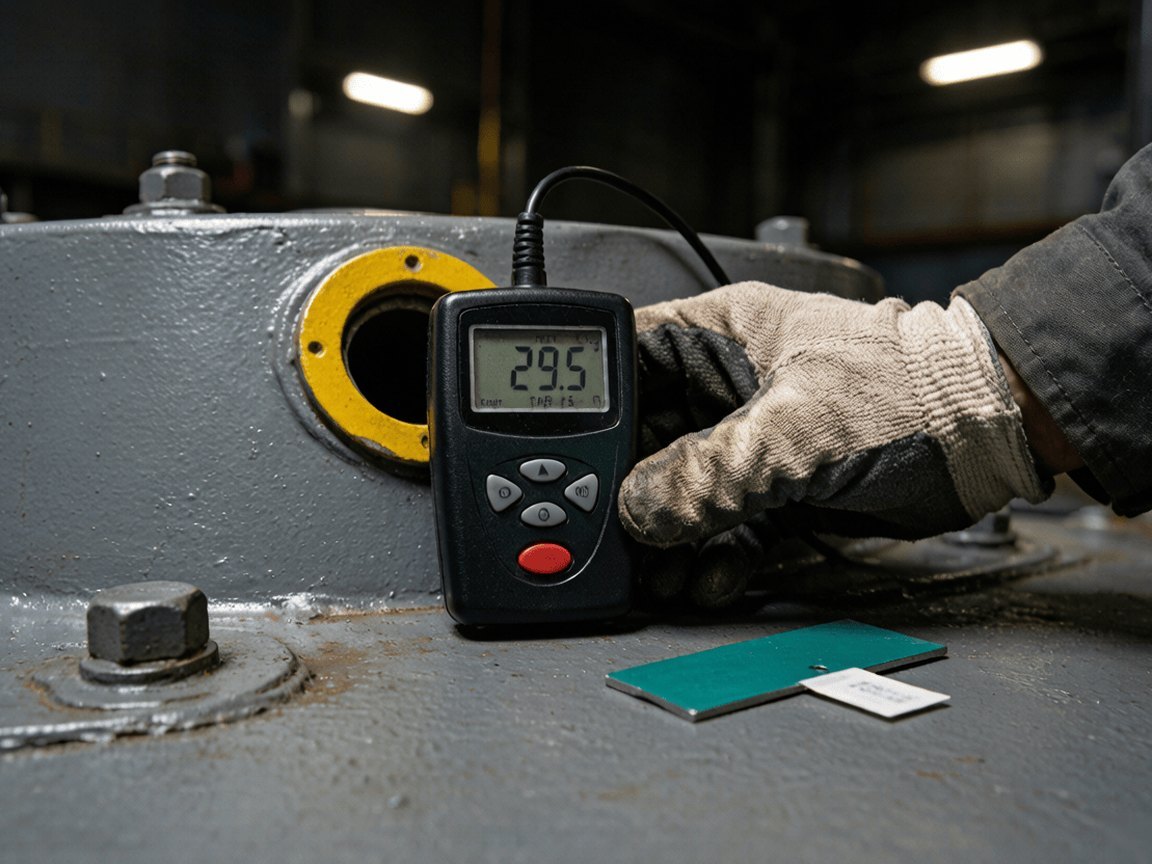
- Film thickness management: Ballast tanks are accepted according to the minimum and average film thickness specified by PSPC; magnetic thickness gauge is used with grid points.
- Environmental window: Steel temperature 3℃ above dew point, relative humidity controlled, to avoid condensation causing early failure.

VII. Cargo Tanks and Special Cargo Types
Cargo tanks of product tankers and chemical tankers need to withstand cargo erosion, and often use pure epoxy or phenolic epoxy systems to resist certain temperatures and chemicals. Phenolic epoxy has better heat and chemical resistance, but is more brittle and has a narrow application window. Inert gas protection system (IGS) etc. also affect the corrosion environment inside the tank. Selection must strictly follow the cargo compatibility table and specifications.
VIII. Superstructure and Deck Weathering
Superstructures and decks mainly withstand salt spray and UV; the system is mostly epoxy primer + aliphatic polyurethane / acrylic polyurethane topcoat, emphasizing color retention, gloss retention, and weather resistance. Decks, due to pedestrian and equipment wear, often add anti-slip aggregate or use high-build wear-resistant topcoat. Deck anti-slip paint needs to balance friction coefficient and safe walking.
IX. Maintenance, Drydocking, and Record Management
Ship coating is a process of "construction + lifelong maintenance". During drydocking, inspect the corrosion and fouling of the underwater part and ballast tanks, and treat by "grinding—touch-up" or "overall recoating". PSPC requires that a complete Coating Technical File (CTF) be established for ballast tanks during construction, and subsequent maintenance should also continue the records to facilitate life assessment and liability tracing.
Kexin New Materials (kexinMaterials)It is recommended to specify the DFT lower limits, curing window, and film thickness acceptance criteria for each area in the marine outfitting technical documents, and to include the PSPC-approved verification report as part of the ship delivery documentation to reduce later disputes. For an overview of the standards system, you may further read the Overview of the Industrial Coating Standards System.
X. Common Selection Misconceptions
Misconception 1: Ballast tanks can use just any epoxy. Wrong. A system type-approved by IMO PSPC must be used; otherwise it will not pass classification society inspection.
Misconception 2: Epoxy coal tar is the cheapest and most durable. Wrong. Its environmental and health restrictions constrain its use in newbuilds, and its dark color is unfavorable for defect inspection; selection should follow specifications and location.
Misconception 3: The thicker the antifouling paint, the better. Wrong. Antifouling paint has a designed effective period and release mechanism; excessive thickness may crack and flake off, and should be strictly controlled per the TDS.
Misconception 4: Shop primer can replace the main system. Wrong. Shop primer is only for temporary rust prevention and must be compatible with the main system and not affect final adhesion.
Misconception 5: Salt spray hours equal service life. Wrong. The basis should be the PSPC verification procedure or ISO 20340 cyclic aging report, not a single salt spray duration.
XI. Techno-Economics and Traceability of Marine Coating
The economic logic of marine coating is similar to that of bridges, but with the added hard constraints of classification society inspection and convention compliance. Ballast tanks using PSPC-approved systems often have a higher material unit price than ordinary epoxy, but this is the cost of passing type testing and guaranteeing a 15-year service life; it cannot be replaced in tenders by low-price products of "equivalent appearance," otherwise it will fail classification society inspection, affect the delivery milestone, and the breach cost far exceeds the material price difference.
From the construction perspective, the efficiency and quality of block coating at the shipyard directly determine cost. The steel pretreatment line (blast cleaning + shop primer) is completed in one pass, which is more economical than later piece-by-piece blasting; block coating reduces the costly occupancy time of the building berth/drydock. Therefore, "moving coating processes forward and reducing onboard work" is the industry-common cost-reduction path. At the same time, drydock periods are expensive, and the interleaved scheduling of coating with joining-up and outfitting often becomes the critical path of project progress.
Traceability is a special value of marine coating. PSPC requires establishing a Coating Technical File (CTF), recording all data from pretreatment, environmental parameters, film thickness to inspection certification. This is not only delivery documentation, but also the basis for later drydock repairs, life assessment, and liability definition. Digital inspection and electronic records are gradually replacing paper certification, enabling cross-fleet data comparison and predictive maintenance. For shipowners, a complete CTF means lower lifetime maintenance uncertainty and higher asset residual value.
In addition, environmental regulations increasingly affect marine coatings: the IMO restrictions on biocides and organotin compounds in antifouling paint, as well as national VOC controls, are driving the application of solvent-free epoxy and low-VOC antifouling systems. Ignoring regulatory trends in selection may face retrofit or compliance risks during the vessel's life cycle. Therefore, marine coating decisions should be a three-dimensional trade-off of "technical performance + convention compliance + regulatory foresight," rather than simple price comparison.
XII. In-Depth Reading of Marine Coating Materials and Process Details
The formulation logic of ballast tank coatings determines their long-term performance. Pure epoxy ballast tank paint approved by mandatory standards typically uses amine-cured bisphenol-type or phenolic-modified epoxy resin as the base, pursuing high crosslink density and strong adhesion to steel; solvent-free or high-solid designs reduce application passes and shrinkage. The key of such systems is not how high a single indicator is, but maintaining integrity in the simulated dry-wet alternating environment of ballast tanks without through-rusting. Selection should not only look at a certain hour of salt spray data, but examine whether it has passed the complete cyclic verification procedure required by mandatory standards, and whether the failure mode in the verification report is acceptable.
Solvent-free epoxy is increasingly used in ballast tanks. Its viscosity is significantly higher than ordinary epoxy, and application often requires heating and dedicated two-component pumping equipment, but the advantage is that one spray pass can achieve high film thickness, reducing interlayer interfaces and application passes. The cost is extreme sensitivity to surface treatment, mixing ratio, and ambient temperature; any deviation may cause poor curing or pinholes. Therefore, solvent-free systems demand much higher construction management and personnel skills than conventional solvent-based epoxy, and projects must be equipped with corresponding process documents and on-site supervision, otherwise advanced materials are prone to failure.
The mechanism of antifouling paint is divided into two types. Self-polishing copolymers slowly release copper ions or organic active ingredients in seawater through controlled surface hydrolysis, inhibiting barnacle and algae attachment; foul-release types rely on very low surface energy and elasticity, making it difficult for organisms to firmly attach and they detach with water flow or navigation. Each has applicable sea areas and speed ranges; selection must combine route, berthing rate, and biological activity, rather than simply using "long effective period" as the only criterion. Antifouling paint is usually not overcoated, and its effective period should match the drydock cycle to avoid mid-term deactivation causing increased resistance and fuel consumption.
Although shop primer is only a temporary rust-proof layer, it affects subsequent quality. It must be applied shortly after block blasting and be compatible with the main system, not becoming an interlayer weakness. Some projects ignore shop primer compatibility evaluation to catch up on schedule, resulting in interlayer adhesion problems after main coating, with rework cost far exceeding the initial savings. The connection between temporary and permanent protection is an often-overlooked link in the marine coating quality chain and should be specified in the technical specification for its type and compatibility requirements.
Film thickness uniformity and miss-out control are the focus of ballast tank construction. The cabin structure is complex; behind stiffeners, corners, and around pipe seats are prone to miss-out or insufficient film thickness, and these are exactly the corrosion initiation points. Engineering controls risks through edge stripe coating, vacuum or spark holiday detection, and grid-based film thickness random inspection. Mandatory standards also have clear requirements for average and minimum film thickness; inspectors must record cabin by cabin and correspond with the Coating Technical File to ensure each tank is traceable and any non-conforming area can be rectified before delivery.
From construction to operation, the data chain of marine coating should be closed. Pretreatment records, environmental parameters, film thickness curves, adhesion random inspection, and defect repair certification together constitute the Coating Technical File. This file is both delivery documentation and the basis for later drydock repair and life assessment. For shipowners, complete data is more valuable than any single-point promise and is also the foundation of modern ship asset management. When a vessel rotates repairs among different shipyards, this file allows subsequent maintenance parties to quickly understand the original system and historical states, avoiding blind repairs.
Another easily overlooked aspect of marine coating is the cross-shipyard transfer of the Coating Technical File. When a vessel rotates repairs among different shipyards, complete historical system and state records allow subsequent maintenance parties to quickly understand the original system, avoiding blind repairs. For shipowners, this file also highlights value in second-hand transactions and insurance assessments, as part of the vessel's intangible assets. Making delivery documentation solid and complete is essentially endorsing the long-term credibility of the asset, and its return far exceeds the labor cost of file organization itself.
Another easily overlooked aspect of marine coating is the cross-shipyard transfer of the Coating Technical File. When a vessel rotates repairs among different shipyards, complete historical system and state records allow subsequent maintenance parties to quickly understand the original system, avoiding blind repairs. For shipowners, this file also highlights value in second-hand transactions and insurance assessments, as part of the vessel's intangible assets. Making delivery documentation solid and complete is essentially endorsing the long-term credibility of the asset, and its return far exceeds the labor cost of file organization itself.
The failure modes of ballast tank coatings deserve in-depth understanding. In dry-wet alternating environments, if the coating has pinholes or miss-outs, seawater will penetrate along defects and stagnate, gradually forming blister rust and bulges, then developing into through-rusting. Therefore, pinhole control and edge coverage during construction are more critical than ordinary areas. Engineering blocks these risk points through edge stripe coating, spark or vacuum holiday detection, and grid-based film thickness random inspection, and ensures traceability with cabin-by-cabin records, allowing any non-conforming area to be rectified before delivery.
Antifouling paint selection should match the operational profile. The biological activity of different sea areas, route berthing rate, and speed determine the applicable boundaries of the two mechanisms: self-polishing and foul-release. Wrong type selection may lead to either insufficient antifouling period or cost waste, or even violation in some waters due to active ingredient restrictions. Therefore, the antifouling scheme should be formulated based on actual vessel operational data and coordinated with the drydock cycle, so that the protection window covers the entire operational interval, rather than isolated pursuit of nominal effective period.
The efficiency and quality of block coating at the shipyard directly determine cost. The steel pretreatment line completes blasting and shop primer in one pass, which is more economical than later piece-by-piece blasting; block coating reduces the costly occupancy time of the building berth and drydock. Therefore, moving coating processes forward and reducing onboard work is the industry-common cost-reduction path. At the same time, drydock periods are expensive, and the interleaved scheduling of coating with joining-up and outfitting often becomes the critical path of project progress, requiring fine construction organization to balance.
Digitalization is gradually replacing paper certification. Electronic records and image retention enable cross-fleet data comparison and predictive maintenance. For shipowners, a complete retrievable file means lower lifetime maintenance uncertainty and higher asset residual value, and also makes classification society inspection and charterer surveys more efficient. Assetizing coating data is an indispensable part of modern ship operation management.
The particularity of marine coating is that it compresses material performance, convention enforcement, and construction efficiency into the same process. Ballast tanks must meet international mandatory standards and be approved; below the waterline must balance anti-corrosion and antifouling; the superstructure focuses on weather resistance and appearance. These requirements, combined with the shipyard's tight drydock cycle, make coating a key link affecting delivery milestones and full-life-cycle cost. Only by managing standards, materials, processes, and files as a closed loop can the vessel maintain reliable protection throughout decades of sea life, and provide solid support for the shipowner's asset value.
In the final analysis, marine coating is a discipline of achieving reliability within constraints. International conventions set mandatory thresholds that cannot be crossed, shipyard tempo limits available construction time, and the marine environment poses stringent durability requirements. Only by treating material approval, process discipline, and file completeness as one can a reliable bridge be built between delivery milestones and decades of sea life. For shipowners and shipyards, valuing coating is valuing the asset itself, and also building an invisible yet crucial defense line for safety and value amid the waves.
The story of marine coating is a journey of pursuing reliability within constraints. Twisting convention, process, and files into one rope, the protection of offshore assets gains lasting confidence, and also writes a silent footnote for shipping safety.
Marine coating is worth repeated study because it compresses convention enforcement, construction efficiency, and marine durability into the same process. Only by doing every detail well can steel giants sail safely for decades on global routes.
The value of marine coating will ultimately manifest in every safe arrival at port, and also reminds us: persistence in details is the longest devotion to navigation safety.
FAQ
FAQ
Q: What is IMO PSPC, and why must ballast tanks comply?
A: IMO PSPC is the mandatory "Performance Standard for Protective Coatings of Ballast Water Tanks in Ships" (MSC.215(82)) of the International Maritime Organization, requiring ballast tank coatings to achieve a 15-year target life, surface Sa2.5, controlled soluble salts, and use a type-approved system. Because it directly relates to ship structural safety and life, it is included in mandatory inspection; those not meeting it cannot pass classification society approval.
Q: How to choose between epoxy coal tar and pure epoxy ballast tank coating?
A: Pure epoxy has high adhesion, easy inspection, and high specification acceptance, and is the mainstream of PSPC approval; epoxy coal tar has good water resistance but contains asphalt components, and is restricted in some newbuilds and environmental requirements. Specifically, the classification society approved list and project specification shall prevail, and shall not be replaced arbitrarily.
Q: Why is ballast tank soluble salt controlled at around 50 mg/m²?
A: Soluble salts such as chloride ions will penetrate the coating and induce blister rust and filiform corrosion; chloride residue is one of the main causes of early ballast tank failure. PSPC controls surface salt at about ≤50 mg/m² (as NaCl), to eliminate osmotic blistering risk from the source.
Q: What is the relationship between ISO 20340 and PSPC?
A: PSPC is a mandatory performance standard for ballast tanks, and its verification uses a specific cyclic procedure; ISO 20340 is a laboratory cyclic aging test method for protective coating of offshore structures, with a mechanism closer to the real marine environment. Both adopt a cyclic aging approach, but their scopes and procedures differ, so they should be selected by location and verified against third-party reports.
Q: Why is both anti-corrosion and antifouling needed below the waterline?
A: Below the waterline is long-term immersed in seawater, subject to both seawater corrosion and attachment of barnacles and algae. Attachments increase sailing resistance, raise fuel consumption, and may cause local corrosion, so a composite system of "epoxy anti-corrosion primer + antifouling topcoat" is used; the antifouling paint inhibits biofouling and the anti-corrosion layer provides barrier protection.
Q: How is the film thickness of marine coating accepted/inspected?
A: Ballast tanks are accepted by the minimum and average dry film thickness specified in PSPC, using a magnetic thickness gauge with grid point layout; other hull areas follow the specification and the 90/90 rule of ISO 12944. The key is representativeness of measurement points, complete records, and process traceability.
Q: What to do when the antifouling paint expires?
A: Antifouling paint has a designed service life (e.g., 60 months); upon expiry or when failure is found during drydock repair, it should be re-treated and coated with new antifouling paint. Before recoating, confirm compatibility between the old antifouling paint and the new system to avoid intercoat issues.
Q: Why is phenolic epoxy commonly used in cargo tanks?
A: Phenolic epoxy has better temperature and chemical resistance than ordinary epoxy, suitable for cargo tanks carrying specific oils and chemicals. But it is more brittle and has a narrow application window, requiring strict control of curing conditions and film thickness.
Q: Does shop primer affect the final coating quality?
A: Yes. If the shop primer is incompatible with the main system or improperly dosed, it may become an intercoat weak point. A pre-coat primer compatible with the subsequent system should be selected, and its residual impact evaluated during blasting.
Q: Why are marine coating records important?
A: PSPC requires establishing a Coating Technical File (CTF), recording the whole process of surface preparation, environment, film thickness, and inspection; this file is the basis for delivery documents, later life assessment, and liability tracing. Missing it leaves maintenance without evidence.
Further Reading
- General Anti-corrosion System Design for Steel Structures: Understand how the primer-intermediate-topcoat three-layer logic migrates to marine epoxy systems.
- Overview of Industrial Coating Standard Systems: Systematically sort out the positioning of IMO PSPC and ISO 20340 in the standard hierarchy.
- Anti-corrosion Coating Case for Sea-crossing Bridges: Under the same marine C5-M environment, compare the protection similarities and differences of ballast tanks and splash zones with bridges.
- Metal Protection for Water Conservancy Projects: Steel Gates, Penstocks, and Water-level Fluctuation Zones
- Hygienic-grade Coating for Food Plants: Hygienic Design and Food-contact Compliance
- General Theory of Industrial Protective Coating Systems: ISO 12944 Corrosion Grades and System Design