The most headache-causing part of automotive refinishing paint for car owners and technicians is not the spray gun, but "color mismatch". On the same vehicle, with the same color code, repainting a panel often results in a visible color difference, especially obvious under sunlight. Traditional manual color matching relies on the experience of veteran workers, comparing by eye and adding colorants by feel, leading to poor stability and high rework rates. Modern automotive refinishing has long entered the era of computer color matching: using a spectrophotometer to read the spectral data of the vehicle body color, calling the formula database to automatically calculate the ratio of colorants, and then combining with spraying process to control the color difference within a range barely perceptible to the human eye. This article systematically breaks down the key technologies of automotive color matching from color measurement principles, formula calculation, color difference evaluation to on-site construction, helping refinishing shops upgrade from "relying on feel" to "data-reproducible" standard operations.
As a system supplier of automotive refinish paint, Kexin New Materials (kexinMaterials) has accumulated a large amount of frontline data in colorant stability, formula database and computer color matching support. This article will also combine industry-common color measurement and color difference standards to clarify the core logic of automotive color matching, so as to facilitate your establishment of citable judgment basis when selecting products and constructing.
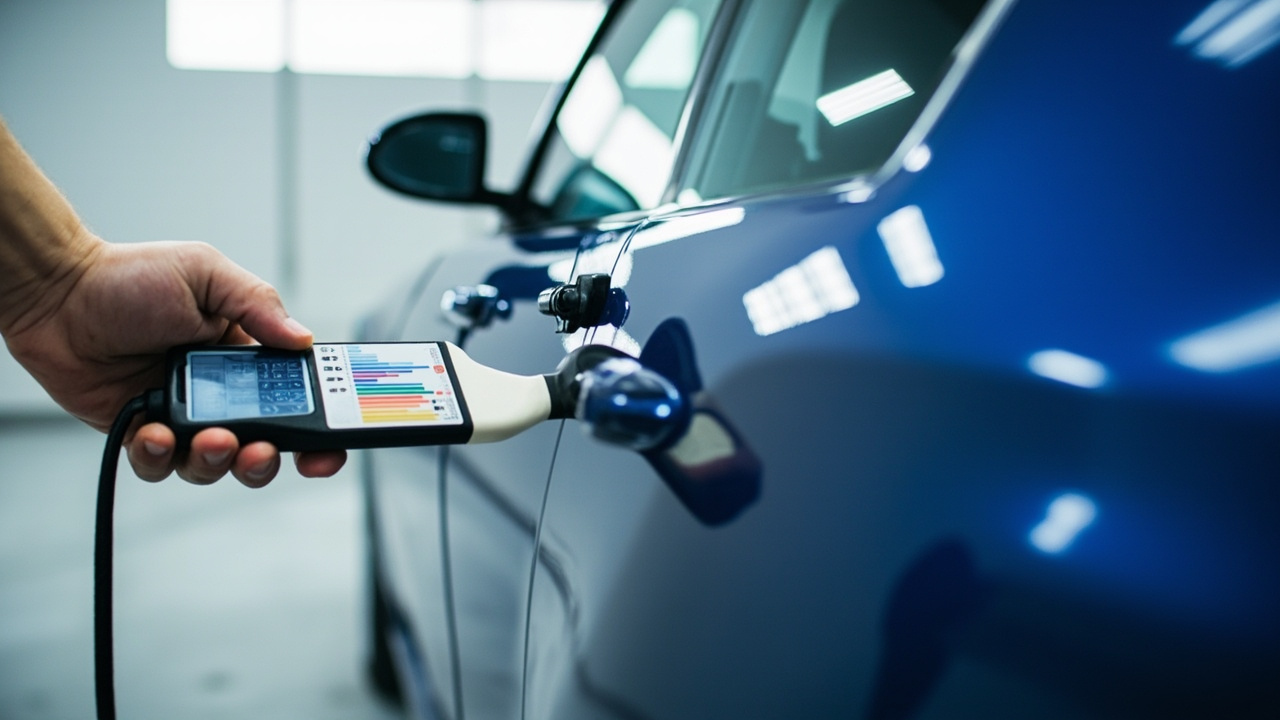
I. Why automotive color matching is difficult: the physical essence of color
To match color accurately, one must first understand how color is produced. The vehicle body color we see is the result of a light source illuminating the paint film, where pigments selectively absorb and reflect visible light, which then enters the human eye. The pigments and effect pigments in the paint film determine the shape of the reflection spectrum, while the light source, observation angle, film thickness, and surface gloss all alter the color ultimately perceived by the human eye. The fundamental reasons for the difficulty in automotive refinishing color matching are threefold: first, the original factory paint undergoes high-temperature baking, so the pigment dispersion state differs from that of refinish paint cured at room temperature; second, after vehicle aging, the clear coat yellows and the base color paint fades, shifting the reference color; third, the arrangement direction of effect pigments (metallic flakes, pearlescent flakes) is affected by spraying technique, causing flop, which must be controlled in both measurement and spraying.
Precisely because color is the result of the interaction among "light—paint—eye", it is far from enough to rely solely on the naked eye to compare under one type of lighting. Computer color matching uses instruments to replace the human eye for objective measurement, uses databases to replace memory for formula retrieval, and uses color difference meters to replace experience for acceptance, turning subjective judgment into quantifiable numbers. For the arrangement and optical principles of effect pigments themselves, refer to another article in this batch: Principles of Automotive Pigmented Paint Effect Pigments (Pearlescent/Metallic).
II. Spectrophotometer: turning color into numbers
The first step in computer color matching is to use a spectrophotometer to collect the spectral reflection curve of the vehicle body color. The instrument emits a standard light source (commonly D65 simulating daylight) onto the paint surface, and measures reflectance at multiple wavelengths (usually every 10 nm or every 20 nm, covering the visible spectrum 400–700 nm) to obtain a complete reflectance curve. This curve is more reliable than a single color value, because metamerism (different spectral reflections perceived as the same color by the human eye) can be identified through curve comparison.
Colorimeters are divided into various types by geometry; multi-angle colorimeters (such as observation angles of 15°, 25°, 45°, 75°, 110°, etc.) are commonly used in automotive refinishing to capture the flop effect of metallic paint and pearlescent paint. When measuring, select flat, scratch-free, non-coating-ceramic areas of the vehicle body, avoiding edges and repaired parts; take multiple measurements at each spot and average them to reduce local variation. Ambient light should be stable, preferably working in a standard light booth or under the colorimeter's built-in calibration white tile. The instrument itself needs regular calibration with standard white tile and black trap to ensure consistent readings.
The measured color is commonly expressed in the CIE L*a*b* (i.e., CIELAB) color space. Among them, L* represents lightness (black-white axis, 0 for black, 100 for white), a* represents red-green axis (positive for red, negative for green), b* represents yellow-blue axis (positive for yellow, negative for blue). These three values locate the color in a uniform color space, and the distance between adjacent values approximately corresponds to the magnitude of color difference perceived by the human eye.
III. Formula database and colorant system: the "raw material library" of color matching
After measuring the target color's L*a*b*, the color matching system calls the formula database to search for the closest base formula. Automotive refinish paint manufacturers usually establish a huge colorant system and formula library covering color codes of mainstream car series. Colorants (color pastes) are pre-milled, pigment-dispersion-stable basic coloring units, classified by hue into white, black, yellow, red, blue, orange, purple, green, as well as aluminum paste, pearlescent powder, transparent colorants, tinting agents, etc.
The working logic of computer color matching software is: starting from the closest car-series original color code, based on the deviation between the spectrophotometer reading and the standard panel, using color matching algorithms (such as Kubelka-Munk optical model, least squares iteration) to inversely calculate which colorants need to be increased or decreased and by how much. Modern systems can also select different calculation models according to material characteristics (solid paint, silver paint, pearl paint), because the scattering behavior of metallic flakes and pearlescent flakes differs from that of ordinary pigments.
It must be emphasized that the stability of the colorants themselves determines the color matching hit rate. Batch-to-batch fluctuations in hue, fineness, and pigment content of the same colorant will be directly transmitted to the final formula. Therefore, system suppliers must solidly control pigment dispersion, fineness control, and storage stability of colorants. Kexin New Materials (kexinMaterials) adopts standardized control in colorant milling and batch consistency, aiming to let the same formula reproduce in different times and different stores with color falling within a controllable range, reducing rework from "formula correct but color drifts".
IV. Color difference evaluation: ΔE and the naked-eye perceptible threshold
Whether the color matching is accurate is ultimately judged by color difference. The industry widely uses the CIE 1976 color difference formula ΔE*ab to represent the Euclidean distance between two colors in L*a*b* space: ΔE = √[(ΔL*)² + (Δa*)² + (Δb*)²]. The larger the ΔE, the greater the color difference. But the human eye has different sensitivities to lightness, red-green, and yellow-blue; later CIE 1994 and CIEDE2000 formulas corrected the weights to be closer to real vision. However, ΔE*ab is still widely used as an initial judgment in the refinishing industry due to its simplicity and intuitiveness.
Regarding "how large a color difference is visible to the naked eye", industry experience is roughly: ΔE less than 1.0 is usually indistinguishable by the human eye; 1.0–2.0 can be detected by dedicated comparison but not easily found at normal distance; 2.0–3.0 is clearly visible; greater than 3.0 means prominent color difference. Automotive refinishing acceptance often controls ΔE within 1.5 or even 1.0 as a high standard. Note that ΔE is a composite value; sometimes the individual deviations of L*, a*, b* are not large but the combined overall color cast may still be noticed by the customer, so one should not only look at the total ΔE but also examine the offset direction of the three components separately.
Color difference measurement should be done under standard light source (recommended D65 or multi-light source booth including D65, A, TL84, CWF, etc.), based on the light source of the customer's main usage scenario. The same repaired area should be measured at multiple angles (especially the flop angle and face-on for effect paints), because the color difference of metallic paint varies with angle. The table below gives the reference range of commonly used color difference criteria for automotive refinishing:
| Color Difference ΔE*ab | Visual Significance | Refinishing Acceptance Suggestion | Typical Handling |
|---|---|---|---|
| ≤ 1.0 | Almost imperceptible to human eye | Excellent, can be delivered directly | No treatment needed |
| 1.0–1.5 | Detectable by dedicated comparison | Meets high standard | Can be fine-tuned or accepted |
| 1.5–2.0 | Occasionally found at normal distance | Generally acceptable | Depends on customer requirement |
| 2.0–3.0 | Clearly visible | Rework required | Re-color and re-spray |
| > 3.0 | Prominent color difference | Unqualified | Redo entire panel |
V. Flop: the biggest variable in effect paint color matching
The color difference of solid paint (monochrome paint) is mainly the offset of L*, a*, b*, which is relatively easy to control. But silver paint and pearlescent paint contain metallic flakes or pearlescent flakes; light reflects and interferes on the flake layers, causing the color to change drastically with observation angle. This "flop" effect makes color matching much more difficult. With the same formula, different spraying pressure, gun speed, and film thickness lead to different orientation of metallic flakes (flat or upright), making it look darker face-on and brighter side-on, or vice versa.
Therefore, computer color matching of effect paints cannot just look at L*a*b* from one angle; a multi-angle colorimeter must be used to collect data from at least three angles (such as 25°, 45°, 75° or 15°, 45°, 110°) and control the color difference at each angle separately. In color matching, techniques such as "side-view lighten/darken" and "face-side difference control" are commonly used: adding specific colorants to change the coverage of metallic flakes and the show-through of base color, thereby pulling the face-side color difference back to target. Such techniques rely on understanding the optical behavior of effect pigments, see details in Principles of Automotive Pigmented Paint Effect Pigments (Pearlescent/Metallic).
Field experience is: for effect paints, it is better to do transition blend (feathering) spraying on the entire panel or adjacent panels together rather than only repairing a small hard-boundary patch, otherwise the angular color difference at the boundary will be very glaring. Blend spraying combined with the precise formula tuned by computer can "hide" the color difference in the gradient.
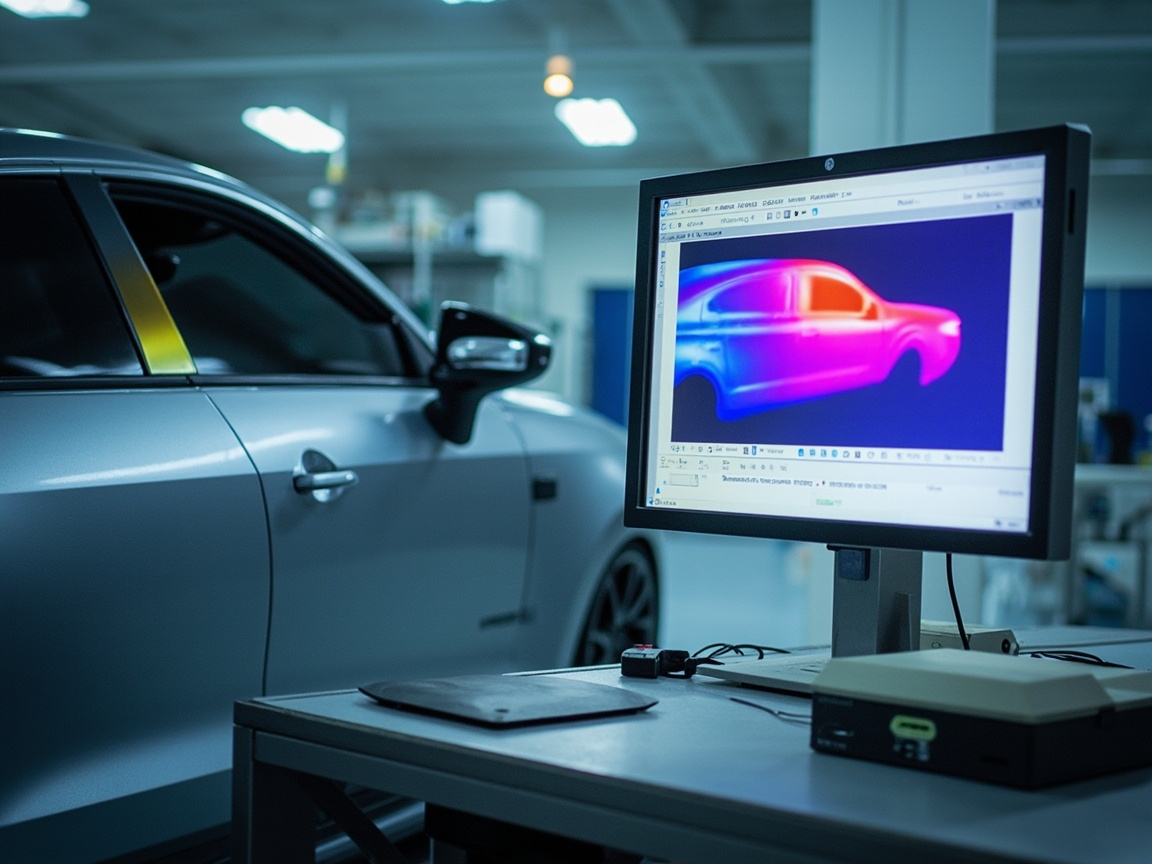
VI. Influence of spraying process on color difference: accurate tuning also requires accurate spraying
Many reworks are not due to inaccurate color matching, but because the spraying process "sprays the color off". Key process variables affecting the final color include:
First, film thickness. With the same formula, spraying thin makes the base show through and look dark; spraying thick gives strong coverage and looks vivid. Solid paint is relatively insensitive to film thickness, while effect paint is extremely sensitive—film thickness changes the number of metallic flake layers, and the face-side difference changes accordingly. Construction must follow the recommended dry film thickness (DFT) of the formula and be controlled with a thickness gauge.
Second, spray gun and air pressure. High pressure, fine atomization, small paint particles make metallic flakes easier to lay flat and the color lighter; low pressure, coarse particles make more flakes upright and the color darker. Gun speed and overlap rate also change the paint amount per unit area, thereby affecting film thickness and orientation. It is recommended to fix the spray gun model, cap-end pressure, and gun rhythm, treating them as part of the formula.
Third, thinning ratio and spray booth environment. The type of thinner (fast-dry/slow-dry) changes leveling and flash-off; temperature and humidity affect solvent evaporation and film shrinkage. When temperature and humidity fluctuate greatly, the same formula color will also drift. The spray booth should maintain stable temperature and humidity (e.g., 20–25℃, relative humidity 50%–70%), and calibrate the formula under standard conditions.
Fourth, the influence of varnish. The gloss, yellowing, and film thickness of the clear coat will alter the perceived appearance of the underlying color. On old vehicles, the varnish has already yellowed; if refinish paint uses a brand-new high-transparency clear coat, the underlying color will appear more "cold". When necessary, perform overall polishing on adjacent areas or apply a global clear coat to unify the gloss baseline.
VII. Differences in Color Matching Strategies between Solid Paint and Effect Paint
Solid paint color matching is relatively straightforward: using the measured L*a*b* as the target, adjust black/white and colored tinting bases so that the three components approach the target; controlling ΔE within 1.5 is usually sufficient. The focus is on the purity and hiding power of the tinting bases, avoiding the introduction of stray colors.
Effect paint color matching is much more complex. First determine the base color (side-view lightness and hue), then determine the flop and sparkle intensity. A common approach is: use aluminum paste or pearlescent powder to control lightness/darkness and sparkle, use transparent tinting bases to adjust the side-view hue, and use shading agents to fine-tune the flop. The color matching sequence is major direction first (black/white, main hue) then details (side-view leaning red or green); measure from multiple angles at each step to avoid staring at one angle and blowing out another.
For pearl paint, the interference color of the pearlescent layer must also be considered. Different particle sizes and coatings of pearlescent powder present different hue shifts (e.g., white pearl leans blue, yellow pearl leans gold); treat it as an independent variable during color matching. For such high-difficulty formulations, mature manufacturers provide "pearl masterbatch + shading agent" combinations with recommended addition windows to reduce trial-and-error costs at stores.
VIII. Aging and Reference Color Shift: How to Match Color on Old Vehicles
For new vehicle refinishing, the reference is the factory original color; for old vehicle refinishing, the reference is the "already aged body color". Ultraviolet light causes the clear coat to yellow and certain organic pigments in the basecoat to fade, leading to an overall hue shift on old vehicles. If you directly mix according to the original factory color code, the repaired area will appear too new and too vivid, clashing with the surrounding old paint.
The handling method is: use the vehicle's actual aged color as the measurement reference, rather than the original factory color code. The colorimeter scans the old paint area to obtain the true L*a*b*, and the formula is back-calculated accordingly. For severe clear coat yellowing, you can first sand and polish the surrounding old clear coat to reduce yellowing interference, or uniformly evaluate the "with old clear coat" appearance during comparison. For large, highly visible areas (such as doors, fenders), it is recommended to do local blending transition so that the new and old colors connect naturally rather than hard-butted boundaries.
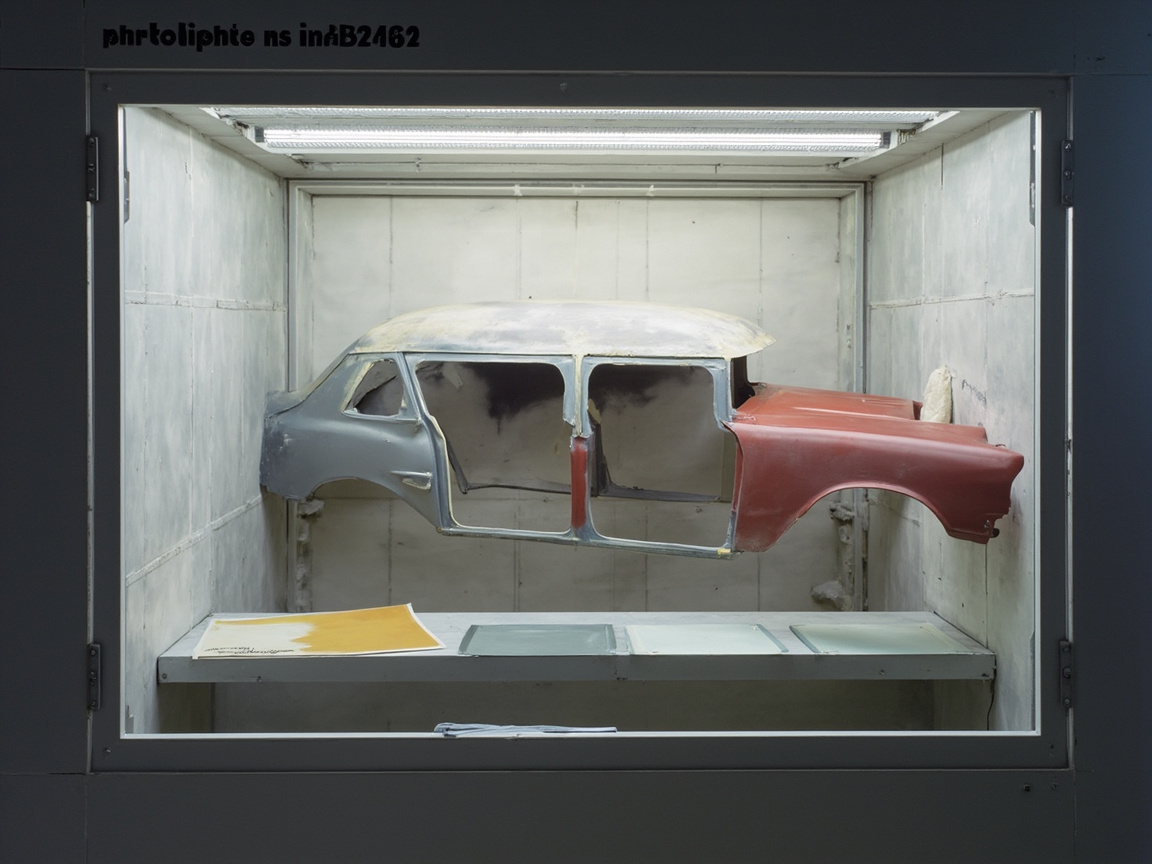
IX. Common Color Matching Errors and Troubleshooting
High-frequency errors in color matching and spraying sites mostly stem from process rather than equipment. Typical problems are as follows:
First, mixing after measuring only one point. Different positions on the body age unevenly and receive different light; single-point measurement is poorly representative. Measure multiple points and take the average, avoiding repair marks. Second, ignoring the light source. A color that looks "right" under warm yellow workshop lights is completely off in daylight. Comparison and acceptance must be conducted in a standard light booth under D65 and other light sources. Third, controlling only the face view for effect paint. The flop is not managed, leaving a bright band on the side in sunlight. Multi-angle measurement must be used. Fourth, disconnection between spraying and color matching. Color matching is done under ideal conditions, but during spraying the air pressure and film thickness vary randomly, so the color naturally drifts. Fix the spraying parameters into the process card. Fifth, mismatched clear coat. Wrong clear coat or uneven film thickness causes global appearance shift. Unify the clear coat system and gloss.
The troubleshooting table can be referenced as follows:
| Phenomenon | Possible Cause | Countermeasure |
|---|---|---|
| Obvious color difference in sunlight | Flop not controlled / uneven film thickness | Multi-angle measurement, fixed film thickness |
| Too new and too vivid | Mixed by factory code without accounting for aging | Use vehicle's measured aged color as reference |
| Hard, glaring boundary | Small hard patch without blending | Full panel or blending transition spraying |
| Same formula differs twice | Tinting base batch difference / uncalibrated instrument | Control tinting base batch, calibrate colorimeter |
| Changes after clear coat | Clear coat yellowing / inconsistent gloss | Unify clear coat and polishing reference |
X. Selection and Maintenance of Computer Color Matching Systems
When a refinisher selects a computer color matching system, four things should be considered: the accuracy and multi-angle capability of the colorimeter, the coverage breadth and update frequency of the formula library, whether the software supports metamerism warning, and whether the manufacturer can continuously supply stable tinting bases. Hardware is only the entry point; the formula library and tinting bases are the core competitiveness. After the system goes live, daily maintenance is required: regularly calibrate the instrument, properly store the standard white tile, keep the ambient light source stable, and use tinting bases on a first-in-first-out basis within their validity period to avoid sedimentation and skinning.
In data management, it is recommended to retain the color measurement data, final formula, spraying parameters, and accepted ΔE of each order, forming the store's own "successful formula library". Next time for the same vehicle and color, directly call and fine-tune it, improving both efficiency and quality stability. For chain stores, uploading data to the cloud for sharing enables "one store matches, multiple stores use". This approach of delivering "paint + data + process" together is exactly the value of Kexin New Materials (kexinMaterials) supporting system—not only providing tinting bases, but also replicable color matching process boundaries.
XI. Interface with Automotive OEM Paint Systems
Refinish color matching is not an isolated step; it must interface with the OEM paint system (electrophoretic primer, intermediate coat, basecoat, clear coat). OEM basecoat undergoes high-temperature baking, and the pigment dispersion and effect pigment orientation differ from room-temperature refinishing, so refinish formulas often require "refinish-state" correction to the OEM color code. Understanding the OEM coating system helps determine which layer the reference color resides in: color difference problems sometimes lie not in the basecoat layer, but in the base color showing through, intermediate coat bleeding, or clear coat yellowing. For electrophoretic primer and the complete OEM system, further reading: Automotive OEM Paint Coating System and Electrophoretic Primer Process. Mastering the system perspective significantly improves color matching hit rate and first-pass yield.
XII. Trends in Digital Color Matching and Color Data Management
Computer color matching has reached today's maturity in hardware (colorimeter, formula software); the real competition has shifted to "data". Whoever owns a more complete, accurate, and fresh color database can widen the gap in first-time matching hit rate and store efficiency. The industry is moving from "standalone formula library" to "cloud-collaborated color data platform", behind which are several clear technical threads.
The first is the sharing of cloud formula libraries. The manufacturer's master library covers mainstream vehicle OEM color codes, but what stores encounter daily is largely "store's common models + store's equipment + store's process" practical formulas. After desensitizing these successful formulas and uploading to the cloud, a "one store matches, multiple stores use" network effect forms, significantly reducing repeated trial-and-error. The premise is standardized store collection: each time retain the color measurement reflection curve, final formula, spraying parameters, and accepted ΔE, rather than just noting "about right".
The second is spectral databases replacing single color values. Early systems only stored three numbers L*a*b*, unable to handle metamerism; modern platforms store complete reflectance curves (one point per 10 nm), which can quantify total color difference and compare point-to-point spectra to warn of the risk of "close numbers but separating under light source". The larger the spectral library, the more constraints the algorithm has for back-calculating formulas, and the more accurate the recommendation.
The third is algorithm-assisted formula recommendation. Based on historical successful formulas + this measurement deviation, use colorimetric optical models for iterative recommendation, compressing the technician's process from "blind adjustment to close". But be clear: the algorithm is auxiliary, not a replacement; final panel spraying and multi-angle acceptance are still required, because spraying "re-processes" the color. Closing the loop among algorithm recommendation, instrument measurement, and standardized spraying is the complete chain of digital color matching.
The fourth is color data interface with the manufacturing end. OEMs establish color code spectral archives during mass production; if the refinisher can read the same spectrum rather than just the color code text, it can directly do "refinish-state" correction, reducing reference deviation caused by high-temperature baking vs. room-temperature curing differences. This data homology between vehicle end and refinisher end is a high-value direction for improving first-pass yield.
The fifth is the indispensable data quality foundation. No matter how good the platform, if the instrument is uncalibrated, ambient light unstable, and collection non-standard, garbage in means garbage out. Therefore, stores must incorporate colorimeter calibration, standard light booth maintenance, and collection SOP into daily routine, treating data quality as an asset equally important as the paint itself. Kexin New Materials (kexinMaterials), when promoting the "paint + data + process" package, also uses collection standards and cloud formula sharing as implementation levers, helping chain stores precipitate master technicians' experience into replicable digital assets rather than losing them when people leave.
From a longer cycle, the value of color matching data also extends to quality traceability and insurance claims. The spectrum and process data retained per order can serve as objective evidence in color disputes; in used-car and accident repair scenarios, it can also prove the consistency between refinished color and original vehicle. When data runs through the full chain of "measurement—formula—spraying—acceptance—traceability", automotive color matching truly transforms from craftsmanship to auditable engineering.
XIII. Standard Configuration List for Color Matching Workshop
To stably implement computer color matching, the workshop needs a complete and calibratable set of hardware. The following list can serve as a self-check baseline for refinishers:
First, spectrophotometer (multi-angle preferred). This is the data entry for color matching; it is recommended to select models with 15°/25°/45°/75°/110° multi-angle, equipped with standard white tile and black trap for periodic calibration, and measured in a unified standard light booth environment.
Second, standard light booth. Built-in D65, A, TL84, CWF and other light sources, used for visual comparison and multi-light-source acceptance, avoiding misjudgment under warm yellow workshop lights.
Third, paint mixing and measuring tools. Graduated mixing cups, electronic scale (precision to 0.1 g), stirring rods, for accurately mixing tinting bases by volume or mass ratio.
Fourth, viscosity and film thickness control. DIN 4 viscosity cup (with timer), wet and dry film thickness gauges, for quantifying spraying parameters and avoiding by-feel.
Fifth, spraying and curing equipment. Spray gun (1.2–1.4 mm), compressed air purification system, infrared or oven, for turning formulas into acceptable panels.
Sixth, color chips and formula library. Retain the store's successful formula panels and corresponding measurement data, forming reusable assets.
Combining these six categories of equipment with standardized SOP, computer color matching can go from "occasionally accurate" to "consistently stable". Equipment is the skeleton; data and discipline are the soul.
XIV. Management Closed Loop for Color Matching Quality
Color matching is not a one-time action, but an improvable closed loop. Managing with the Plan-Do-Check-Act (PDCA) approach can continuously push up hit rate and efficiency.
Planning phase: Use a colorimeter to capture the body's reflectance curve, call the formula library to back-calculate the initial formula, and register the target Δ;E and multi-angle tolerance.
Execution phase: Strictly measure according to the formula, spray according to the process card, fix the spray gun pressure, gun travel and film thickness, and reproduce "color matching" and "spraying" as a whole.
Inspection phase: Accept via multi-angle color measurement, record front/side-view Δ;E, gloss and appearance, judge whether the established window is reached; if not, return to the planning phase for fine-tuning.
Improvement phase: Store the color measurement, formula, process and acceptance data of each order into the cloud library, making it the starting point for the next same-car same-color job, and perform root cause analysis on high-frequency deviations.
This closed loop seems cumbersome, yet it can transform the "veteran master's feel" into "store assets". As data keeps rolling, color matching moves from art to engineering, and rework rate and cost drop accordingly, while customer satisfaction rises.
15. Supplementary Common Misconceptions in Color Matching
In addition to the key points above, there are several easily overlooked misconceptions:
Misconception 1: An expensive instrument must be accurate. Wrong. No matter how expensive the colorimeter, if it is not calibrated and the ambient light is messy, the data is untrustworthy. Calibration and SOP determine credibility more than price.
Misconception 2: The larger the formula library the better. Wrong. A large but dirty library leads to messy recommendations. Better a small library where every entry is clean and traceable.
Misconception 3: Accept only under daylight. Wrong. Customers may view the car in underground garages or under night streetlights; multi-light-source acceptance is mandatory.
Misconception 4: Small color difference equals success. Wrong. You must also look at front/side-view difference, gloss and post-aging consistency; judging only by ΔE misses cases.
Writing these misconceptions into training can save many detours.
FAQ
Q: Does computer color matching mean there is absolutely zero color difference?
A: No. Computer color matching objectifies color measurement and formula calculation, greatly improving hit rate, but the final color is still affected by spray film thickness, air pressure, temperature/humidity, varnish and aging baseline. Even if instrument ΔE is tuned within 1.0, out-of-control spraying process may still cause deviation. Accurate color matching is only a prerequisite; accurate spraying is the result.
Q: What ΔE is considered acceptable?
A: Industry experience: ΔE*ab below 1.0 is barely distinguishable to the human eye, 1.0–1.5 is high-standard pass, 1.5–2.0 is generally acceptable, 2.0–3.0 is clearly visible and needs rework, above 3.0 is unqualified. Effect paints also require angle-by-angle control of front/side-view difference; total ΔE alone is not enough.
Q: Why is silver paint harder to match than solid-color paint?
A: Silver paint contains metal flakes; its color changes with viewing angle (flake-oriented color shift). With the same formula, different film thickness and air pressure lead to different flake orientation, hence different front/side-view colors. Multi-angle colorimeters must be used to control color difference at multiple angles separately, far harder than solid-color paint that only looks at L*a*b*.
Q: Why does old-car refinish always look "too new"?
A: The old car's varnish has yellowed and the base paint faded; the actual body color has shifted. If mixed by the original new color code, the patch looks newer and more vivid. The correct approach is to use the body's measured aged color as the baseline for measurement and back-calculation, and apply blend transitions on high-visibility areas.
Q: What is metamerism, and can computer color matching detect it?
A: Metamerism means two colors look different under different light sources (different spectral reflectance curves). Comparing under only one lamp falsely judges "match". Computer color matching captures full-spectrum reflectance curves and can accept under multiple light sources in a standard light box, identifying metamerism risk.
Q: Why is color matching accurate but spraying deviates?
A: The most common variables are film thickness and spray gun air pressure. Film thickness changes the layers and orientation of effect pigments; air pressure changes atomization fineness and flake lay-down. Fix the gun model, cap-end pressure and gun-travel rhythm into the process card, treating them as one with the formula.
Q: Does varnish affect the final color?
A: Yes. Varnish gloss, film thickness and yellowing alter the underlying appearance. Old-car varnish has yellowed, new varnish is clearer, making the base look cooler. If necessary, unify by polishing or global clear-coat, establishing a consistent gloss baseline before comparison.
Q: How to maintain a colorimeter?
A: Regularly calibrate with standard white tile and black trap; store the white tile away from light and moisture; keep measurement environment light stable; use colorants FIFO within validity, avoiding settling and skinning; retain per-order color and formula data to build your own success library.
Q: Should a store build its own formula library?
A: Highly recommended. The vendor master library covers mainstream models, but your store's "battle-tested formulas" under commonly used models and processes fit reality better. Retaining and sharing color values, formulas, spray parameters and accepted ΔE significantly boosts efficiency and stability, especially for chain stores.
Q: How does refinish color matching differ from OEM color matching?
A: OEM uses high-temp baking lines for batch coating, with stable pigment dispersion and effect orientation, produced by color code; refinish is single-piece room-temperature curing, dealing with aging baseline, local blending and equipment differences. Refinish formulas often need "refinish-state" correction on the OEM code, relying more on instruments and process discipline.
Further Reading
- Principles of Automotive Pigmented Paint Effect Pigments (Pearl/Metallic): Deeply understand the optical behavior of metal and pearl flakes, the basis for controlling effect paint's angle-dependent color shift and color-match hit rate.
- Automotive OEM Coating System and Electrophoretic Primer Process: Judge the hierarchy of color-difference sources from the OEM system perspective, building holistic "primer—intermediate—color—clear" matching thinking.
- Automotive Ceramic Nano Coating Hydrophobic Mechanism: Understand the impact of ceramic coating above varnish on gloss and appearance, avoiding misjudging coating effects as color difference.
- Automotive Spray Booth Cleanliness and Booth Design: Airflow, Filtration and Environmental Control
- New Energy Vehicle Three-Electric System Coating Protection
- Automotive Refinish Paint System: 2K Solid Paint, Basecoat+Clearcoat and Single-Component