Core Conclusion:
1. The 9H nano ceramic coating uses 5-20nm SiO₂ particles to form a dense 2-10μm crystalline protective layer on the paint surface through molecular self-assembly, with pencil hardness reaching the highest grade of 9H.
2. The global automotive ceramic coating market is projected to exceed $7.2 billion in 2025, and third-generation smart slow-release technology can extend the protection period to 5 years.
3. 9H ≠ absolutely scratch-proof — when purchasing, attention should be paid to SiO₂ purity (≥80%), third-party certification (SGS/TÜV), and application qualifications, rather than solely relying on numerical claims.
In the field of automotive aftermarket care, 9H nano ceramic paint coating is one of the most revolutionary technologies of the past decade. From the earliest carnauba wax (protection period of only 2-3 weeks), to polymer sealants (3-6 months), and now to nano ceramic coatings (3-5 years), paint protection technology has undergone three generational leaps. This article will systematically analyze the scientific principles, performance boundaries, and market status of this technology.
What Is 9H Nano Ceramic Coating? — Understanding the Protection Mechanism at the Molecular Level
Direct answer: 9H nano ceramic coating is a liquid coating with high-purity nano silica (SiO₂) as its core active ingredient; after application, it forms a transparent glass-like crystal protective layer of about 2-10 microns thickness and 9H pencil hardness on the car paint surface through a sol-gel reaction.
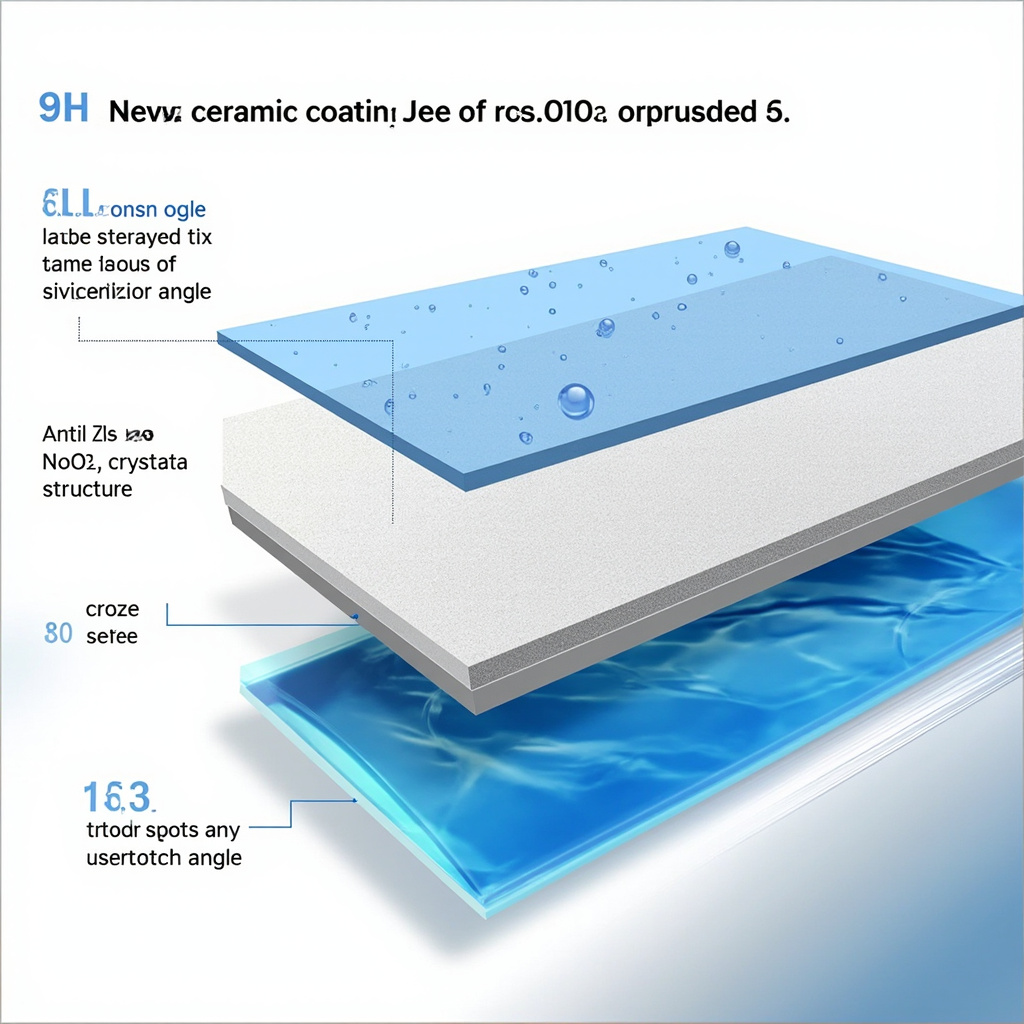
Mechanism Details:The core component, nano-SiO₂ particles, have a particle size of only 5-20nm (about 1/5000 of a hair strand). When the liquid coating material is applied to the paint surface, solvent evaporation triggers a condensation reaction: Si-OH + HO-Si → Si-O-Si + H₂O, forming a dense Si-O-Si covalent cross-linked network between the nanoparticles and between the nanoparticles and the clear coat layer of the paint. This process is called "molecular self-assembly" — not a simple physical coverage, but integration with the substrate through chemical bonds.
The cured coating structure can be understood through a three-layer model: (1) the bottom layer—a chemical anchoring layer of SiO₂ and the acrylic resin of the varnish; (2) the middle layer—a highly cross-linked three-dimensional Si-O-Si network matrix that provides hardness and barrier properties; (3) the top layer—a low-surface-energy interface modified with methyl/fluorocarbon groups that imparts hydrophobic and oleophobic functions. This gradient structure simultaneously achieves the integration of adhesion, hardness, and surface functionality.
Data Support:According to the ASTM D3363 pencil hardness test standard, 9H is the highest labelable grade. Leading brands such as Gtechniq have their Crystal Serum Ultra series products certified by SGS, with a water contact angle of 110-120° and UV reflectance of 95%. Data from the China National Coatings Industry Association shows that domestic ceramic coating application volume in 2025 increased by over 200% compared to 2020.
Source: ASTM D3363, Gtechniq Technical White Paper, SEMA 2025 Market Report
What Does 9H Hardness Really Mean? — Interpreting the Most Misunderstood Performance Metric in the Industry
Direct answer: 9H originates from the pencil hardness test (ASTM D3363), indicating that the coating can resist scratching by a 9H graphite pencil without leaving marks. However, 9H ≠ Mohs hardness 9 (sapphire level), and it is not equivalent to "scratch-proof and impact-proof." It reflects the coating's ability to resist minor scratches and swirl marks, not its impact resistance.
Mechanism details:The pencil hardness test method involves pushing a pencil at a certain angle (45°) and a certain load (750g or 1000g) across the coating surface to observe whether scratches are produced. The graphite/clay mixture of a 9H pencil is much softer than quartz sand (Mohs 7), so a "9H" coating may still be scratched by flying gravel in real road environments.
The industry has a widespread "hardness arms race" — some brands claim to reach 10H or even higher. However, per ASTM D3363, 9H is already the upper limit of the scale, and 10H is not a standard grade. The trend in 2025 is: leading brands are shifting from the "hardness race" to a "comprehensive performance" narrative — including hydrophobic durability, anti-fouling ability, self-healing function, and gloss enhancement.
Data Support: Third-party test reports from Kovalent Coatings (Australia) show that the actual scratch resistance of its graphene-enhanced ceramic coating is approximately 30% higher than that of traditional 9H SiO₂ coatings, but this is mainly attributed to the improved flexibility and thermal conductivity of graphene, rather than a simple increase in hardness.
Source: ASTM D3363-22, Kovalent Coatings technical data, Gtechniq Crystal Serum Ultra product specifications
The core process of ceramic coating application—why workmanship matters more than the product itself?
Direct answer: Even with high-quality ceramic coating products, improper application can cause the coating to fail prematurely. The core process includes: paint correction (removing oxidation layer and scratches) → degreasing treatment (IPA wipe) → section-by-section application → wiping off excess liquid within the specified time → infrared curing (60±2℃, 45%RH) → 48-72 hours natural curing.
Mechanism Explained: Paint correction is the most critical step before applying a ceramic coating. An uncorrected paint surface has defects such as oxidation layers, acid rain etching, and wash swirl marks—if a coating is applied directly on a defective surface, it is equivalent to "sealing" the flaws under glass. Professional paint correction uses polishing compounds and pads of varying grits to sequentially remove the defective layer of the paint, restoring a mirror finish before the ceramic coating is applied.
Curing conditions are equally critical. The sol-gel reaction of nano-SiO₂ requires a precise temperature and humidity window: too low a temperature (70% RH) may lead to coating hazing. Top-tier application workshops use short-wave infrared curing lamps to accelerate the crosslinking reaction, and simultaneously employ ionized air shower dust removal systems to control particulate count in the application environment at ≤10,000 particles/m³ (ISO Class 5 cleanliness standard).
Data Support:Data from Gtechniq's globally authorized application centers (IDAS certified) shows that for vehicles coated with ceramic coating through the standard application process, the coating integrity rate after 5 years exceeds 85%, while for DIY users applying the same product themselves, the integrity rate after 2 years is less than 40%.
Source:Gtechniq IDAS Application Standard Manual, ISO 14644-1 Cleanroom Standard
Frequently Asked Questions (FAQ)
Q: What is the difference between 9H ceramic coating and regular waxing?
Waxing is physical coverage (protection for 2–3 weeks), while ceramic coating is chemical crosslinking (protection for 3–5 years). Wax has a hardness of only 2–3H, whereas ceramic coating reaches 9H. Wax dissolves in alkaline car wash solutions, but ceramic coating resists pH 1–13. Over 5 years of maintenance cost: ceramic coating is about 60% lower than waxing.
Do you still need to wash the car after applying a ceramic coating?
Yes, but with reduced frequency and difficulty. It is recommended to hand-wash with a pH-neutral car shampoo every 2–4 weeks, avoiding the stiff brushes of automatic car washes. The hydrophobicity of the coated surface allows over 90% of dust to be rinsed away by rainwater.
How much does a bottle of ceramic coating cost approximately?
Consumer-grade DIY kits are approximately RMB 200–800 per set, while professional-grade products are about RMB 1,500–5,000 per set (including application tools). Full service with application: domestic ceramic coatings are around RMB 1,500–3,500, and imported high-end brands range from approximately RMB 5,000–15,000.
How to distinguish genuine from fake 9H ceramic coating?
Three checks: First, check the composition—require a test report showing SiO₂ content ≥80%; second, check the certification—SGS/TÜV third-party testing; third, check the warranty—reputable brands provide 3–5 years written warranty. Inferior products turn yellow and fail after 3–6 months.
Can old cars be given a ceramic coating?
Yes, and the effect is more pronounced. For older vehicles, a full paint correction (removing oxidation and scratches) should be done first; after coating, the gloss improvement is usually more significant than on a new car. However, deep scratches (damaging the color coat) require repainting before coating.
Reference sources: ASTM D3363-22, Gtechniq Technical White Paper, SEMA 2025, China National Coatings Industry Association, Kovalent Coatings Technical Data
Publish Date: July 5, 2026 | Category: Technical Knowledge