How to solve poor paint adhesion on aluminum alloy, galvanized steel, and stainless steel? This article details epoxy zinc phosphate primer, epoxy zinc-rich primer, and surface sandblasting and grinding processes to improve industrial anti-corrosion adhesion and durability.
Aluminum alloy, galvanized steel, and stainless steel are prone to poor adhesion, paint peeling, and blistering when painted. This article provides a detailed analysis of the application processes for epoxy zinc phosphate primer, dedicated epoxy primer, and epoxy zinc-rich primer, introduces blast cleaning and grinding surface preparation methods and heavy-duty industrial anti-corrosion coating systems, so as to improve metal adhesion and corrosion protection service life.
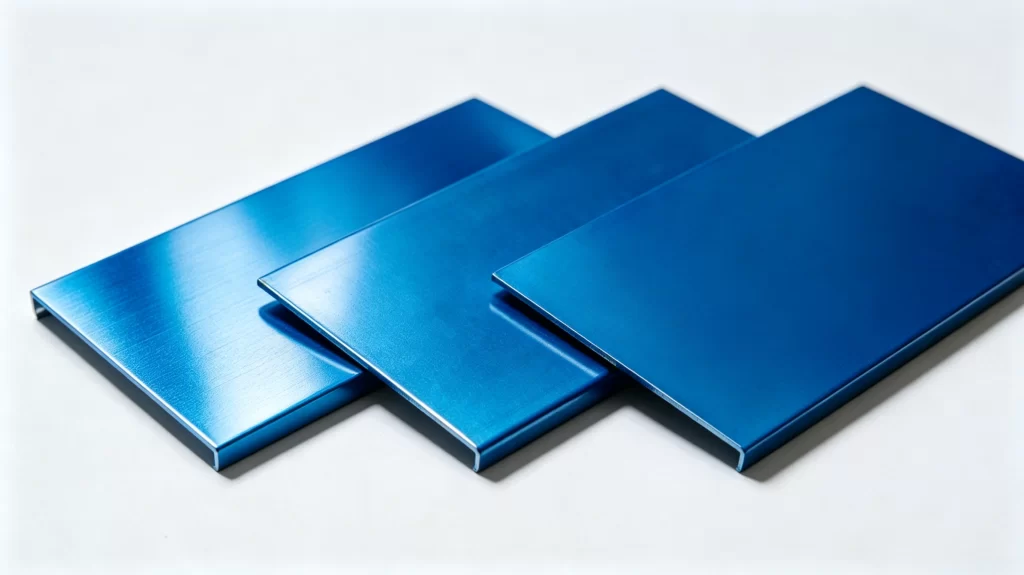
In the field of industrial anti-corrosion coating, aluminum alloys, galvanized steel sheets, and stainless steel have long been regarded as "difficult substrates." In many engineering projects, problems such as paint peeling, flaking, blistering, and insufficient adhesion frequently occur, and are especially common in outdoor steel structures, mechanical equipment, automotive parts, storage tanks, power facilities, curtain walls, bridges, and industrial equipment.

A large number of construction cases show:
It is not that the quality of the topcoat is poor, but that the substrate treatment and the selection of the primer system are incorrect.
Especially in some projects, construction units habitually apply epoxy zinc-rich primer directly, and as a result, large-scale peeling occurs within just a few months. This situation is particularly prominent on galvanized parts, stainless steel parts, and aluminum profiles.
This paper will systematically analyze:
- Why do aluminum alloys, galvanized materials, and stainless steel exhibit poor adhesion?
- Physicochemical properties of different metal surfaces
- Advantages of epoxy zinc phosphate primer
- Application scheme for dedicated epoxy primer
- Why does zinc-rich epoxy primer tend to fail easily?
- Proper blasting and grinding treatment process
- Optimal primer system combinations for industrial corrosion protection
- Core methods for improving paint adhesion and durability
Assist industrial coating companies, contractors, equipment manufacturers, and steel structure clients in selecting the right coating solutions.
Why do aluminum alloys, galvanized materials, and stainless steel exhibit poor adhesion?
I. Characteristics of Aluminum Alloy Surfaces
A dense oxide film rapidly forms on the surface of aluminum alloy.
This oxide film can protect the metal, but at the same time it also:
- reduce paint penetration ability
- hindering the adhesion between resin and metal
- resulting in insufficient mechanical interlocking of the paint film
- affecting intercoat adhesion
Especially in:
- fluorocarbon coating / fluorocarbon spray coating
- Industrial equipment painting
- Automotive components
- aluminum curtain wall
- Electrical enclosure
and other fields, if the primer is not selected correctly, large-scale peeling is highly likely to occur at a later stage.
II. Adhesion Issues on Galvanized Steel Sheets
The surface of the galvanized sheet is coated with a zinc layer.
Moreover, the zinc coating has the following characteristics:
- Smooth surface
- high activity
- Prone to forming zinc salts
- Prone to saponification
After direct spraying of ordinary paint:
- The paint film cannot adhere firmly.
- Prone to bubbling.
- Prone to delamination in the later stage.
- Failure occurs more rapidly in hot and humid environments.
This is especially pronounced in hot-dip galvanized steel structures.
Many steel structure projects fail not because of steel corrosion, but because the paint fails first.
III. Why is it difficult to paint stainless steel?
The most prominent characteristic of stainless steel is:
passivation film
This passivation film gives it excellent corrosion resistance, but also makes it difficult for paint to adhere.
Common issues include:
- The paint film peels off with a single pull.
- Cross-cut test failed
- edge delamination
- paint loss after impact
- Cracking under high-temperature conditions
Especially 304 stainless steel and 316 stainless steel surfaces are extremely smooth.
Without surface roughening, no primer can achieve long-term, durable adhesion.
Why can't ordinary primers solve the problem?
Many construction units, in order to save costs, will adopt:
- ordinary anti-rust paint
- alkyd primer
- general-purpose epoxy primer
- red lead primer
Apply directly.
However, these products often lack:
- reactive anchoring groups
- metal binding capacity
- surface wetting ability
- chemical anchoring capacity
Therefore, it is prone to failure on smooth metal surfaces.
Why is epoxy zinc phosphate primer suitable for these substrates?
I. Core Advantages of Epoxy Zinc Phosphate Primer
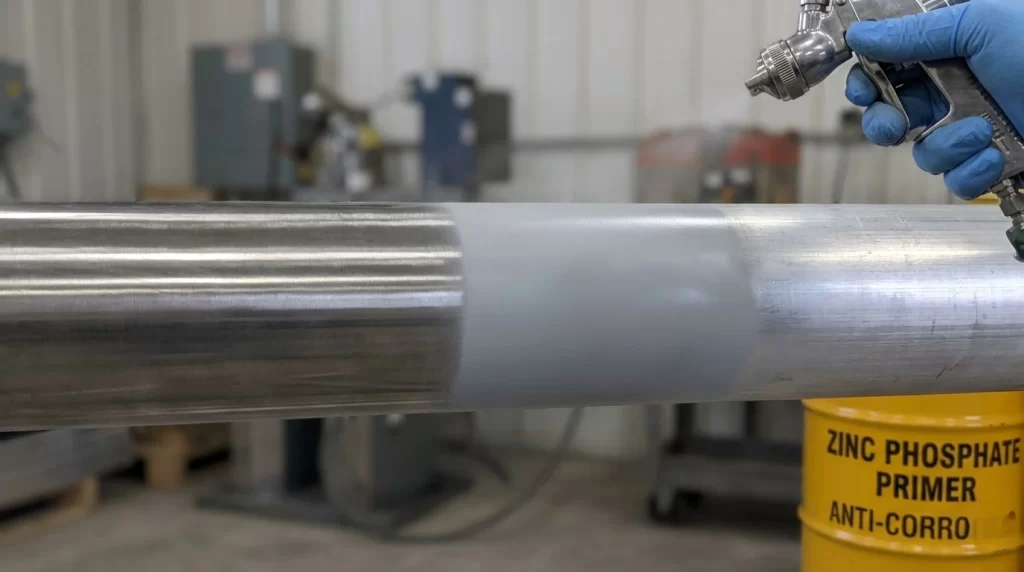
Epoxy zinc phosphate primer is a high-adhesion anti-corrosion primer.
Its characteristics include:
- excellent metal wettability
- extremely strong adhesion
- good sealing performance
- Stable anti-corrosion performance
- Excellent salt spray resistance
- Compatible with a wide range of topcoats
Especially suitable for:
- aluminum alloy
- galvanized parts
- stainless steel
- cold-rolled steel sheet
- carbon steel
and other complex substrates.
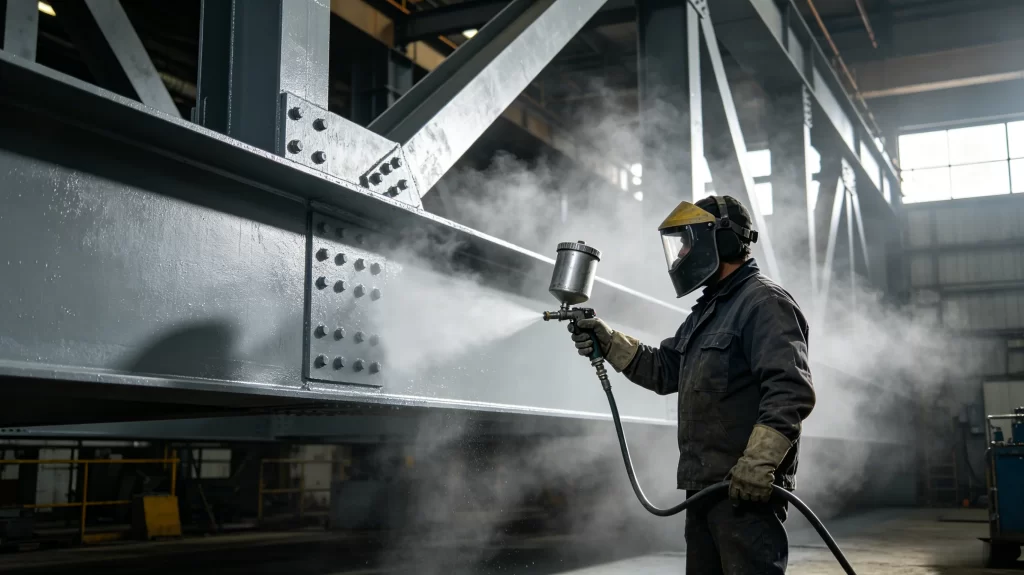
II. Anticorrosive Mechanism of Zinc Phosphate Pigments
Zinc phosphate can form:
- passivation protective layer
- chemical corrosion-inhibiting film
- electrochemical shielding layer
At the same time, it can also:
- Improve film density
- reduce water vapor permeation
- enhance corrosion resistance
Therefore, it is widely used in:
- industrial heavy-duty anti-corrosion
- steel structure
- construction machinery
- marine equipment
- container
- power facilities
and other industries.
Importance of dedicated epoxy primer
For difficult-to-adhere metals, many high-end projects adopt:
Specialized Epoxy Adhesion Primer
This primer typically features:
- special adhesion promoter
- Modified epoxy resin
- metal coupling system
- excellent wetting and leveling
Its characteristics are:
Even on smooth metal surfaces, it can form strong mechanical interlocking and chemical bonding.
Suitable applications for dedicated epoxy primer
1. Aluminum profile spraying
Widely used in:
- Doors and windows
- curtain wall
- industrial aluminum profiles
- rail transit
2. Stainless steel equipment
For example:
- Food machinery
- Chemical equipment
- Medical equipment
- Water treatment equipment
3. Galvanized steel structure
For example:
- photovoltaic mounting system
- steel tower
- guardrail
- power facilities
Why is epoxy zinc-rich primer not suitable for direct application on these substrates?
Many projects specify:
A zinc-rich epoxy primer must be used.
But the problem is:
Epoxy zinc-rich primer is not equivalent to a universal primer.
I. Working Principle of Epoxy Zinc-Rich Primer
Epoxy zinc-rich primer relies on:
zinc dust cathodic protection
That is to say:
Protect steel by preferential corrosion of zinc powder.
Therefore, it is most suitable for:
- carbon steel
- blast-cleaned steel
- black iron parts
rather than:
- galvanized sheet
- stainless steel
- aluminum alloy
II. Why is it prone to peeling/off?
The main reasons include:
1. The surface is too smooth
Zinc-rich primer itself:
- high zinc dust content
- The paint film is relatively brittle.
- High requirement for mechanical interlocking
If the substrate is smooth:
Adhesion will drop sharply.
2. Lack of effective anchor profile
Epoxy zinc-rich primer is highly dependent on:
blast profile
Without roughness:
The paint film cannot adhere firmly.
3. Electrochemical system mismatch
Applying zinc-rich paint over the galvanized coating:
Complex potential differences may be formed.
in severe cases, it may instead:
- accelerated local failure
- cause interlayer delamination
- formation of bubbles
What should be done if epoxy zinc-rich primer must be used?
Many large-scale engineering specifications explicitly require that:
- Epoxy zinc-rich primer
- inorganic zinc-rich primer
- high-zinc-content systems
Construction cannot be carried out directly at this time.
Must be added:
Surface treatment process
Correct application method: sand or blast first.
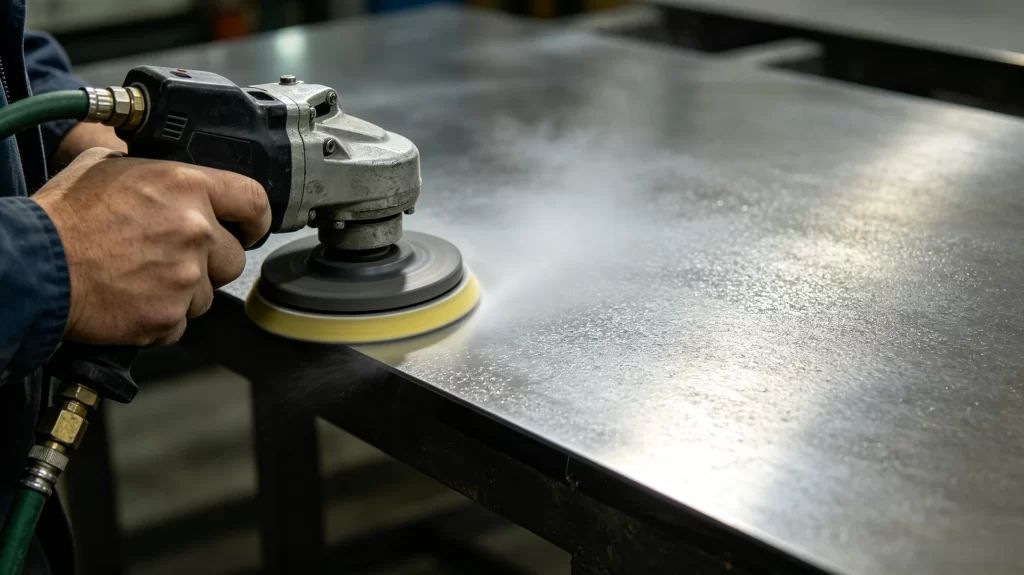
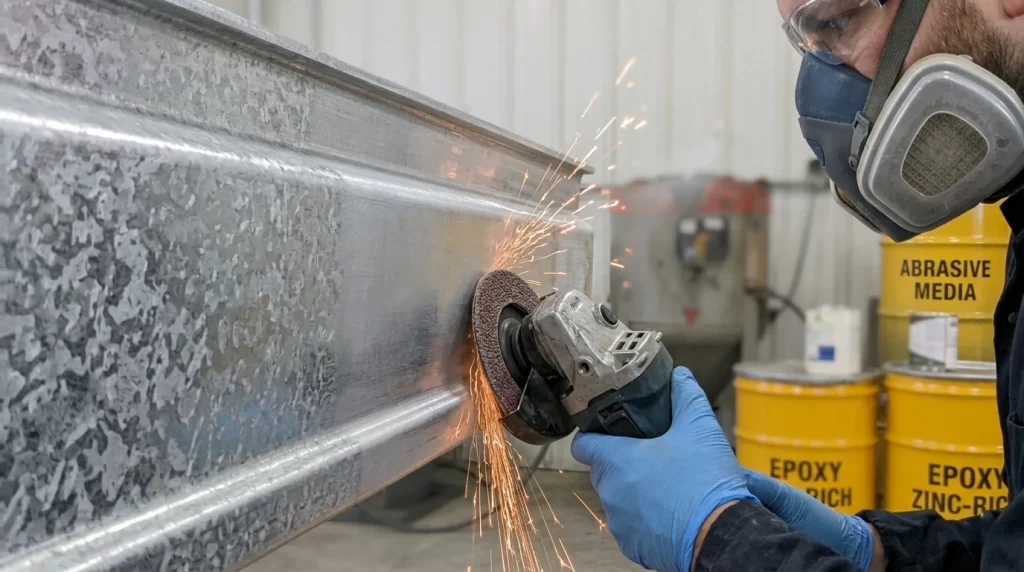
I. Sanding Treatment
Suitable for:
- small workpieces
- localized repair
- indoor equipment
Recommended use:
- 80#-120# sandpaper
- angle grinder
- flap disc
Purpose:
Form a uniform roughness.
II. Sandblasting Treatment
Recommended for large-scale projects:
Sandblasting or shot blasting.
Recommended to achieve:
Sa2.5
This is acceptable.
- Remove oxide layer
- increase roughness
- improve mechanical adhesion
- enhance primer adhesion
III. Roughness Recommendations
Recommended roughness:
30-70 μm
In particular, epoxy zinc-rich primer is highly sensitive to surface roughness.
Aluminum alloy surface treatment standard
Recommendations before construction on aluminum alloy:
1. Degreasing and cleaning
Remove:
- oil stains
- rust preventive oil
- fingerprint
- cutting fluid
2. Mechanical sanding
Form a uniform matte surface.
3. Chemical conversion treatment
For example:
- chromated
- chrome-free passivation
- phosphating
It can significantly improve adhesion.
Precautions for Construction on Galvanized Steel Sheets
I. Newly galvanized steel sheets cannot be directly painted.
Due to the presence of on the surface:
- passivation layer
- oil film
- zinc salt
Must be treated first.
II. Recommended Treatment Methods
light sweep blasting
Will not damage the zinc layer.
Simultaneously increase the roughness.
2. Specialized cleaner
Remove surface contamination.
3. Epoxy zinc phosphate primer sealing
The effect is significantly superior to that of ordinary primers.
Optimal solution for painting stainless steel
Recommended process:
Step 1: Roughening treatment
Adopt:
- sandblasting
- roughening
- sanding
Step 2: Specialized Epoxy Primer
Improve adhesion.
Step 3: Intermediate Coat
Commonly used:
- Epoxy micaceous iron oxide intermediate paint
Enhance shielding performance.
Step 4: High-performance topcoat
For example:
- Polyurethane topcoat
- fluorocarbon topcoat
- acrylic polyurethane
Recommended coating system for heavy-duty industrial corrosion protection
Option 1: Galvanized steel structure
- Epoxy zinc phosphate primer
- Epoxy micaceous iron oxide intermediate paint
- Polyurethane topcoat
Features:
- Strong adhesion
- Excellent salt spray resistance
- Good outdoor weather resistance
Option 2: Stainless steel equipment
- Specialized Epoxy Adhesion Primer
- Epoxy intermediate coat
- fluorocarbon topcoat
Features:
- long-term corrosion resistance
- high decorative quality
- Long service life
Option 3: Epoxy zinc-rich primer must be used.
Process requirements:
- Sandblasting Sa2.5
- Roughness 30-70 μm
- zinc-rich primer
- epoxy micaceous iron oxide
- Polyurethane topcoat
This is a relatively mature heavy-duty anti-corrosion system in industrial corrosion protection.
Why do many paint projects fail after just a few years?
The root cause is usually not the paint itself.
Instead:
Inadequate substrate preparation
Many construction sites:
- without sanding
- without sandblasting
- without degreasing
- unmeasured roughness
Direct spray painting.
Ultimately resulting in:
- large-area peeling
- Foaming
- corrosion spread
- Rework costs are substantial
Key factors for improving adhesion
I. Surface Cleanliness
Oil contamination is the greatest enemy of adhesion.
II. Roughness
Appropriate roughness determines the mechanical interlocking capability.
III. Primer Selection
Different metals must be paired with different primers.
IV. Application Environment
High-humidity environments are prone to:
- rust recurrence
- Foaming
- cratering
V. Recoat Time
Beyond recoat interval:
Interlayer adhesion will decrease.
How to correctly select between epoxy primer and zinc-rich primer?
Suitable for epoxy zinc phosphate primer
Recommended:
- aluminum alloy
- galvanized sheet
- stainless steel
- complex metal
- multi-metal hybrid structure
Suitable for epoxy zinc-rich primer
Recommended:
- sandblasted carbon steel
- heavy-duty anti-corrosion steel structures
- offshore platform
- bridge
- petrochemical equipment
Development Trends in Modern Industrial Coating
With increasing industrial anti-corrosion requirements:
More and more projects are beginning to prioritize:
- adhesion
- long-term anti-corrosion
- Environmentally friendly construction
- high-weathering-resistant system
Therefore:
The traditional extensive construction method of "direct spray painting" is being phased out.
Modern industrial coating places greater emphasis on:
- standardized surface treatment
- scientific primer system
- heavy-duty anti-corrosion system design
- full-life-cycle protection
Conclusion
Aluminum alloys, galvanized materials, and stainless steel have long been challenging for adhesion in industrial coating due to their special surface properties.
If the primer is incorrectly selected, even high-end topcoats cannot remain stable over the long term.
In practical engineering:
- Epoxy zinc phosphate primer
- Specialized Epoxy Adhesion Primer
It is generally more suitable for these complex metal substrates.
If the project must use epoxy zinc-rich primer, the following must be done in advance:
- sanding
- sandblasting
- roughening treatment
Otherwise, large-scale peeling is highly likely to occur.
An excellent industrial anti-corrosion system never relies solely on "high-grade paint," but rather on:
Proper substrate preparation + appropriate primer system + standardized application process
Only in this way can we truly achieve:
- long-term anti-corrosion
- high adhesion
- weather-resistant and salt spray resistant
- Reduce maintenance costs
- Extend equipment service life