Core conclusions:
1. The photo-oxidative aging of PP/TPO automotive plastic parts follows the Norrish I/II free-radical chain reaction mechanism—nano-TiO2/ZnO blocks photo-initiation at the source by bandgap absorption of UV (<390nm), while HALS captures generated free radicals to block chain propagation.
2. CPO (chlorinated polyolefin) adhesion promoter works via the "like dissolves like" principle—the polyolefin backbone of CPO interdiffuses and entangles with the PP/TPO substrate, and the polar chlorine atoms provide hydrogen-bond/covalent anchoring sites with the 2K PU topcoat—raising coating adhesion from 5MPa.
3. The global automotive exterior plastic parts coating market is about USD 3.5 billion in 2025; "paint-free" (in-mold coloring + nano-clearcoat protection) is the fastest-growing technology route—eliminating primer/basecoat spraying processes and reducing VOC emissions by >60%.
The plastic usage in modern passenger vehicles has exceeded 20% of the total vehicle weight—exterior parts such as bumpers, grilles, side skirts, mirror housings, and tailgate trim panels are almost entirely made of PP (polypropylene), TPO (thermoplastic polyolefin elastomer), or PC/ABS alloy. The fatal weakness of these polymer materials is their extreme sensitivity to ultraviolet light—the tertiary C-H bonds in PP and TPO (C-H bond energy approx. 381 kJ/mol) undergo homolytic cleavage under irradiation by UV photons with wavelength 363 kJ/mol), triggering free-radical chain auto-oxidation reactions (Norrish I/II mechanism), which macroscopically manifest as yellowing, chalking, loss of gloss, and decline in mechanical properties. The natural outdoor weathering lifetime of PP/TPO (without stabilization treatment) shows significant degradation in only about 6–12 months. Anti-aging and UV-resistant nano-coating for automotive plastic parts is a multi-layer UV protection and weather-resistant barrier constructed on the surface of polymer substrates.
Chemical Mechanism of Polymer Photo-Oxidative Aging—How UV "Kills" Plastics?
Direct answer: The photo-oxidative aging of PP/TPO is a free-radical chain reaction, divided into four stages. (1) Photo-initiation — UV photons (wavelength <330 nm) break the tertiary C-H bonds on the PP main chain or residual Ti/Al catalyst initiators from production, generating alkyl radicals (R•); (2) Chain propagation — R• reacts with O₂ to form peroxy radicals (ROO•), and ROO• abstracts an H atom from a neighboring PP chain to generate hydroperoxides (ROOH) and a new R• (chain transfer); (3) Chain branching — ROOH decomposes under UV or heat into RO• + •OH (two highly active radicals), causing the number of radicals to grow exponentially; (4) Chain termination — two radicals terminate via coupling or disproportionation, but the PP chains have already undergone scission, crosslinking, and oxidative functionalization (forming chromophores such as carbonyl C=O, hydroxyl -OH, carboxyl -COOH, etc., leading to yellowing).
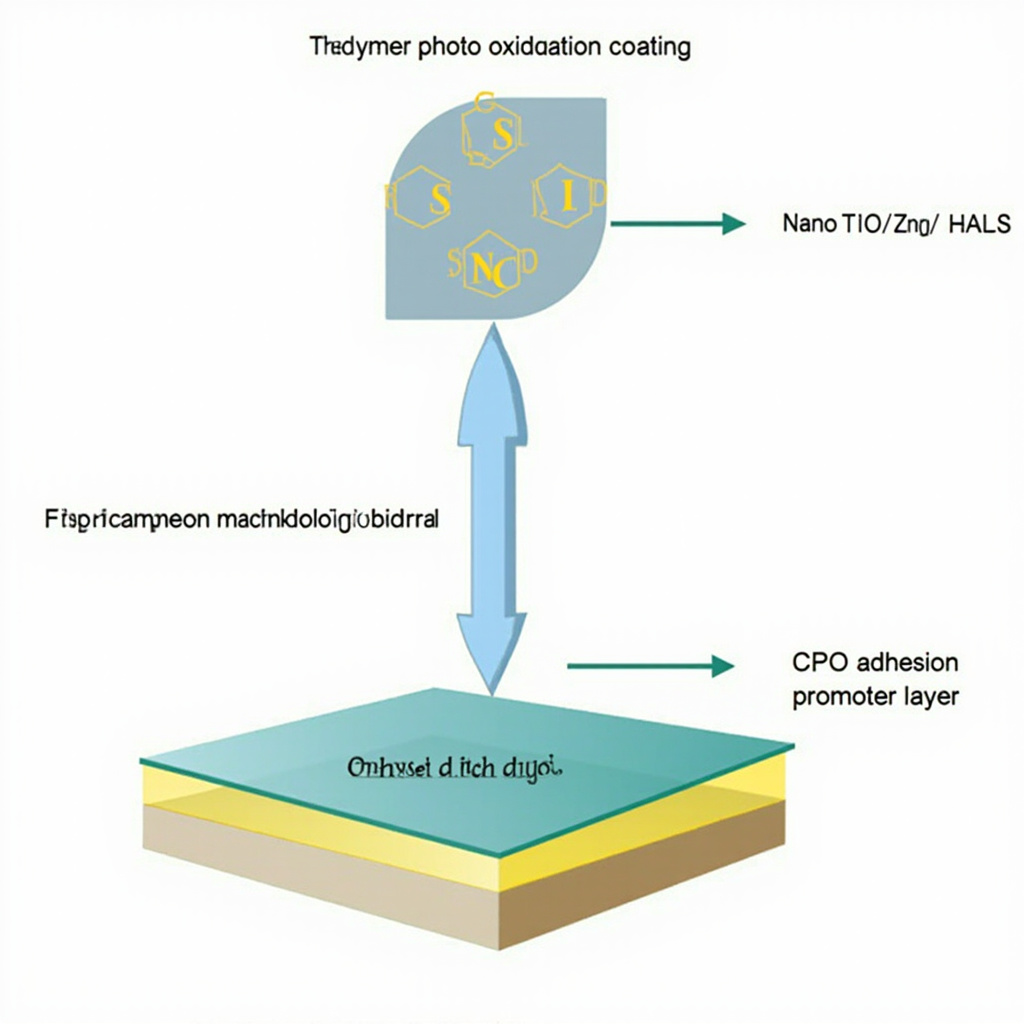
Mechanism Details—UV Shielding Mechanism of Nano TiO2/ZnO.Nano TiO2 (rutile) has a band gap of 3.0–3.2 eV, with a corresponding absorption edge at approximately 390 nm—this means that all ultraviolet light with wavelength <390 nm (UVA 315–400 nm, UVB 280–315 nm, UVC <280 nm) can be absorbed by valence band electrons of TiO2 and excited to the conduction band, generating electron-hole pairs. The electrons and holes subsequently release energy through non-radiative recombination (thermal dissipation) or by reacting with surface-adsorbed H2O/O2 to generate reactive oxygen species (ROS), returning to the ground state. Key engineering consideration: directly photo-generated ROS poses an oxidative degradation risk to the coating resin matrix itself—therefore nano TiO2 must undergo surface passivation treatment (coated with a thin layer of SiO2 or Al2O3 to block the diffusion pathway of ROS into the resin matrix).
Nano-ZnO has a bandgap of approximately 3.3 eV (absorption edge ~375 nm). Its additional advantages are that ZnO itself is an excellent white pigment (refractive index 2.0) and antibacterial agent (photogenerated ROS for disinfection), while ZnO exhibits a higher absorption coefficient than TiO2 in the UVA band (315–400 nm)—their combination enables synergistic shielding across the full UV spectrum.
Data support:Adding only 2-3wt% nano-TiO2 (rutile type, 15nm, SiO2 coated) to a 2K PU clearcoat with a 50μm film thickness reduces UV transmittance (300-380nm) from >85% for the bare resin to <5%. After 4000 hours of accelerated weathering by QUV (ASTM G154, UVA-340 lamp, 60°C/8h UV + 50°C/4h condensation cycle), the coating's ΔE (color difference) is 85%. The control group without nano-TiO2 shows ΔE>15 and gloss retention <40% after 2000 hours.
Source:SONGWON SABO®STAB Technical Leaflet, ASTM G154, ExxonMobil Exxtral™ TPO Datasheet
CPO Adhesion Promoter—Solving the Fundamental Problem of "Poor Coatability"
Direct answer: PP and TPO are known as the most difficult plastic substrates to coat—their surface energy is extremely low (about 29-31 mN/m, only 3/4 of the surface tension of polyurethane coatings at about 40 mN/m), and they are completely non-polar (no polar functional groups such as -OH, -COOH, -NH2). CPO (chlorinated polyolefin) adhesion promoter creates polar anchoring points that the coating resin can "grab" onto by introducing chlorine atoms (electronegativity 3.16, generating C-Cl dipoles, raising surface energy from 29 to 35-40 mN/m) onto the PP backbone.
Mechanism Explained — The Amphiphilic Structure of CPO.CPO molecules exhibit unique "amphiphilicity": (1) Polyolefin backbone segment (same nature as PP/TPO substrate) — under solvent swelling or thermal action, the polyolefin backbone of CPO interdiffuses and entangles with the surface molecular chains of the PP/TPO substrate — a physical interlock akin to a "molecular zipper"; (2) Chlorinated segment (containing C-Cl bonds, chlorine content typically 15-30 wt%) — the dipole moment of the C-Cl bond (about 1.87 D) provides hydrogen bonding and dipole-dipole interactions with the carbamate (-NHCOO-) and hydroxyl (-OH) groups in polyurethane/acrylic coating resins. Some CPO formulations also introduce maleic anhydride grafting (CPO-g-MAH) — the -COOH generated after hydrolysis of the MAH groups undergoes covalent reaction with isocyanate curing agent (-NCO), providing the strongest chemical anchoring for coating adhesion.
Data support: For PP substrate without CPO treatment, the pull-off adhesion of 2K PU clear coat (ASTM D4541) is usually 80%.
Source:Automotive Paints and Coatings Handbook, ASTM D4541, ExxonMobil TPO Painting Guide
"Spray-free" technical route — integration of in-mold coloring and nano-clearcoat protection
Traditional painting process for automotive plastic parts: injection molding → surface degreasing → flame/plasma treatment → CPO primer (3-5 μm) → basecoat (15-25 μm) → clearcoat (30-50 μm) → baking (80-120°C / 20-30 min), with three coating layers and two baking steps, resulting in extremely high energy consumption and VOC emissions. The recently emerged "paint-free" (Paint-Free or Molded-in-Color) technology route achieves in-mold coloring by directly adding color masterbatch and UV stabilizers into PP/TPO pellets, eliminating the primer and basecoat steps and requiring only a single layer of transparent nano-clearcoat (20-30 μm) for final UV protection and gloss. Advantages: VOC reduction >60%, per-vehicle cost reduction of $15-30, and painting line investment reduced by approximately 40%. SABIC's PPcompound 8520U/8578U/8650U series and LyondellBasell's Hifax TRC 221P series are UV-stabilized PP/TPO materials specifically designed for paint-free applications.
Source:SABIC PPcompound Datasheet, LyondellBasell Hifax TRC Series, Patent CN-High Weather-Resistant Transparent PP Automotive Exterior Parts
Frequently Asked Questions
Can nanocoatings completely replace the UV protection function of basecoats?
In spray-free systems, the nano clearcoat assumes the full UV protection function—therefore the requirements for the addition level and dispersion quality of nano TiO2/ZnO are much higher than those for conventional clearcoats (which share UV protection with the basecoat). The addition level typically needs to be increased from the conventional 1–2 wt% to 3–5 wt%, combined with a higher concentration of HALS (1–1.5 wt%) to ensure over 10 years of outdoor durability.
Is the chlorine content in CPO primer harmful to the environment?
The dry film thickness of CPO primer is extremely thin (3–5 μm, approx. 3–5 g/m²), with CPO solid usage per vehicle of about 200–400 g. Compared with PVC underbody coating (8–15 kg of chlorinated material per vehicle), the environmental impact of CPO is negligible. Halogen-free adhesion promoters under development (e.g., maleic anhydride-grafted PP emulsion, PP-g-MAH aqueous dispersion) are expected to enter mass production in 2027–2028.
How to test the UV aging performance of plastic parts?
Core standards: SAE J2527 (xenon arc accelerated weathering for automotive exterior), SAE J2412 (xenon arc for automotive interior), QUV ASTM G154 (UVA-340/UVB-313 lamps). Acceptance criteria vary by OEM — typical requirements: after xenon arc 2500–3000 kJ/m² (approx. 5–7 years Florida outdoor exposure) or QUV 3000–4000 h, ΔE 80%, no chalking (ASTM D4214 rating > 8).
Reference sources:SONGWON SABO®STAB UV, ASTM G154, SAE J2527, Automotive Paints and Coatings Handbook, ExxonMobil/SABIC/LyondellBasell TPO Datasheets
Publish Date: July 6, 2026 | Category: Technical Knowledge