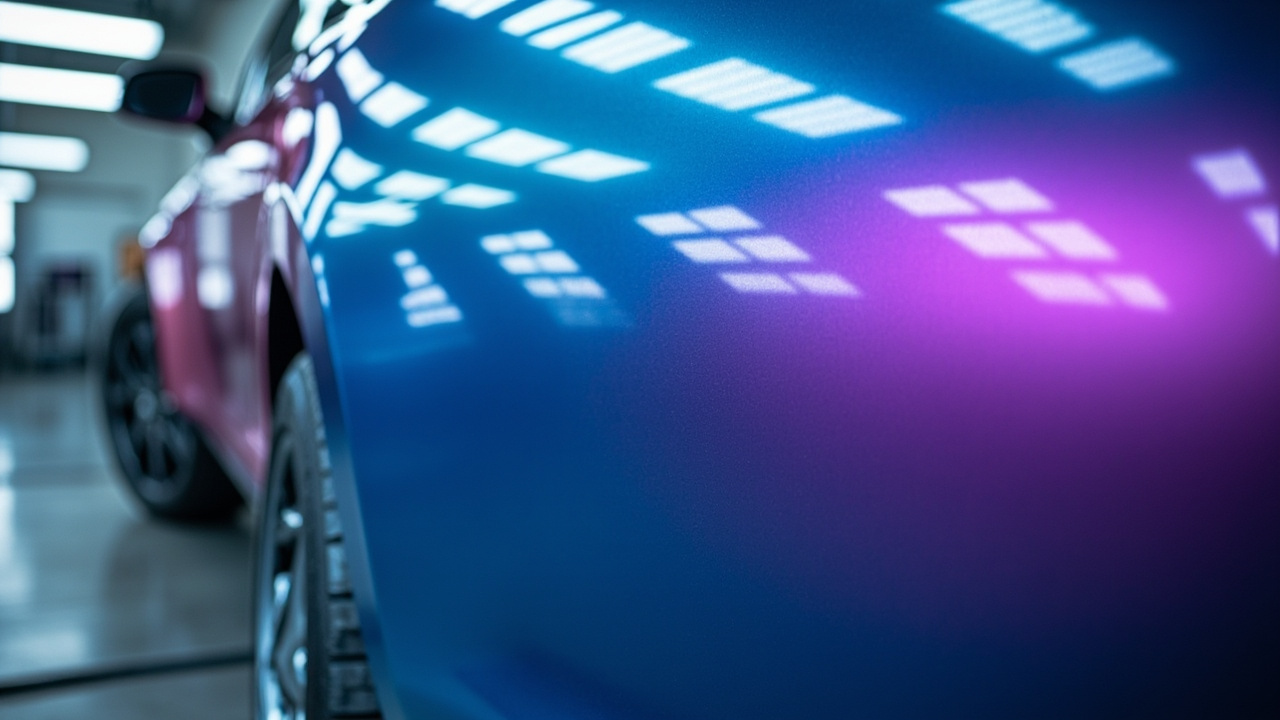
Why does the same car, same color, "change its look" when you turn it in the sunlight? Why do people always feel "the color difference is a bit odd" after touch-up paint at a 4S shop? The answer almost always lies in two terms: automotive metallic paint, pearl paint, and the "angle-dependent color" (flake flop / angle-dependent color) effect they jointly create. This article starts from the optical principles, clarifying the orientation of aluminum flakes, the interference color of mica, and the differences of solid color paint, and combines the basecoat + clearcoat system and spraying process parameters to provide engineers, colorists, and refinish technicians with a practical framework for understanding.
As a supplier of automotive coating and supporting systems, Kexin New Materials (kexinMaterials) has mature solutions in basecoats, high-solid 2K clearcoats, and refinish accessories. The optical and process points in this article also apply to evaluating the selection of our metallic/pearl paint products for the OEM and refinish markets. If you are building a color and effect system for an OEM or refinish shop, you can first refer to our Water-based vs. Solvent-based Coating Selection Guide to define the substrate, VOC limits, and process conditions first.
I. What Exactly Is Angle-Dependent Color (Flop)
"Angle-dependent color" is the general term in the coating industry for "optical effects that change with the observation angle," often called flop, flip-flop, or angle-dependent effect in English. Ordinary solid color paint (also called monochrome paint) shows basically no change in lightness and hue at different angles; whereas metallic paint and pearl paint show obvious lightness, and even hue shifts, when switching between face view (perpendicular to the paint surface) and side view (grazing angle).
What causes this effect are the "effect pigments" suspended in the paint film—mainly aluminum flakes (metallic paint) and mica/pearl flakes (pearl paint). They act like tiny mirrors or thin films, reflecting incident light back in specific directions. When your viewing angle changes, the intensity and wavelength of the light "sent back to your eyes" changes, so the naked eye sees "the color moving."
One qualitative conclusion must be emphasized: angle-dependent color is not the pigment itself changing color, but rather the change in reflection direction in geometric optics combined with (in pearl paint) the wavelength selection of thin-film interference. Understanding this is the root of all subsequent process control.
1.1 How to "Quantify" Angle-Dependent Color: Multi-Angle Spectrophotometer
Since the effect changes with angle, ordinary 45°/0° or d/8° single-angle color difference meters are insufficient—they can only read at one fixed geometry and cannot capture flop. The industry uses a multi-angle spectrophotometer, commonly taking colors simultaneously at the following three observation geometries:
- 25° (near face view): Captures the lightness and hue of "looking straight on," corresponding to the brightest angle of metallic paint.
- 45° (mid angle): Close to the conventional human eye viewing angle of a car, the main criterion for color matching.
- 75° (grazing/side view): Corresponds to the angle of "looking dark from the side," a key reading for flop drop.
Using the L* (lightness), a*, b* differences at these three angles, the drop of "bright at front, dark at side" can be quantified. When a colorist says "this silver flop is too large/too small," it essentially means the lightness difference (ΔL*) between 25° and 75° exceeds the target tolerance. Without multi-angle data, batch consistency and refinish matching of metallic paint and pearl paint can only rely on "experienced naked eyes," which are highly prone to misjudgment under different light sources.
1.2 Lighting Conditions Can Also Deceive the Eyes: Metamerism and Standard Light Source
Besides angle-dependent color, another often-overlooked variable is the light source. Under different light sources (daylight D65, showroom fluorescence, underground garage sodium lamp), metallic paint and pearl paint may show "looks the same here, but different there" due to the different reflection spectral shapes of aluminum flakes/mica, which is metamerism. Therefore, color matching and acceptance must be conducted under a standard light booth (e.g., multiple light sources mainly D65), and multi-angle readings should be used as hard indicators, rather than relying solely on the look at one location.
II. Metallic Paint: Flake Orientation of Aluminum
2.1 How Aluminum Flakes Produce Sparkle
The core effect pigment of automotive metallic paint (metallic paint) is flake aluminum powder (aluminum flake). Aluminum flakes are produced by atomizing aluminum ingots or ball-milling into extremely thin scale-like particles, with thickness typically ranging from tens of nanometers to one or two micrometers, and diameter from a few to tens of micrometers. Their cross-section is a mirror-like metallic reflective surface.
When aluminum flakes "lie flat" in the paint film, roughly parallel to each other and arranged parallel to the substrate surface, incident light undergoes specular reflection on a large number of aluminum flake surfaces, forming a bright, concentrated "metallic sparkle" (sparkle / glint). The finer the flakes and the flatter the arrangement, the more delicate the sparkle; the coarser the flakes, the more "bold" the sparkle and the stronger the particle feel.
2.2 What Is Flake Orientation
Flake orientation refers to the distribution of arrangement direction of aluminum flakes in the dried paint film. The ideal state is "the vast majority of aluminum flakes parallel to the substrate." Better orientation means more concentrated reflected light at face view and stronger metallic feel; poorer orientation (flakes lying randomly, standing up) means light is scattered by diffuse reflection, weakening the metallic feel and making the color grayish and dark.
Many factors affect flake orientation, which will be discussed in the process section later, but first remember three points mechanistically:
- Aluminum flakes need to be "flattened during the flow of the wet film," so solvent evaporation rate (flash-off) is key—too fast flash-off, flakes are "frozen" before they can lie flat; too slow, flakes may sink and orientation worsens.
- The atomization and fan pattern of spraying "pat" the flakes toward the substrate; air pressure and gun distance directly affect orientation.
- Film thickness determines how many layers of flakes there are and how neatly they can arrange; too thin, flakes cannot stack; too thick, inter-layer orientation becomes uneven.
2.3 The "Face-Side Color Difference" Law of Metallic Paint
The most common flop of metallic paint shows: face view (face) is brighter and lighter; side view (flop / profile) is darker and deeper. This is because at side view, the flakes parallel to the surface reflect light to other directions, reducing the specular component returning to the eye; what you mainly see is the absorption of the pigment body and a small amount of scattering, so lightness drops. Controlling this "bright at front, dark at side" drop during color adjustment is the key to whether metallic paint looks good.
III. Pearl Paint: Interference Color of Mica/Pearl Flakes
3.1 Not "Real Pearl," But a Film Coated on Mica
The effect pigment of pearl paint (pearlescent / mica paint) is usually mica flakes surface-coated with metal oxide (most typically titanium dioxide TiO₂, also iron oxide, etc.). Mica itself is a transparent flake, and the coating acts like an "optical thin film."
3.2 Interference Color: How the Thin Film "Selects" Wavelengths
When light hits the coated mica flake, it reflects separately at the top and bottom surfaces of the thin film, and the two reflected beams interfere. The interference result depends on the film thickness and light wavelength: some wavelengths are enhanced by constructive interference, some are weakened by destructive interference, so the mica flake shows a "color that changes with thickness"—this is interference color.
The most wonderful part is: because mica is transparent, light can also pass through and be reflected back by the base color layer, passing through the film a second time, so the "depth feel" of pearl paint is usually softer and more moist than metallic paint, as if there is a "second layer of light" inside the film. This is also why pearl white and pearl blue always look more "spirited" than ordinary white and blue.
3.3 Angle-Dependent Color of Pearl Paint Is More Complex Than Metallic Paint
Metallic paint is mainly "lightness flop"; pearl paint, besides lightness, often has hue flop—for example, from green at face view to gold at side view, or blue to purple. The reason is: the interference color itself changes with observation angle (the constructive wavelength of thin-film interference changes with optical path difference), plus the superposition of transparent mica transmission-reflection, making the hue shift more obvious.
Colorists therefore call pearl paint "three-layer light": the coupling of base color absorption, mica interference, and clearcoat surface reflection. To reproduce a pearl color, relying solely on the colorant formula is not enough; you must also reproduce the particle size, coating thickness, and orientation of the effect pigment.

IV. Solid Color Paint, Metallic Paint, Pearl Paint: A Summary Comparison Table
Putting the three in one table makes selection and communication much clearer. The table below is compiled from general processes of automotive refinish/OEM systems (basecoat + clearcoat) and public technical data, mainly qualitative with key values noted for source.
| Comparison Dimension | Solid color paint (solid / Solid) | Metallic paint (Metallic / aluminum powder) | Pearl paint (Pearl / mica) |
|---|---|---|---|
| Effect pigment | None (only conventional coloring pigments) | Flake aluminum powder | Mica flakes coated with metal oxides (TiO₂, etc.) |
| Optical mechanism | Pigment absorption + diffuse reflection | Aluminum flake specular reflection (flake orientation control) | Thin-film interference + transmission superposition (interference color) |
| Flop (color shift by angle) | Almost none (consistent front and side) | Obvious, mostly lightness flop (bright front, dark side) | Obvious, may include hue flop (color change front to side) |
| Visual texture | Flat, pure | Sparkling, metallic, granular | Mild, deep, pearly luster |
| Typical systems | Mostly single-component solid or 2K solid | 1K basecoat + 2K clear coat | 1K basecoat + 2K clear coat |
| Repair difficulty | Low (can skip clear coat, or one coat of solid paint) | Medium-high (sensitive to orientation and film thickness) | High (interference color extremely sensitive to process) |
| Color matching points | Hue, lightness, hiding | Silver flake coarseness + flop contrast | Interference hue + depth + flop |
| Common defects | Sagging, orange peel | Blushing, aluminum spotting, excessive front-side difference | Discoloration, haze, uneven mica arrangement |
| Representative colors | Pure red, pure black, engineering white | Silver, champagne, gunmetal, sparkling blue | Pearl white, pearl blue, iridescent green |
This table is the "result"; below we explain the "cause"—especially why metallic and pearl paints almost always adopt the "basecoat + clear coat" two-layer structure.
V. Basecoat + Clear Coat: Why Effect Pigments Are "Hidden Under the Clear Coat"
5.1 Common Structure for OEM and Refinish
Modern automotive topcoats are generally two layers: "base + clear":
- Basecoat: Carries color and effect pigments (aluminum powder/mica), usually non-baked 1K (single-component, solvent-evaporation drying) or low-film-thickness 2K.
- Clearcoat: Transparent 2K polyurethane, applied as the outermost layer, providing gloss, weather resistance, scratch resistance and chemical resistance.
According to the automotive paint system overview in the research archive, the OEM four-process is: pretreatment → cathodic electrophoretic deposition (CED) → intermediate coat → pigmented paint → clear coat (baking); the refinish system is single-component (1K basecoat + 2K clear coat), two-component (2K) solid paint or single-component solid. In other words, metallic and pearl paints almost uniformly follow the "1K base + 2K clear coat" route in both OEM and refinish.
5.2 Why Effect Pigments Cannot Be Placed Directly on the Topcoat Surface
Placing aluminum powder/mica beneath the clear coat serves three purposes:
- Protect effect pigments: The clear coat isolates UV, acid rain and car-wash friction, preventing aluminum oxidation darkening and mica layer scratching.
- Stabilize flop: The basecoat's film thickness and solvent节奏 determine orientation; the upper clear coat does not disturb it, making the effect reproducible.
- Enhance appearance: The clear coat provides high gloss (high gloss can exceed 85 GU, per GB/T 9754 / ISO 2813 gloss measurement) and encapsulates the basecoat's "sparkle" into a mirror-grade texture.
According to the AkzoNobel Lesonal 2K clear coat (288 HS) technical data in the archive: it is a two-component acrylic polyurethane, mixing ratio 2K clear coat : 728 hardener = 2 : 1 plus about 10% thinner, spray viscosity (DIN 4 @20℃) 13–16 s, spray gun 1.2–1.4 mm, inlet pressure 1.7–2.2 bar (HVLP cap end ≤0.7 bar), dry film thickness DFT 50–60 µm, VOC about 538 g/L (mixed). BASF Glasurit 923-666 HS clear coat is a 2K acrylic polyurethane, solids (ready-mixed) 50–55%, VOC ≤ 419 g/L, mixing ratio clear coat : 929-666 hardener = 2 : 1, DFT 40–60 µm, pencil hardness > 2H. Although these clear coat parameters do not determine flop, they determine whether the "glass layer above the basecoat" is smooth and durable—indirectly affecting the perception and lifespan of the effect.

VI. How Application Determines Effect: Spray Gun, Film Thickness, Flash-off
No matter how good the formula, a botched application will "ruin" it. Metallic and pearl paints are extremely sensitive to application; the three items below are what should be strictly controlled on site.
6.1 Spray Gun and Atomization: "Flatten" the Aluminum Flakes
- Gun type and nozzle: Refinish commonly uses HVLP (high transfer efficiency low-pressure spray gun), nozzle size 1.2–1.4 mm class (per AkzoNobel Lesonal data). Too small = insufficient atomization, coarse aluminum spotting; too large = easy sagging.
- Inlet pressure: Cap-end pressure must fall within the process window (e.g., HVLP cap end ≤0.7 bar, per Lesonal; Axalta-type fast-dry clear coat cap end about 6–8 PSI). Too low = chaotic flake orientation, blushing; too high = flakes stood up, dark side view.
- Spray distance and speed: Too close = drastic film thickness increase, easy sagging; too far = excessive solvent evaporation, poor flake orientation. Constant speed, 1/2–2/3 fan overlap is basic discipline.
For systematic selection of spraying equipment and nozzle parameters, see extended reading Water-based Paint Application Tools and Equipment, where the general knowledge on guns, pressure and atomization logic also applies to solvent-based basecoats.
6.2 Film Thickness: Balance Point of Orientation and Hiding
The basecoat film thickness directly determines the number of layers and orientation quality of effect pigments. With 2K clear coat DFT 50–60 µm (Lesonal) or 40–60 µm (Glasurit) as reference, basecoats are usually thinner (mostly 10–25 µm range, depending on formula). Too thin: aluminum/mica not enough, poor hiding, weak flop; too thick: inconsistent interlayer orientation, side-view blushing, even sagging.
A practical rule: metallic and pearl paints must be applied by "multi-layer thin spraying"—each coat gives aluminum flakes time to "lie flat", rather than one thick coat. This is why refinish emphasizes "2 wet coats" instead of "1 thick coat".
6.3 Flash-off: Let Aluminum Flakes "Have Time to Lie Flat"
Flash-off refers to the wait between coats, or between basecoat and clear coat, for solvent to evaporate to a suitable degree. It is the "invisible protagonist" of flop control:
- Flash-off insufficient: Next coat re-stirs the wet film, chaotic flake orientation, blushing.
- Flash-off excessive: Surface skins over, later clear coat cannot bite, orange peel or loss of gloss.
The flash-off window of solvent-based basecoat is determined by the formula solvent curve (fast, medium, slow solvent blend). Ambient temperature is also key: per archive, refinish drying can use room temp / 60℃ bake / infrared, pot life 1–3h depending on hardener. Although basecoat is not 2K curing, temperature equally affects solvent evaporation rhythm—summer flash-off fast, winter slow, adjust gun distance and wait accordingly.
VII. Kexin New Materials' Supporting Approach and Selection Advice
Back to engineering implementation. Whether metallic and pearl paints are "good-looking, easy to repair" is half formula, half system matching and application discipline. Kexin New Materials (kexinMaterials) suggests:
- Basecoat and clear coat must be "well matched": The clear coat's solvent strength and drying rhythm must match the basecoat, otherwise the clear coat "bites" the basecoat when applied. Our matching table clearly marks usable clear coat models and mixing ratios (e.g., 2 : 1 type 2K acrylic polyurethane).
- Define effect first, then color: Whether the client wants "finely sparkling silver" or "blue with purple flop" determines the aluminum powder particle size and mica coating thickness; simply adjusting colorants to match the color card is not enough.
- Write application window into the work instruction: Gun distance, pressure, number of coats, flash-off time must be quantified, otherwise the same formula yields vastly different results across shops.
For the clear coating and curing rhythm above the basecoat system (e.g., trade-offs among room temp, 60℃ bake and infrared), see extended reading Water-based Paint Drying and Curing, where the discussion on drying window, temperature and final performance relationship is consistent with the curing logic of solvent-based 2K clear coats.
2.4 Two "Personalities" of Aluminum Powder: Leafing and Non-leafing
Aluminum powder for metallic paint, by surface treatment, is also divided into leafing and non-leafing:
- Leafing-type aluminum powder is surface-treated with stearic acid and similar agents; in the wet film it floats up and aggregates at the surface, forming a dense "aluminum mirror" with strong hiding power and intense metallic feel, but it often causes poor intercoat adhesion and difficulty in recoating, so it is rarely used in modern automotive topcoats.
- Non-leafing aluminum powder is uniformly dispersed within the paint film, with controllable orientation and good compatibility, and is the current mainstream for automotive metallic paint. The colorist chooses it precisely to hand flop back to the application and formulation for fine control.
In addition, the "particle size distribution" and "shape factor" of aluminum powder (flake ratio thickness/diameter) directly determine the sparkle particle size: narrow fine distribution = delicate silky silver; wide distribution + coarse flakes = bold metallic sparkle. These are the "raw material language" at the formulation level, but the final orientation still has to be realized in application.
Part Five-One: Putting the System into Real Processes: OEM Electrophoresis and Environmental Limits for Vehicle Coatings
To make the "basecoat + clear coat" context more complete, here is a brief explanation of the "foundation" beneath it. According to the research archive's overview of automotive coating processes, before spraying the intermediate coat and pigmented paint, OEMs apply cathodic electrodeposition (CED) as a primer. Typical parameters: voltage 200–350 V, bath solids 15–20%, pH 5.8–6.2, temperature 28–35°C, using an electric field to electrophoretically deposit the electrophoretic paint into the body seams. This layer determines substrate anti-corrosion and also the adhesion base for subsequent intermediate coat and pigmented paint.
Another "hard constraint" is regulation. According to the archive's environmental national standards section, vehicle coatings are governed by GB 24409-2020 "Limits of Harmful Substances in Vehicle Coatings", which sets limits on VOC, lead/cadmium/mercury/chromium, and benzene series; this runs in parallel with GB 30981-2020 for industrial protective coatings. That is to say, the basecoat and clear coat schemes for metallic paint and pearl paint, besides being "good-looking," must also keep VOC within the limits (as mentioned, Glasurit clear coat VOC ≤ 419 g/L, Axalta fast-dry clear coat about 230 g/L i.e. 2.1 lb/gal, both reflecting the high-solids low-VOC direction). When selecting配套, calculating both "effect" and "compliance" together is the correct engineering perspective.
Part Seven-One: Troubleshooting Table for Common Metallic Paint / Pearl Paint Defects
Below is a table summarizing the most frequent on-site "effect failures" for technicians to reference. Note: most defect root causes lie in flake orientation and flash-off rhythm.
| Defect Phenomenon | Possible Root Cause | Troubleshooting and Countermeasures |
|---|---|---|
| Mottling (light/dark patchiness) | Uneven aluminum flake orientation, insufficient flash-off disturbed by subsequent coat | Extend flash-off, stabilize gun speed and distance, confirm solvent curve match |
| Excessive face/side difference (too dark from side view) | Excessive pressure standing aluminum flakes up, excessive film thickness | Reduce to process pressure window, switch to multi-layer thin spraying |
| Aluminum flakes too coarse / heavy grainy feel | Aluminum powder particle size too coarse, insufficient atomization | Switch to fine aluminum powder, improve atomization (within compliant pressure), check nozzle |
| Pearl hue shift incorrect | Mica coating / interference color formula wrong, poor orientation | Verify colorant interference properties, calibrate multi-angle readings |
| Biting/mottling after clear coat | Clear coat solvent stronger than basecoat tolerance, insufficient flash-off | Select matching clear coat, enhance basecoat flash-off, control clear coat film thickness |
| Loss of gloss / orange peel | Excessive flash-off, poor clear coat leveling, uneven film thickness | Adjust flash-off, optimize clear coat application parameters (e.g. 13–16 s viscosity window) |
| Repair color difference | Inconsistent orientation across different shops, no multi-angle comparison | Establish standard work instruction, accept with multi-angle meter not single-angle visual |
This table can serve as a quick-reference card for the shop's "effect quality gate." Truly stable metallic/pearl effects rely on the interlocking of formulation,配套, and work discipline, not temporary "by feel."
Part Seven-Two: Colorants and Formulation Language: How Effects Are "Formulated"
In the mixing room, metallic paint and pearl paint are not sprayed directly from a single "silver colorant," but mixed from multiple colorants by weight ratio. Each colorant contains: coloring pigment (provides hue and lightness), effect pigment (aluminum powder or mica, provides flop), resin and solvent (provides film formation and orientation environment). The colorist's job, beyond "getting the hue right," is to also tune the "amount, particle size, orientation of effect pigment" to target — which is why the same silver can look "delicate as silk" or "rough as sand."
Two engineering reminders on formulation: first, the addition level of effect pigment has an upper limit; too much causes mutual shielding and worse orientation; second, different resin systems "wet" aluminum powder differently; in water-based systems aluminum powder also needs anti-oxidation coating (aluminum easily evolves hydrogen and outgasses in water), otherwise storage and application will both have problems. This is also one reason metallic paint is harder to tackle than solid color paint in the water-based vehicle coating process.
Part Seven-Three: From Solvent-Based to Water-Based: Rebalancing Effect and Compliance
Returning to the constraint of GB 24409-2020, water-based vehicle coatings are the general direction. But in moving metallic paint and pearl paint from solvent-based to water-based, "flake-by-angle color change" is one of the hardest traits to preserve: water-based systems differ greatly from solvent-based in surface tension and evaporation curve, and the orientation window for aluminum flakes/mica is narrower. Industry practice usually redesigns the resin and additives of colorants (e.g. orientation aids, anti-settling agents), and at the application end tightens the temperature/humidity window even more (per archive general application environment requirements: temperature 5–35°C, relative humidity ≤80%, substrate temperature above dew point by 3°C or more, which is more sensitive for water-based).
Therefore when selecting, it is recommended to evaluate "effect stability" and "VOC compliance" side by side: don't just ask "how much VOC," but also ask "under the shop's actual temperature and humidity, can flop be reproduced." This is also a point repeatedly emphasized by Kexin New Materials (kexinMaterials) when doing automotive配套 schemes — what we provide is not an isolated can of paint, but a closed loop of "basecoat + clear coat + application window," enabling effects to be stably replicated under compliance. If you want to first clarify the boundary between solvent-based and water-based schemes, you can return to the water-based/solvent-based coating selection guide for an overview.
To sum up: the "good looks" of metallic paint and pearl paint are not mysticism, but the realization in engineering of two optical mechanisms — aluminum flake orientation and mica interference; whoever manages formulation,配套, and application window more finely gets more stable and reproducible flake-by-angle color change. For repair shops, writing the effect into a standard work instruction and accepting with a multi-angle meter is more reliable than relying on personal feel.
Eight: Frequently Asked Questions
Q: What is the fundamental difference between metallic paint and pearl paint?
A: Metallic paint uses flake aluminum powder for specular reflection, mainly producing "lightness flake-by-angle color change" (bright face, dark side); pearl paint uses mica flakes coated with metal oxides for thin-film interference, besides light/dark it often has "hue flake-by-angle color change" (face/side color shift), visually more gentle and deep.
Q: Why is metallic paint prone to color difference in repair?
A: Because flop is determined by aluminum flake orientation, and orientation is greatly affected by gun pressure, gun distance, film thickness, and flash-off. The same formula oriented differently under different application conditions changes the face/side lightness contrast, and the naked eye immediately feels "color is wrong."
Q: Is flake-by-angle color change the pigment itself changing color?
A: No. It is in geometric optics the reflection direction changing with viewing angle, overlaid (in pearl paint) with wavelength selection by thin-film interference. The pigment chemical structure does not change; what changes is the direction and wavelength composition of the "light returning to the eye."
Q: Does pearl paint contain real pearl components?
A: No. In the industry, "pearl / pearlescent" refers to mica flakes coated with titanium dioxide or other metal oxides, producing pearl-like luster via thin-film interference, unrelated to natural pearls.
Q: Why do metallic paint and pearl paint both need clear coat, while solid color paint sometimes does not?
A: Effect pigments exposed outside will oxidize and be scratched, and clear coat can encapsulate the basecoat sparkle into a high-gloss mirror and block UV; solid color paint has no effect pigment, with relatively lower surface protection needs, so it can be one coat as-is or separately clear-coated.
Q: Is higher pressure better for spraying metallic paint?
A: No. Excessive pressure stands aluminum flakes up, causing dark side view and mottling; too low pressure gives insufficient atomization and coarse aluminum flakes. It should fall within the process window (e.g. HVLP cap end ≤0.7 bar level) with suitable nozzle size.
Q: How to judge flash-off time?
A: Empirically judge by "surface not reflective, back of finger lightly testing not sticky"; more accurately quantify waiting by the formula's solvent curve and ambient temperature. Insufficient flash-off causes mottling, excessive causes orange peel and gloss loss.
Q: Does thicker film give stronger metallic feel?
A: Not a monotonic relation. Too thin and flakes don't pack, flop weak; too thick and interlayer orientation uneven, side view mottling and easy sagging. Should use multi-layer thin spraying within the formula's recommended film thickness window.
Q: Do clear coat parameters (VOC, hardness) affect metallic/pearl effect?
A: Clear coat does not directly determine flop, but determines surface flatness, gloss, and durability. E.g. Glasurit 923-666 HS pencil hardness > 2H, VOC ≤ 419 g/L — such parameters ensure the "glass above the basecoat" is flat and durable, indirectly affecting appearance lifespan.
Q: Can solid color paint be tuned to metallic paint's sparkle?
A: No. Sparkle comes from specular orientation of flake aluminum powder; solid color paint only has conventional absorption pigments, no effect pigment means no flop. To get metallic feel must introduce aluminum powder or mica-type effect pigment.
Nine: Further Reading
- Water-Based Coating Color and Gloss Control (same cluster: general knowledge of color and gloss regulation, applicable to basecoat formulation thinking)
- Water-Based Coating Drying and Curing
- (Same cluster: drying window, temperature and curing pace, corresponding to the flash-off and clear coat logic in this article)
- Water-based vs. Solvent-based Coating Selection Guide(Related: overall framework for selection based on substrate, VOC limits and application scenarios)