High-temperature resistant paint, underbody coating, and stone-chip resistant coating: applications and construction of automotive specialty coatings

2026-07-12 · Category: Technical Knowledge, Paint & Coatings

🌐 This article was automatically translated from Chinese. Please refer to the original Chinese version if needed. · View original (Chinese)
.kx-article{max-width:860px;margin:0 auto;background:#ffffff;color:#232a33 !important; border-radius:16px;padding:32px 30px 40px;box-shadow:0 8px 40px rgba(0,0,0,.25); font-family:-apple-system,"Segoe UI","PingFang SC","Microsoft YaHei",sans-serif;line-height:1.9;font-size:16px} .kx-article *{box-sizing:border-box} .kx-article h1,.kx-article h2,.kx-article h3,.kx-article p,.kx-article li,.kx-article td,.kx-article th,.kx-article strong, .kx-article .summary,.kx-article .summary p,.kx-article .summary strong, .kx-article .note,.kx-article .note p,.kx-article .kxbox-brand, .kx-article .related,.kx-article .related li,.kx-article .kx-foot, .kx-article .kxqa-q,.kx-article .kxqa-a{color:#232a33 !important} .kx-article h1{font-size:28px;line-height:1.35;font-weight:800;margin:0 0 18px;color:#1a1d21 !important} .kx-article .lead,.kx-article p{margin:14px 0} .kx-article .cover{width:100%;border-radius:14px;box-shadow:0 6px 24px rgba(0,0,0,.15);margin:6px 0 26px;display:block} .kx-article h2{font-size:22px;font-weight:700;margin:40px 0 16px;padding-bottom:10px;border-bottom:2px solid #eceff3;position:relative;color:#1a1d21 !important} .kx-article h2::before{content:"";position:absolute;left:0;bottom:-2px;width:64px;height:2px;background:#e8720c} .kx-article h3{font-size:18px;font-weight:700;margin:26px 0 12px;color:#2a2f36 !important} .kx-article strong{color:#111418 !important;font-weight:700} .kx-article img.inline{width:100%;border-radius:12px;box-shadow:0 4px 16px rgba(0,0,0,.12);margin:22px 0 8px} .kx-article figcaption{color:#7a828d !important;font-size:13px;text-align:center;margin:6px 0 24px} .kx-article table{width:100%;border-collapse:collapse;margin:20px 0;font-size:14.5px;background:#fff;border-radius:10px;overflow:hidden;box-shadow:0 2px 12px rgba(0,0,0,.06);border:1px solid #eceff3} .kx-article th,.kx-article td{padding:12px 14px;text-align:left;border-bottom:1px solid #eceff3;vertical-align:top} .kx-article th{background:#2a2f36;color:#ffffff !important;font-weight:600;font-size:14px} .kx-article tr:last-child td{border-bottom:none} .kx-article tbody tr:nth-child(even){background:#fafbfc} .kx-article .note{background:#eef6ff !important;border-left:4px solid #0a67d0;padding:14px 18px;border-radius:0 10px 10px 0;margin:22px 0} .kx-article .note strong{color:#0a4a97 !important} .kx-article .kxbox-brand{background:#fff3e8 !important;border-left:4px solid #e8720c;padding:16px 18px;border-radius:0 10px 10px 0;margin:22px 0} .kx-article .kxbox-brand strong{color:#5a4632 !important} .kx-article ul{margin:12px 0;padding-left:22px} .kx-article li{margin:8px 0} .kx-article .kxqa-item{background:#fbfcfd;border:1px solid #eceff3;border-radius:12px;padding:16px 20px;margin:14px 0} .kx-article .kxqa-q{font-weight:700;color:#e8720c !important;font-size:16px;margin-bottom:8px} .kx-article .kxqa-a{color:#3a4048 !important;display:block;margin:0} .kx-article .related{background:#fff !important;border:1px dashed #e8720c;border-radius:12px;padding:16px 22px;margin:26px 0} .kx-article .related h3{margin:0 0 6px;color:#e8720c !important} .kx-article .summary{background:linear-gradient(135deg,#fff3e8,#ffe9d6) !important;border-radius:12px;padding:20px 22px;margin:26px 0} .kx-article .summary h3{margin:0 0 10px;color:#1a1d21 !important} .kx-article .kx-foot{margin-top:34px;padding-top:18px;border-top:1px solid #eceff3;text-align:center;color:#8a929d !important;font-size:13px} .related{margin:30px 0 6px;} .related h3{font-size:18px;color:#1C1917;margin:0 0 12px;padding-left:10px;border-left:4px solid #F97316;} .related ul{list-style:none;margin:0;padding:0;} .related li{margin:0 0 9px;padding-left:16px;position:relative;} .related li:before{content:"203A";position:absolute;left:0;color:#F97316;font-weight:700;} .related a{color:#F97316 !important;text-decoration:underline !important;font-weight:600;} .related a:hover{color:#EA580C !important;} .kx-article{max-width:860px;margin:0 auto;background:#ffffff;color:#232a33 !important; border-radius:16px;padding:32px 30px 40px;box-shadow:0 8px 40px rgba(0,0,0,.25); font-family:-apple-system,"Segoe UI","PingFang SC","Microsoft YaHei",sans-serif;line-height:1.9;font-size:16px} .kx-article *{box-sizing:border-box} .kx-article h1,.kx-article h2,.kx-article h3,.kx-article p,.kx-article li,.kx-article td,.kx-article th,.kx-article strong, .kx-article .summary,.kx-article .summary p,.kx-article .summary strong, .kx-article .note,.kx-article .note p,.kx-article .kxbox-brand, .kx-article .related,.kx-article .related li,.kx-article .kx-foot, .kx-article .kxqa-q,.kx-article .kxqa-a{color:#232a33 !important} .kx-article h1{font-size:28px;line-height:1.35;font-weight:800;margin:0 0 18px;color:#1a1d21 !important} .kx-article .lead,.kx-article p{margin:14px 0} .kx-article .cover{width:100%;border-radius:14px;box-shadow:0 6px 24px rgba(0,0,0,.15);margin:6px 0 26px;display:block} .kx-article h2{font-size:22px;font-weight:700;margin:40px 0 16px;padding-bottom:10px;border-bottom:2px solid #eceff3;position:relative;color:#1a1d21 !important} .kx-article h2::before{content:"";position:absolute;left:0;bottom:-2px;width:64px;height:2px;background:#e8720c} .kx-article h3{font-size:18px;font-weight:700;margin:26px 0 12px;color:#2a2f36 !important} .kx-article strong{color:#111418 !important;font-weight:700} .kx-article img.inline{width:100%;border-radius:12px;box-shadow:0 4px 16px rgba(0,0,0,.12);margin:22px 0 8px} .kx-article figcaption{color:#7a828d !important;font-size:13px;text-align:center;margin:6px 0 24px} .kx-article table{width:100%;border-collapse:collapse;margin:20px 0;font-size:14.5px;background:#fff;border-radius:10px;overflow:hidden;box-shadow:0 2px 12px rgba(0,0,0,.06);border:1px solid #eceff3} .kx-article th,.kx-article td{padding:12px 14px;text-align:left;border-bottom:1px solid #eceff3;vertical-align:top} .kx-article th{background:#2a2f36;color:#ffffff !important;font-weight:600;font-size:14px} .kx-article tr:last-child td{border-bottom:none} .kx-article tbody tr:nth-child(even){background:#fafbfc} .kx-article .note{background:#eef6ff !important;border-left:4px solid #0a67d0;padding:14px 18px;border-radius:0 10px 10px 0;margin:22px 0} .kx-article .note strong{color:#0a4a97 !important} .kx-article .kxbox-brand{background:#fff3e8 !important;border-left:4px solid #e8720c;padding:16px 18px;border-radius:0 10px 10px 0;margin:22px 0} .kx-article .kxbox-brand strong{color:#5a4632 !important} .kx-article ul{margin:12px 0;padding-left:22px} .kx-article li{margin:8px 0} .kx-article .kxqa-item{background:#fbfcfd;border:1px solid #eceff3;border-radius:12px;padding:16px 20px;margin:14px 0} .kx-article .kxqa-q{font-weight:700;color:#e8720c !important;font-size:16px;margin-bottom:8px} .kx-article .kxqa-a{color:#3a4048 !important;display:block;margin:0} .kx-article .related{background:#fff !important;border:1px dashed #e8720c;border-radius:12px;padding:16px 22px;margin:26px 0} .kx-article .related h3{margin:0 0 6px;color:#e8720c !important} .kx-article .summary{background:linear-gradient(135deg,#fff3e8,#ffe9d6) !important;border-radius:12px;padding:20px 22px;margin:26px 0} .kx-article .summary h3{margin:0 0 10px;color:#1a1d21 !important} .kx-article .kx-foot{margin-top:34px;padding-top:18px;border-top:1px solid #eceff3;text-align:center;color:#8a929d !important;font-size:13px} .related{margin:30px 0 6px;} .related h3{font-size:18px;color:#1C1917;margin:0 0 12px;padding-left:10px;border-left:4px solid #F97316;} .related ul{list-style:none;margin:0;padding:0;} .related li{margin:0 0 9px;padding-left:16px;position:relative;} .related li:before{content:"203A";position:absolute;left:0;color:#F97316;font-weight:700;} .related a{color:#F97316 !important;text-decoration:underline !important;font-weight:600;} .related a:hover{color:#EA580C !important;}

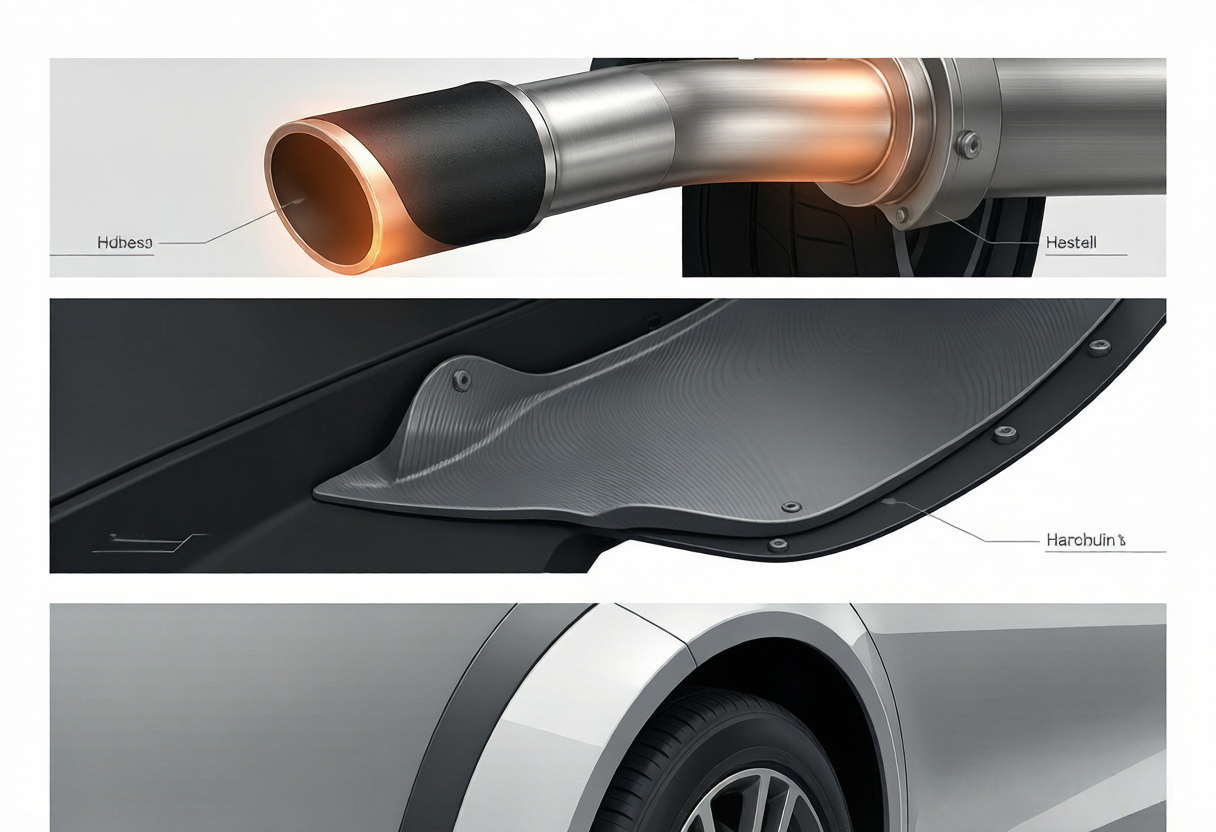
Automotive specialty coatings: exhaust pipe high-temperature resistant paint, underbody coating, wheel arch stone-chip resistant coating illustration

When it comes to "car paint," most people only think of the exterior coating on the body. But there is another type of unremarkable yet crucial coating on automobiles—they are not responsible for looks, only for "taking a beating": the high-temperature resistant paint on the exhaust pipe, the underbody armor coating, and the stone-chip resistant coating on the wheel arches. These specialty coatings face high temperatures, stone impacts, mud, water, and rust, and their material selection and application logic are completely different from those of topcoats.

In a nutshell:Specialty coatings are the car's "functional armor" — high-temperature resistant paint withstands 300–600℃, underbody coating prevents rust and reduces noise, and stone-chip resistant coating protects wheel arches and sills. They are not visible in color, but determine the vehicle's overall durability.

I. What is "specialty coating"?

Unlike decorative body coatings, specialty coatings are functional coatings, aimed at coping with extreme environments: high temperature, impact, corrosion, and noise. Three common types: high-temperature-resistant paint, underbody coating, and stone-chip resistant coating. They are usually applied to non-appearance areas of the vehicle body.

II. High-Temperature Resistant Paint (Exhaust Pipe / Turbocharger)

The exhaust pipe operating temperature can reach 300–600℃, and ordinary paint will rapidly carbonize and peel off. High-temperature resistant paint uses silicone resin as the base material, which can form a stable protective film at high temperatures, preventing the exhaust pipe from rusting and maintaining its appearance. Before application, it is necessary to thoroughly degrease and derust, and ensure the surface is dry; otherwise, adhesion will be poor.
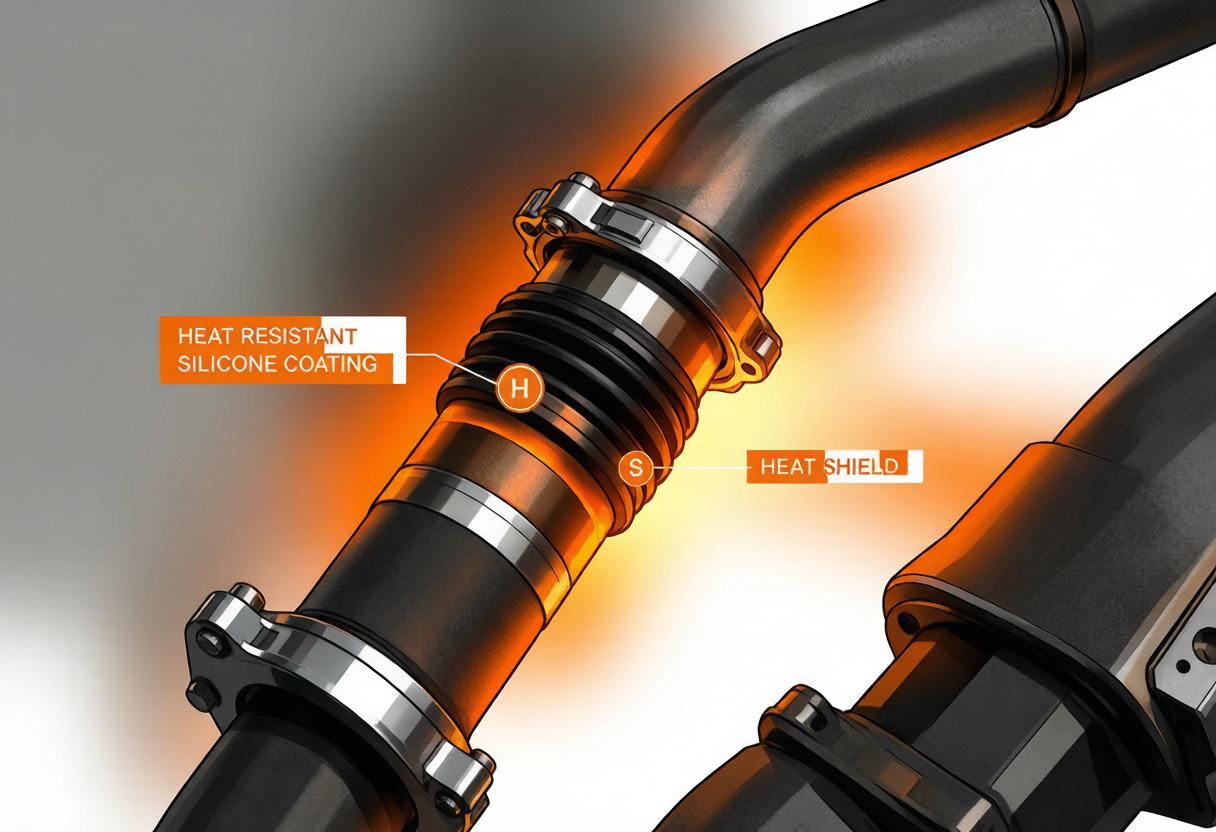
Schematic of high-temperature resistant silicone coating forming a stable protective film on exhaust pipe under high temperature
Figure: Silicone high-temperature resistant paint still forms a stable film at 300–600℃, protecting the exhaust pipe from rust.

III. Underbody Coating

Chassis armor is an elastic protective coating sprayed on the vehicle chassis. Common materials include asphalt-based, rubber-based, and water-based types, forming a layer of "soft armor":

  • Rust prevention: Isolate rainwater, snow-melting agents from the chassis metal.
  • Noise reduction: Absorbs impact from road gravel and cavity resonance.
  • Stone impact resistance: Cushions the impact of flying stones and protects the sheet metal.
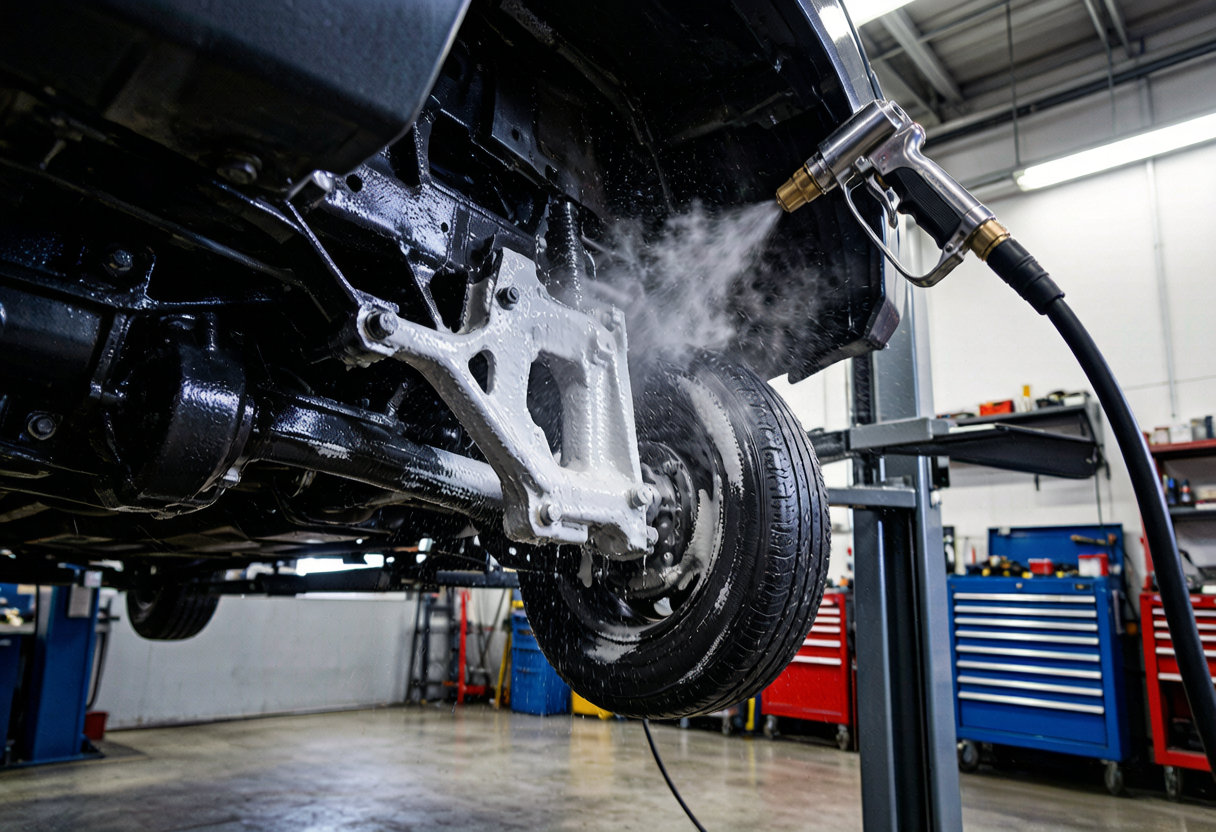
Illustration of elastic protective layer formed after spraying automotive undercoating
Fig.: The undercoating forms an elastic protective layer, providing rust prevention, noise reduction, and stone-chip resistance.
Type Features Suitable for
Asphalt-based Low cost, strong odor Economy
Rubber-based Good elasticity, excellent noise reduction Mainstream
Water-based Environmentally friendly, low odor High environmental requirements

IV. Anti-stone-impact Coatings (Wheel Arch / Rocker Panel)

Wheel arches, rocker panels, and side skirts are the areas most frequently hit by flying stones. Stone chip protection coating is a highly elastic, high-adhesion coating that absorbs impact and prevents paint chipping and rusting of the sheet metal, often used together with undercoating. Before application, good surface preparation (derusting, degreasing, drying) is also required.

V. Construction Precautions and Misconceptions

Key construction points:The success or failure of special coatings lies in pre-treatment—the surface must be degreased, derusted, and thoroughly dried; after applying high-temperature-resistant paint, low-temperature preheating curing is often required to achieve optimal performance; undercoating should be avoided in humid or low-temperature environments.
Misconception 1:“The thicker the undercoating, the better the sound insulation”—too thick may flow or peel off; uniform and moderate application is more important.
Misconception 2:“High-temperature-resistant paint can be applied on oily surfaces”—oil stains will directly cause peeling.
Misconception 3:“New cars don't need underbody protection”—the factory already has primer, but additional undercoating can improve long-term rust prevention and quietness.

Summary

Automotive specialty coatings are functional armor against high temperature, impact, and corrosion: high-temperature resistant paint uses silicone-based binders to withstand 300–600℃ at the exhaust pipe; underbody coating is an elastic coating that provides rust prevention, noise reduction, and stone-chip resistance; stone-chip resistant coating protects wheel arches and door sills. Their reliability also depends on thorough pre-treatment, not the coating itself.

Frequently Asked Questions (FAQ)

What kind of paint should be used on the exhaust pipe so it won't peel off?
You should use an organosilicon-based high-temperature resistant paint that can withstand 300–600℃. Before application, the surface must be thoroughly degreased, derusted, and dried; if necessary, low-temperature preheating and curing should be performed to form a stable, non-peeling protective film.
Is underbody coating really useful?
Yes. Underbody coating forms an elastic protective layer that prevents rust, reduces road noise and the sound of gravel impact, and cushions the impact of flying stones. Its effect depends on the material type and construction quality; only with proper pre-treatment can it last long.
What types of underbody coating are there?
Mainly asphalt-based (low cost but strong odor), rubber-based (good elasticity, excellent noise reduction, mainstream), and water-based (eco-friendly, low odor). The choice should be based on budget, environmental requirements, and construction conditions.
Which areas are stone-chip resistant coatings generally used on?
Mainly used on areas frequently hit by flying stones such as wheel arches, sills, and side skirts. As a highly elastic, high-adhesion coating, it absorbs impact and prevents paint chipping and rusting of the sheet metal, often applied together with underbody coating.
What is the most critical step in the application of special coatings?
It is pre-treatment. The surface must be degreased, derusted, and thoroughly dried; otherwise adhesion will be poor and peeling likely. High-temperature resistant paint also requires proper preheating and curing, and underbody-type coatings should avoid spraying in damp or low-temperature environments.
Kexin New Materials · Automotive Coating Technology Library | This article is technical Q&A content, for reference in selection and application

{ "@context": "https://schema.org", "@type": "FAQPage", "mainEntity": [ {"@type":"Question","name":"What paint should be used on the exhaust pipe so it won't peel off?","acceptedAnswer":{"@type":"Answer","text":"You should use an organosilicon-based high-temperature resistant paint that can withstand 300–600℃. Before application, the surface must be thoroughly degreased, derusted, and dried; if necessary, low-temperature preheating and curing should be performed to form a stable, non-peeling protective film."}}, {"@type":"Question","name":"Is underbody coating really useful?","acceptedAnswer":{"@type":"Answer","text":"Yes. Underbody coating forms an elastic protective layer that prevents rust, reduces road noise and the sound of gravel impact, and cushions the impact of flying stones. Its effect depends on the material type and construction quality; only with proper pre-treatment can it last long."}}, {"@type":"Question","name":"What types of underbody coating are there?","acceptedAnswer":{"@type":"Answer","text":"Mainly asphalt-based (low cost but strong odor), rubber-based (good elasticity, excellent noise reduction, mainstream), and water-based (eco-friendly, low odor). The choice should be based on budget, environmental requirements, and construction conditions."}}, {"@type":"Question","name":"Where are stone-chip resistant coatings generally used?","acceptedAnswer":{"@type":"Answer","text":"Mainly used in areas frequently hit by flying stones such as wheel arches, sills, and side skirts. As a highly elastic, high-adhesion coating, it absorbs impact and prevents paint chipping and rusting of the sheet metal, often applied together with underbody coating."}}, {"@type":"Question","name":"What is the most critical step in special coating construction?","acceptedAnswer":{"@type":"Answer","text":"It is pre-treatment. The surface must be degreased, derusted, and thoroughly dried; otherwise adhesion will be poor and peeling likely. High-temperature paint also requires appropriate preheating and curing, and underbody-type coatings should avoid spraying in damp or low-temperature environments."}} ] }