When you turn the car key in the showroom, the automotive coating flashes different gloss and hues at different angles—sometimes brighter, sometimes more colorful. This "color-shifting paint" is the work of effect pigments. Modern automotive pigmented paint is no longer satisfied with mere red, yellow, blue, or green; metallic paint, pearlescent paint, and dreamcoat rely on effect pigments such as aluminum powder and mica pearlescent to create a premium texture of goniochromatism (flake effect / goniochromatism). Understanding how these pigments emit light and shift color with angle is not only about aesthetics, but also directly related to color-matching difficulty, application process, and final weather resistance. This article systematically breaks down the technical core of effect pigments in automotive pigmented paint, from optical principles, pigment structure, orientation control, to application key points.
As a supplier in the automotive coating system, Kexin New Materials (kexinMaterials) has done a great deal of foundational work on the particle size distribution, coating stability, and batch consistency of effect color masters. This article will also combine industry-common optical models and application standards to thoroughly explain the principles behind "why metallic paint is hard to spray and pearlescent paint is hard to tint", so as to facilitate engineering and selection with citable judgments.
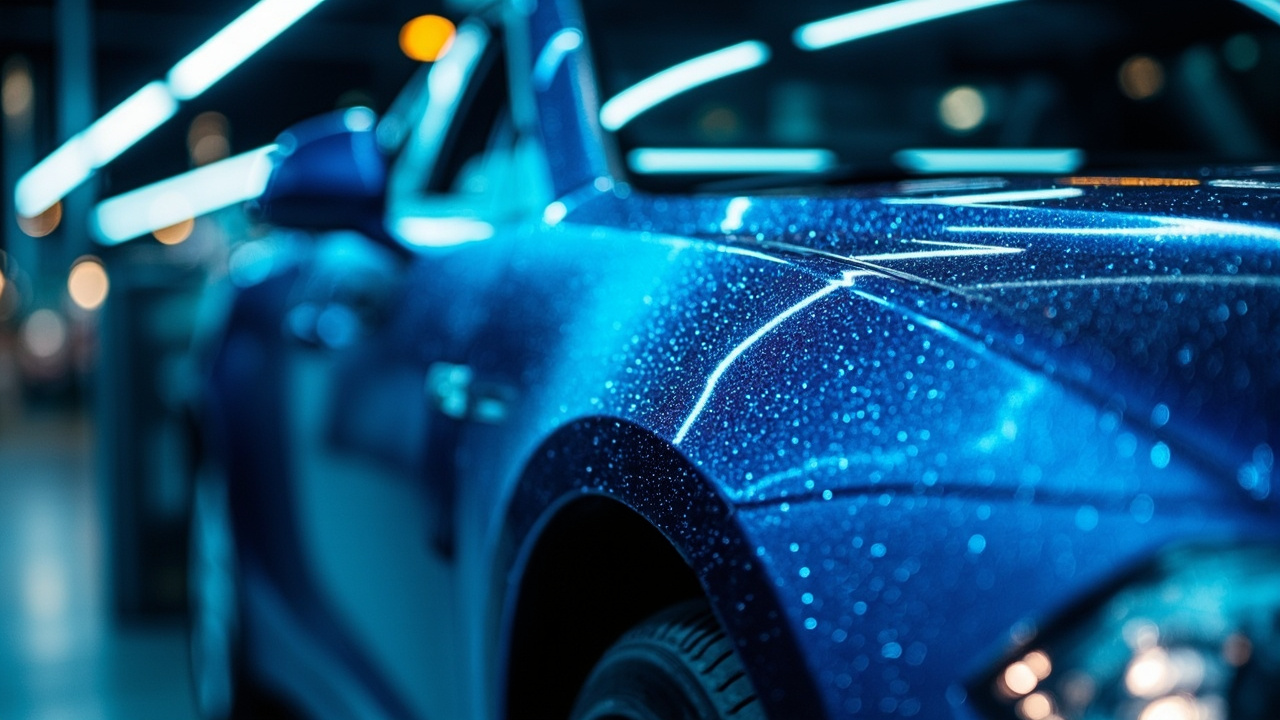
I. What are effect pigments: from ordinary pigments to "light-reflecting pigments"
Ordinary pigments (such as titanium white, carbon black, iron oxide) present color by selectively absorbing visible light. They are themselves "light absorbers" and do not depend on observation angle. Effect pigments are different: they are flat flake-shaped particles, with dimensions much larger than the wavelength of visible light, and mainly perform specular reflection rather than absorption of light, thus possessing metallic luster, sparkle, and goniochromatic characteristics. Effect pigments do not provide the basic hue, but are overlaid on transparent or semi-transparent colored pigments to create visual effects of "glitter", "sparkle", and "light-dark variation".
The most common effect pigments in automotive pigmented paint are two types: one is aluminum flake, the core of metallic paint; the other is mica-based pearlescent powder, the core of pearlescent paint. In addition, there are high-end categories such as silica/borosilicate-based interference pigments and colored aluminum flakes (such as electroplated aluminum, colored aluminum). Their common feature is "flake + high reflectivity + orientation sensitivity".
II. The principle of metallic paint: specular reflection of aluminum flakes
Metallic paint uses aluminum powder as the effect pigment. Aluminum powder is extremely thin scale-like particles, mostly 5–30 microns in diameter and only a fraction of a micron in thickness, like countless tiny mirrors laid flat in the paint film. When light enters, part is specularly reflected by the aluminum flakes (forming highlights and sparkle), and part passes through the gaps between flakes and is absorbed/reflected by the underlying colored pigment. When the observer faces the paint surface directly, more specular reflection is seen and the paint appears bright and light; when viewed from the side, specular reflection leaves the line of sight and the body color via transmission-absorption dominates, making the paint appear dark and deep—this is the source of the "face bright, side dark" flop of metallic paint.
The characteristic parameters of aluminum flakes determine the effect: larger particle size and wider distribution give coarser, stronger sparkle particles; smaller and finer particles make the surface more delicate and smooth. Higher flake aspect ratio (diameter/thickness) means better laying and stronger reflection. Aluminum powder surfaces are often passivated (e.g., silica, acrylic coating) to prevent gas generation from reaction and improve stability. Some high-end products use "electroplated aluminum" for brighter, whiter flakes, or colored aluminum (vacuum-deposited metal oxide) for colored sparkle.
III. The principle of pearlescent paint: thin-film interference of mica
Pearlescent paint uses mica-based pearlescent powder as the effect pigment. Its structure is a flake mica substrate coated with one or more layers of metal oxide (most typically titanium dioxide TiO2) by vapor deposition, forming a "mica core + oxide shell" sandwich structure. When light hits this thin film, reflection occurs separately on the upper and lower surfaces of the film, and the two reflected beams interfere due to optical path difference—certain wavelengths are enhanced (colored) and others canceled (decolored). This is thin-film interference, and also the fundamental source of pearly luster and "angle-dependent color shift".
The pearlescent hue is determined by the coating thickness and material. Thin TiO2 coating tends to silver-white, pale yellow; thickening shifts to golden, red, purple, blue, showing typical "rainbow interference color". By stacking different thicknesses and different oxides (Fe2O3 tends gold-red, Cr2O3 tends green), white pearl, gold pearl, red pearl, blue pearl, etc. can be made. The interference color of pearlescent powder is "added" on top of the underlying body color, so the same pearlescent powder shows different appearances on different base colors—this is exactly why pearlescent paint tinting is far more complex than solid color paint.
Unlike aluminum flakes, pearlescent powder is light-transmitting interference rather than strong specular reflection, so the sparkle of pearlescent paint is softer, with a "silky feel" and "soft color feel", not as hard as metallic paint. This is also why luxury cars and special colors favor pearls. It should be noted that the interference effect of the pearlescent layer depends on film integrity and uniform coating, and the coating uniformity in pigment manufacturing directly determines batch color stability.
IV. Goniochromatism: one formula, multiple colors
Goniochromatism is the most core yet most troublesome characteristic of effect pigments: the same paint surface shows different lightness or even different hues at face-on, oblique, and flash angles. The essence is that effect pigments are orientation-sensitive reflecting/interfering bodies, and when the observation geometry changes, the proportion of specular reflection or interference light entering the human eye changes accordingly.
Usually described by "flop": near face-on at 15° or 25°, side view at 75° or 110°, comparing the L* difference at the two angles. Metallic paint typically shows "face bright, side dark" (dark flop); some pearls and special interference pigments can do "face dark, side bright" (reverse flop) or two-color flip. Tinting and color measurement must use multi-angle colorimeters (e.g., 25°/45°/75° or 15°/45°/110°) to read separately; single-angle L*a*b* is insufficient to describe effect paint.
Orientation is the key variable. If aluminum and mica flakes lay parallel to the paint surface, specular reflection is concentrated and the face is brightest; if erect or random, scattering increases, face darkens and side brightens. During spraying, film flow, solvent evaporation, gravity settling, and gun direction all change flake orientation, so effect paint color is extremely sensitive to application. For multi-angle color measurement and color difference control, refer to another article in this batch Automotive Refinish Paint Computer Color Matching and Color Difference Control.

V. Synergy between effect pigments and basecoat
Automotive pigmented paint is usually a combination of "effect pigment + transparent/semi-transparent colored pigment + resin". Effect pigments handle lightness and sparkle, colored pigments handle hue. The ratio and arrangement of the two determine the final texture: more aluminum, less color tends to "silver metallic"; more color, less aluminum tends to "colored metallic"; mica pearl overlaid on dark base makes dream effects like "deep sea blue pearl".
One engineering point is the balance between hiding power and transparency. Aluminum flakes have strong hiding; too much will cover the underlying color, making the paint "dull" and losing transparency; pearlescent powder is highly translucent, allowing layered buildup. High-end colors often use "low aluminum + pearl + transparent color master" for multi-layer transparency. In application, the film thickness and uniformity of the basecoat directly affect the "background" under the effect layer, and thus the overall appearance, so the basecoat must be sprayed stably at the recommended DFT (dry film thickness).
VI. Particle size and morphology: how parameters determine appearance
The designable parameters of effect pigments mainly include particle size, particle size distribution, aspect ratio, shape regularity, and coating type. For metallic paint: coarse particle size + wide distribution = strong sparkle, rugged; fine particle size + narrow distribution = smooth, delicate, elegant. For pearl: particle size affects sparkle particle size, coating thickness and layers determine interference hue and purity. The table below summarizes the characteristics and effects of common effect pigments:
| Effect pigment type | Structural feature | Optical mechanism | Typical appearance | Application sensitivity |
|---|---|---|---|---|
| Aluminum powder (metallic paint) | Flaky aluminum, high aspect ratio | Specular reflection | Silver bright, sparkle, face bright side dark | Film thickness, air pressure, orientation |
| Fine aluminum powder | Small particle size narrow distribution | Specular reflection (fine) | Smooth delicate metallic feel | Easy to darken, control film thickness |
| Pearl mica (TiO2) | Mica + oxide thin film | Thin-film interference | Soft color pearly luster | Base color, coating uniformity |
| Colored aluminum / interference flake | Aluminum or substrate plated color oxide layer | Reflection + interference | Colored sparkle / two-color | Large angle color difference |
| Silica interference pigment | Flaky silica-based coating | Thin-film interference | High-transparent dream sparkle | Hard to tint, expensive |
VII. Control of effect presentation by application process
For effect paint, "seven parts tinting, three parts spraying"—the spraying process greatly affects the final result. Key control points:
First, film thickness. Film thickness determines the number of effect pigment layers and orientation. Thin spray means fewer flakes, darker side view; thick spray means more flakes, larger flop. Must apply per formula DFT and monitor with thickness gauge.
Second, spray gun and air pressure. High pressure gives fine atomization; aluminum flakes lay flatter, face brighter, finer sparkle; low pressure gives coarser droplets, more erect flakes, face darker, side brighter. Gun speed, overlap rate, and fan width all change paint amount per unit area and leveling, thus changing orientation. It is recommended to fix gun model, cap-end pressure, and gun rhythm into the process card.
Third, thinning and flash-off. Thinner speed and temperature/humidity affect leveling time and aluminum settling. More slow solvent gives flakes more time to lay flat, face brighter; fast dry tends to "freeze" flakes erect. Stable spray booth temperature/humidity (e.g., 20–25℃, relative humidity 50%–70%) is the premise of effect stability.
Fourth, clear coat. The gloss and film thickness of the clear coat change the underlying appearance, and yellowing of old clear coat also shifts the effect color. Unifying the clear coat system and polishing baseline is necessary to stably present the effect.
VIII. Stability and weather resistance of effect pigments
The effect pigment itself must be weather-resistant. Aluminum powder may corrode and generate gas in acidic or alkaline environments (causing blistering of the paint film and can swelling), so stable encapsulation and a neutral resin system are required; the TiO2 coating on pearlescent mica may chalk if insufficiently protected under long-term UV exposure. Weather resistance is also related to the UV shielding of the entire pigmented paint–varnish system: UV absorbers (UVA) and hindered amine light stabilizers (HALS) in the clear coat protect the underlying effect layer. Formula design must consider "effect aesthetics" and "long-term weather resistance" together, rather than only pursuing a fresh appearance.
In addition, effect pigments have a large density difference from the resin and easily settle during storage, so they must be thoroughly stirred evenly before use; the spraying process also requires periodic stirring to prevent bottom-of-can deposition from causing front-to-back color drift. Regarding the stabilizing effect of OEM high-temperature baking on effect orientation, you may read further at Automotive OEM Coating System and Electrophoretic Primer Process.
IX. Difficulties and Countermeasures in Tinting Effect Coatings
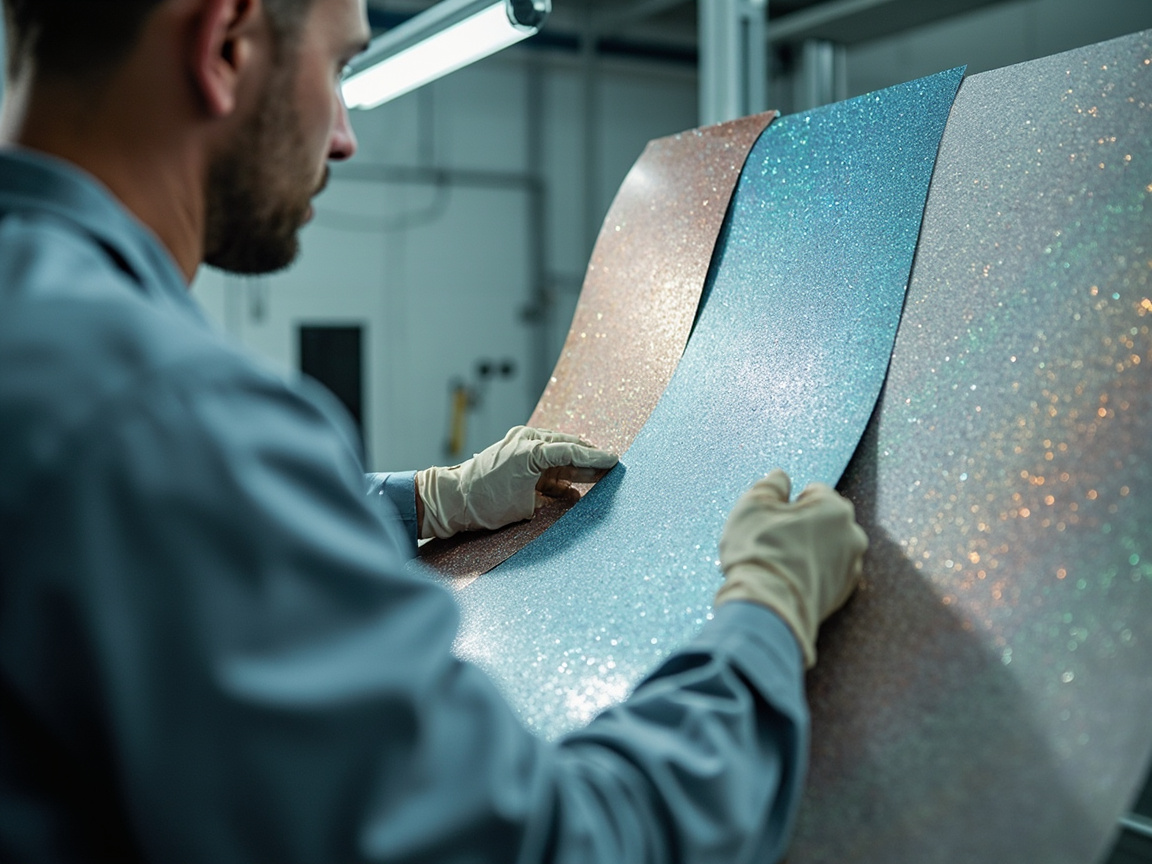
The difficulty in tinting effect coatings lies in "multi-angle viewing of multiple sets of data." The countermeasure is: first use a multi-angle colorimeter to collect the target color's face, flop, and sparkle angle data; when tinting, first set the base lightness and hue (mainly flop view), then set the face-flop difference and sparkle intensity; use transparent colorants to adjust the flop hue, use control agents to fine-tune the face-flop difference, and use effect masterbatches to control sparkle. Re-measure at multiple angles at each step to avoid over-adjusting at a single angle. For pearl paints, treat the pearlescent interference color as an independent variable and select the right particle size and coated pearl masterbatch.
A common on-site mistake is only controlling the face view and ignoring the flop view, resulting in a bright or dark band on the side under sunlight. Another mistake is drift in spraying parameters, which sprays the tuned formula off-target. Locking "tinting + spraying" as an integrated process can stably reproduce the effect.
X. Environmental Protection and Safety: Compliance of Effect Pigment Systems
Metallic paint and pearlescent paint are mostly solvent-based basecoats (1K or 2K), and their VOC is regulated by GB 24409-2020 "Limits of Harmful Substances in Vehicle Coatings." Some effect basecoats are high-solid or water-based to reduce emissions. Water-based effect coatings are more technically difficult—aluminum powder easily reacts and generates gas in the aqueous phase, and pearlescent dispersion stability is a major challenge, requiring special encapsulation and anti-settling systems. Kexin New Materials (kexinMaterials) has invested in R&D on the stability treatment of water-based effect colorants, aiming to let water-based metallic paint and pearlescent paint reduce VOC while maintaining sparkle texture without compromise. When selecting, VOC compliance and effect appearance must be reviewed side by side, rather than sacrificing one for the other.
XI. Appearance Difference Between Effect Pigments and Ceramic Coatings
Market "automotive ceramic nano coatings" stacked on top of the OEM clear coat provide enhanced gloss, clarity, hydrophobicity, and self-cleaning, but do not change the effect mechanism of the basecoat (see whitelist article Hydrophobic Mechanism of Automotive Ceramic Nano Coatings). It makes the clear coat brighter and smoother, thereby "revealing" the underlying effect, but does not produce new angle-dependent color shift. To judge a vehicle's color problem, first distinguish whether it is the effect pigmented paint itself or a gloss issue of the surface coating/clear coat, to avoid mistakenly treating the coating effect as color difference and re-tuning.
XII. Development Trends and New Categories of Effect Pigments
The technical evolution of effect pigments follows the主线 of "finer, more transparent, more vivid, more stable, more eco-friendly." Traditional coarse aluminum powder gives strong sparkle but looks rough, while fine aluminum powder is smoother but lacks variation; new-generation narrow particle size distribution aluminum powder enhances sparkle layering while maintaining fineness, relying on more precise grinding and classification control. Colored aluminum (vacuum-deposited metal oxide on aluminum flake surfaces) lets the sparkle flakes themselves carry color, producing more personalized effects like "gold sparkle" "blue sparkle" rather than just silver-white sparkle.
Beyond mica pearlescent, borosilicate and silica-based flake interference pigments are rising rapidly. They have better light transmission, purer and more vivid interference colors, and superior weather and chemical stability, and unlike mica they do not have batch fluctuations from natural flake size distribution, making them more suitable for high-end dream colors. Multi-layer coating technology (e.g., sequentially depositing oxide layers of different thicknesses and materials on mica) can produce more complex face-flop flip colors, letting the same car paint change from gold to blue, red to green as it rotates; this "dual-color flip" is a popular direction for luxury custom colors.

The trends on the manufacturing side are equally clear. First, more precise particle size control, where aspect ratio and distribution width are strictly designed to match the target appearance; second, more uniform and complete coating, which directly determines interference color purity and batch color stability, and is also an upstream variable for pearl paint tinting hit rate; third, low heavy metals and chrome-free passivation, complying with RoHS, REACH and other environmental constraints; fourth, surface modification to improve dispersion and anti-reaction ability in water-based systems, supporting the water-based reduction of VOC in effect coatings.
Detection and evaluation methods are also being upgraded. Besides multi-angle spectrophotometry, laser particle size analysis looks at particle size distribution, scanning electron microscopy looks at flake shape and coating, gloss and orange peel meters look at effect presentation, and weathering tests look at long-term stability. Establishing a mapping database of "pigment parameters—coating process—final appearance" can turn effect coatings from "art" into "designable, reproducible" engineering technology. For the refinish side, understanding these category differences helps select the right effect masterbatch and control angle color difference when tinting, rather than blindly adding or subtracting colorants.
Worth noting is the intersection of effect pigments with "smart color change." If electrochromic or thermochromic films are combined with effect coatings, theoretically the body color could change with voltage or temperature; although far from mass production, it represents the imaginative boundary of decorative coatings. At the same time, high-end effect pigments are not cheap, and selection must balance appearance premium and formula cost; for mass-produced models, the combination of "small amount of high-price effect master + large amount of base colorant" is common, achieving effect while controlling cost. Understanding this cost-effect curve is a perspective that both coating engineers and purchasers should have.
In the chain from pigment production to coating application, stability is another gate. Effect pigments have high density and easily settle; paint making must rely on dispersants and anti-settling agents to maintain suspension; storage and transport must avoid high temperature and long static periods; the spraying process requires periodic stirring to prevent front-back drift. These seemingly trivial steps directly determine whether the effect coating on the car is "consistent per vehicle." Moving pigment stability management upstream is more economical than remedying at the tinting end later.
XIII. Quick Troubleshooting of Common Effect Coating Application Defects
Most defects in effect coatings stem from flake orientation and film thickness loss of control; on-site, quickly troubleshoot by "phenomenon—cause—countermeasure":
Abnormal face-flop difference: face too bright or flop too dark, mostly due to air pressure and film thickness drift. Countermeasure: fix spray gun pressure and stroke rhythm, use thickness gauge to control DFT.
Uneven sparkle, cloud spots: uneven aluminum flake distribution or improper dilution. Countermeasure: stir thoroughly, select suitable thinner and viscosity, ensure leveling time.
Particles and fibers: poor environment cleanliness or unfiltered paint. Countermeasure: strengthen spray booth purification, filter before spraying, clean tooling.
Blushing, hue deviation: wrong colored colorant added or pearlescent interference out of control. Countermeasure: multi-angle re-measure, fine-tune within control agent window, avoid single-angle tinting.
Insufficient angle-dependent color shift: weak pearlescent layer interference or abnormal base color show-through. Countermeasure: verify pearlescent masterbatch particle size and coating, adjust base coverage and film thickness.
Appearance change after clear coat: clear coat gloss or yellowing impact. Countermeasure: unify clear coat system and polishing baseline, do global treatment on old cars first.
Posting this quick-reference table at the workstation, together with multi-angle color measurement and process cards, can significantly reduce effect coating rework rate. Remember: effect coatings tune "multi-angle data," not "good-looking at one angle."
XIV. Application of Effect Pigments in New Energy Vehicles and Special Vehicles
The application of effect pigments is extending from passenger cars outward. New energy vehicles, to show a tech feel, often use matte clear coat over metallic basecoat, creating a "satin metal" restrained premium feel; matte systems are more demanding on effect flake orientation and surface uniformity, any orange peel or particle is amplified, and the process window is narrower.
Luxury and custom vehicles prefer complex flip-color pearlescent, changing from gold to blue, red to green as they rotate, relying on multi-layer coating and precise film thickness control. Commercial vehicles and engineering machinery value weather resistance and anti-fouling more, tending toward stable, low-maintenance silver powder or light pearlescent rather than delicate high-chroma interference colors.
Special scenarios like racing cars and co-branded editions may try extremely high sparkle or colored aluminum, but mass production must balance cost and yield. Understanding the correspondence of "vehicle positioning—effect category—application difficulty—cost" enables selecting the right solution between aesthetics and manufacturability. The choice of effect pigments is never the more expensive the better, but the more "scene-fitting" the better.
XV. Cost and Selection Trade-off of Effect Pigments
Selecting effect pigments cannot only look at unit price; one must account for "effect premium, yield, batch stability, compliance" together. High-price interference pigments that bring higher rework and longer debugging are actually more expensive; cheap aluminum powder with large batch drift requires constant compensation at the tinting end, with higher hidden costs.
The truly cost-effective choice is the balance point of "adequate performance, stable batch, mass-producible." For mass-produced models, a small amount of high-price effect master paired with a large amount of base colorant achieves effect while controlling cost; for custom and luxury cars, complex flip and multi-layer coating are used. Drawing the cost-effect curve clearly gives purchasing and engineers a common language, avoiding paying for "pretty parameters" while sacrificing manufacturability.
XVI. Storage and Incoming Inspection of Effect Pigments
Effect pigments have high density, easily settle, and fear contamination; incoming and storage must follow rules. Upon arrival, three quick checks are recommended: first, check if batch number and SDS are consistent; second, compare appearance with standard panel, noting interference hue for pearlescent and sparkle and particle size for aluminum powder; third, check settling and skinning—severe settling or skinning indicates improper transport or storage.
Storage should be cool, dark, sealed, and crush-proof; aluminum powder especially needs moisture and fire protection; use first-in-first-out, finish opened packages soon and stir periodically. Seal and retain samples of each batch for traceability in color difference disputes. Making incoming inspection a fixed action can block most "mysterious" color deviations and batch drifts, and is the first gate for effect coating stability.
XVII. Effect Pigments and Color Trends
Color trends also drive pigment innovation in reverse. In recent years, matte metal, low-saturation Morandi colors, and high-chroma flip pearlescent have taken turns in popularity, each trend imposing different requirements on effect pigment particle size, coating, and process window. What coating engineers must do is anticipate trends and translate "good-looking" into "manufacturable parameters." When pigment innovation and color trends are in sync, car paint can be both trendy and stably delivered to consumers.
FAQ
Q: What is the fundamental difference between metallic paint and pearlescent paint?
A:Metallic paint uses aluminum powder for specular reflection, showing a silvery shimmer, bright from front and dark from side; pearlescent paint uses mica coated with metal oxides for thin-film interference, showing a soft, colorful pearl luster with richer angle-dependent color shift. The former is crisp and sparkling, the latter soft and dreamy, with different optical mechanisms.
Q: What is angle-dependent color shift, and why is it hard to tune effect paint?
A: Angle-dependent color shift means the same paint surface shows different lightness or even hue at different viewing angles, arising from the orientation-sensitive reflection/interference of effect pigments. Color matching must use multi-angle color measurement and separately control front/side viewing differences; single-angle data is insufficient to describe it, so it is far harder than solid-color paint.
Q: Why is it better for aluminum flakes to lie flat?
A: When aluminum flakes lie parallel to the paint surface, specular reflection is concentrated and the front is brightest; if upright or random, scattering increases, the front darkens and the side brightens. Spray leveling, film thickness, and air pressure affect orientation, so effect paint is extremely sensitive to application parameters.
Q: How does pearlescent color come about, does the pigment itself have color?
A: Pearlescent color mainly comes from interference of the metal oxide thin film on mica, not from bulk absorption. Coating thickness and material determine the interference hue (e.g., thin TiO2 tends silver-white, thickening shifts to gold, red, blue, purple). The same pearlescent powder looks different over different base colors, so color matching must treat it as an independent variable.
Q: Why do spray parameters change the color?
A: Air pressure, film thickness, gun travel, and evaporation rate change the orientation and layer count of effect flakes, thus changing the front/side reflection ratio. Color is matched under ideal conditions, but spray drift shifts the color off. Gun, pressure, and gun travel should be fixed in the process card.
Q: Do effect pigments age?
A: Yes. Aluminum powder may corrode and release gas in acidic/alkaline environments; pearlescent coating layers may chalk under long-term UV exposure. Weathering resistance relies on UV absorbers and light stabilizers in the clear coat to protect the lower layers; the formulation must balance aesthetics and long-term weatherability.
Q: Where is the difficulty in water-based effect paint?
A: Aluminum powder easily reacts and releases gas in the aqueous phase, and pearlescent dispersion stability is hard; special coating and anti-settling systems are needed, with a higher technical barrier than solvent-based. Water-based conversion is to reduce VOC, but the sparkle texture must not be compromised.
Q: Will a ceramic coating change the car's color?
A: No. A ceramic coating only enhances gloss, clarity, and hydrophobicity, does not change the effect mechanism of the base color paint, nor produces new angle-dependent color shift. For color issues, first distinguish whether it is the effect color paint itself or the surface clear coat/coating gloss.
Q: Why control side viewing when tuning effect paint?
A: Because the human eye most easily notices abnormal front/side differences in sunlight, especially at edges. Controlling only the front view can blow out the side view, causing obvious bright or dark bands; multiple angles must meet standards simultaneously.
Q: What should be noted for effect pigment storage?
A: Effect pigments are dense and settle easily; thorough stirring before use and during spraying prevents front/back drift; aluminum powder needs moisture-proofing and reaction prevention; pearlescent needs intact coating. Batch consistency from the system supplier also determines reproduction stability.
Further Reading
- Automotive Refinish Computer Color Matching and Color Difference Control: Multi-angle color measurement and front/side difference control of effect paint are key to matching hit rate.
- Automotive OEM Coating System and Electrophoretic Primer Process: Understand the stabilizing effect of OEM high-temperature baking on effect orientation and the matching of the whole system.
- Automotive Ceramic Nano Coating Hydrophobic Mechanism: Distinguish color shift from the effect color paint itself versus surface coating gloss effect to avoid misjudgment.
- Coating Protection for New Energy Vehicle Three-Electric System
- Isocyanate Health Hazards and Protection in Automotive Paint
- Automotive Refinish System: 2K Solid Paint, Basecoat + Clear Coat and 1K