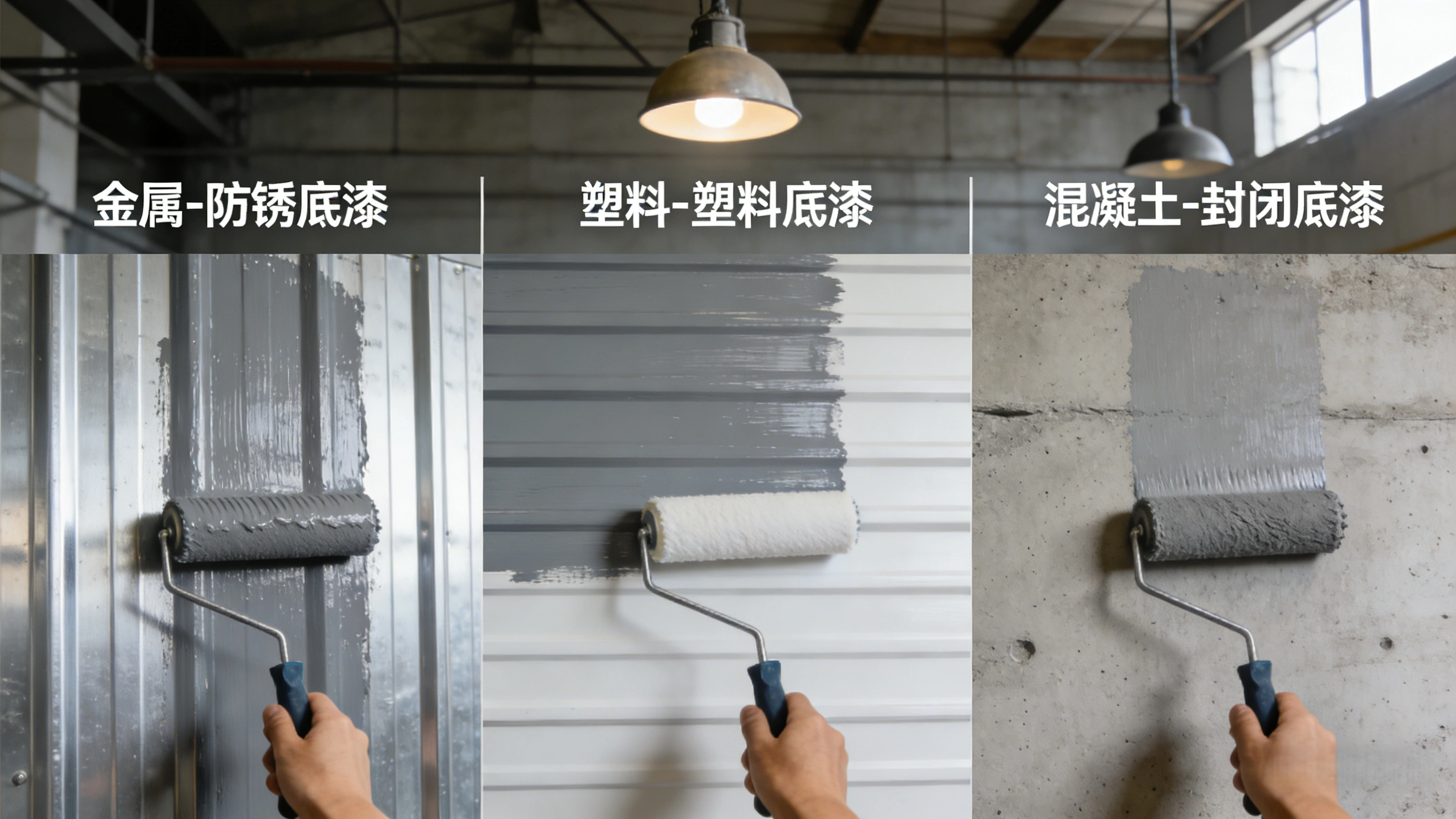
Summary: Concrete is alkaline, porous and damp (pore-fluid pH 12.5-13.5). Success is not a premium paint but controlling alkali and moisture-cure, dry and profile the slab, then balance sealing alkali against venting water vapour.
Definition & system
Concrete pore fluid is rich in portlandite and alkali hydroxides at pH 12.5-13.5, and wicks water and soluble salts to the surface. Alkali saponifies ester-based binders (alkyd), while vapour and salt blister the film, causing bloom and delamination.
A working system has three layers: a penetrating/sealing primer (blocks alkali, anchors, moderates vapour), a levelling filler, and an alkali-resistant topcoat with real water-vapour permeability so trapped moisture can escape.
Key data
- Pore-fluid pH of fresh concrete ~12.5-13.5; ~8-9 after surface carbonation.
- Prerequisite moisture: ≤4% (CM/carbide) or substrate RH ≤75-80%.
- Cure new concrete ≥28 days before coating.
- Pull-off adhesion (ASTM D4541 / EN 1542) typically ≥1.5 MPa.
- Mechanical profile CSP 3-5 (~25-50 µm) for wetting and key.
- After acid etch, rinse and dry to surface pH 6-9 (ASTM D4262).
Blocking alkali vs venting moisture
| Route | Main role | Typical use |
|---|---|---|
| Epoxy sealer | High alkali block, strong key, chemical resistance | Floors, tank/sewer internals |
| Silicate penetrant | Gels pores, densifies, cuts ingress | Friable/bleeding slabs |
| Silane/siloxane | Water-repellent yet breathable | Facades, masonry |
| Breathable topcoat | UV/weather, lets vapour out | Exteriors, fluctuating humidity |
Substrate preparation
Strip curing compounds, release agents, oil and laitance first. Prefer blasting/scarifying (NACE No.6 / SSPC-SP 13) to CSP 3-5; acid etching is secondary and must be rinsed to pH 6-9. Keep substrate ≥3°C above dew point.
Defects & fixes
- Chalking/softing loss of gloss: binder saponified - switch to epoxy/pu alkali barrier, avoid alkyd on green concrete.
- Blistering/bubbling: vapour or salt push-off - control moisture, use breathable topcoat.
- Alkali bloom/salt: soluble salts migrate - dry the substrate, repel water.
- Delamination: exceeded recoat window or contaminated interface - abrade and clean.
FAQ
Why must concrete use an alkali primer?
Pore fluid at pH 12.5-13.5 saponifies ester binders and drives salt/vapour migration; plain alkyd softens, glosses off, blisters and peels.
How long before painting new concrete?
Cure ≥28 days and verify moisture and adhesion against the system spec-do not rely on days alone.
What if moisture will not drop?
Use moisture-tolerant/breathable systems (waterborne epoxy, 1K polyurethane) and keep vapour transmission; a fully sealed film traps water.
Is a dead-sealed primer better?
Not always. Facades and damp-prone areas need 'seal alkali + breathe'; a fully dense film can be pushed off by trapped vapour.
Acid etch or blast?
Blasting is the preferred, controllable route to CSP 3-5; acid etch must be rinsed to pH 6-9 or it leaves salts that cause bloom.
Old, dusty, spalling concrete?
Remove the friable layer, densify with a silicate penetrant, then epoxy sealer plus alkali-resistant topcoat-and fix the water source first.
Last updated: 2026-09-18
References: ISO 12944-6 (concrete/masonry protection); NACE No.6 / SSPC-SP 13 (concrete surface prep); ASTM D4262; ASTM D4541 / EN 1542.
Kexin New Materials (Guangdong) Co., Ltd.