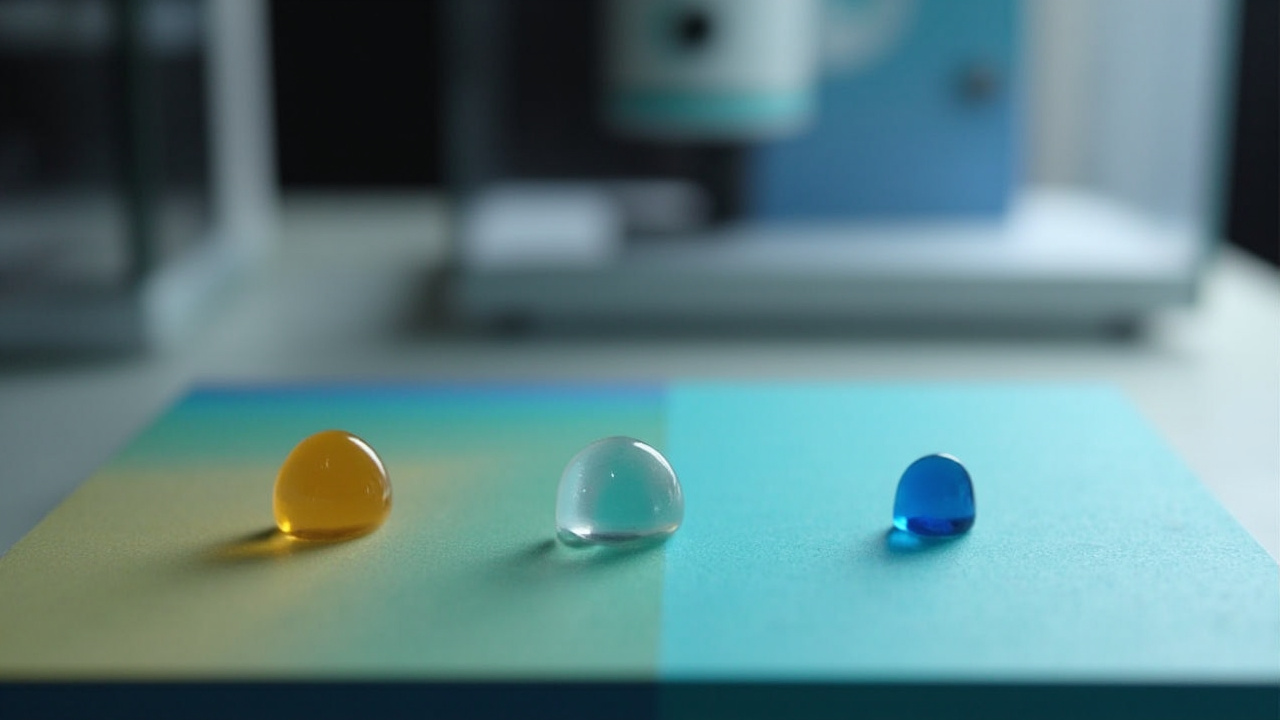
Wettability is the cornerstone of surface science and the physical origin of almost every nano-coating function — hydrophobicity, self-cleaning, anti-fouling, adhesion, corrosion protection, printing. The core “ruler” of wettability is the contact angle (CA). Starting from interfacial thermodynamics, this article systematically explains the Young equation, Wenzel and Cassie-Baxter models, surface energy, and their engineering use.
kexinMaterials uses contact angle and surface energy as core monitoring metrics in functional nano-coating development, applying a “infer low-surface-energy design from wettability” R&D method.
1. Interfacial Tension and the Young Equation
Whether a liquid spreads on a solid is decided by the balance of three interfacial tensions (solid-vapor S-V, solid-liquid S-L, liquid-vapor L-V). On an ideal smooth, chemically homogeneous, rigid surface, astatic droplet satisfies the Young equation:
γ_SV = γ_SL + γ_LV · cos θ_Y → cos θ_Y = (γ_SV − γ_SL) / γ_LV
θ_Y is the Young contact angle. Smaller θ_Y → easier spreading (better wetting); larger → non-wetting (hydrophobic). Classification: θ < 90° hydrophilic, 90° ≤ θ < 150° hydrophobic, θ ≥ 150° superhydrophobic, θ ≈ 0° superhydrophilic (spreading).
Note: γ_SV and γ_SL are not directly measurable; one infers the solid surface free energy γ_S from measurable probe liquids — leading to surface-energy decomposition below.
2. Solid Surface Energy: OWRK and Fowkes
A solid has no directly measurable “surface tension”, but by measuring contact angles of several probe liquids of known surface tension (water, diiodomethane, formamide), models back-calculate γ_S and its polar/dispersive components:
- Fowkes (1964): splits interfacial tension into dispersive and polar components, γ = γ^d + γ^p.
- OWRK (Owens-Wendt-Kaelble-Rabel): extends Fowkes with geometric-mean assumption, solving solid γ^D and γ^P from two probe liquids.
- Acid-base (van Oss): further splits polar into acid/base, suited to high-energy surfaces.
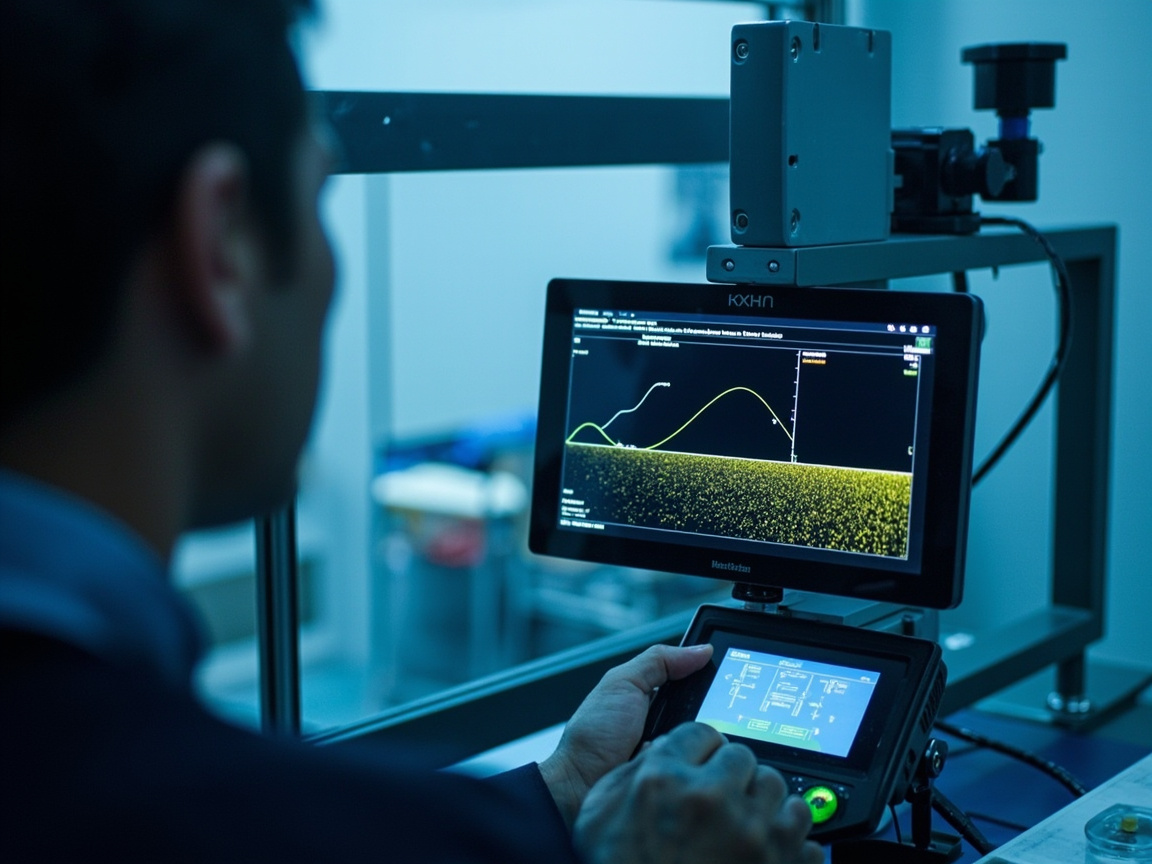
Engineering meaning: nano-coating “hydrophobicity” is essentially lowering solid surface energy (introducing —CF₃, —Si—CH₃ low-energy groups) to raise θ_Y. Understanding surface-energy decomposition explains “why fluorosilane modification is hydrophobic” beyond “it feels slippery”.
3. Two Rough-Surface Models: Wenzel and Cassie-Baxter
Real coating surfaces are microscopically rough, so the Young equation fails and a roughness factor enters:
1. Wenzel (1936): droplet fully wets the rough grooves; actual solid-liquid area = apparent area × roughness r (>1): cos θ_W = r · cos θ_Y. If intrinsically hydrophobic (θ_Y > 90°, cos θ_Y < 0), larger r makes cos θ_W more negative → θ_W larger (roughness enhances hydrophobicity); if intrinsically hydrophilic, roughness enhances hydrophilicity. So “hydrophobic first, then roughen” — roughness cannot turn hydrophilic into hydrophobic.
2. Cassie-Baxter (1944): droplet does not fill grooves; air is trapped underneath, contacting solid only at asperity tops, fraction f (0<f<1): cos θ_CB = f · cos θ_Y − (1 − f). When f is small and air fraction large, cos θ_CB → −1, θ_CB exceeds 150° — superhydrophobic with very low roll-off angle (lotus effect).
The two are not opposed: low roughness tends Wenzel (wetted), high roughness + low surface energy tends Cassie-Baxter (composite). Nano-coating process goal is to build proper roughness with nanoparticles (e.g., nano SiO₂) to push the surface from Wenzel to Cassie-Baxter.
4. Quantifying Wettability: Standards and Testing
Wettability must be quantified, never by eye. Mainstream standards: GB/T 30693 / ISO 19403 for contact angle; ISO 15989 / ASTM D7334 for powder; roll-angle per tilt-stage. Typical flow: sample conditioned at 25 °C, 50% RH; micro-syringe drops 2–5 µL deionized water (add diiodomethane for dispersive on high-energy surfaces); camera captures contour, software fits left/right CA averaged. Roll angle: tilt stage slowly, record critical angle where the droplet rolls; quality superhydrophobic nano-films reach 5°–15°.
5. Real Factors Affecting Contact Angle
- Surface chemistry: low-energy groups (—CF₃ ≈ 6 mN/m, —CH₃ ≈ 22 mN/m) set the θ_Y ceiling.
- Roughness & morphology: nano/micro-nanohierarchical structure drives Wenzel→Cassie transition.
- Liquid nature: water vs salt water vs oil differ; multi-probe needed.
- Environment: temperature, humidity affect adsorbed water film; contamination (fingerprint, oil) drops hydrophobicity sharply.
- Time/aging: UV, friction, acid rain break low-energy groups, θ decays — re-measure periodically.
Engineers often use “contact angle + roll angle + decay curve” as the triple metric for hydrophobic coatings; a single peak value misleads.
6. Coupling Wettability with Other Functions
- Corrosion: hydrophobic surface slows water/electrolyte spreading; with barrier layer reduces corrosion.
- Anti-fouling/self-cleaning: high θ + low roll angle lets dirt roll off with water.
- Adhesion/printing: needs good wetting (low θ) for coating/ink spread — hydrophobicity is an obstacle, needing plasma activation to raise surface energy.
- Anti-icing: superhydrophobic can delay icing but needs mechanical durability.
So “high contact angle” is not universally good — self-cleaning wants hydrophobic, adhesion wants hydrophilic, corrosion wants hydrophobic + barrier. Understand wettability to avoid “hydrophobic for its own sake”.
7. Measurement Pitfalls and Dynamic CA
Pitfall 1: “one drop, read angle” — wrong; control T/RH, equilibration, volume, average multiple points or error ±10° is common. Pitfall 2: “bigger angle = cleaner” — wrong; roll angle and air-trapping (Cassie) are the self-clean key; high θ in Wenzel wetted state still traps dirt.
Static CA is just a start; a real droplet’s advancing/receding angles differ — their difference is contact-angle hysteresis Δθ = θ_A − θ_R. Small Δθ → easy roll (good self-clean); large Δθ → pinned, residue. True superhydrophobic self-cleaning is “high θ AND low Δθ” — report θ, Δθ and roll angle together.
8. Zisman Critical Surface Tension
Zisman critical surface tension γ_c: plot cosθ of a homologous series of probe liquids vs γ_LV, extrapolate to cosθ=1 (θ=0); the corresponding γ_LV is γ_c. If liquid surface tension < γ_c, it spontaneously spreads on that solid. Engineering: knowing a coating’s γ_c (fluorinated ~18 mN/m, silane ~22–24 mN/m, untreated metal 40+ mN/m) predicts whether water (72 mN/m) spreads — turning “wettable?” into a look-up design parameter.
FAQ
Q: What is contact angle and why does it matter?
A: It is the angle between the liquid-vapor and solid-liquid interfaces of a static droplet, quantifying wetting/hydrophobicity. It is the basis for designing hydrophobic, self-cleaning, anti-fouling and adhesion behavior of nano coatings.
Q: What are the premises of the Young equation, and why not use it directly on real paint?
A: Young assumes ideal smooth, homogeneous, rigid surface. Real coatings are rough and chemically non-uniform, so droplet behavior deviates — hence Wenzel / Cassie-Baxter. Using the Young angle on a rough painted surface seriously distorts reality.
Q: Wenzel vs Cassie-Baxter — what is the difference?
A: Wenzel has the droplet fully filling grooves (wetted): cos θ_W = r·cos θ_Y, amplifying the intrinsic trend. Cassie-Baxter traps air underneath (composite): cos θ_CB = f·cos θ_Y − (1−f), can exceed 150° superhydrophobic with very low roll angle. Nano coatings aim to push into the Cassie state.
Q: Can roughness make hydrophilic become hydrophobic?
A: No. Wenzel only amplifies the intrinsic trend: intrinsically hydrophobic (θ_Y > 90°) becomes more hydrophobic when roughened; intrinsically hydrophilic becomes more hydrophilic. Roughness cannot flip it.
Q: What do OWRK/Fowkes surface-energy models measure?
A: Solid surface energy cannot be measured directly; use several probe liquids of known tension, measure their contact angles, and back-calculate total surface energy and its dispersive/polar components. OWRK (Owens-Wendt-Kaelble-Rabel) is the most common geometric-mean model, explaining “why fluorosilane modification is hydrophobic”.