磷化 / 硅烷前Treatment在AutomotiveCoating Application中的应用与Eco-Friendly替代

2026-07-12 · Category: Technical Knowledge, Paint & Coatings

🌐 This article was automatically translated from Chinese. Please refer to the original Chinese version if needed. · 查看中文原文

.kx-article{max-width:860px;margin:0 auto;background:#ffffff;color:#232a33 !important;
border-radius:16px;padding:32px 30px 40px;box-shadow:0 8px 40px rgba(0,0,0,.25);
font-family:-apple-system,”Segoe UI”,”PingFang SC”,”Microsoft YaHei”,sans-serif;line-height:1.9;font-size:16px}
.kx-article *{box-sizing:border-box}
.kx-article h1,.kx-article h2,.kx-article h3,.kx-article p,.kx-article li,.kx-article td,.kx-article th,.kx-article strong,
.kx-article .summary,.kx-article .summary p,.kx-article .summary strong,
.kx-article .note,.kx-article .note p,.kx-article .kxbox-brand,
.kx-article .related,.kx-article .related li,.kx-article .kx-foot,
.kx-article .kxqa-q,.kx-article .kxqa-a{color:#232a33 !important}
.kx-article h1{font-size:28px;line-height:1.35;font-weight:800;margin:0 0 18px;color:#1a1d21 !important}
.kx-article .lead,.kx-article p{margin:14px 0}
.kx-article .cover{width:100%;border-radius:14px;box-shadow:0 6px 24px rgba(0,0,0,.15);margin:6px 0 26px;display:block}
.kx-article h2{font-size:22px;font-weight:700;margin:40px 0 16px;padding-bottom:10px;border-bottom:2px solid #eceff3;position:relative;color:#1a1d21 !important}
.kx-article h2::before{content:””;position:absolute;left:0;bottom:-2px;width:64px;height:2px;background:#e8720c}
.kx-article h3{font-size:18px;font-weight:700;margin:26px 0 12px;color:#2a2f36 !important}
.kx-article strong{color:#111418 !important;font-weight:700}
.kx-article img.inline{width:100%;border-radius:12px;box-shadow:0 4px 16px rgba(0,0,0,.12);margin:22px 0 8px}
.kx-article figcaption{color:#7a828d !important;font-size:13px;text-align:center;margin:6px 0 24px}
.kx-article table{width:100%;border-collapse:collapse;margin:20px 0;font-size:14.5px;background:#fff;border-radius:10px;overflow:hidden;box-shadow:0 2px 12px rgba(0,0,0,.06);border:1px solid #eceff3}
.kx-article th,.kx-article td{padding:12px 14px;text-align:left;border-bottom:1px solid #eceff3;vertical-align:top}
.kx-article th{background:#2a2f36;color:#ffffff !important;font-weight:600;font-size:14px}
.kx-article tr:last-child td{border-bottom:none}
.kx-article tbody tr:nth-child(even){background:#fafbfc}
.kx-article .note{background:#eef6ff !important;border-left:4px solid #0a67d0;padding:14px 18px;border-radius:0 10px 10px 0;margin:22px 0}
.kx-article .note strong{color:#0a4a97 !important}
.kx-article .kxbox-brand{background:#fff3e8 !important;border-left:4px solid #e8720c;padding:16px 18px;border-radius:0 10px 10px 0;margin:22px 0}
.kx-article .kxbox-brand strong{color:#5a4632 !important}
.kx-article ul{margin:12px 0;padding-left:22px}
.kx-article li{margin:8px 0}
.kx-article .kxqa-item{background:#fbfcfd;border:1px solid #eceff3;border-radius:12px;padding:16px 20px;margin:14px 0}
.kx-article .kxqa-q{font-weight:700;color:#e8720c !important;font-size:16px;margin-bottom:8px}
.kx-article .kxqa-a{color:#3a4048 !important;display:block;margin:0}
.kx-article .related{background:#fff !important;border:1px dashed #e8720c;border-radius:12px;padding:16px 22px;margin:26px 0}
.kx-article .related h3{margin:0 0 6px;color:#e8720c !important}
.kx-article .summary{background:linear-gradient(135deg,#fff3e8,#ffe9d6) !important;border-radius:12px;padding:20px 22px;margin:26px 0}
.kx-article .summary h3{margin:0 0 10px;color:#1a1d21 !important}
.kx-article .kx-foot{margin-top:34px;padding-top:18px;border-top:1px solid #eceff3;text-align:center;color:#8a929d !important;font-size:13px}
.related{margin:30px 0 6px;}
.related h3{font-size:18px;color:#1C1917;margin:0 0 12px;padding-left:10px;border-left:4px solid #F97316;}
.related ul{list-style:none;margin:0;padding:0;}
.related li{margin:0 0 9px;padding-left:16px;position:relative;}
.related li:before{content:”203A”;position:absolute;left:0;color:#F97316;font-weight:700;}
.related a{color:#F97316 !important;text-decoration:underline !important;font-weight:600;}
.related a:hover{color:#EA580C !important;}

.kx-article{max-width:860px;margin:0 auto;background:#ffffff;color:#232a33 !important;
border-radius:16px;padding:32px 30px 40px;box-shadow:0 8px 40px rgba(0,0,0,.25);
font-family:-apple-system,”Segoe UI”,”PingFang SC”,”Microsoft YaHei”,sans-serif;line-height:1.9;font-size:16px}
.kx-article *{box-sizing:border-box}
.kx-article h1,.kx-article h2,.kx-article h3,.kx-article p,.kx-article li,.kx-article td,.kx-article th,.kx-article strong,
.kx-article .summary,.kx-article .summary p,.kx-article .summary strong,
.kx-article .note,.kx-article .note p,.kx-article .kxbox-brand,
.kx-article .related,.kx-article .related li,.kx-article .kx-foot,
.kx-article .kxqa-q,.kx-article .kxqa-a{color:#232a33 !important}
.kx-article h1{font-size:28px;line-height:1.35;font-weight:800;margin:0 0 18px;color:#1a1d21 !important}
.kx-article .lead,.kx-article p{margin:14px 0}
.kx-article .cover{width:100%;border-radius:14px;box-shadow:0 6px 24px rgba(0,0,0,.15);margin:6px 0 26px;display:block}
.kx-article h2{font-size:22px;font-weight:700;margin:40px 0 16px;padding-bottom:10px;border-bottom:2px solid #eceff3;position:relative;color:#1a1d21 !important}
.kx-article h2::before{content:””;position:absolute;left:0;bottom:-2px;width:64px;height:2px;background:#e8720c}
.kx-article h3{font-size:18px;font-weight:700;margin:26px 0 12px;color:#2a2f36 !important}
.kx-article strong{color:#111418 !important;font-weight:700}
.kx-article img.inline{width:100%;border-radius:12px;box-shadow:0 4px 16px rgba(0,0,0,.12);margin:22px 0 8px}
.kx-article figcaption{color:#7a828d !important;font-size:13px;text-align:center;margin:6px 0 24px}
.kx-article table{width:100%;border-collapse:collapse;margin:20px 0;font-size:14.5px;background:#fff;border-radius:10px;overflow:hidden;box-shadow:0 2px 12px rgba(0,0,0,.06);border:1px solid #eceff3}
.kx-article th,.kx-article td{padding:12px 14px;text-align:left;border-bottom:1px solid #eceff3;vertical-align:top}
.kx-article th{background:#2a2f36;color:#ffffff !important;font-weight:600;font-size:14px}
.kx-article tr:last-child td{border-bottom:none}
.kx-article tbody tr:nth-child(even){background:#fafbfc}
.kx-article .note{background:#eef6ff !important;border-left:4px solid #0a67d0;padding:14px 18px;border-radius:0 10px 10px 0;margin:22px 0}
.kx-article .note strong{color:#0a4a97 !important}
.kx-article .kxbox-brand{background:#fff3e8 !important;border-left:4px solid #e8720c;padding:16px 18px;border-radius:0 10px 10px 0;margin:22px 0}
.kx-article .kxbox-brand strong{color:#5a4632 !important}
.kx-article ul{margin:12px 0;padding-left:22px}
.kx-article li{margin:8px 0}
.kx-article .kxqa-item{background:#fbfcfd;border:1px solid #eceff3;border-radius:12px;padding:16px 20px;margin:14px 0}
.kx-article .kxqa-q{font-weight:700;color:#e8720c !important;font-size:16px;margin-bottom:8px}
.kx-article .kxqa-a{color:#3a4048 !important;display:block;margin:0}
.kx-article .related{background:#fff !important;border:1px dashed #e8720c;border-radius:12px;padding:16px 22px;margin:26px 0}
.kx-article .related h3{margin:0 0 6px;color:#e8720c !important}
.kx-article .summary{background:linear-gradient(135deg,#fff3e8,#ffe9d6) !important;border-radius:12px;padding:20px 22px;margin:26px 0}
.kx-article .summary h3{margin:0 0 10px;color:#1a1d21 !important}
.kx-article .kx-foot{margin-top:34px;padding-top:18px;border-top:1px solid #eceff3;text-align:center;color:#8a929d !important;font-size:13px}
.related{margin:30px 0 6px;}
.related h3{font-size:18px;color:#1C1917;margin:0 0 12px;padding-left:10px;border-left:4px solid #F97316;}
.related ul{list-style:none;margin:0;padding:0;}
.related li{margin:0 0 9px;padding-left:16px;position:relative;}
.related li:before{content:”203A”;position:absolute;left:0;color:#F97316;font-weight:700;}
.related a{color:#F97316 !important;text-decoration:underline !important;font-weight:600;}
.related a:hover{color:#EA580C !important;}

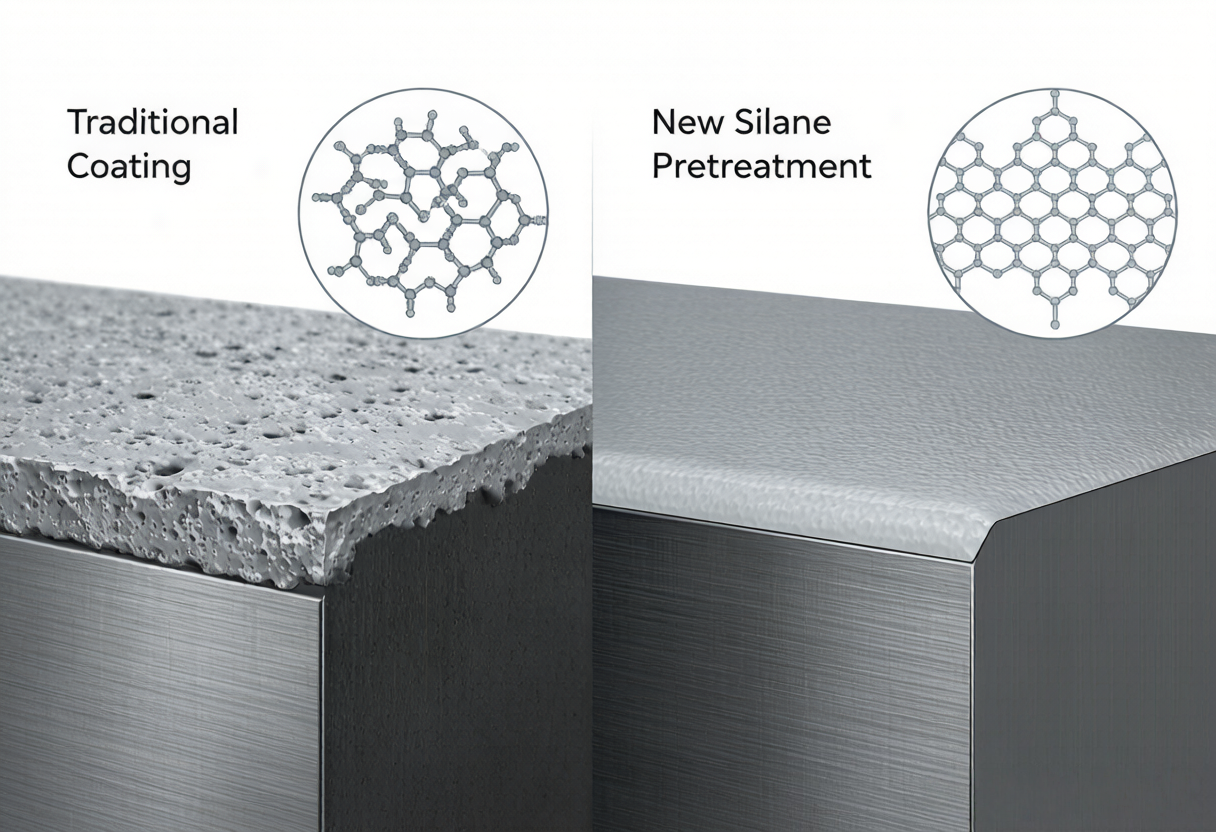
Automotive pre-treatment before painting: comparison between traditional phosphating and new phosphorus-free silane conversion coating process

Before electrophoresis, the steel plate must also undergo a surface conversion treatment—forming an extremely thin “activation film” on the metal surface, which both prevents rust and enhances the adhesion of the electrophoretic paint. For a long time this was the domain of phosphating, but phosphating contains zinc, nickel, and manganese and generates phosphorus-containing wastewater, creating significant environmental pressure. Thus phosphorus-free silane treatment has emerged. This article compares the two.

In a nutshell: Phosphating is a mature but highly polluting “veteran,” while silane is a more environmentally friendly and water-saving “newcomer.” The trend is for silane to gradually replace phosphating, especially in production lines with high environmental requirements.

I. Phosphating Treatment

Phosphating is a process that allows metal to react in an acidic solution to form an insoluble phosphate conversion coating (commonly zinc-based phosphating). The coating is porous, mechanically interlocks well with paint films, and provides excellent corrosion resistance. However, it relies on heavy metal ions, consumes a lot of water, and generates phosphorus-containing sludge.

II. Silane Pretreatment

Silane treatment utilizes organic silanes to form an extremely thin organic-inorganic hybrid film on metal surfaces, containing no heavy metals, phosphorus-free, with less wastewater and shorter process. Although the film is thin, it can significantly improve adhesion and corrosion resistance.
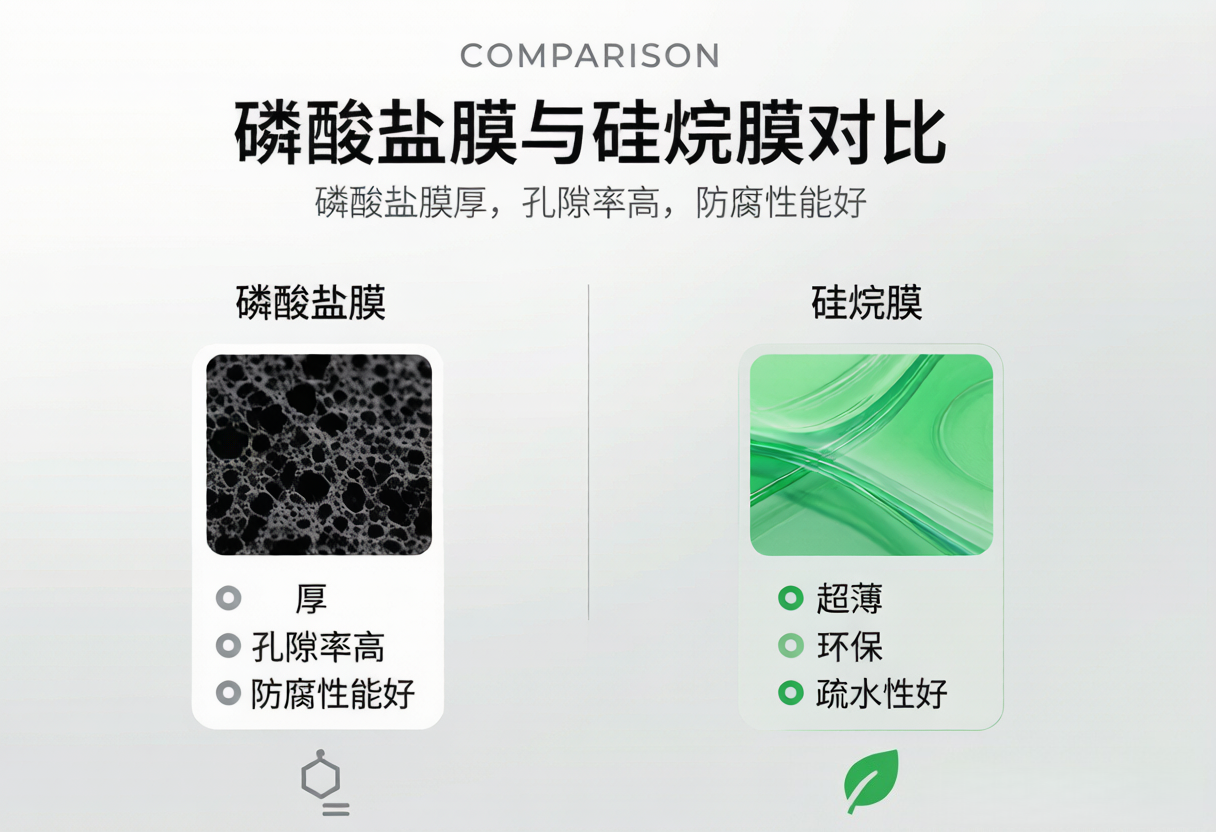
Schematic comparison of the structure and environmental characteristics of phosphate and silane films
Figure: Phosphate film is thick and porous but highly polluting; silane film is extremely thin, phosphorus-free, and environmentally friendly.

III. Comparison Between the Two

Dimension Phosphating Silane
Environmental Contains heavy metals, phosphorus-containing wastewater Phosphorus-free, low pollution
Water/Energy Consumption High Low
Coating Thicker and porous Extremely thin and dense
Maturity Highly mature Rapidly gaining popularity
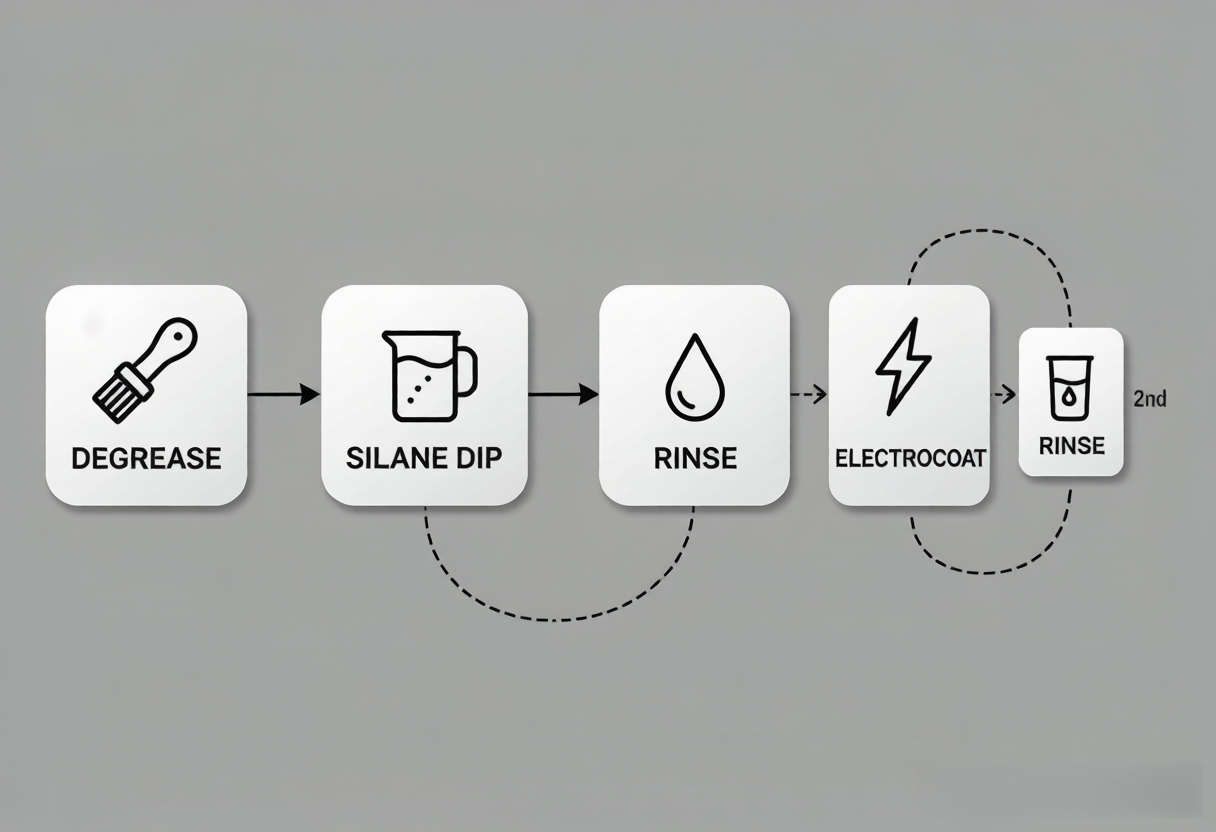
Phosphorus-free silane pretreatment process flow: degreasing — silane immersion — water rinse — electrophoresis schematic
Figure: Silane pretreatment process is shorter — degreasing, silane immersion, water rinse, then electrophoresis.
Selection key points: Prioritize silane for new production lines or when under high environmental pressure; for retrofitting old lines, evaluate compatibility with existing electrophoretic paint. Regardless of which, clean degreasing is a prerequisite.

Summary

Phosphating provides mature and reliable corrosion protection and adhesion with a thick, porous conversion film, but it has heavy metals, contains phosphorus, and high water consumption; silane achieves phosphorus-free, low-pollution, and short process with an extremely thin organic-inorganic film, and is the current eco-friendly alternative trend. Both require thorough degreasing as a prerequisite, and proper compatibility verification should be done according to the electrophoretic paint system.

Frequently Asked Questions (FAQ)

Can silane pretreatment really replace phosphating?
It can already replace phosphating on most passenger vehicle production lines, and is more environmentally friendly, water-saving, and has shorter process steps. The key is to properly conduct compatibility verification with electrophoretic paint, and ensure degreasing and other preceding steps are in place.
Where is the main pollution from phosphating treatment?
Phosphating uses heavy metals such as zinc/nickel/manganese and generates phosphorus-containing wastewater and sludge. High treatment costs and large environmental load are its main shortcomings.
The silane film is so thin, is the corrosion protection sufficient?
Although the silane film is only at the nano-to-submicron level, it can significantly improve the adhesion and corrosion resistance of the subsequent electrophoretic paint. The overall corrosion protection relies on the “silane + electrophoresis” combination, not solely on this film.
Which one to choose for retrofitting an old production line?
It is necessary to evaluate the compatibility of the existing electrophoretic paint with silane, the amount of equipment modification, and the environmental benefits. If the matching is mature and the retrofit is feasible, silane is the better direction; otherwise, maintain phosphating and optimize emission reduction.
Are the degreasing requirements for the two pretreatments the same?
Yes. Whether phosphating or silane, if surface oil is not thoroughly removed, it will lead to uneven conversion film and reduced adhesion. Thorough degreasing is always the top priority.
Kexin New Materials · Automotive Coating Technology Library | This article is technical Q&A content, for reference in selection and construction

{
“@context”: “https://schema.org”,
“@type”: “FAQPage”,
“mainEntity”: [
{“@type”:”Question”,”name”:”Can silane pretreatment really replace phosphating?”,”acceptedAnswer”:{“@type”:”Answer”,”text”:”It can already replace phosphating on most passenger vehicle production lines, and is more environmentally friendly, water-saving, and has shorter process steps. The key is to properly verify compatibility with electrophoretic paint and ensure pre-treatments such as degreasing are adequately performed.”}},
{“@type”:”Question”,”name”:”Where is the main pollution from phosphating treatment?”,”acceptedAnswer”:{“@type”:”Answer”,”text”:”Phosphating uses heavy metals such as zinc/nickel/manganese and generates phosphorus-containing wastewater and sludge. High treatment costs and large environmental load are its main shortcomings.”}},
{“@type”:”Question”,”name”:”The silane film is so thin, is the corrosion protection sufficient?”,”acceptedAnswer”:{“@type”:”Answer”,”text”:”Although the silane film is only at the nano to sub-micron level, it significantly improves the adhesion and corrosion resistance of the subsequent electrophoretic paint. The overall corrosion protection relies on the silane + electrophoresis combination, not solely on this film.”}},
{“@type”:”Question”,”name”:”Which one to choose when retrofitting an old production line?”,”acceptedAnswer”:{“@type”:”Answer”,”text”:”It is necessary to evaluate the compatibility of existing electrophoretic paint with silane, the amount of equipment modification, and the environmental benefits. If the matching is mature and the retrofit is feasible, silane is the better direction; otherwise, maintain phosphating and optimize emission reduction.”}},
{“@type”:”Question”,”name”:”Are the degreasing requirements for the two pretreatments the same?”,”acceptedAnswer”:{“@type”:”Answer”,”text”:”They are the same. Whether phosphating or silane, if surface oil is not thoroughly removed, it will lead to uneven conversion film and reduced adhesion. Thorough degreasing is always the top priority.”}}
]
}