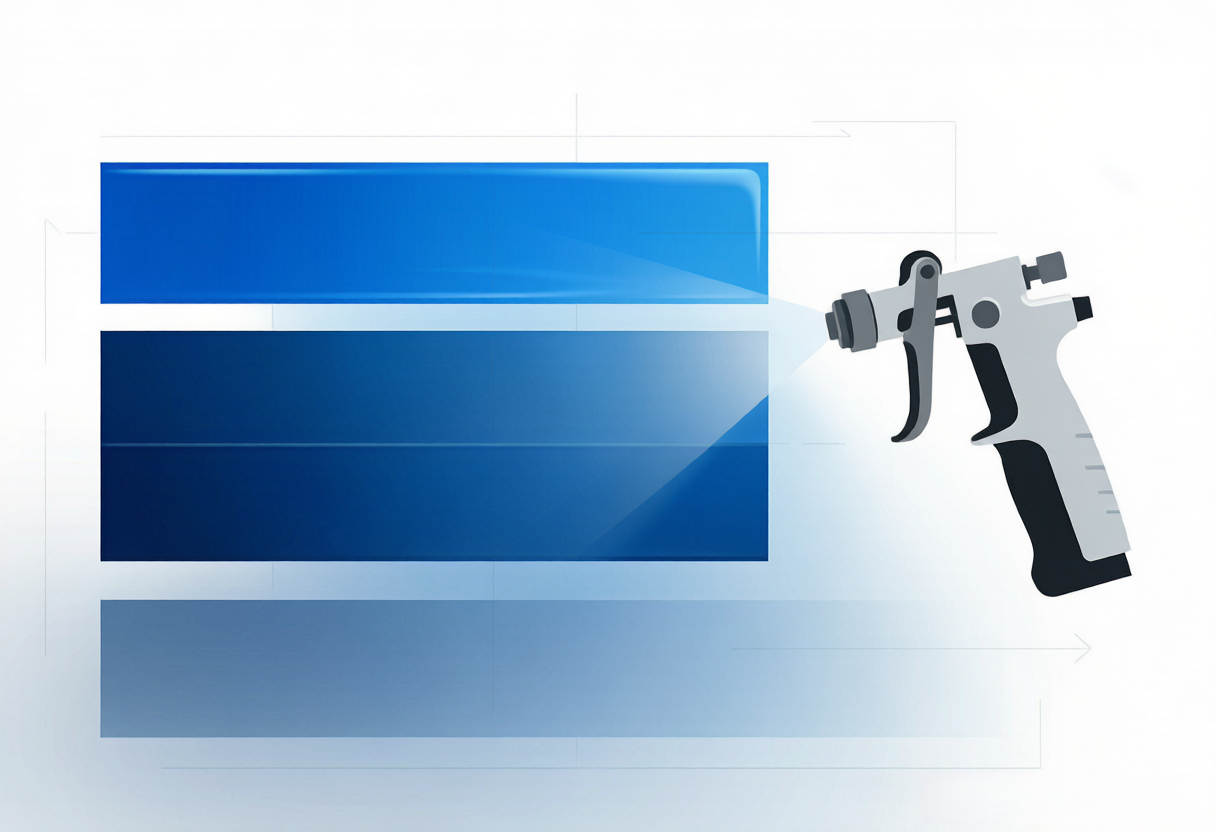
Automotive喷漆StandardApplicationProcess与Spraying技法(湿喷/干喷/雾喷)

2026-07-12 · Category: Technical Knowledge, Paint & Coatings

🌐 This article was automatically translated from Chinese. Please refer to the original Chinese version if needed. · 查看中文原文

.kx-article{max-width:860px;margin:0 auto;background:#ffffff;color:#232a33 !important;
border-radius:16px;padding:32px 30px 40px;box-shadow:0 8px 40px rgba(0,0,0,.25);
font-family:-apple-system,”Segoe UI”,”PingFang SC”,”Microsoft YaHei”,sans-serif;line-height:1.9;font-size:16px}
.kx-article *{box-sizing:border-box}
.kx-article h1,.kx-article h2,.kx-article h3,.kx-article p,.kx-article li,.kx-article td,.kx-article th,.kx-article strong,
.kx-article .summary,.kx-article .summary p,.kx-article .summary strong,
.kx-article .note,.kx-article .note p,.kx-article .kxbox-brand,
.kx-article .related,.kx-article .related li,.kx-article .kx-foot,
.kx-article .kxqa-q,.kx-article .kxqa-a{color:#232a33 !important}
.kx-article h1{font-size:28px;line-height:1.35;font-weight:800;margin:0 0 18px;color:#1a1d21 !important}
.kx-article .lead,.kx-article p{margin:14px 0}
.kx-article .cover{width:100%;border-radius:14px;box-shadow:0 6px 24px rgba(0,0,0,.15);margin:6px 0 26px;display:block}
.kx-article h2{font-size:22px;font-weight:700;margin:40px 0 16px;padding-bottom:10px;border-bottom:2px solid #eceff3;position:relative;color:#1a1d21 !important}
.kx-article h2::before{content:””;position:absolute;left:0;bottom:-2px;width:64px;height:2px;background:#e8720c}
.kx-article h3{font-size:18px;font-weight:700;margin:26px 0 12px;color:#2a2f36 !important}
.kx-article strong{color:#111418 !important;font-weight:700}
.kx-article img.inline{width:100%;border-radius:12px;box-shadow:0 4px 16px rgba(0,0,0,.12);margin:22px 0 8px}
.kx-article figcaption{color:#7a828d !important;font-size:13px;text-align:center;margin:6px 0 24px}
.kx-article table{width:100%;border-collapse:collapse;margin:20px 0;font-size:14.5px;background:#fff;border-radius:10px;overflow:hidden;box-shadow:0 2px 12px rgba(0,0,0,.06);border:1px solid #eceff3}
.kx-article th,.kx-article td{padding:12px 14px;text-align:left;border-bottom:1px solid #eceff3;vertical-align:top}
.kx-article th{background:#2a2f36;color:#ffffff !important;font-weight:600;font-size:14px}
.kx-article tr:last-child td{border-bottom:none}
.kx-article tbody tr:nth-child(even){background:#fafbfc}
.kx-article .note{background:#eef6ff !important;border-left:4px solid #0a67d0;padding:14px 18px;border-radius:0 10px 10px 0;margin:22px 0}
.kx-article .note strong{color:#0a4a97 !important}
.kx-article .kxbox-brand{background:#fff3e8 !important;border-left:4px solid #e8720c;padding:16px 18px;border-radius:0 10px 10px 0;margin:22px 0}
.kx-article .kxbox-brand strong{color:#5a4632 !important}
.kx-article ul{margin:12px 0;padding-left:22px}
.kx-article li{margin:8px 0}
.kx-article .kxqa-item{background:#fbfcfd;border:1px solid #eceff3;border-radius:12px;padding:16px 20px;margin:14px 0}
.kx-article .kxqa-q{font-weight:700;color:#e8720c !important;font-size:16px;margin-bottom:8px}
.kx-article .kxqa-a{color:#3a4048 !important;display:block;margin:0}
.kx-article .related{background:#fff !important;border:1px dashed #e8720c;border-radius:12px;padding:16px 22px;margin:26px 0}
.kx-article .related h3{margin:0 0 6px;color:#e8720c !important}
.kx-article .summary{background:linear-gradient(135deg,#fff3e8,#ffe9d6) !important;border-radius:12px;padding:20px 22px;margin:26px 0}
.kx-article .summary h3{margin:0 0 10px;color:#1a1d21 !important}
.kx-article .kx-foot{margin-top:34px;padding-top:18px;border-top:1px solid #eceff3;text-align:center;color:#8a929d !important;font-size:13px}
.related{margin:30px 0 6px;}
.related h3{font-size:18px;color:#1C1917;margin:0 0 12px;padding-left:10px;border-left:4px solid #F97316;}
.related ul{list-style:none;margin:0;padding:0;}
.related li{margin:0 0 9px;padding-left:16px;position:relative;}
.related li:before{content:”203A”;position:absolute;left:0;color:#F97316;font-weight:700;}
.related a{color:#F97316 !important;text-decoration:underline !important;font-weight:600;}
.related a:hover{color:#EA580C !important;}

.kx-article{max-width:860px;margin:0 auto;background:#ffffff;color:#232a33 !important;
border-radius:16px;padding:32px 30px 40px;box-shadow:0 8px 40px rgba(0,0,0,.25);
font-family:-apple-system,”Segoe UI”,”PingFang SC”,”Microsoft YaHei”,sans-serif;line-height:1.9;font-size:16px}
.kx-article *{box-sizing:border-box}
.kx-article h1,.kx-article h2,.kx-article h3,.kx-article p,.kx-article li,.kx-article td,.kx-article th,.kx-article strong,
.kx-article .summary,.kx-article .summary p,.kx-article .summary strong,
.kx-article .note,.kx-article .note p,.kx-article .kxbox-brand,
.kx-article .related,.kx-article .related li,.kx-article .kx-foot,
.kx-article .kxqa-q,.kx-article .kxqa-a{color:#232a33 !important}
.kx-article h1{font-size:28px;line-height:1.35;font-weight:800;margin:0 0 18px;color:#1a1d21 !important}
.kx-article .lead,.kx-article p{margin:14px 0}
.kx-article .cover{width:100%;border-radius:14px;box-shadow:0 6px 24px rgba(0,0,0,.15);margin:6px 0 26px;display:block}
.kx-article h2{font-size:22px;font-weight:700;margin:40px 0 16px;padding-bottom:10px;border-bottom:2px solid #eceff3;position:relative;color:#1a1d21 !important}
.kx-article h2::before{content:””;position:absolute;left:0;bottom:-2px;width:64px;height:2px;background:#e8720c}
.kx-article h3{font-size:18px;font-weight:700;margin:26px 0 12px;color:#2a2f36 !important}
.kx-article strong{color:#111418 !important;font-weight:700}
.kx-article img.inline{width:100%;border-radius:12px;box-shadow:0 4px 16px rgba(0,0,0,.12);margin:22px 0 8px}
.kx-article figcaption{color:#7a828d !important;font-size:13px;text-align:center;margin:6px 0 24px}
.kx-article table{width:100%;border-collapse:collapse;margin:20px 0;font-size:14.5px;background:#fff;border-radius:10px;overflow:hidden;box-shadow:0 2px 12px rgba(0,0,0,.06);border:1px solid #eceff3}
.kx-article th,.kx-article td{padding:12px 14px;text-align:left;border-bottom:1px solid #eceff3;vertical-align:top}
.kx-article th{background:#2a2f36;color:#ffffff !important;font-weight:600;font-size:14px}
.kx-article tr:last-child td{border-bottom:none}
.kx-article tbody tr:nth-child(even){background:#fafbfc}
.kx-article .note{background:#eef6ff !important;border-left:4px solid #0a67d0;padding:14px 18px;border-radius:0 10px 10px 0;margin:22px 0}
.kx-article .note strong{color:#0a4a97 !important}
.kx-article .kxbox-brand{background:#fff3e8 !important;border-left:4px solid #e8720c;padding:16px 18px;border-radius:0 10px 10px 0;margin:22px 0}
.kx-article .kxbox-brand strong{color:#5a4632 !important}
.kx-article ul{margin:12px 0;padding-left:22px}
.kx-article li{margin:8px 0}
.kx-article .kxqa-item{background:#fbfcfd;border:1px solid #eceff3;border-radius:12px;padding:16px 20px;margin:14px 0}
.kx-article .kxqa-q{font-weight:700;color:#e8720c !important;font-size:16px;margin-bottom:8px}
.kx-article .kxqa-a{color:#3a4048 !important;display:block;margin:0}
.kx-article .related{background:#fff !important;border:1px dashed #e8720c;border-radius:12px;padding:16px 22px;margin:26px 0}
.kx-article .related h3{margin:0 0 6px;color:#e8720c !important}
.kx-article .summary{background:linear-gradient(135deg,#fff3e8,#ffe9d6) !important;border-radius:12px;padding:20px 22px;margin:26px 0}
.kx-article .summary h3{margin:0 0 10px;color:#1a1d21 !important}
.kx-article .kx-foot{margin-top:34px;padding-top:18px;border-top:1px solid #eceff3;text-align:center;color:#8a929d !important;font-size:13px}
.related{margin:30px 0 6px;}
.related h3{font-size:18px;color:#1C1917;margin:0 0 12px;padding-left:10px;border-left:4px solid #F97316;}
.related ul{list-style:none;margin:0;padding:0;}
.related li{margin:0 0 9px;padding-left:16px;position:relative;}
.related li:before{content:”203A”;position:absolute;left:0;color:#F97316;font-weight:700;}
.related a{color:#F97316 !important;text-decoration:underline !important;font-weight:600;}
.related a:hover{color:#EA580C !important;}

Standard Automotive Painting Procedure: Spray Gun Pass, Wet-on-Wet, Dry Spray, and Fog Coat Technique Illustration

Same paint, same spray gun, yet two people’s spraying results are worlds apart — the difference lies in the spraying technique. Whether the gun movement is steady, the atomized flow is even, and the overlap is correct directly determines whether there will be runs, orange peel, missed spots, color difference. This article clearly explains the standard construction process and three core techniques.

In a nutshell: A good paint finish = steady spray gun handling (distance 15–25cm, even speed, 1/2–2/3 overlap) + choosing the right technique (wet coat/dry coat/fog coat); neither can be omitted.

I. Standard Spray Application Process

  • Debugging:Adjust the air pressure, paint output, and fan pattern according to the coating, then do a test spray to check the spray pattern.
  • First pass (mist spray/dusting): A thin layer establishes adhesion and reveals defects.
  • Mid-coat / Basecoat: Apply by “wet-on-wet” or build up layer by layer with flash-off intervals.
  • Clear coat: Final 1–2 passes of actual spraying to ensure gloss and thickness.

II. Three Core Techniques

Technique Characteristics Application
Wet spray High paint output, close distance, thick film Solid color topcoat, clear coat
Dry spray Low paint output, relatively dry, strong texture Blending, color difference repair
Mist spray (dusting) Extremely thin, scattered, only wets First pass, blend feathering
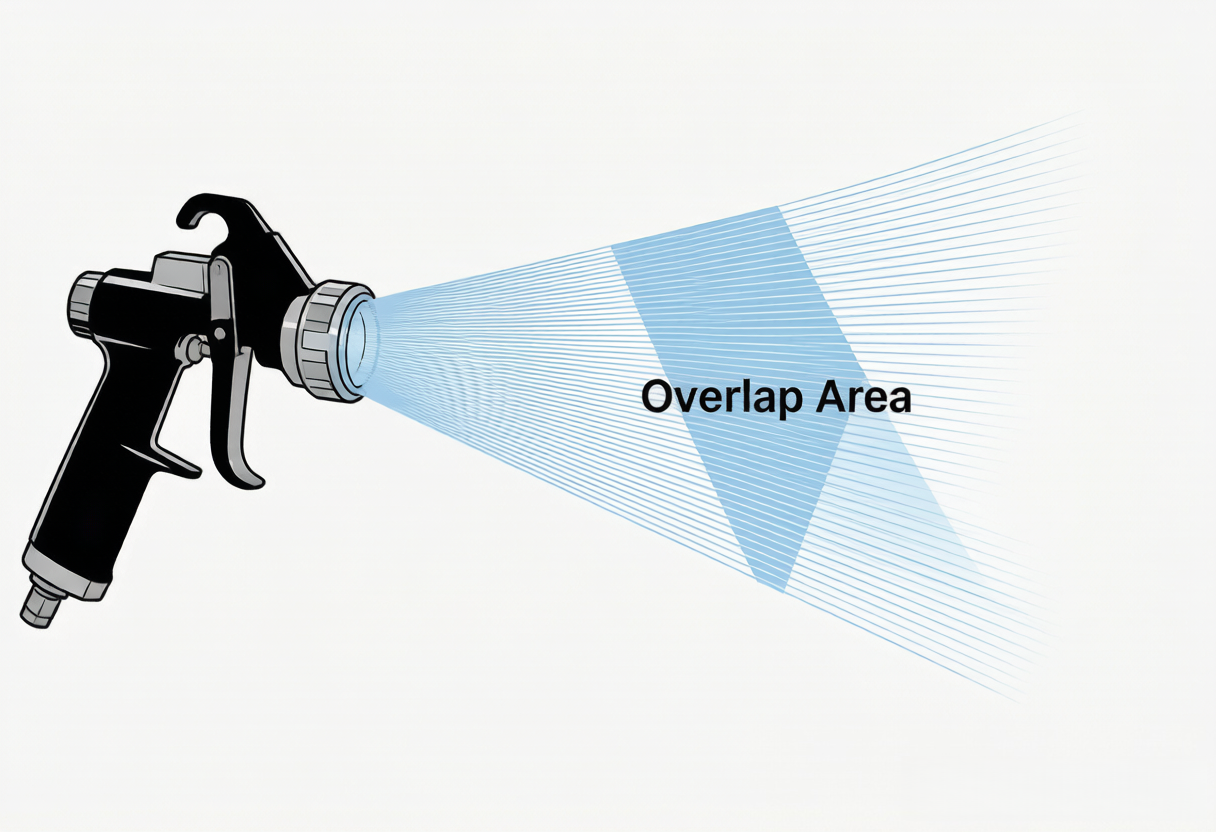
Spray gun fan pattern and pass overlap rate illustration: 1/2 to 2/3 overlap to avoid missed spots
Figure: Spray gun fan pattern — keep 1/2–2/3 overlap between passes to avoid missed spots and lap marks.

III. Three Key Elements of Spray Gun Movement

  • Distance: Generally 15–25 cm; too close causes sagging, too far causes dry spray and roughness.
  • Speed: Move at a constant speed, approximately 30–60 cm/s, avoid speeding up and slowing down abruptly.
  • Overlap: Adjacent two courses overlap by 1/2–2/3 to ensure uniformity.
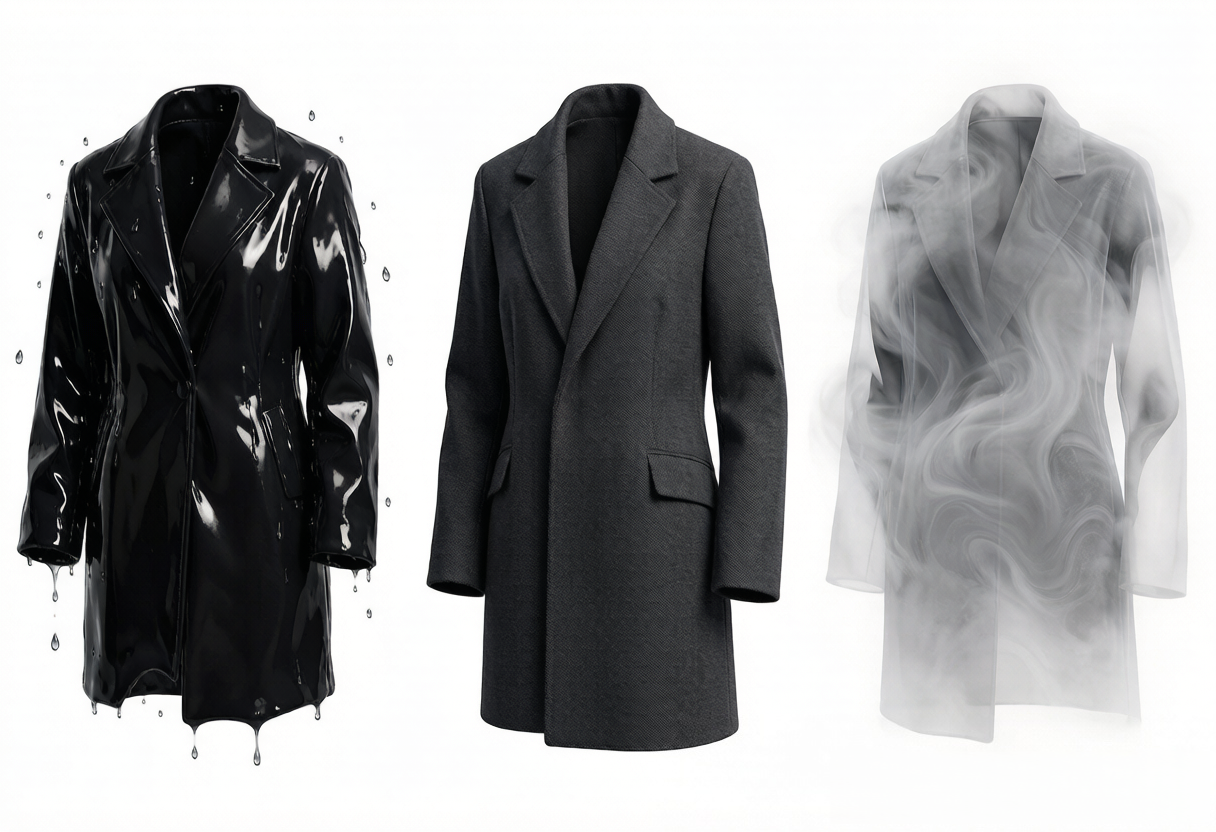
Comparison of paint surface effects of wet spray, dry spray, and fog spray techniques
Fig: Effect differences of wet spray (thick and glossy), dry spray (strong texture), and fog spray (very thin transition).
Application key points: Always keep the spray gun aligned vertically and perpendicular to the surface; move the wrist at a constant speed, do not swing with the arm; allow sufficient flash-off time between coats to avoid solvent trapped causing orange peel/pinholes.

Summary

Spray quality is jointly determined by process + technique + gun movement: first adjust the spray pattern, use fog spraying for the base, and wet spraying for the actual topcoat and clearcoat; keep the gun at a distance of 15–25cm, move at a constant speed, with 1/2–2/3 overlap. Choosing the right wet spray/dry spray/fog spray and allowing sufficient flash-off time will help you avoid sagging, orange peel, and lap marks.

Frequently Asked Questions (FAQ)

What is the appropriate spray gun distance?
Generally 15–25 cm. Too close results in excessive paint and easy sagging, as well as solvent streaks; too far and the atomized droplets dry before reaching the surface, forming a dry-spray rough finish. Follow the interval recommended by the coating and spray gun parameters.
How to distinguish and use wet spraying and dry spraying?
Wet spraying emits more paint and is done at a closer distance, used for solid color topcoats and clear coat full spraying; dry spraying emits less paint and is relatively dry with stronger texture, used for local blending and color difference repair. Fog spraying (dusting) only slightly wets the surface very thinly, used for priming and feathering.
What is the best overlap rate for gun passes?
Overlapping adjacent passes by 1/2–2/3 is most common, which avoids missed spots and obvious lap marks (banding). Insufficient overlap causes streaking, while excessive overlap leads to locally excessive thickness.
Why does orange peel occur?
Common causes include high coating viscosity, low or high air pressure, insufficient leveling time, and mismatch in thinner evaporation rate. Adjusting parameters and ensuring flash-off and leveling will improve it.
How long to wait between coats?
Depends on the coating type and ambient temperature and humidity, based on “touch-dry / dust-free” (usually a few minutes). Insufficient flash-off causes solvent retention, leading to orange peel and pinholes; excessive flash-off reduces intercoat adhesion.
Kexin New Materials · Automotive Coating Technology Library | This article is technical Q&A content, for reference in selection and application

{
“@context”: “https://schema.org”,
“@type”: “FAQPage”,
“mainEntity”: [
{“@type”:”Question”,”name”:”What is the appropriate spray gun distance?”,”acceptedAnswer”:{“@type”:”Answer”,”text”:”Generally 15–25 cm. Too close results in excessive paint and easy sagging, as well as solvent streaks; too far and the atomized droplets dry before reaching the surface, forming a dry-spray rough finish. Follow the interval recommended for the coating and spray gun parameters.”}},
{“@type”:”Question”,”name”:”How to distinguish and use wet spraying and dry spraying?”,”acceptedAnswer”:{“@type”:”Answer”,”text”:”Wet spraying uses more paint and a closer distance, used for solid color topcoats and clear coat full spraying; dry spraying uses less, drier paint with stronger texture, used for local blending and color difference repair. Fog spraying (dusting) only slightly wets the surface very thinly, used for priming and feathering.”}},
{“@type”:”Question”,”name”:”What is the best overlap rate for gun passes?”,”acceptedAnswer”:{“@type”:”Answer”,”text”:”Overlapping adjacent passes by 1/2–2/3 is most common, which avoids missed spots and obvious lap marks (banding). Insufficient overlap causes streaks, while excessive overlap leads to locally excessive thickness.”}},
{“@type”:”Question”,”name”:”Why does orange peel occur?”,”acceptedAnswer”:{“@type”:”Answer”,”text”:”Common causes include high coating viscosity, low or high air pressure, insufficient leveling time, and mismatch in thinner evaporation rate. Adjust parameters and ensure flash-off and leveling to improve it.”}},
{“@type”:”Question”,”name”:”How long to wait between coats?”,”acceptedAnswer”:{“@type”:”Answer”,”text”:”Depends on coating type and ambient temperature/humidity, based on tack-free / non-dust-picking (usually a few minutes). Insufficient flash-off traps solvent, causing orange peel and pinholes; excessive flash-off reduces intercoat adhesion.”}}
]
}