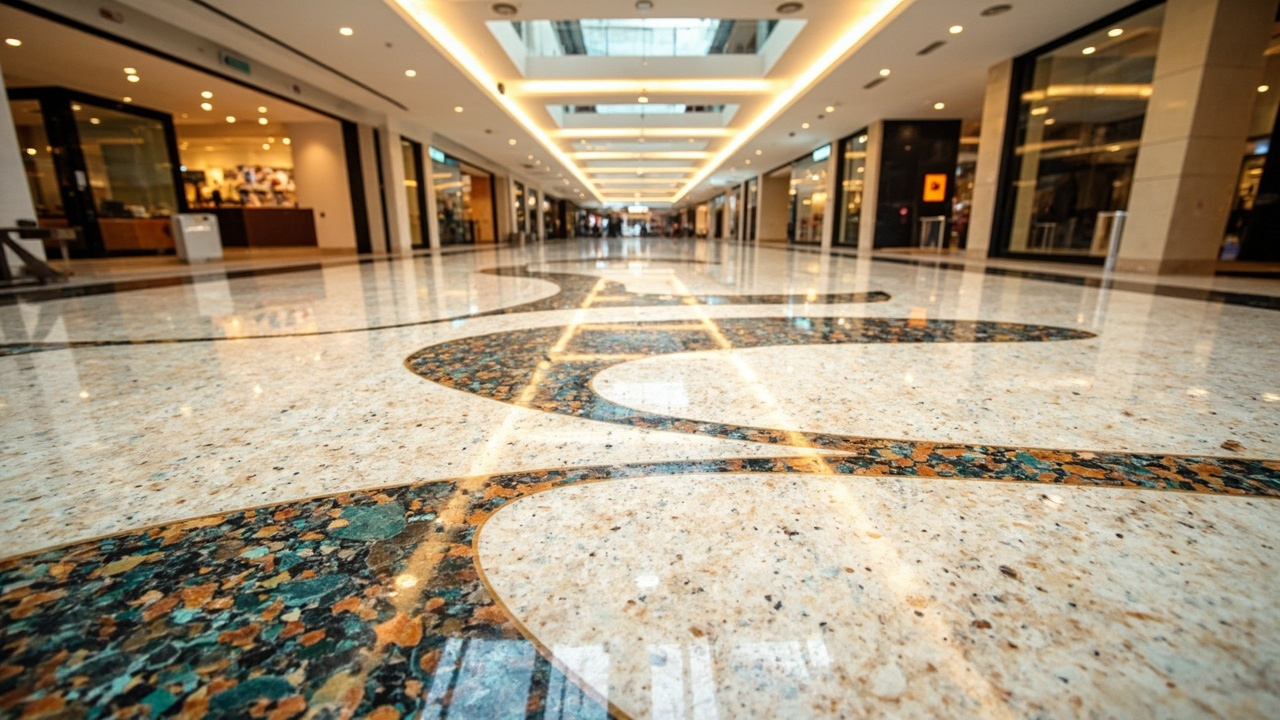
Walking into a modern airport terminal or a high-end shopping mall, the seamless floor underfoot with flowing colors and a glossy, mirror-like finish is very likely an epoxy terrazzo floor. It combines the artistic texture of traditional terrazzo with the high performance of epoxy resin, capable of withstanding the daily trampling of tens of thousands of people in places like airports and subway stations, while also being able to spell out brand logos, wayfinding patterns, and even abstract art. For high-end venues that demand both "durability" and "aesthetics", epoxy terrazzo is almost the most mainstream flooring solution at present.
I. What is Epoxy Terrazzo Flooring
Epoxy terrazzo (Epoxy Terrazzo) is a high-end seamless floor made by using epoxy resin as the binder, mixing and paving natural stones (quartz, basalt, shells, glass fragments, etc.), metal strips, and colored aggregates according to a designed ratio, and then grinding and polishing step by step after curing. Compared with cement-based terrazzo with a history of over a hundred years, the epoxy matrix brings higher strength, thinner thickness, and richer color expression. Its core advantages can be summarized in four points:
- Seamless overall: Paved and formed in one shot on site, with no joints except for necessary dividing strips, fundamentally preventing dirt accumulation and making cleaning and maintenance extremely convenient.
- Super wear-resistant: The high-hardness matrix of epoxy resin plus high-strength stone aggregates give a surface hardness of 4–6H, with wear resistance far exceeding ordinary epoxy floor coating and cement self-leveling.
- Chemical corrosion resistance: Resistant to acid, alkali, and oil, suitable for places with requirements for floor corrosion resistance such as food, pharmaceutical, and chemical industries.
- Strong decorativeness: The color, particle size of aggregates, and direction of dividing strips can be freely designed to achieve highly customized artistic effects such as gradients, parquet, and inlaid characters.
II. Comparison with Traditional Flooring Materials
Different flooring materials vary significantly in wear resistance, decoration, and cost, and selection should weigh the use scenario:
| Comparison Item | Epoxy Terrazzo | Ordinary Epoxy Floor | Cement-based Self-leveling |
|---|---|---|---|
| Wear Resistance | ★★★★★ | ★★★★ | ★★ |
| Decorativeness | ★★★★★ (can do parquet and inlay) | ★★ | ★ |
| Seamlessness | ★★★★★ | ★★★★ | ★★ |
| Service Life | 15–30 years | 5–10 years | 3–8 years |
| Comprehensive Cost | Relatively high | Medium | Relatively low |
| Applicable Scenarios | High-end commercial, airport, medical | Industrial plant, workshop | Ordinary office, residential |
III. Typical Application Scenarios
- Commercial Complexes and Transportation Hubs: Shopping malls, hotel lobbies, airport terminals, high-speed rail stations, balancing high foot-traffic tolerance and brand image display, are the most typical stage for epoxy terrazzo.
- Industrial and Warehouse Plants: Heavy-load workshops, automated warehouses, forklift aisles, requiring floors that are both wear-pressure resistant and easy to mark for management.
- Medical and Clean Places: Operating rooms, ICUs, clean workshops, the seamless, disinfectant-resistant, and easy-to-clean characteristics of epoxy terrazzo meet strict hygiene standards.
- Cultural, Sports and Educational Venues: Museums, exhibition halls, libraries, university halls, pursuing the dual goals of high decorativeness and long-term durability.
IV. Full Construction Process
The final quality of epoxy terrazzo relies 70% on materials and 30% on craftsmanship; a standardized construction process is crucial:
- Substrate Treatment: Concrete substrate strength should be above C25, moisture content below 8%; use a grinder to create sufficient roughness and thoroughly clean dust to ensure subsequent adhesion.
- Primer Sealing: Apply epoxy penetrating primer to infiltrate concrete capillaries, enhancing adhesion and sealing moisture return channels from the substrate.
- Dividing and Strip Inlay: Lay copper or aluminum dividing strips according to the design drawing, which controls thermal expansion cracks and serves as the skeleton of parquet patterns.
- Aggregate Paving: Thoroughly mix epoxy resin and colored aggregates by ratio, then pave and level, controlling uniform thickness; typical finished thickness is 5–10mm.
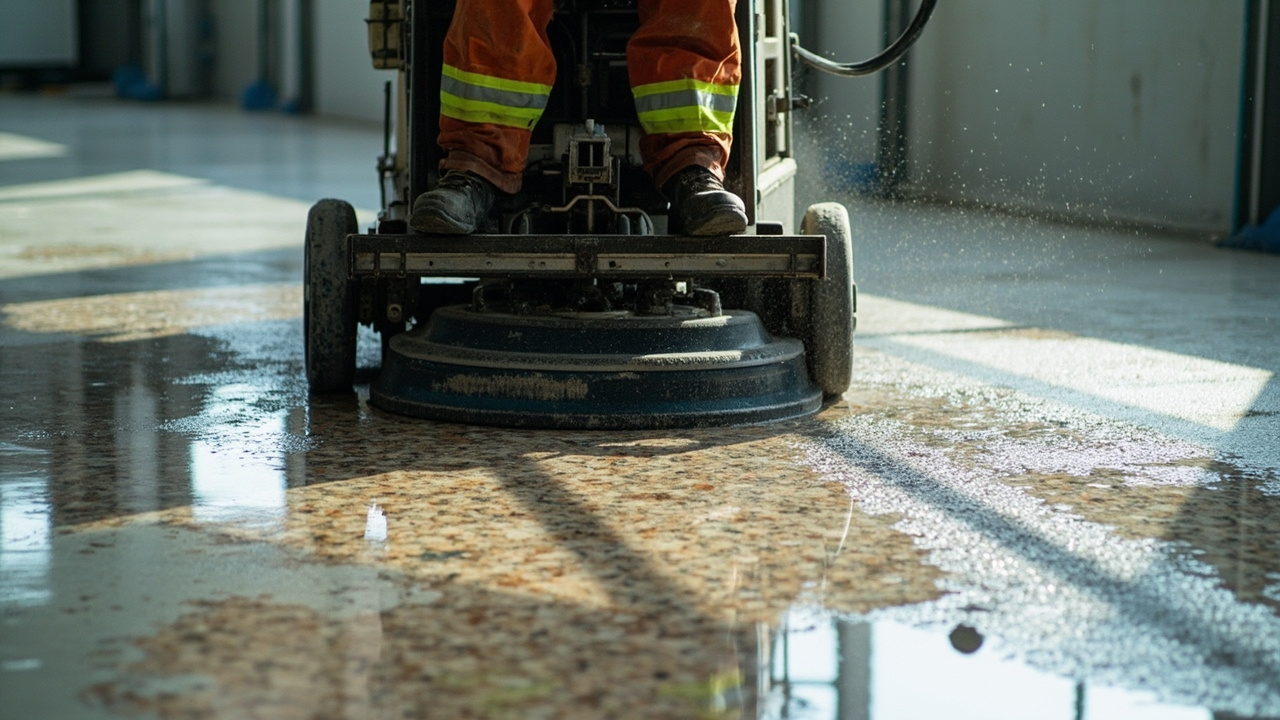
- Coarse to Fine Grinding: After 24–48 hours of curing, sequentially grind with 50 to 3000 grit pads to reveal stone cross-sections and gradually improve flatness and gloss.
- Slurry Repair and Polishing: Micro-pores from grinding are filled with same-color epoxy slurry, finally mirror-polished with polishing liquid for high-gloss or matte effect.
- Curing and Glazing: Apply crystalline surface protector to delay wear; perform periodic daily maintenance polishing after handover.
V. Selection and Maintenance Key Points
- Aggregate Choice Determines Grade: For high-end effects, choose imported marble, glass, or shell aggregates; industrial sites mainly use economical and wear-resistant quartz sand.
- Thickness Matches Load: 5–8mm is sufficient for ordinary commercial spaces; heavy-load industrial areas recommend 8–10mm or above.
- Control Construction Environment: Construction temperature should be 10–30℃; excessive humidity affects epoxy curing and final gloss.
- Daily Maintenance: Daily mopping with neutral cleaner is enough, avoid strong acids and alkalis; annual crystalline treatment keeps mirror gloss long-term.
VI. Common Construction Quality Issues and Prevention
Epoxy terrazzo is a typical "on-site manufactured" product, with final effect highly dependent on construction control. The following common quality defects can be mostly avoided with early prevention during the process:
- Bubbles and Pinholes: Mostly caused by substrate moisture return, air entrainment during mixing, or too-fast paving. Prevention: strictly control substrate moisture, use low-speed thorough deaeration mixing, and use defoaming roller to release air.
- Color Difference and Mottling: Different batches of aggregates or inconsistent resin ratios cause color difference. Prepare sufficient same-batch materials at once, strictly weigh by ratio, and construct continuously in same area to avoid joints.
- Grinding Marks and Uneven Gloss: Skipping grit levels or insufficient polishing leaves marks. Must grind step by step without skipping, finally use high-grit pads and polishing liquid for mirror treatment.
- Hollow and Cracking: Main causes are insufficient base strength, no dividing strips, or excessive moisture. Test base strength before construction, reasonably arrange copper strip divisions to absorb deformation stress.
- Edge Fall-off: Corners like wall feet and column roots easily fall off if not properly treated. These details should strengthen primer sealing and do fillet transition.
VII. Cost Composition and Return on Investment
The initial cost of epoxy terrazzo is higher than ordinary flooring, but it is often more economical from a full life-cycle view. Its cost is mainly determined by aggregate grade, thickness, pattern complexity, and grinding process: high-end aggregates like imported marble, glass, and shells are pricey, and parquet inlay designs and dividing strips also increase labor. However, the 15–30 year service life of epoxy terrazzo far exceeds the 5–10 years of ordinary epoxy floor coating and 3–8 years of cement self-leveling, with almost no renovation needed, only routine crystalline maintenance to keep mirror effect long-term.
For places like airports, malls, and hospitals that operate long-term with extremely high renovation shutdown costs, the "one-time investment, long-term maintenance-free" feature significantly reduces full life-cycle cost, while seamless, easy-clean, high-decorative properties also bring hidden returns in hygiene and brand value. This is the fundamental reason high-end venues are willing to pay for epoxy terrazzo.
VIII. Frequently Asked Questions (FAQ)
Q: What is the difference between epoxy terrazzo and terrazzo? Traditional terrazzo uses cement as binder, heavy and prone to cracking, with grayish dim color; epoxy terrazzo uses epoxy resin as binder, thinner, harder, more vivid color, seamless overall, and stronger chemical resistance.
Q: Will epoxy terrazzo crack? As long as substrate treatment is in place and dividing strips are reasonably set to absorb deformation, it is not prone to cracking under normal use. Base hollowing or excessive moisture are main triggers, must be strictly controlled before construction.
Q: Can locally worn or chipped floor be repaired? Yes. Epoxy terrazzo is an integral material; local damage can achieve "invisible repair" by refilling aggregate slurry and local grinding polishing, which is also a key advantage over tiled floors.