Core Conclusion:
1. The essence of corrosion of automotive clearcoat by acid rain (pH<5.6) is H⁺-catalyzed hydrolytic cleavage of ester and ether bonds in the clearcoat resin—nano anti-acid-rain clearcoats achieve chemical inertization by replacing hydrolysis-sensitive bonds with -Si-O-Si- crosslinked bonds.
2. Nano SiO₂/TiO₂ particles (5-20nm) form a dual protection of "free volume filling + UV absorption" in the clearcoat matrix—reducing the water vapor transmission rate of the coating by 50-70%, while absorbing/reflecting 95%+ of UV radiation to protect the underlying basecoat.
3. BASF iGloss nano-hybrid clearcoat represents the state-of-the-art technology level of OEM factory paint—achieving the optimal balance of comprehensive performance through nano-hybridization of 90-95% organic (flexibility/weather resistance) + 5-10% inorganic (hardness/scratch resistance).
In southern China and industrial-intensive areas, acid rain (pH as low as 3.5–4.5) poses a severely underestimated long-term threat of corrosive damage to automotive paint surfaces. The H₂SO₄, HNO₃, and organic acids (formic acid, acetic acid) contained in acid rain increase sharply in concentration after water droplets on the paint surface evaporate—a single drop of pH 4.0 acid rain, once completely evaporated, can leave residual acid liquid with a local pH below 1.0—sufficient to form irreversible ring-shaped etching (acid rain etching) on the clear coat surface within hours. High-Gloss Anti-Acid-Rain Nano Full-Body Topcoat reconstructs the coating's hydrolytic resistance and density from the crosslinking chemical foundation of the clear coat resin.
Acid rain corrosion chemistry—why does clearcoat get "eaten" by acid?
Direct answer: The mainstream crosslinking system for traditional automotive clearcoats (OEM factory and refinish paints) is the melamine-acrylic (amino resin-acrylic) system—the hydroxymethyl groups (-CH₂OH) of the melamine resin condense with the hydroxyl groups (-OH) of the acrylic resin to form ether bond crosslinks (-C-O-C-). These ether bonds are highly susceptible to hydrolytic cleavage under acid catalysis: -C-O-C- + H₂O →(H⁺)→ -C-OH + HO-C-—the crosslinking network of the coating is "cut," manifesting macroscopically as loss of gloss, hazing, and irreversible etching marks.
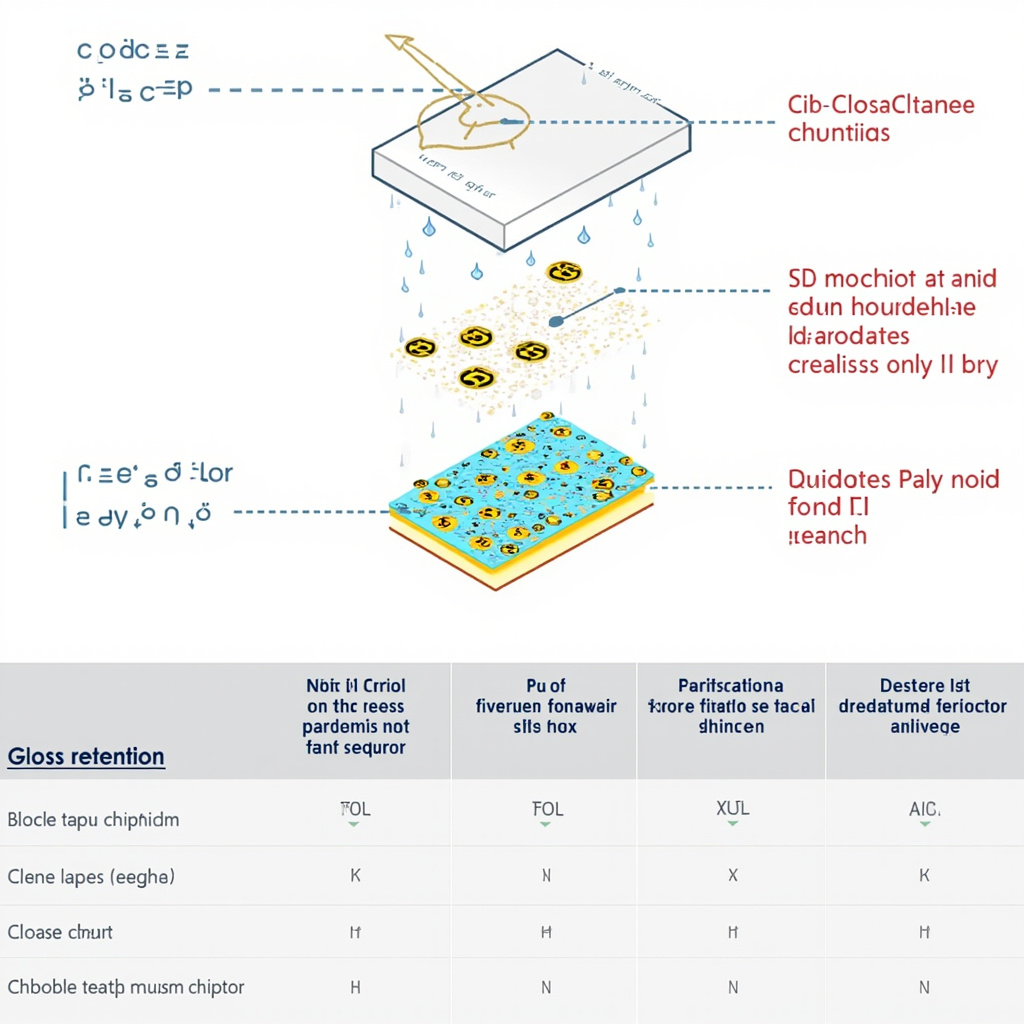
Mechanism Explained — The Formation Process of Acid Rain Etching.The formation of acid rain etching is divided into three stages: (1) Acid Enrichment — raindrops spread into a film on the paint surface (contact angle typically <80°), and after water evaporation the concentration of acidic substances is enriched by 10–100 times; (2) Acid-Catalyzed Hydrolysis — H⁺ in the concentrated acid catalyzes the hydrolysis and cleavage of ether crosslinks in the clear coat and acrylate side chains, reducing crosslink density and causing local softening and swelling of the paint; (3) Drying Shrinkage — water continues to evaporate until completely dry, and the softened area shrinks under surface tension to form ring-shaped depressions — the visible "acid rain spots" or "water stain marks". Once formed, polishing alone may remove 2–5 μm of clear coat (about 5–15% of total clear coat thickness).
Data Support:Data from the China National Environmental Monitoring Center in 2025 shows that approximately 28% of cities nationwide had an annual average precipitation pH below 5.6, and more than 15 cities in South China and East China had acid rain frequencies exceeding 40%. In a typical acid rain event (rainfall 10mm, pH 4.0, lasting 4 hours), visible etching spots can appear on unprotected paint surfaces within 24 hours at an ambient temperature of 40°C.
Source: China National Environmental Monitoring Center 2025 Annual Report, EP0484540A1 Patent Specification, BASF iGloss Technical White Paper
Nano-densification protection — a triple-mechanism acid-resistant defense
Mechanism 1: Chemical passivation of Si-O-Si crosslink bonds.European Patent EP0484540A1 proposes a hybrid crosslinking system of alkoxysilane-modified acrylic resin + amino resin—by introducing -Si(OR)₃-functionalized acrylic monomers, the -Si(OR)₃ hydrolyzes and condenses during curing to form -Si-O-Si- crosslinking points. Unlike traditional -C-O-C- ether bond crosslinks, the bond energy of the Si-O-Si bond (about 452 kJ/mol) is much higher than that of the C-O bond (about 358 kJ/mol), and the Si-O-Si bond does not undergo hydrolysis under acidic conditions (in fact, hydrolysis of the Si-O-Si bond requires alkaline or F⁻-containing catalysis). This enables the coating to show no change whatsoever in a 40% H₂SO₄/50°C/5-hour immersion test.
Mechanism 2: Free volume filling and barrier enhancement by nano-SiO₂ particles.Organic polymer coatings contain a large number of "free volume holes" at the microscopic scale—gaps between polymer chain segments, with diameters of approximately 0.5-2 nm. Water molecules (kinetic diameter ~0.27 nm) and H₃O⁺ ions can diffuse through these holes within the coating. Nano-SiO₂ particles (5-20 nm) fill these free volume holes and form a physical barrier network within the coating, reducing the water vapor transmission rate (WVTR) by 50-70%. Experimental data show that an acrylic varnish with 10 wt% nano-SiO₂ (particle size 15 nm) exhibits a WVTR decrease from approximately 25 g/m²/day to about 9 g/m²/day under 40°C/90% RH conditions.
Mechanism 3: UV shielding and free radical quenching by nano-TiO₂/ZnO. Ultraviolet light is an "accomplice" of acid rain etching—UV radiation generates free radicals that attack the C-H and C-C bonds of the clearcoat resin, causing microcracks and polar groups (such as -COOH, -OH) on the coating surface, which increases surface hydrophilicity and acid wettability. Nano-TiO₂ (rutile type, particle size 10-30 nm) and nano-ZnO (particle size 20-50 nm) are efficient UV shielding agents—the band gap of TiO₂ is about 3.0-3.2 eV, which can absorb ultraviolet light with wavelength <390 nm; the band gap of ZnO is about 3.3 eV, absorbing ultraviolet light with wavelength <375 nm. At the same time, nano-CeO₂ and hindered amine light stabilizers (HALS) synergistically quench the free radicals generated by photo-oxidation, blocking the free radical chain degradation reaction.
Data support:BASF iGloss——currently the only nano-hybrid clearcoat in the world to achieve OEM mass production (3-wet integrated painting process)——through a nanoscale hybrid structure of 90-95% organic components (acrylic/amino resins, providing flexibility, weather resistance, and leveling) + 5-10% inorganic components (nano-SiO₂ clusters, providing hardness and scratch resistance), has achieved over 25% improvement in scratch resistance (Amtec-Kistler car wash simulation), 90% instant reflow recovery (scratch reflow at 60°C) on models such as Mercedes-Benz and BMW, while maintaining acid rain resistance comparable to conventional clearcoats. Nanovere Technologies' Nano-Clear® product adopts proprietary 3D nano-structured polymer technology, achieving >10 years of paint life extension and excellent acid rain resistance through extremely high crosslink density, and has passed 4,000 hours of QUV accelerated weathering testing (equivalent to 20 years of Florida exposure).
Source:EP0484540A1, BASF iGloss Technical Press Release, Nanovere Nano-Clear® Technical Data, QUV ASTM G154
Frequently Asked Questions
What is the difference between anti-acid rain nano clear coat and ordinary ceramic coating?
Ceramic coating applies an additional SiO₂ protective layer (2-10 μm) on top of the clearcoat, belonging to aftermarket external protection. Nano acid-rain-resistant clearcoat integrates nanoparticles within the clearcoat formulation itself, belonging to OEM original or professional refinish paint systems. The acid-rain resistance service life of the former depends on the integrity of the applied layer (1-5 years), while the latter is a clearcoat that inherently possesses acid resistance.
Can acid rain spots that have already formed be repaired?
Light etching (depth 3 μm) requires wet sanding + multi-stage polishing + clearcoat re-spray—the damage has penetrated most of the clearcoat thickness, and further polishing risks burning through the clearcoat and exposing the basecoat.
How can you tell if your car paint has been damaged by acid rain?
Observe the paint surface from the side in sunlight—light-colored vehicles show ring-shaped dark spots, while dark-colored vehicles show iridescent ring-shaped marks. The surface feels rough like sandpaper to the touch. Simple test method: place a drop of pH test solution on the suspect area of the paint; if the local pH is below 5.0 and bubbles form, it indicates acid etching damage has occurred.
Will nano acid-rain-resistant clearcoat affect color and gloss?
No. The refractive index of nano-SiO₂ particles (1.46) is very close to that of the varnish acrylic resin (1.48–1.50), so no significant scattering occurs—Distinctness of Image (DOI) can be maintained above 90. In fact, after nano-particles fill the microscopic defects on the coating surface, DOI and 20° gloss usually increase slightly (by 2–5 units).
How durable is the acid rain resistant coating?
The expected lifespan of nano anti-acid-rain clearcoat is comparable to that of the clearcoat itself—OEM factory nano clearcoat 10–15 years, professional refinish paint 5–8 years. Acid resistance does not degrade over time like aftermarket ceramic coatings—because the protective function comes from the chemical structure of the clearcoat itself, not the integrity of an applied layer.
Reference sources:EP0484540A1, BASF iGloss Technical Data, Nanovere Nano-Clear®, QUV ASTM G154, China National Environmental Monitoring Center 2025, Progress in Organic Coatings
Publish Date: July 6, 2026 | Category: Technical Knowledge