Nano ceramic automotive paint coating (often called "ceramic coating" "ceramic layer") is one of the fastest-growing technology routes in the field of automotive paint surface protection in recent years. Its core selling points can be summarized in three words: hard, hydrophobic, durable. But on the market, terms like "9H" "superhydrophobic" "no degradation for five years" are rampant, and ordinary car owners and coating practitioners often find it hard to distinguish which are real performance indicators and which are marketing rhetoric. As a material system supplier, Kexin New Materials (kexinMaterials) has long-term accumulation in formulations and testing of SiO₂-based nano ceramic materials and automotive protective coatings. This article will systematically break down the real technical foundation of nano ceramic automotive paint coatings from four dimensions: material chemistry, mechanical properties, wetting behavior, and application boundaries, and try to mark verifiable sources or testing standards (such as GB/T 6739, ASTM D7334, ISO 19403 series) for each key parameter, to help you build a practical selection judgment framework.
I. What is SiO₂-based nano ceramic automotive paint coating
The so-called "nano ceramic automotive paint coating" is a class of liquid protective layer with silane/siloxane precursors as the main film-forming substance, which forms an inorganic-organic hybrid thin film with a thickness from nano to micron level (about 80 nm–3 µm) on the automotive clear coat after curing. Its "ceramic" attribute comes from the fact that the main chemical skeleton of the cured film is Si–O–Si (siloxane network), which belongs to the same silicon dioxide (SiO₂) chemical family as natural quartz and glass, thus possessing hardness, heat resistance, and chemical inertness close to ceramic. However, it is not a rigid ceramic sintered in a kiln, but a flexible ceramic-organic hybrid layer cured at room or low temperature.
From the perspective of material definition, one of the key features of nano coatings is that at least one dimension of the functional phase is at the 1–100 nm scale. In automotive ceramic coatings, this "nano" source is usually:
- Nano-scale SiO₂ particles (common particle sizes reported in literature are about 5–50 nm, according to automotive detailing and materials research reviews);
- Or the nano-scale SiO₂ network generated after sol-gel reaction of silane precursors;
- Some high-end formulations compound graphene, nano TiO₂ and other additive phases to enhance thermal conductivity, self-cleaning, or antibacterial properties.
It needs to be emphasized that nano particle size itself is not a performance guarantee. Nano particles have extremely high surface energy and are very prone to agglomeration. If the dispersion is unstable, the coating will show uneven film thickness, increased haze, and attenuation of hardness and hydrophobicity. Therefore, what really determines the product grade is the precursor purity, sol stability, crosslink density, and application process, rather than the word "nano" on the package.
II. SiO₂ sol-gel film-forming mechanism: from liquid to glassy network
The mainstream chemical route of nano ceramic coatings is the sol-gel method. Referring to the classic textbook "Sol-Gel Science" by Brinker and Scherer and a large number of organic coating studies, its reaction can be summarized as two steps: hydrolysis and condensation:
1. Hydrolysis: silane precursor (such as alkoxysilane Si–OR) reacts with surface or environmental moisture, converting the alkoxy group into silanol:
Si–OR + H₂O → Si–OH + ROH
2. Condensation (crosslinking): adjacent silanols further react, eliminating water or alcohol, forming the Si–O–Si main chain, which is the source of hardness and chemical resistance:
Si–OH + HO–Si → Si–O–Si + H₂O
3. Aging and densification: within hours to days, residual silanols continue to react, crosslink density increases, and the film gradually "ceramizes" and hardens. The final product is a transparent, glassy thin film with Si–O–Si as the skeleton. Depending on the precursor, the film may retain organic side groups (such as methyl) that contribute to hydrophobicity and flexibility.
This mechanism leads to two important conclusions:
- Hardness comes from crosslink density, not simply "SiO₂ content". The denser the film and the more sufficient the crosslinking, the higher the pencil hardness, but this is also constrained by the hardness of the substrate (clear coat).
- Hydrophobicity comes from low-surface-energy chemistry + micro-roughness. The pure SiO₂ network itself is hydrophilic; the real high contact angle comes from organic hydrophobic side groups (such as methyl), surface fluorination modification, and the Cassie-Baxter state jointly acting with nano-rough structures (see another article "Hydrophobic Angle and Roll-off Angle of Nano Coatings").
III. Hardness: what does pencil hardness "9H" really mean
Almost all automotive ceramic coatings are labeled "9H hardness", but this statement needs rigorous dissection.
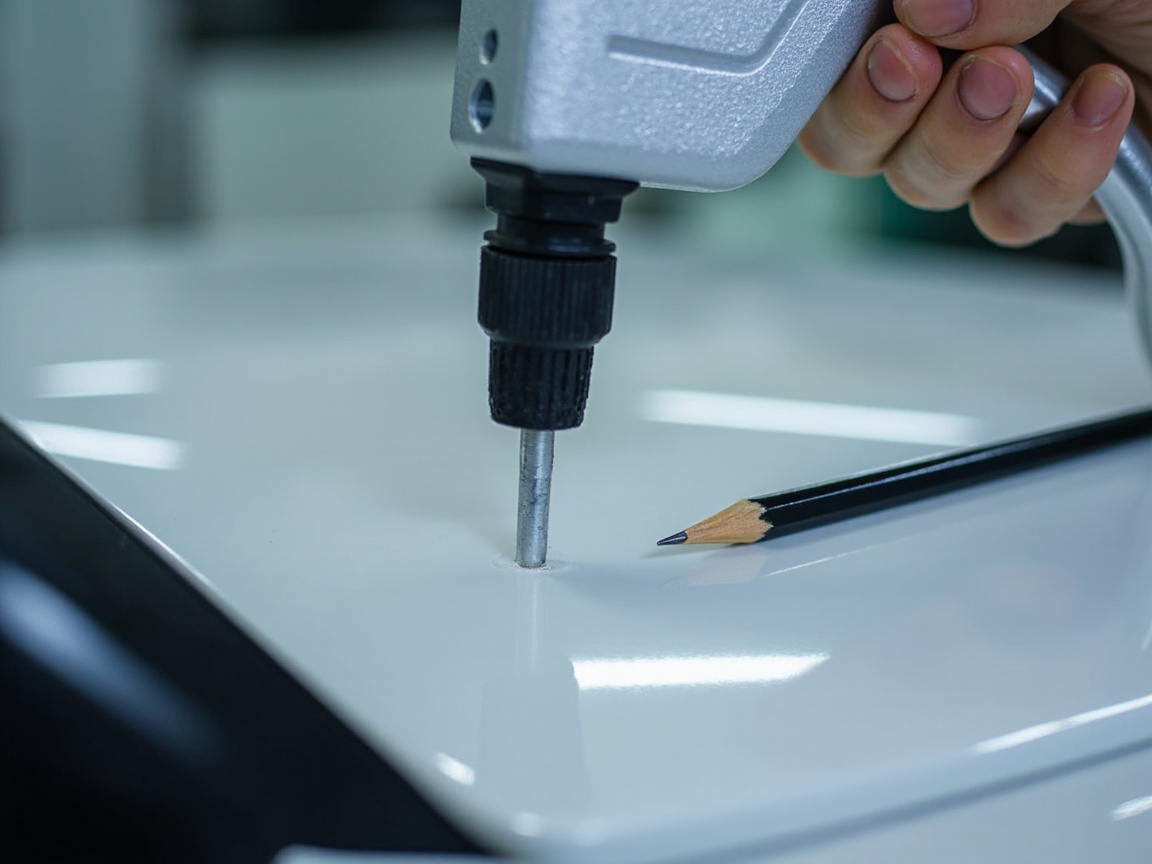
Testing standard: Pencil hardness is executed according to GB/T 6739 "Pigmented paint and varnish — Determination of film hardness by pencil test" or ISO 15184, using a set of calibrated pencil leads to scratch the paint film under specified load, and the result is taken as "the highest pencil grade that does not scratch the film surface". The grades from soft to hard are roughly 6B…B–HB–F–H…9H.
Key limitation: Pencil hardness measures the ability of the "coating + substrate" combination to resist plastic deformation and scratching, not the absolute Mohs hardness of the coating itself. The automotive ceramic layer is only 80 nm–3 µm thick, directly attached on top of the factory clear coat (usually itself about 1H–2H grade), so the actual meaning of "9H" is: on a qualified clear coat substrate, the overall anti-pencil-scratch grade can reach 9H after adding the ceramic layer. If the original car clear coat is aged, cracked, or thinned by heavy polishing, the measured hardness will drop significantly. This is also why professional application requires paint correction beforehand, both to remove the oxidation layer and to provide a healthy substrate for the coating.
Publicly verifiable product data can corroborate this range: according to Onyx Nano Shield (Si-based automotive ceramic shield) technical data, its pencil hardness is labeled 9H, water contact angle about 120°, coating thickness 200–400 nm, roll-off angle 11–55°, durability about 1 year; Gaamp360 (SiO₂-based automotive ceramic coating) labels hardness 9H, thickness 1–3 µm, hydrophobic angle 100–120°, durability 2–5 years; Re-yingcai automotive paint nano ceramic coating (model YCC05006G) labels pencil hardness 8H–9H, dry film thickness 80–150 nm, neutral salt spray resistance ≥1200 h. These data show that 9H does exist in real products, but it is a relative indicator that must be interpreted together with film thickness, substrate condition, and test method.
A more practical suggestion for practitioners: treat pencil hardness as a reference for "resistance to fine scratches (such as car wash brush marks)", not an absolute armor against "key scratches". Real resistance to gravel impact still requires thick-layer physical protection such as paint protection film (PPF).
IV. Hydrophobicity: the dual indicators of contact angle and roll-off angle
The most intuitive experience of ceramic coatings is "water beads up, mud doesn't stick". This is determined by two quantifiable indicators:
1. Water Contact Angle (CA): the static three-phase contact angle of liquid-solid-gas measured by the sessile drop method; the larger the value, the more hydrophobic. According to ASTM D7334-08(2022) "Standard Practice for Surface Wettability of Coatings by Advancing Contact Angle Measurement", this standard is based on goniometry to measure the contact angle of droplets on the coating surface; ISO 19403 series (paints and varnishes — wettability) Part 2 specifies static contact angle, Part 1 (ISO 19403-1:2017) specifies terminology and principles.
Industry grading can refer to:
- Contact angle < 90°: hydrophilic/weakly hydrophobic;
- 90°–150°: hydrophobic, many automotive ceramic coatings fall at 100°–120°;
- > 150° and rolling angle < 10°: superhydrophobic, typical such as lotus leaf.
What needs to be warned is that some products directly call a 120° contact angle "superhydrophobic", which is inaccurate under strict definition — 120° belongs to strongly hydrophobic/highly hydrophobic, but is still far from the >150° superhydrophobic threshold, and its roll-off angle (see below) is often above 11°, not reaching the low roll-off angle threshold of superhydrophobic. This article advocates truthfully stating "highly hydrophobic, strongly water-repellent" to avoid exaggeration.
2. Roll-off / Sliding Angle (SA): tilt the sample, the stage inclination angle when the droplet starts to roll, measuring self-cleaning and "easy-to-clean" degree. This indicator is specified by ISO 19403-7 "Paints and varnishes — Wettability — Part 7: Measurement of contact angle (roll-off angle) on an inclined stage" (2017 and 2024 editions), requiring pretreatment for at least 16 h at (23±2)℃, (50±5)%RH, using deionized water of ≥ analytical pure, surface tension ≥ 71.5 mN/m, at a constant tilt rate until the droplet three-phase line moves ≥ 1 mm.
In real data, Onyx Nano Shield roll-off angle 11–55° — meaning small water droplets may still be "pinned" and not roll at slow tilt, requiring a larger inclination to detach; this again shows that 120° contact angle does not automatically equal "clean with one rinse". Low roll-off angle (ideally < 10°) is the core of the "self-cleaning experience", which comes from the air layer trapped in the surface micro-nano rough structure (Cassie-Baxter state), not simply low surface energy.
V. Durability: The Decisive Factors from One Year to Five Years
The claimed durability of ceramic coatings on the market ranges widely from 1 year to 5 years or even longer; the root of the difference lies in three physical variables:
1. Film Thickness and Solid Content: Spray-on products often form a film of only about 0.1 µm, with durability of 3–12 months; professional-grade SiO₂ coatings deposit 1–3 µm (e.g., Gaamp360 is specified at 1–3 µm), and after sufficient cross-linking can last 2–5 years. Film thickness directly determines the consumable wear "budget".
2. Cross-link Density and Curing: Sol-gel films undergo initial curing and final curing after application. According to product data, Gaamp360 has initial curing of 24–48 h and full curing of 5–7 days; Onyx achieves surface fixation via IR heat treatment for 1 h or at room temperature for 2–3 h, with final curing in 14 days. Insufficient curing leads to low cross-link density, making it vulnerable to car wash chemicals and UV damage. The "avoid water for 24–48 h" maintenance window after application is precisely to ensure the condensation reaction is not interfered with by water.
3. Environmental Stress: Ultraviolet (UV) degrades organic side groups, alkaline car wash solutions (high pH) and acid rain (low pH) erode, and mechanical friction (car wash brushes, sand and grit) collectively consume the film. According to Gaamp360 data, its chemical resistance range is pH 2–12, and heat resistance up to 600℃; Re-yingcai is specified for operating temperature -45℃~180℃, UV-resistant and weather-locking gloss. These boundary values indicate: high-quality SiO₂ ceramic layers have broad tolerance to temperature changes and chemicals, but are still consumables with limited lifespan, requiring periodic maintenance or reapplication.
VI. Heat Resistance, Chemical Resistance and UV Resistance: Why the SiO₂ Skeleton Wins
The thermal stability of the silica network is significantly superior to pure organic polymers. Organic varnish may soften and yellow under sustained high temperatures, whereas the Si–O bond has high bond energy and the Si–O–Si skeleton is stable within hundreds of degrees Celsius. In publicly available data, Gaamp360 is specified for heat resistance up to 600℃, suitable for high-temperature areas such as around exhaust tail sections and engine bay trim parts; Re-yingcai specifies an operating temperature range of -45℃~180℃, covering the vast majority of outdoor and exterior engine bay conditions.
In terms of chemical resistance, a broad window of pH 2–12 means the coating can resist acid rain, bird droppings (weak acid), insect resin and most car wash solutions, but it is still recommended to avoid strong alkalis (high pH) degreasers, as they slowly damage the siloxane network. UV resistance relies on the avoidance of organic dyes and the shielding of nano TiO₂ (if added and surface-treated)—note that untreated nano TiO₂ has photocatalytic activity under UV, which may accelerate the aging of adjacent organic resins, so qualified formulations must employ surface passivation.
VII. Application Process and Curing Window: 70% Process, 30% Material
The performance ceiling of ceramic coatings is determined by the formulation, but the actual measured performance is highly dependent on application. A typical professional process (based on public process data) is:
- Deep Cleaning and Degreasing: Wash with neutral shampoo, use clay to remove embedded contaminants, then perform paint correction (polishing) to eliminate oxidation and micro-scratches, providing a healthy substrate.
- Solvent Degreasing (IPA Wipe): Use diluted isopropyl alcohol to wipe off polishing residue oils, exposing the true varnish surface for silanol bonding.
- Thin, Multiple Cross-coats: Use a dedicated sponge to apply a thin coat of the coating to a small area (e.g., half a meter square), avoiding thick-coat sagging.
- Flash-off 30 s–3 min: Wait for solvent evaporation and precursor condensation to begin.
- Leveling Wipe: Use a microfiber cloth to wipe off excess liquid, preventing high-spot haze from residual formation.
- Water-avoidance Curing 24–48 h: Strictly avoid water contact or rain during initial curing, to prevent hydrolysis interference and water spots.
- Environmental Control: Application temperature 5–30℃, relative humidity < 70% (per Gaamp360 data), ventilated but no direct airflow or dust.
This process explains "why the same product yields very different DIY vs. professional results"—surface contamination and loss of cure window control are the main causes of early coating failure.
VIII. Real Data Comparison of Mainstream SiO₂-based Automotive Ceramic Coatings
The table below summarizes representative product parameters found in public technical data, to facilitate a horizontal understanding of the market range (values are manufacturer-specified; actual values subject to third-party test reports):
| Product/Model | Chemical Type | Pencil Hardness | Water Contact Angle | Roll-off Angle | Dry Film Thickness | Durability | Heat/Chemical Resistance |
|---|---|---|---|---|---|---|---|
| Onyx Nano Shield (Si-based) | Si-based siloxane ceramic | 9H | ~120° | 11–55° | 200–400 nm | ~1 year | Suitable for paint/plastic/aluminum/chrome/wheels |
| Gaamp360 (SiO₂-based) | Nano ceramic (SiO₂), optional graphene/TiO₂ | 9H | 100–120° | Not listed separately (low) | 1–3 µm | 2–5 years | Heat resistance up to 600℃; chemical resistance pH 2–12 |
| Re-yingcai YCC05006G | Inorganic nano ceramic composite | 8H–9H | Superhydrophobic self-cleaning (high) | Low | 80–150 nm | Long (year not specified) | Temp -45~180℃; neutral salt spray ≥1200 h |
| YC-8703 Nano Composite Ceramic | Single-component ceramic coating | 6–7H | ~110° | Low | 50–100 µm (thick coat) | Ceramization 7 d | Long-term use -50~400℃; bond strength >4 MPa |
Note: YC-8703 is a colored/transparent single-component ceramic coating (per its technical data, food-grade SGS+FDA tested), with film thickness of 50–100 µm, belonging to the "thick-coat" nano composite ceramic category, different from thin-layer automotive paint sealants; listed here only for comparing hardness-thickness relationship.
As seen in the table: Hardness is not the higher the better; matching film thickness and working conditions is the key. Thin layers (80–400 nm) sacrifice some mechanical thickness for transparency and ease of application; thick layers (µm to hundreds of µm) have stronger wear and corrosion resistance but may sacrifice mirror finish and adaptability.
IX. Relationship with Automotive OEM Paint System
Automotive ceramic coating is an "aftermarket add-on" layer, applied over the OEM paint system. Understanding the four major OEM processes (pretreatment → cathodic electrophoretic deposition CED → intermediate coat → pigmented paint → varnish baking, see Four Major Automotive OEM Paint Processes) helps position the role of the ceramic layer: OEM varnish is already highly cross-linked acrylic polyurethane, providing basic weather resistance and gloss; the ceramic layer adds a harder, lower surface energy SiO₂ hybrid film on top, mainly improving fine scratch resistance, water beading and easy cleaning, rather than replacing the varnish's anti-corrosion and decorative functions.
Therefore, ceramic coating cannot "repair" corrosion that has penetrated the varnish or deep scratches, nor can it compensate for defects in the OEM coating itself. The correct mindset is: the ceramic layer is a "performance-enhancing outer garment" for the varnish, not a "paint rebirth technique".
X. Selection and Matching Recommendations
For different users, actionable selection logic is given:
- Daily commuting, budget-sensitive: Choose spray-on SiO₂ spray (film ~0.1 µm, durability 3–12 months) as a periodic maintenance layer, lowest cost and DIY-friendly.
- Car care enthusiast, pursuing mirror finish and 2–3 year durability: Choose professional-grade SiO₂ coating (film 1–3 µm, hardness 9H, contact angle 100–120°), with standard professional application and curing window.
- High-temperature/engine bay trim parts: Prioritize confirming heat resistanceमानक (e.g., ≥ 600℃ formulation), avoid non-high-temperature-resistant products.
- Strong self-cleaning demand: Don't just look at contact angle; require roll-off angle (lower is better) and third-party testing from the manufacturer, to avoid being misled by "120° = superhydrophobic".
Kexin New Materials (kexinMaterials) provides delivery from formulation, dispersion stability to application process cards in SiO₂ sol-gel ceramic materials and automotive protective coatings, and recommends writing the four items of "substrate condition—film thickness target—curing condition—acceptance indicators (pencil hardness/contact angle/salt spray)" into the technical agreement, accepting by data rather than rhetoric. If you are planning automotive paint protection or OEM aftermarket matching, you can combine with the article Nano SiO₂ and Hydrophobic/Hardness-enhancing Coating Technology to further understand how silica particles simultaneously contribute to hardness enhancement and water beading.
XI. Common Marketing Rhetoric Breakdown (Avoid Exaggeration)
- "9H equals glass hardness, prevents all scratches": Wrong. 9H is a relative pencil hardness grade, dependent on the varnish substrate, ineffective against hard object impacts like keys and gravel; it resists fine car wash marks.
- "120° is superhydrophobic": Inaccurate. Strict superhydrophobicity requires contact angle >150° and roll-off angle <10°; 120° is strongly hydrophobic, and the self-cleaning experience depends on the roll-off angle rather than a single contact angle.
- "One application lasts five years without degradation": Depends on film thickness, curing, and operating conditions. Thin-layer spray cannot achieve professional-grade multi-year durability; even professional coatings will linearly wear under strong alkaline car washing and high-frequency friction.
- "Nano = better": Nano particle size is merely a scale description; dispersion stability and crosslinking density are the core of performance. Poor nano dispersion instead causes haze and unevenness.
XII. Ceramic Coating, Paint Protection Film (PPF) and Waxing: Comparison of Protection Levels
Many users confuse ceramic coating, invisible paint protection film (PPF) and waxing. The mechanisms and protection levels of the three are completely different; establishing correct understanding can avoid mismatches such as "spending ceramic-coating money while expecting PPF-level protection." The table below makes a horizontal comparison from dimensions such as film-forming mechanism, thickness, scratch resistance and impact resistance:
| Solution | Film-forming / Adhesion Mechanism | Typical Thickness | Resistance to Fine Scratches | Resistance to Gravel Impact | Water Repellency & Self-cleaning | Durability | Cost Level |
|---|---|---|---|---|---|---|---|
| Waxing | Physical coverage, no chemical bonds | µm-scale soft layer | None | None | Medium | Weeks | Low |
| Sealant | Weak adsorption / mild crosslinking | Sub-µm | Weak | None | Medium | Months | Low–Medium |
| SiO₂ Ceramic Coating | Silanol bonding + sol-gel | 80 nm–3 µm | Yes (car-wash-mark level) | None | Strong | 1–5 years | Medium–High |
| Invisible PPF | Physical film (polyurethane) | 100–200 µm | Strong (mostly self-healing) | Strong | Depends on top layer | 5–10 years | High |
Thus a clear conclusion can be drawn: ceramic coating wins in "hard + hydrophobic + easy to clean + cost-effective," but its physical thickness is thin and it is helpless against high-speed gravel and branch scratches; real impact protection relies on PPF. The two can also be used in combination—applying a layer of SiO₂ spray on top of PPF to maintain water repellency and gloss is a common high-end protection combo. This again confirms the principle of "layered protection by operating condition," rather than expecting a single product to solve all problems.
XIII. Nano-particle Dispersion Stability: The Decisive Point of Formulation
As mentioned several times above, nano particles are highly prone to agglomeration due to high surface energy. For SiO₂-based ceramic coatings, dispersion stability directly determines whether the film is transparent and uniform, and ultimately determines whether hardness and hydrophobicity meet standards. Common control methods include:
- Surface modification: Use silane coupling agents (e.g., methyltrimethoxysilane, long-chain hydrophobic modifiers) to coat particles, which both lowers surface energy and provides reactive sites for condensation, enabling stable monodispersion of particles in the carrier.
- Dispersant and ultrasonication: Rely on the steric hindrance of polymeric dispersants, combined with ultrasonication to break formed agglomerates, maintaining a narrow particle size distribution.
- Zeta potential regulation: Adjust via pH or surface charge to maximize electrostatic repulsion between particles and suppress re-agglomeration. Dynamic light scattering (DLS) and Zeta potential are common online characterization means (related methods see nano paint testing and characterization standards).
- Sol aging control: Regulate hydrolysis and condensation rates to avoid premature gelation of precursor causing spray skinning and uneven film thickness.
It is worth emphasizing that dispersion stability is also related to construction safety. According to research archives, liquid uncured nano slurries and spray dust pose inhalable risks; operations should be equipped with NIOSH particulate respirators; while cured films are usually inert. Therefore, a better technical path is to adopt silane precursor "in-situ sol-gel film formation" (i.e., the mechanism in Section II of this article), allowing the network to generate on-site on the substrate, reducing the release of free nano powder from the source, and balancing performance and safety.
XIV. Quality Control and Third-party Testing: How to Accept with Data
To avoid being misled by marketing jargon, the most practical approach is to write "performance acceptance" into the procurement or construction agreement, require the supplier to provide third-party reports issued according to standards, and check item by item:
- Hardness: Pencil hardness per GB/T 6739 / ISO 15184, noting substrate and test load;
- Hydrophobicity: Static contact angle per ASTM D7334 / ISO 19403-2, noting droplet volume and liquid; roll-off angle per ISO 19403-7, noting tilt rate;
- Film thickness: Ellipsometer, step profiler or SEM cross-section, giving nm–µm values rather than the vague term "nano-scale";
- Durability and corrosion resistance: Neutral salt spray per GB/T 1771 / ASTM B117 (e.g., Re-yingcai marked ≥1200 h), UV aging per GB/T 1865 / ASTM G154;
- Chemical resistance: Note the tolerable pH range and test duration.
Kexin New Materials (kexinMaterials) suggests that upon delivery of automotive ceramic coating, an acceptance package composed of five hard indicators—"pencil hardness + contact angle + roll-off angle + film thickness + salt spray"—should be used, with data of same standard, same method, same liquid, and same volume for horizontal comparability. Only by translating vague "9H" "superhydrophobic" into verifiable numbers can selection be truly reliable.
XV. Common Construction Defects and Troubleshooting
Even if the formulation itself is qualified, out-of-control construction can still lead to early failure. The table below summarizes high-frequency defects, causes and countermeasures of automotive ceramic coatings for reference by shops and self-inspection:
| Defect Manifestation | Main Cause | Countermeasure |
|---|---|---|
| Haze / high-spot whitening | Wipe not timely, residue accumulation curing | Control flash-off 30 s–3 min, timely leveling wipe |
| Poor adhesion, easy delamination | Substrate contamination, incomplete degreasing, varnish aging | IPA thorough degreasing + paint correction, confirm varnish health |
| Water spots / rain marks | Water contact within curing window | Strictly avoid water 24–48 h, postpone construction in rainy season |
| Fast hydrophobic decay | Insufficient film thickness, strong alkaline car wash | Ensure deposited film thickness, switch to neutral (pH 6–8) car wash |
| Yellowing / gloss loss | UV + organic side-group degradation | Choose weather-resistant formulation, regular SiO₂ spray maintenance |
| Local uncoated | Cross-coating omission, environmental dust | Zone thin coating, no direct blowing dust, full inspection upon completion |
The commonality of such problems shows "70% process, 30% material": the performance difference of the same product in different shops often lies not in the formulation but in the construction records (temperature and humidity, degreasing quality, water-avoidance duration). It is recommended to write the construction parameters and maintenance window into the delivery file together for traceability and optimization upon repurchase.
FAQ
1. What is the difference between nano ceramic automotive paint coating and waxing, sealant?
Waxing (natural/synthetic wax) relies on physical coverage, durability of weeks; sealant (polymer) relies on weaker adsorption, durability of months; ceramic coating relies on SiO₂ sol-gel and varnish to form chemical bonding (silanol bond), the film is hard and durable for 1–5 years. The essential difference is the bonding method and lifespan, not simply "brighter."
2. Is pencil hardness 9H measuring the coating itself or the entire automotive paint?
Per GB/T 6739 / ISO 15184, it measures the scratch resistance grade of the "coating + substrate" combination. The ceramic layer is only nano-micron thick, and the measured hardness is constrained by the varnish hardness below, so 9H is a relative indicator under the premise of a healthy varnish substrate.
3. Why do some coatings have a contact angle of 120° but the water beads do not roll?
Because self-cleaning depends on the roll-off angle (ISO 19403-7 tilt-stage method); some products have a roll-off angle of 11–55°, and the droplet remains pinned at slow tilt. Superhydrophobic requires roll-off angle <10°; when purchasing, both contact angle and roll-off angle data should be requested.
4. Can ceramic coating prevent automotive paint from rusting?
The ceramic layer mainly enhances the weather resistance, water repellency and micro-scratch resistance of the varnish surface, and is helpless against rust on already exposed substrate. Its indirect value lies in reducing water and pollutant residence and slowing varnish aging, thereby delaying corrosive media from reaching the metal. Heavy anti-corrosion still relies on primer and electrophoretic systems.
5. Is it true that SiO₂ coating is high-temperature resistant up to 600℃?
Some SiO₂-based products are marked with temperature resistance up to 600℃ (e.g., Gaamp360 data), which originates from the high thermal stability of Si–O bonds and is suitable for decorative parts around exhaust; but most automotive thin-layer formulations have a working temperature range of about -45~180℃, and the specific temperature resistance marking must be checked when purchasing.
6. Why must water be avoided for 24–48 hours after construction?
Because sol-gel condensation takes time; early water contact interferes with hydrolysis/condensation balance, causing water spots or reducing crosslinking density. The water-avoidance curing window is a key step to ensure final hardness and hydrophobicity.
7. Does ceramic coating require special maintenance?
It is recommended to use a neutral (pH about 6–8) car wash solution, avoiding strong alkaline degreasing; periodically apply SiO₂ spray to maintain water beading. Do not use abrasives or strong acids/bases, otherwise the ceramic layer will be consumed.8. Can ceramic coating be applied directly to aged old car paint with sun swirls?
Not recommended. Paint correction (polishing) should first be done to remove the oxidation layer and micro-scratches; otherwise the ceramic layer will "seal in" defects and adhesion will decrease. A healthy substrate is the prerequisite for performance and lifespan.
9. Is nano ceramic coating safe, and is protection needed during application?
The liquid formulation contains solvents and silane precursors; application requires ventilation, goggles, and nitrile gloves to avoid inhaling mist; the cured film is generally inert. Refer to the product MSDS for specifics; do not spray in large amounts in enclosed spaces.
10. How to judge whether a ceramic coating claim is reliable?
Look at four hard pieces of information: third-party test reports (pencil hardness per GB/T 6739, contact angle per ASTM D7334/ISO 19403-2, roll-off angle per ISO 19403-7), film thickness (nm–µm), durability corresponding to film thickness and service conditions, and temperature/chemical resistance limits. Products that only label "9H" "superhydrophobic" without standards and methods should be treated with caution.
Further Reading
- Nano SiO₂ and Hydrophobic/Hardening Coating Technology: Deeply understand how silica particles simultaneously contribute to hardening and water beading, which is the upstream technical basis of the sol-gel mechanism in this article.
- Overview of Nano Coatings: Nanoparticles, Mechanisms, and Definition Boundaries: From the 1–100 nm definition, small-size effect to agglomeration challenges, establish an overall cognitive framework for nano coatings.
- Automotive OEM Paint Four Processes: Electrophoretic Paint, Intermediate Coat, Pigmented Paint, and Varnish: Understand the OEM varnish system on which the ceramic layer is stacked, and clarify its positioning as an "enhancing outer layer" rather than a "replacement".