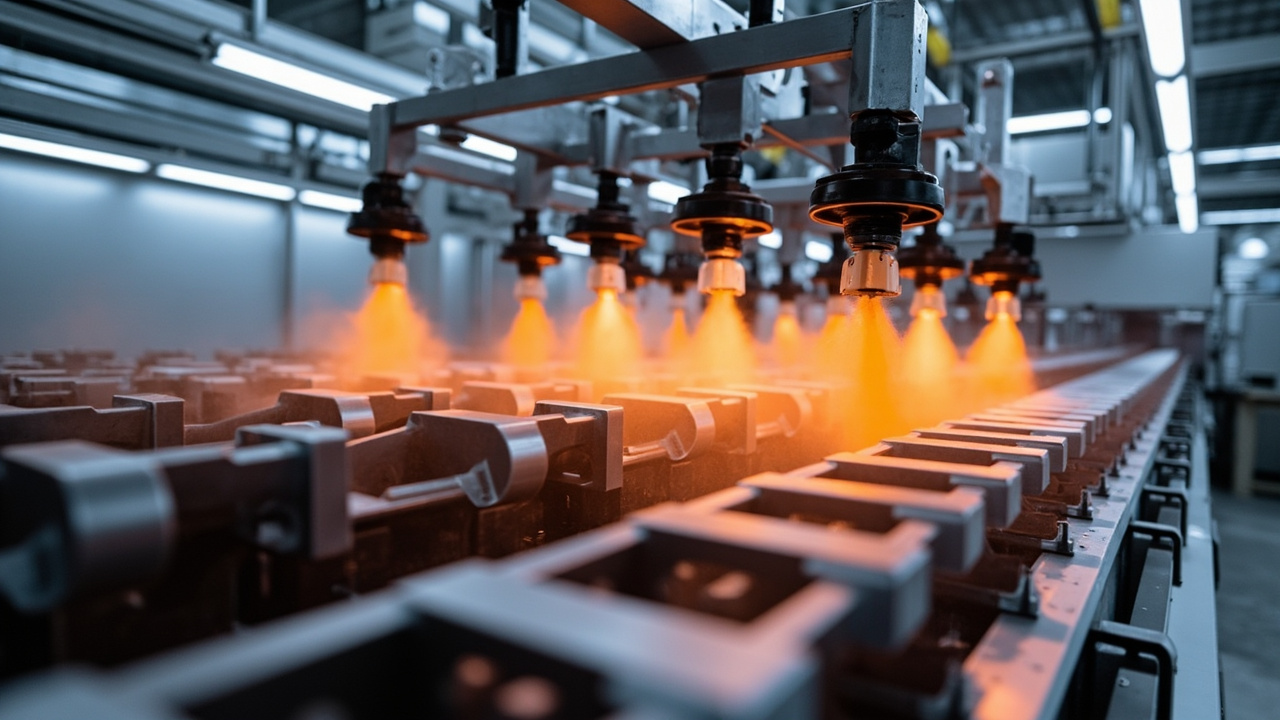
When liquid coatings are restricted, powder becomes the definitive answer
Under the global context of increasingly stringent volatile organic compound (VOC) regulations, powder coating, with its natural advantages of near-zero VOC emissions, transfer efficiency exceeding 95%, and recyclable overspray powder, has become the definitive route for industrial painting to shift from solvent-based to green. Compared with liquid coatings containing over 400 grams of VOC per liter, the eco-friendly and safety attributes of powder coating are almost the primary reason for its selection.
According to Fortune Business Insights, the global powder coating market size was USD 16.12 billion in 2025, and is expected to grow from USD 17.06 billion in 2026 to USD 27.45 billion in 2034, with a forecast CAGR of 6.10% during the period. The Asia-Pacific region dominates the market, with a 63.10% share in 2025. Another institution, Industry Research, gave a similar judgment of a global size of USD 13.52 billion in 2026, USD 23.64 billion in 2035, and a CAGR of 6.4%, confirming the consensus of steady upward momentum in the sector.
China market's excess growth and structural shift
China is one of the world's largest and fastest-growing powder coating markets. China Research Puhua predicts that from 2026 to 2030, China's powder coating industry will maintain a CAGR of 12% to 15%, and by 2030 the market size is expected to reach 4.5 to 5 million tons, with its share of total coating output rising from the current about 10% to 15% to 18%, becoming one of the fastest-growing segments in the coating industry.
The demand structure is diversifying. Architectural aluminum profiles remain the largest application market (doors, windows, curtain walls), but penetration will rise from the current 60% to over 80%; the home appliance sector maintains steady growth, with high-end appliances increasingly relying on decorative and antibacterial, scratch-resistant functional powders; the most significant change comes from emerging fields—the automotive industry is extending from wheels and chassis parts to body panels, and new energy vehicles' battery housings and motor components bring huge increments to insulating, high-temperature-resistant specialty powders; the steel structure and furniture sectors have also begun to replace traditional paint with powder.
Low-temperature curing: opening the gate for heat-sensitive substrates
The large-scale application of low-temperature curing (below 140°C) powder coating is the most noteworthy technological inflection point in 2026. Traditional powder requires curing above 180°C, limiting its use on plastics, composites, and thin-gauge materials. Currently, nearly 25% of new global powder installations are designed for curing temperatures below 160°C, improving energy efficiency by over 20%.
The value of low-temperature curing is not just energy saving, but also the expansion of application boundaries: heat-sensitive substrates such as medium-density fiberboard and engineered wood can be coated, and temperature-sensitive components such as new energy vehicle battery housings can also adopt powder solutions. Industry Research points out that currently less than 20% of total powder is suitable for low-temperature curing, implying huge technological substitution space.
Functional powder: from protection and decoration to active empowerment
Future powder coatings are no longer limited to basic protection and decoration, but are rapidly evolving toward high performance and multi-function. Functional powders such as antibacterial, antiviral, self-cleaning, conductive, and thermal insulation are seeing rapid demand growth in medical, electronics, and construction fields. Industry Research data shows that functional additives already account for nearly 15% of advanced powder formulations, and over 55% of large coating lines have deployed automated and digital color-matching systems, reducing material waste by up to 30%.
In the automotive and infrastructure sectors, super-durable polyester powders are gaining strong momentum, accounting for over 40% of outdoor-grade powders used in architectural facades, windows, and railings; the penetration of high dielectric strength, corrosion-resistant powders in electric vehicle battery enclosures and charging infrastructure continues to rise. The demand for textured, matte, and metallic finishes in high-end appliances and consumer electronics further elevates the high-value attributes of powder.
Bio-based and recyclable: sustainability becomes a hard metric
Sustainability has shifted from a "bonus" to an "entry requirement". Axalta launched Alesta BioCore bio-based powder in 2024, ISCC PLUS certified, with carbon reduction up to 25% without sacrificing performance; PPG launched ENVIROLUXE Plus, containing up to 18% post-industrial recycled plastic (rPET) and free of PFAS, with a carbon footprint about 30% lower than conventional durable powders. Coherent Market Insights also noted that leading companies are focusing on bio-based and recycled-material-based powders to improve sustainability and market share.
From the industry chain perspective, upstream resin, curing agent, and pigment/filler supply is relatively concentrated, with international chemical giants dominating, but domestic suppliers have made significant progress and the substitution process is accelerating; midstream powder production is highly competitive, with overcapacity and shortage of high-end products coexisting; downstream coating equipment localization level has improved, but high-end equipment still relies on imports.
As an important direction of industrial protective coating, Kexin New Materials (Guangdong) Co., Ltd. has accumulated process experience in low-VOC and functional coating systems, and its nano-modification approach is highly consistent with the functionalization and low-temperature trends of powder coating in material logic.
Key data comparison of global and China markets
| Metric | Global market | China market |
|---|---|---|
| 2025 size | USD 16.12 billion | — |
| 2026 size | USD 17.06 billion | High-speed growth |
| 2030 to 2034 | USD 27.45 billion (2034) | 4.5 to 5 million tons (2030) |
| CAGR | 6.10% | 12% to 15% |
| Asia-Pacific share | 63.10% (2025) | 42% of Asia-Pacific |
| Technology mainline | Low-temperature curing, functionalization | Domestic substitution, high-end breakthrough |
Opportunities and Barriers in Industry Reshuffling
First, low- and mid-end homogeneous price wars continue to squeeze profits, but leading enterprises with independent R&D and scale advantages are building moats through product innovation, while small and medium-sized enterprises with backward technology and failing to meet environmental standards face accelerated elimination.
Second, low-temperature curing and functional formulations impose high requirements on resin synthesis and curing kinetics, and are not a simple substitution of pigments; they require enterprises to possess systematic R&D capabilities from base materials to additives.
Third, the cost of bio-based raw materials remains 10% to 20% higher than traditional versions, and their promotion relies on the pull of carbon policies and downstream green procurement.
Fourth, recycled powder incurs high equipment and management costs in variable-color scenarios; only single or few main-color production lines can maximize recycling benefits.
FAQ
Q: What are the core advantages of powder coating compared to liquid coating? A: Near-zero VOC emissions, transfer efficiency over 95%, overspray powder recyclable and reusable, low fire hazard, and safer storage and handling, making it a green alternative route to address VOC regulations.
Q: Why is low-temperature curing powder important? A: Traditional powder requires curing above 180°C, limiting applications on heat-sensitive substrates; low-temperature curing below 140°C can extend to wood, plastics, and new energy battery components, with over 20% energy savings.
Q: Where does the growth momentum of China's powder coating market come from? A: Increased penetration of architectural aluminum profiles, functional demands of high-end home appliances, incremental specialty powder for new energy vehicle battery enclosures and motor components, plus the dual drivers of environmental substitution and domestic substitution, supporting an annual growth rate of 12% to 15%.
Further Reading
– Green Transition of Industrial Coating: Triple Challenges of Water-based, Low-VOC and Carbon Footprint – Nano Thermal Insulation and Building Energy-Saving Coating – Industrial Protective Coating Product System